
In This Article
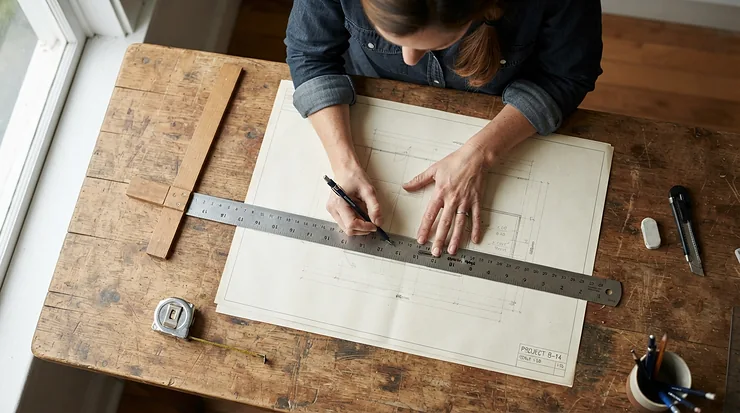
Every building you’ve ever loved began as a line on paper, and that line only means something if it’s the right length. A ruler for architectural drawing is the quiet referee of the whole process. At 1:50, a 12-metre extension becomes 240 millimetres of paper. Read the wrong face of your rule and your extension is suddenly the size of a garden shed.

Yes, CAD runs the show these days. But planning drawings still get printed, marked up and argued over, and a scale ruler remains the fastest way to sanity-check a PDF printed at “1:100” that may not actually be 1:100. A scale ruler measures at a fixed ratio, so you read real dimensions straight off the plan with no calculator and no battery. It also doesn’t crash.
This guide covers seven real products, from pocket-money plastic to a long aluminium rule, and sorts them by how they behave on a drawing board. It also covers the architectural scale itself, the maths of reading it, and the metal ruler for technical drawing that handles the straight lines a scale rule must never draw. Along the way you’ll meet the drafting tools that belong on the same desk, and some honest thoughts on precision measurement.
One transparency note. This analysis is built from manufacturer specifications, retailer listings and published review data, not a bench test. Where I couldn’t verify review sentiment for a product, I say so rather than invent it. Prices are given as ranges and move constantly, so check current price before you buy.
Quick Comparison: Ruler for Architectural Drawing Options at a Glance
| Product | Type | Scale Coverage | Price Range | Best For |
|---|---|---|---|---|
| Westcott Reduction Scale | Six-scale reduction rule, 30cm | 1:2.5 to 1:100 | Under £10 | Students on a tight budget |
| Helix 300mm Metric Triangular Scale | Plastic triangular, 30cm | 12 scales, 1:1 to 1:2500 | Under £10 | All-round beginners |
| Staedtler Mars 561 70-2 Oval Scale Ruler | Flat oval PVC, 30cm | 1:1 to 1:500 (eight scales) | £10-£20 | Sketchbook and pencil-case carry |
| Staedtler Mars 561 Triangular Scale | Triangular, 30cm | Six scales (variant-dependent) | £10-£20 | Everyday studio use |
| Linex Triangular Scale Rule | Triangular, 30cm | 1:20 to 1:125 | £30-£50 | Practices that favour intermediate ratios |
| Linex Steel Ruler 600mm | Stainless steel straight edge | Metric and imperial, no ratios | £15-£25 | Cutting, ruling and A2 sheets |
| Helix 45cm Tri-Scale | Aluminium triangular, 45cm | 12 colour-coded scales | Check current price | Long elevations and heavy use |
Look at the table and one thing stands out: the cheapest rules are not the cheapest decisions. The Helix 300mm Metric Triangular Scale gives you twelve ratios for under a tenner, which is hard to beat for a first purchase. If you mostly draw houses, the Staedtler Mars 561 Triangular Scale earns its slightly higher price through readability. The Linex Steel Ruler 600mm isn’t a scale rule at all, so it belongs in your kit as a partner to the others, not a rival.
💬 Just one click — help others make better buying decisions too!😊
Top 7 Picks: Expert Analysis of Each Ruler for Architectural Drawing
1. Westcott Reduction Scale — cheapest route to six useful ratios
This is the entry ticket: one slim rule, six ratios, and a price that won’t sting a first-year student.
The listed set runs 1:2.5, 1:5, 1:10, 1:20, 1:50 and 1:100. That’s a quietly clever spread. The 1:2.5 and 1:5 faces suit joinery and wall build-ups, while 1:50 and 1:100 handle the floor plans that fill most coursework folders. What the spec sheet won’t tell you is that the set stops short of 1:200 and 1:500, so you can’t read a block plan with it.
Based on the spec comparison, it suits students and hobbyists drawing buildings at room-to-house scale, not site-wide work. Variants with different scale sets exist, so check the printed ratios in the listing before ordering.
I couldn’t verify a meaningful pool of UK reviews for this exact model, so there’s no review sentiment to report. Treat it as a low-risk, low-cost purchase.
Pros:
- ✅ Covers detail ratios like 1:2.5 and 1:5
- ✅ Six scales on one compact 30cm rule
- ✅ Very low cost of entry
Cons:
- ❌ No 1:200 or 1:500 for site plans
- ❌ Review data hard to verify
Expect to pay well under £10 at the time of research. Good value if the scale set matches your work.

2. Helix 300mm Metric Triangular Scale — twelve ratios across three faces
Twelve scales on one rule means you rarely need to reach for a second tool.
The listing describes 12 metric scales from 1:1 to 1:2500 on three colour-coded faces, printed in UV-resistant ink. In practice, that covers everything: 1:1, 1:2 and 1:5 for details, 1:20 to 1:200 for buildings, and 1:500 to 1:2500 for the site and map scales British planning drawings lean on. The colour-coding saves the small daily irritation of hunting along an edge for the right ratio.
The trade-off is plastic. Printed markings generally wear faster than engraved or etched ones, and plastic edges nick if they meet a scalpel. For a student or occasional drafter, that’s a fair deal at this price.
Review data specific to this model was thin where I looked. Buyer feedback on related Helix scale rulers describes them as easy to use and clear, but that’s a related product, not a verdict on this one.
Pros:
- ✅ Twelve ratios from 1:1 to 1:2500
- ✅ Colour-coded faces speed up scale selection
- ✅ Fully metric, with no imperial confusion
Cons:
- ❌ Printed markings may wear with heavy use
- ❌ Plastic edge scars easily
Typically under £10. Excellent value as a first scale ruler.
3. Staedtler Mars 561 70-2 Oval Scale Ruler — flat, eight scales, pocket-friendly
The flat profile is the point: this one slides into a sketchbook where a triangular rule simply won’t.
Listings give the dimensions as 338 x 55 x 2mm and roughly 35g in white PVC. The front carries 1:1, 1:5, 1:10 and 1:100; the back carries 1:20, 1:50, 1:200 and 1:500. Pairing 1:10 with 1:100 and 1:20 with 1:200 is a smart British convention, because you read the same digits and just shift the decimal point.
The catch is the flip. With eight scales over two faces, you turn the rule over rather than rotating it, and there’s no 1:1250 or 1:2500 for large sites. Staedtler also sells siblings with different scale sets, such as the 561 70-1 and 561 70-3, so match the model number to your needs.
The retail pages I checked showed little or no review data, so I can’t report sentiment honestly.
Pros:
- ✅ Slim enough for sketchbooks and pencil cases
- ✅ Paired scales make decimal shifts easy
- ✅ Reaches 1:500 for block plans
Cons:
- ❌ No 1:1250 or 1:2500 coverage
- ❌ Flipping faces slows rapid scale switching
Expect roughly £10-£20. A sound mid-range pick if portability beats scale count.
4. Staedtler Mars 561 Triangular Scale — studio staple with readable markings
A rule you see on a lot of drawing boards for a reason: clean, high-contrast and predictable.
The listing I found describes a 30cm triangular rule with six scales: 1:20, 1:25, 1:50, 1:75, 1:100 and 1:125 on one face group, 1:100 to 1:500 on another, and 1:500 to 1:2500 on a third. Because variants are sold separately, double-check which set you’re buying. This family leaves out 1:1, 1:5 and 1:10, so you’ll want another rule for construction details.
Reviewer sentiment is the useful bit. Retailer pages for the Mars 561 range showed modest review counts. The closest well-reviewed sibling, an imperial Staedtler architect’s triangular scale, carried a 4.6-star average from a few hundred reviews, with buyers praising etched numbering that doesn’t rub off and a light, sturdy build. One buyer’s complaint is instructive: they bought an architect’s scale without realising it differs from an engineer’s. UK buyers should look for metric ratios.
Pros:
- ✅ High-contrast markings that are easy to read
- ✅ Reaches from 1:20 up to 1:2500
- ✅ Light, familiar triangular profile
Cons:
- ❌ No 1:1, 1:5 or 1:10 detail scales
- ❌ Variants differ, so read the listing
Roughly £10-£20. Strong value for everyday studio work.
5. Linex Triangular Scale Rule — premium feel for intermediate ratios
The Linex Triangular Scale Rule sits at the premium end, and the question is whether its scale set justifies that.
It’s listed as a 30cm triangular rule with 1:20, 1:25, 1:50, 1:75, 1:100 and 1:125. Wikipedia notes 1:25 as a less common scale in British practice, and 1:75 and 1:125 are rarer still. So half the faces may sit unused if your office draws at 1:20, 1:50 and 1:100.
Where it makes sense is practices that regularly work in European-style intermediate ratios, or anyone collaborating with drawings from outside the UK. For standard UK residential work, a cheaper rule with a more conventional set will do the same job.
I couldn’t verify review sentiment for this model, so I’m not offering any. Think of it as a considered choice, not an automatic upgrade.
Pros:
- ✅ Covers 1:25, 1:75 and 1:125 for international drawings
- ✅ Established technical-stationery brand
- ✅ Familiar triangular profile
Cons:
- ❌ Several scales rarely used in UK practice
- ❌ Clearly pricier than comparable rules
Expect roughly £30-£50 at the time of research. Worth it only if the scale set matches your workflow.

6. Linex Steel Ruler 600mm — stainless straight edge for technical drawing
This is the metal ruler for technical drawing that sits alongside your scale rule and does the jobs the scale rule must never do.
Listings describe stainless steel with metric and imperial graduations and a conversion table on the reverse. At 600mm it spans the long side of an A2 sheet (594mm), a detail the spec sheet won’t point out but that matters for anyone ruling border lines or title blocks. Steel also shrugs off scalpel nicks that would ruin a plastic edge, which makes it the sensible choice for cutting card models.
Note what the listing doesn’t mention: a cork or non-slip backing. A ruler this long can skate across smooth paper, so a strip of masking tape or a non-slip underlay is a worthwhile cheap upgrade.
I couldn’t verify review sentiment for this specific model.
Pros:
- ✅ Stainless steel edge resists nicks and wear
- ✅ 600mm spans a full A2 sheet
- ✅ Metric and imperial with a conversion table
Cons:
- ❌ No ratio scales, so it isn’t a scale ruler
- ❌ No non-slip backing listed
Roughly £15-£25. Good value as the straight edge in a drafting kit.
7. Helix 45cm Tri-Scale — long aluminium rule for big sheets
Extra length is a quiet luxury: fewer re-placements, fewer cumulative errors.
The listing describes a 450mm aluminium triangular rule with 12 colour-coded scales from 1:1 to 1:2500. At 1:100, that’s a 45-metre reach in a single placement, and at 1:50, still 22.5 metres. A long elevation measured in one pass beats three short hops, because every hop is a chance to drift by half a millimetre.
Aluminium adds rigidity and a more premium feel than plastic, though it’s still not as hardwearing as a steel straight edge for cutting. It also costs more than Helix’s 300mm plastic sibling, and I couldn’t verify a UK price, so check current price.
No verifiable review sentiment turned up for this model. That’s a gap I’d rather flag than fill.
Pros:
- ✅ 450mm reach covers long elevations in one pass
- ✅ Aluminium body feels rigid and durable
- ✅ Twelve colour-coded scales from 1:1 to 1:2500
Cons:
- ❌ Costs more than plastic 30cm alternatives
- ❌ Too long for a pencil case
Pricing sits above Helix’s plastic range; confirm before buying. Good value if you regularly draw on A2 or larger.
Spec Showdown: How the Seven Stack Up
| Product | Material | Length | Marking Detail | Review Data Found | Best For |
|---|---|---|---|---|---|
| Westcott Reduction Scale | Plastic | 30cm | Six scales, 1:2.5 to 1:100 | Not verified | Budget students |
| Helix 300mm Metric Triangular Scale | Plastic | 30cm | 12 scales, UV-resistant print | Related models described as clear | First-time buyers |
| Staedtler Mars 561 70-2 Oval Scale Ruler | PVC | 30cm | Eight scales on two faces | Little data | Portability |
| Staedtler Mars 561 Triangular Scale | Plastic | 30cm | Six scales, high contrast | Modest counts; imperial sibling praised | Daily studio use |
| Linex Triangular Scale Rule | Plastic | 30cm | 1:20 to 1:125 | Not verified | Intermediate ratios |
| Linex Steel Ruler 600mm | Stainless steel | 60cm | Metric and imperial | Not verified | Cutting and A2 ruling |
| Helix 45cm Tri-Scale | Aluminium | 45cm | 12 colour-coded scales | Not verified | Long elevations |
The table makes the strategy clear. For most UK students and early-career drafters, the Helix 300mm Metric Triangular Scale or the Staedtler Mars 561 Triangular Scale is the sensible primary rule, with the Linex Steel Ruler 600mm as a straight-edge partner. If you routinely work on larger sheets, the Helix 45cm Tri-Scale justifies the step up. Note how many review cells say “not verified”: that’s honest, and it’s a reason to lean on specs and return policies when buying.
✨ Don’t Miss These Exclusive Deals!
🔍 Take your drafting to the next level with these carefully selected rulers. Click on any highlighted product name to check current pricing and availability. A good scale ruler will help you create authentic, accurate plans you’ll be proud to submit!

How to Use and Maintain Your Ruler for Architectural Drawing
A scale ruler rewards habits more than gadgets. Here’s the routine worth building.
Setup and first use. Place your drawing flat under good light, with the light coming from the side opposite your drawing hand to reduce shadow. Choose the face that matches the drawing’s stated ratio, then read zero from the rule’s end. At 1:50, one millimetre on the rule equals 50mm in reality, so a 4.2 metre wall reads as 84mm on paper.
Mark, don’t draw. Use the scale rule to measure and mark points, then draw lines against a steel edge or set square. Scale rules are for measuring, not drawing, and pencil graphite quickly clogs engraved or printed markings.
Maintenance schedule. Wipe plastic rules weekly with a barely damp cloth. Store them flat in a case or drawer, never loose in a bag where they’ll bend or scratch. Keep a steel ruler’s edge free of burrs, because a nicked steel edge will chew through paper.
Mistakes in the first 30 days. Reading the wrong face is the classic one: 1:20 and 1:200 share digits, so check the ratio label before you commit. Next comes holding the rule at an angle, which introduces parallax. Third is trusting a PDF printed “to fit page” without checking it against a known dimension.
Real-World Scenarios: Matching a Ruler to Your Workflow
Specs are abstract until they meet a budget, a desk and a deadline. Here are three profiles with reasoned matches.
The first-year architecture student, tight budget. Roughly £15 total, drawing mostly at 1:50 and 1:100 in a shared studio. The Helix 300mm Metric Triangular Scale covers every ratio they’ll meet, and a basic steel ruler handles the cutting. It’s a cheap, durable pairing that won’t hurt if it’s lost.
The home extension designer working on planning drawings. Mid-range budget, drawing at 1:50 plans and a 1:100 or 1:200 site layout. The Staedtler Mars 561 Triangular Scale gives high-contrast markings for long sessions, and the Linex Steel Ruler 600mm gives a dependable straight edge. This pair covers most of what a residential planning submission needs.
The small studio working on A2 boards daily. Higher budget, heavy use, long elevations. The Helix 45cm Tri-Scale reaches further per placement, and the steel ruler handles borders and cutting. If the studio frequently works with international consultants, the Linex Triangular Scale Rule is worth adding for its intermediate ratios.
What Is a Ruler for Architectural Drawing?
A ruler for architectural drawing is a measuring tool marked with several reduction ratios, such as 1:20, 1:50 and 1:100, so you can read real-world dimensions directly from a scaled plan without calculation. It usually comes as a flat or three-sided scale ruler, often paired with a plain straight edge for drawing lines.
The distinction matters. A standard ruler measures at 1:1 only, while a scale ruler reads drawings that are reduced. In British practice, scale rules are marked with bare ratios and no base unit, so the drawing itself states the unit, usually millimetres. That’s different from the American architect’s scale, which uses feet and inches, and it’s why UK buyers should look specifically for metric ratio markings.
How to Choose a Ruler for Architectural Drawing
- Match the scale set to your work. House plans need 1:20, 1:50 and 1:100; site plans add 1:200, 1:500 and sometimes 1:1250. Pick the set you’ll actually use.
- Pick the material for how hard you’ll work it. Plastic is cheap and light, aluminium is rigid, and stainless steel is the answer for cutting and heavy ruling.
- Check how the markings are made. Etched or engraved markings outlast printed ones, though good UV-resistant print is a fair compromise at low prices.
- Choose length by sheet size. 300mm suits A3 and below; 450mm to 600mm suits A2 and larger.
- Decide flat or triangular. Flat rules travel well; triangular rules put more scales in one tool and speed up switching.
- Confirm it’s metric. Imperial architect’s scales will frustrate you on UK drawings.
- Set a budget you won’t regret. A solid scale rule costs little, so spend your extra on a good steel straight edge.
Scale Ruler for Architects: What Professionals Actually Need
A scale ruler for architects needs less than you’d think, and the right set matters more than the brand. Most UK residential work lives at 1:20, 1:50 and 1:100, with 1:200 and 1:500 for site layouts. Large-scale Ordnance Survey mapping is typically 1:1250 and 1:2500, and local planning authorities commonly ask for location plans at those scales, though you should always check your council’s validation requirements.
That’s why a scale ruler for architects built around twelve ratios, like the Helix 300mm Metric Triangular Scale, covers nearly every situation, while a six-ratio rule like the Westcott Reduction Scale covers the building but not the site. Professionals tend to own two rules: one at 300mm for daily use and a longer one for large sheets. Treat it as a basic kit, not a luxury. The cost of a missing scale on deadline day is far higher than the price of a second rule.
Architectural Scale Explained: Reading Metric Ratios Without Tears
The architectural scale simply states how many times smaller the drawing is than reality. At 1:50, everything is fifty times smaller. Read one millimetre on the rule, and you’re reading 50mm of building. At 1:100, one millimetre becomes 100mm, which is why 1:50 and 1:100 share a decimal-shifted layout on many rules.
The Designing Buildings wiki explains that a scale rule allows measurement of drawings not at full scale without conversion, which is the whole point. Flat rules usually pair scales on each edge, with triangular rules offering up to twelve ratios. The best habit is to read the stated ratio on the drawing, find the matching face, and verify with one known dimension before measuring anything else. If a drawing’s printed bar scale and your rule disagree, trust the bar scale: it shrinks and stretches with the print, while the ratio label does not.
Metal Ruler for Technical Drawing: Steel, Aluminium or Plastic?
A metal ruler for technical drawing handles a different job from a scale rule: it guides the pencil or blade. Stainless steel is the benchmark because its edge stays straight and resists nicks. That’s why the Linex Steel Ruler 600mm earns a place in this guide despite lacking any ratio markings.
Aluminium, as in the Helix 45cm Tri-Scale, sits in the middle: lighter than steel and stiffer than plastic, but more easily dented. Plastic is perfectly fine for measuring, but it’s a poor straight edge once the edge is chipped. Anodised or etched markings, common on aluminium, also outlast printed ones. If you cut with a scalpel, choose steel and avoid plastic and thin aluminium. A non-slip backing helps any metal ruler for technical drawing stay put, so if yours lacks one, add a strip of masking tape on the underside.
Drafting Tools That Belong Beside Your Scale Ruler
Good drafting tools work as a system, and the scale ruler is only one part. A steel straight edge guides your lines. A parallel motion or drawing board keeps horizontals true. Set squares at 45 and 60 degrees handle angles. A propelling pencil in 0.3mm, 0.5mm or 0.7mm gives consistent line weights, and an eraser shield protects the lines you want to keep.
Add a circle template for radii and drafting tape to hold the sheet flat, and you’ve got a complete kit. The common thread is consistency: drafting tools that don’t flex, slip or wear unevenly make every line more trustworthy. Buy the best straight edge you can afford, and let the scale ruler do what it does best, which is measuring. Every other drafting tool exists to make that measurement count.
Precision Measurement: Accuracy, Parallax and BS 8888
Precision measurement on paper is a three-way balance between the tool, your eye and the print. The tool has etched or printed marks, and their sharpness limits how finely you can read. Your eye introduces parallax if you view the rule from an angle, which is why thin or bevelled edges help and why you should look straight down onto the markings.
Then there’s the drawing itself. British drawing practice is shaped by BS 8888, which BSI describes as the standard for technical product documentation and specification. Older guidance lists recommended scales including 1:5, 1:10, 1:20, 1:50 and 1:100, and says the scale should be stated as a ratio rather than as “full size” or “half size”. The practical takeaway: write the ratio on every sheet, trust it over the paper’s visual size, and avoid reading finer than half a millimetre from any ordinary rule.
Common Mistakes When Buying a Ruler for Architectural Drawing
The classic error is buying an imperial architect’s scale, which looks perfect and reads in feet and inches. UK drawings are metric, so check the listing for ratios like 1:50 rather than fractions of an inch per foot. One retailer-listing buyer admitted they’d bought an architect’s scale not realising it differed from an engineer’s, which is a mistake you only make once.
Second, ignoring the scale set. A rule that offers 1:25 and 1:75 but not 1:200 or 1:500 won’t help with site plans. Third, using a scale rule as a straight edge, which damages its markings. Fourth, trusting a marketing phrase such as “professional” without checking the material and marking method. Finally, not buying a good steel ruler. A cheap plastic edge will chip, and every ruled line will carry that flaw.
Long-Term Cost and Maintenance
Scale rules are among the cheapest professional tools you’ll own, but cheap doesn’t mean replaceable on a whim. A plastic rule like the Helix 300mm Metric Triangular Scale costs under £10 and may last a few years of light use. Spend more on the Helix 45cm Tri-Scale or the Linex Triangular Scale Rule, and you’re buying rigidity and, in some cases, markings that won’t fade.
Think cost per year of use. A tenner over three years is pennies a month, while a £40 rule over ten years is similar, provided you actually need its features. Maintenance is nearly free: wipe, store flat, avoid sunlight and heat, which warp plastic. The bigger cost is replacing a rule mid-project because the markings have worn off. If you work every day, the longer-lasting option pays back. If you draw occasionally, the budget option is the economical choice.
Scale Ruler vs Digital Tools: Does the Ruler Still Win?
Digital measuring has undeniably taken over the production side of design. BSI describes the latest BS 8888 edition as arriving as industry accelerates toward digital design and model-based definition, moving away from 2D drawings. That makes the ruler’s role narrower, not obsolete: it’s the fast, battery-free check on anything printed.
| Tool | Speed | Accuracy Limit | Cost | Best For |
|---|---|---|---|---|
| Helix 300mm Metric Triangular Scale | Instant | About 0.5mm reading | Under £10 | Quick checks on printed plans |
| Standard 30cm ruler | Instant, 1:1 only | About 0.5mm | Very low | Full-size measuring |
| CAD or PDF measure tool | Fast, needs a device | Depends on file scale | Software cost | Digital drawings |
The table shows a simple division of labour. For printed sheets, the Helix 300mm Metric Triangular Scale gives answers in seconds with no setup. A digital tool wins when the file is accurate and you’re already at the screen. Use both, and you’ll catch scale errors that either alone would miss.
FAQ
❓ Can I use a normal ruler for architectural drawing?
❓ Which scale do UK architects use for house plans?
❓ Is a metal ruler better than plastic for technical drawing?
❓ How do I read a scale ruler at 1:50?
❓ Are drafting tools still worth buying in the age of CAD?
Conclusion
Choosing a ruler for architectural drawing comes down to three questions: which scales do you actually use, how hard will you work the tool, and what will you pair it with? For most UK students and early-career drafters, the Helix 300mm Metric Triangular Scale offers the broadest coverage at the lowest cost. If you want clearer markings for long sessions, the Staedtler Mars 561 Triangular Scale is a considered step up.
For portability, the Staedtler Mars 561 70-2 Oval Scale Ruler slides into places a triangular rule can’t. The Westcott Reduction Scale is a budget-friendly option for building-scale work, while the Linex Triangular Scale Rule suits practices that favour intermediate ratios. For ruling and cutting, the Linex Steel Ruler 600mm is the sensible straight-edge partner, and the Helix 45cm Tri-Scale makes sense when you regularly work on large sheets.
Remember the honest caveat: review data for several of these was thin or unverifiable, so lean on specifications, scale sets and return policies. Prices move constantly, so check current price before buying. Whatever you choose, measure twice, state the ratio on every sheet, and keep your scale rule off the line.
Recommended for You
- Set Square For Technical Drawing: 7 Brilliant UK Picks (2026)
- Portable Drawing Board For Sketching Outdoors: 7 Best Picks (2026)
- Drawing Board For Artists: 7 Best UK Picks Worth Buying (2026)
Disclaimer: This article contains affiliate links. As an Amazon Associate, I earn from qualifying purchases. If you purchase products through these links, we may earn a small commission at no additional cost to you.
✨ Found this helpful? Share it with your friends! 💬🤗
