In This Article
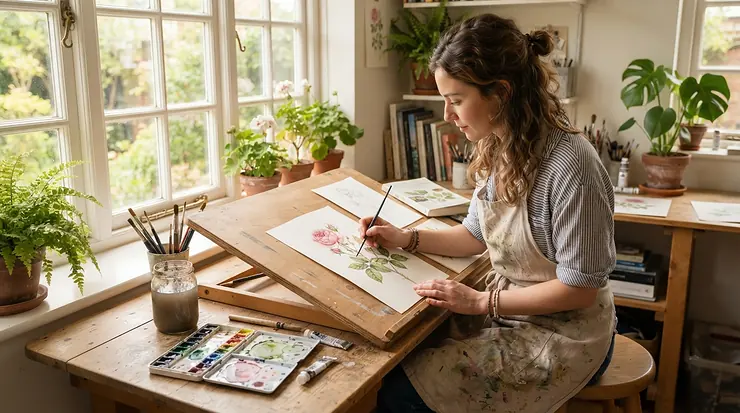
Lean over a flat desk for an hour and your neck starts filing complaints. Stretch that to a three-hour session and your wrists join the protest. That is the unglamorous reason a drawing board for artists deserves a place in your kit: it brings the paper towards you, instead of asking you to fold yourself down to the paper. The idea isn’t new either. The drawing board has a long history in architects’ offices and artists’ studios.

This guide compares seven real, widely sold options for UK buyers in 2026, from a featherlight lap board to a professional A2 drafting setup. Expect analysis, not adjectives: what each spec means in practice, where the published evidence is solid, and where it’s thin. One honest note on method. This article rests on manufacturer specifications, retailer listings and the aggregated feedback I could verify, not on personal hands-on testing.
You’ll also find practical advice on art board angle, ergonomic drawing habits and building a studio art setup that doesn’t swallow your spare room. Short on time? The table below is your cheat sheet. Want the reasoning? Keep scrolling. A good drawing board for artists is a small purchase that quietly changes how long you can comfortably work.
Quick Comparison: Seven Boards at a Glance
Prices below are indicative ranges at the time of research and will vary, so check current price and availability on amazon.co.uk before buying.
| Board | Size | Angle options | Indicative price | Best for |
|---|---|---|---|---|
| Koh-I-Noor Portable Studio | 37.5 × 49.5 cm | Reversible feet: 7° or 15° | Around £60–£110 | Travel and urban sketching |
| US Art Supply Adjustable Drawing Board | 66 × 53 cm (26″ × 21″) | Six angle settings | Around £50–£90 | Home-studio illustration |
| Rotring Designer A2 | 70 × 60 cm | Tilters included | Around £250–£350 | Precision studio work |
| Pacific Arc Tabletop 24 x 36 | 61 × 91 cm | Mainly flat (check listing) | Around £110–£170 | Large-format pen work |
| Staedtler Mars Technico A3 (661) | About 52 × 38 cm | Flat only | Around £50–£80 | Compact, precise linework |
| Juvale Extra Large Landscape Clipboard | 29 × 43 cm (11.5″ × 17″) | None (lap or prop) | Under £25 | Budget lap sketching |
| JR Bourne Tecnostyl Tom2 A2 | A2 | Fully adjustable | Premium tier, check current price | Professional drafting |
Read across the table and the pattern is clear: angle options and price rise together. The US Art Supply Adjustable Drawing Board is the cheapest route to a genuinely tilted art board with several settings, while the Koh-I-Noor Portable Studio trades range for portability. Anyone working at A2 or larger should look at the Rotring Designer A2 or the Pacific Arc Tabletop 24 x 36, accepting the extra weight.
💬 Just one click — help others make better buying decisions too!😊
Top 7 Drawing Boards for Artists: Expert Analysis
Each pick below is judged on what its specifications mean at the desk or easel, what verifiable reviewer feedback says, and who it genuinely suits. Where review evidence is thin, I say so rather than papering over it.
1. Koh-I-Noor Portable Studio — best for artists who travel light
Most portable boards are glorified clipboards. This one adds a lockable straightedge, clamps and reversible feet to a package light enough for a rucksack. The board measures roughly 37.5 × 49.5 cm and weighs around 1.4 kg. The reversible feet raise the surface by 7° or 15°. In practice, 7° barely nudges the paper towards you, while 15° is comfortable for linework but too shallow for big, sweeping charcoal marks.
Based on the specs, this suits urban sketchers, students and anyone working at roughly A3 scale, since it handles paper up to 11 × 17 inches. Larger sheets won’t fit, and the gentle tilt range makes it a compromise rather than a true tilted art board for long studio sessions.
Reviewers on a US retailer’s site praise the light weight and the smooth, lockable ruler, while the carry case draws the most criticism. An independent roundup also calls the board slightly flimsy.
Pros:
- ✅ Light enough to carry daily
- ✅ Two tilt positions via reversible feet
- ✅ Lockable straightedge and clamps included
Cons:
- ❌ Carry case quality draws complaints
- ❌ Limited to roughly A3-size paper
Price: around £60–£110 at the time of research (UK availability can vary, so check current price). Verdict: strong value if portability matters more than size.
2. US Art Supply Adjustable Drawing Board — best-value tilt for a home studio
A proper adjustable drawing board for studio use doesn’t have to cost the earth. This beechwood board offers a 26 × 21 inch work area (about 66 × 53 cm), hand-finished wood, six stable angle settings, a built-in pencil ledge and an included T-square. Six settings should let you move from a near-flat position for ink to a steeper one for large pencil or charcoal work. The ledge stops pencils rolling away, and the T-square gives you dependable horizontals without extra spend.
Here’s what the spec sheet won’t tell you. Solid wood is generally heavier than laminate or composite, and weight isn’t stated in the sources I checked. Confirm it before assuming this is a travelling board. It’s best understood as a studio resident that can be moved, not a commuter companion. For illustrators who want a tilted art board without graduating to a full drafting table, it’s an easy recommendation on paper.
Independent review data is limited. The clearest endorsement I could verify is a guide from Art Side of Life, which describes it as a durable, mid-priced board that is a joy to use. Treat the star ratings on the listing as your main evidence.
Pros:
- ✅ Six angle settings for different media
- ✅ Built-in pencil ledge and T-square
- ✅ Solid beechwood construction
Cons:
- ❌ Likely heavier and bulkier than composite boards
- ❌ Limited independent review evidence
Price: around £50–£90 at the time of research. Verdict: arguably the best entry point for a first adjustable setup.
3. Rotring Designer A2 — best for precision on a studio desk
Some tools earn their reputation by refusing to wobble. The board measures 700 × 600 × 16 mm, is laminated on both sides, uses an anodised aluminium guide track and a parallel straightedge with a stop-and-go mechanism, and weighs about 8.75 kg. The double-sided laminate resists warping, and the 600 mm depth takes A2 paper (420 × 594 mm) with room for taping. The stop-and-go straightedge lets you reposition one-handed. Tilters are included, so you can raise the back edge for comfort.
At almost 9 kg this is a desk resident, not a bag item. For technical illustration, comic page layout, architectural sketches or botanical plates where accurate parallels matter, it’s hard to beat on paper. For loose sketching it’s overkill.
Verified review snippets are limited, but one buyer praised its ease of use and an arm that can move freely or lock in place. Art Side of Life names it the best premium artist board.
Pros:
- ✅ Warp-resistant laminate on both sides
- ✅ Stop-and-go parallel straightedge
- ✅ Generous A2 working capacity
Cons:
- ❌ Heavy at roughly 8.8 kg
- ❌ Premium price for casual users
Price: around £250–£350 at the time of research. Verdict: worth it only if you’ll use the precision daily.
4. Pacific Arc Tabletop 24 x 36 — best for large-format work
If your paper is bigger than your ambitions, start here. Listings for this class of board describe a 24 × 36 inch (61 × 91 cm) solid-core melamine surface that takes paper up to roughly 22 × 34 inches, with a top-mounted parallel bar and an elevated acrylic inking edge. That inking edge lifts the straightedge off the paper, which helps keep wet ink from smearing. Comparable listings put the weight at about 18–19 lb, or roughly 8–9 kg.
This suits muralists planning compositions, pattern designers and pen-and-ink illustrators who need long, true parallels at near-A1 scale. Tilt is the catch. The listings I checked emphasise flat table-top use, so if you want a tilted art board, plan on propping the rear edge with a wedge and check the listing for any angle options.
Verifiable review evidence for this exact listing is sparse, so treat it as under-reviewed and lean on the specifications. Art Side of Life rates it as its runner-up premium pick.
Pros:
- ✅ Huge 24 × 36 inch surface
- ✅ Elevated inking edge reduces smudging
- ✅ Solid-core melamine stays flat
Cons:
- ❌ Around 8 kg or more to move
- ❌ Tilt options appear limited
Price: around £110–£170 at the time of research. Verdict: good value for big sheets, if you accept a mostly flat surface.
5. Staedtler Mars Technico A3 (661) — best compact board for hard-edged linework
Small, plastic and surprisingly precise, this is the board for artists who live in perspective grids. It measures about 52 × 37.8 cm and weighs roughly 1 kg. The parallel arm carries a scale on both sides, clamping strips on either edge hold the sheet, and rubber feet keep it planted. Break-resistant plastic means no warping, and it’s light enough to slide into a portfolio bag.
Comic and manga layout artists, students and anyone drawing technical perspective will appreciate the one-handed locking. The limitation is angle. It isn’t adjustable in angle, so you’ll prop it up yourself or accept a flat surface.
Verified review evidence is thin. One marketplace listing carries a single five-star rating, which tells you little. Rely on the specs and published endorsements, such as Art Side of Life’s pick of it as a budget technical option.
Pros:
- ✅ Lightweight A3 format
- ✅ One-handed locking parallel arm
- ✅ Break-resistant plastic won’t warp
Cons:
- ❌ Flat only, no built-in tilt
- ❌ A3 size limits bigger artwork
Price: around £50–£80 at the time of research. Verdict: a sensible, compact choice for linework specialists.
6. Juvale Extra Large Landscape Clipboard — best budget lap board
Sometimes a clipboard is all you need. This one is an 11.5 × 17 inch fibreboard with a low-profile clip. The low profile lets your drawing hand sweep across the top edge without snagging. At about 29 × 43 cm it comfortably holds A4 and a little more, though A3 sheets will overhang slightly.
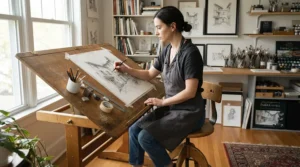
For beginners and life-drawing classes it’s hard to argue with. Resting it on your knees gives you a free tilt, which is a handy experiment for finding your preferred art board angle before you invest in an adjustable drawing board for studio use.
I couldn’t verify a meaningful review pool. The best-known endorsement is Art Side of Life naming it the best basic board: sturdy, smooth and reliable.
Pros:
- ✅ Extremely light and inexpensive
- ✅ Low-profile clip keeps hand movement free
- ✅ Slips easily into a bag
Cons:
- ❌ No built-in tilt or straightedge
- ❌ Plain fibreboard suits dry media best
Price: under £25 at the time of research. Verdict: the lowest-risk way to try a drawing board for artists.
7. JR Bourne Tecnostyl Tom2 A2 — best for professional-grade drafting
At the top of the ladder sits a board that behaves like a small drafting studio. The Tom2 pairs a rigid A2 surface with an integrated drafting head and fully adjustable angles, and the same guide calls it far more expensive than most boards but good value against pricier drafting systems. A drafting machine replaces the T-square and set squares with a pair of rules you can lock at precise angles.
Most artists don’t need this. Technical illustrators, architectural renderers and model-makers who repeat exact angles for hours will feel the difference, because a drafting head turns repeated measuring into one locked motion.
I couldn’t verify a meaningful pool of independent reviews, so judge it on specifications and your budget.
Pros:
- ✅ Fully adjustable working angles
- ✅ Integrated head for precise angles
- ✅ Rigid professional-grade A2 surface
Cons:
- ❌ Far higher cost than other boards here
- ❌ Overkill for sketching
Price: premium bracket, well above the other six boards, so check current price. Verdict: only for daily professional drafting.
✨ Ready to Set Up Your Studio?
🔍 Take your drawing to the next level with these carefully selected boards. Click on any highlighted product name to check current pricing and availability. The right tilted art board will help you draw longer, more comfortably and with better results!
What Is a Drawing Board for Artists?
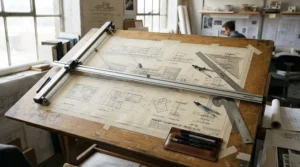
A drawing board for artists is a rigid surface that holds paper steady while you draw, ink or paint, and that can usually be tilted, clamped or propped towards you. Unlike a standard desk, it improves your viewing angle and hand position. Sizes run from lap-sized clipboards to A2 drafting boards with parallel motion.
The terms get tangled. A drawing board is also called a drawing table, drafting table or architect’s table. In everyday shopping, though, a board is the portable surface you rest on a desk or lap, while a drafting table is a full piece of furniture with its own legs.
That distinction matters. A board is cheaper, stores flat and works as a tilted art board only if it has feet, legs or a stand. A table adds stability and height adjustment at the price of floor space. In this guide, “tilted art board” means any board raised at an angle, whether by reversible feet, flip-out legs or a stand.
As a rule of thumb, choose a board if you draw a few hours a week or move between rooms. Consider a table if you draw most days. Either way, a drawing board for artists is the cheapest ergonomic upgrade you can make.
How to Choose a Drawing Board for Artists
Follow these steps in order. Each one narrows the field.
- Match the board to your paper. Aim for a board 1–2 inches (2–5 cm) larger than your sheet on each side. Too small and you tape over your art; too big and it never leaves the house.
- Decide how much tilt you need. Fixed feet suit sketching, six settings suit mixed media, and full adjustability suits long studio days.
- Check weight against how you’ll use it. A day-carry A3 board should come in under roughly 1 kg; studio boards can be heavier.
- Inspect the surface. Smooth sealed laminate suits pens and markers, while a little tooth helps graphite and charcoal. Raw, fuzzy MDF can drink tape adhesive, so seal it.
- Think about paper hold-down. Clips, clamping strips or low-tack tape each behave differently. Watercolourists need a clean border.
- Add a straightedge only if you need one. Parallel motion is superb for hard-edged work and dead weight for loose sketching.
- Spend on stiffness first. A flat, flex-free surface beats any extra gadget.
Art Board Angle: Which Tilt Suits Which Medium?
Art board angle is the most underrated setting in any studio art setup. Too flat and you hunch; too steep and wet media run. Flip-out legs giving 10–20° are usually enough to improve posture and control glare, and watercolourists on location often work at 10–15°. One guide notes that most drafting tables tilt from flat to roughly 40°, with shallower angles for detailed linework and steeper ones for larger drawings.
Treat the following as starting points drawn from those sources and basic reasoning, not rules:
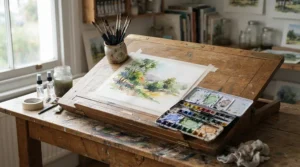
- 🎨 Watercolour and wet media: roughly 10–15°, so washes don’t run.
- ✏️ Pencil, fine pen and technical linework: around 15–30°, which supports the wrist while keeping the whole sheet in view.
- 🖌️ Large charcoal, pastel and gestural work: 30–45° or steeper, which presents the paper more squarely to your eyes.
The Koh-I-Noor Portable Studio covers the shallow end with its 7° and 15° feet, while the US Art Supply Adjustable Drawing Board offers six settings for finer adjustment. Change your art board angle by small steps between tasks rather than hunting for one perfect setting. You’ll notice quickly which angle lets your shoulders drop.
Ergonomic Drawing: Set Up Your Body, Not Just Your Board
Ergonomic drawing is more than a tilt. It’s the whole chain: feet, hips, spine, elbows, eyes. HSE’s guidance on good posture is written for screen users, but its basic checklist of chair height, desk position and sitting close to the work transfers sensibly to a drawing board for artists.
The advice isn’t uniform, though. A Cambridge University Hospitals leaflet recommends keeping the spine’s natural curves and using a small lumbar roll. A South Tees NHS patient sheet, adapted from a 2019 paper, argues there’s no strong evidence that one optimal posture exists. The honest takeaway is to avoid chasing a perfect pose and build in variety. Another NHS leaflet suggests changing position every 20–30 minutes.
A practical ergonomic drawing checklist:
- ✅ Feet flat, chair far enough back to support you
- ✅ Board tilted so you don’t hunch over the sheet
- ✅ Forearms lightly supported, wrists neutral
- ✅ Stand, stretch and look away from the page on a timer
A tilted art board does the heavy lifting here by reducing forward lean, but only if the rest of the chain cooperates. If you have persistent pain, speak to a health professional.
Tilted Art Board vs Flat Desk: What Changes?
On a flat desk your head tips forward and your forearm flattens against the surface. A tilted art board rotates the paper towards you, so your neck stays closer to neutral and your hand approaches the page more naturally. The trade-offs are stability and space. A flat desk never slips, while a board needs non-slip feet or clamps.
| Option | Posture effect | Portability | Typical cost | Best for |
|---|---|---|---|---|
| Flat desk | More forward lean | None | Already owned | Occasional sketching |
| Juvale Extra Large Landscape Clipboard (on knees) | Variable, self-adjusted | Excellent | Under £25 | Quick sketches |
| Koh-I-Noor Portable Studio | Gentle 7°–15° | Very good | Around £60–£110 | Travel and café sketching |
| US Art Supply Adjustable Drawing Board | Six settings | Moderate | Around £50–£90 | Home-studio work |
| Drafting table | Wide tilt, adjustable height | Poor (furniture) | Higher, varies widely | Daily professional use |
The table shows a ladder, not a contest. If you draw casually, the Juvale Extra Large Landscape Clipboard captures much of the benefit for pocket money. Once sessions pass an hour, a settings-based board such as the US Art Supply Adjustable Drawing Board earns its keep. A drafting table only makes sense when drawing is a daily job.
Adjustable Drawing Board for Studio: Features That Matter (And Those That Don’t)
An adjustable drawing board for studio use should do three things well: hold its angle without creeping, stay flat under pressure, and stay put on the desk. Everything else is garnish.
Features that matter
- Secure angle locking. A board that slowly sinks mid-line is worse than a flat one. Six defined settings, as on the US Art Supply Adjustable Drawing Board, beat a friction hinge.
- Stiffness. Press the centre firmly with a soft pencil. If it flexes, your lines will too.
- Surface finish. Sealed laminate wipes clean and takes tape without lifting paper fibres.
- A pencil ledge or tool lip. Small feature, big daily benefit.
Features that don’t
- A parallel bar for freehand work. The Rotring Designer A2 and Pacific Arc Tabletop 24 x 36 are brilliant for hard edges, but add weight if you sketch loosely.
- Fancy carry cases. Reviewers of the Koh-I-Noor Portable Studio complain about the case more than the board.
- Oversized surfaces. If you can’t reach the far corner comfortably, the extra area becomes a hazard.
Choose an adjustable drawing board for studio sessions based on your longest working day, not your shortest.
Studio Art Setup: A Practical First-30-Days Guide
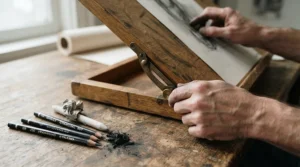
Buying the board is step one. A proper studio art setup takes a month to settle. Here’s a workable plan.
Week one: place and test
- Put the board where light falls across your page rather than behind your head.
- Start at a shallow angle, around 15°, and adjust in small steps each session.
- Flex test: press hard at the centre. The board shouldn’t bow.
- Tape test: apply low-tack tape, then peel slowly. It shouldn’t lift paper fibres.
Ongoing maintenance
- Weekly: wipe the surface and check clips or clamps.
- Monthly: tighten screws and look for wobble.
- Annually: re-seal wood boards if needed.
- If you use a drafting-style surface, clean its cover often so graphite doesn’t smudge new drawings.
Common first-month mistakes
- Raising the angle too fast, then blaming the board
- Leaving clips pressed on delicate paper
- Skipping breaks. A 20–30 minute timer is cheap insurance.
A well-run studio art setup is mostly small habits. The hardware is the easy part.
Real-World Scenarios: Which Drawing Board for Artists Fits Your Life?
These are illustrative profiles, not real customers.
The commuter sketcher. Imagine 25 minutes of sketching on the train, five days a week, with a budget around £100. The Koh-I-Noor Portable Studio is the logical match: light, clamped, with a 15° option. On a tighter budget, the Juvale Extra Large Landscape Clipboard covers the basics for under £25.
The home-studio illustrator. Picture 10–15 hours a week in a spare room and a budget near £100. The US Art Supply Adjustable Drawing Board gives a tilted art board with six settings, a pencil ledge and a T-square. It’s the closest thing here to a studio workhorse at a mid-range price.
The architectural illustrator. Think 25-plus hours a week of precise linework and £300 or more to spend. The Rotring Designer A2 suits a desk-based workflow with true parallels. The JR Bourne Tecnostyl Tom2 A2 suits someone repeating exact angles all day.
Specialists have good options too. Large pen-and-ink artists can look at the Pacific Arc Tabletop 24 x 36, and comic layout artists at the Staedtler Mars Technico A3 (661). Match the board to frequency of use first, then to environment and budget.
Common Mistakes When Buying a Drawing Board for Artists
- Buying bigger than you’ll carry. A beautiful A1 surface that never leaves the cupboard is a very expensive shelf.
- Assuming a “correct” tilt exists. Posture Reframed, a South Tees NHS patient sheet, argues for variety rather than a single ideal. Choose a board that lets you change position.
- Ignoring parts and support. Blundell Harling ended production of its desktop and free-standing drawing boards in early 2024. It’s a reminder to check spares and warranty before buying.
- Skipping the surface check. Raw or porous surfaces fight tape and ink.
- Paying for features you won’t use. A parallel bar or drafting head is wasted on loose sketching.
A good drawing board for artists should disappear while you work. If you’re thinking about it mid-drawing, something’s wrong.
Long-Term Cost & Maintenance
Cost per use is where cheap boards and premium boards converge. As an illustration, a board costing around £80 used three times a week for three years covers roughly 470 sessions, about 17p each. A £300 board used four times weekly for ten years covers around 2,000 sessions, about 15p each. Neither figure counts replacement clips or tape, but both show that durability matters more than the sticker price.
Maintenance is modest. Wipe surfaces, tighten fittings, and re-seal wood occasionally. Mechanical parts such as linkages are the real long-term risk, which is why support availability matters.
| Tier | Boards | Indicative range | Value verdict |
|---|---|---|---|
| Budget | Juvale Extra Large Landscape Clipboard, Staedtler Mars Technico A3 (661) | Under £25 to around £80 | Cheap per session, limited tilt |
| Mid-range | Koh-I-Noor Portable Studio, US Art Supply Adjustable Drawing Board, Pacific Arc Tabletop 24 x 36 | Around £50–£170 | Best balance of tilt, size and durability |
| Premium | Rotring Designer A2, JR Bourne Tecnostyl Tom2 A2 | Around £250 and up | Worth it for daily precision work |
The mid-range tier is where most artists will find the sweet spot, because it offers real tilt without drafting-table pricing. Budget boards are excellent for testing whether a board suits your style. Premium boards pay back only through heavy use, so be honest about how often you’ll actually draw.
✨ Ready to Draw Smarter?
🎨 Pick the board that matches your paper, your posture and your schedule, then click through to check current pricing and availability. A good drawing board for artists is a small purchase with a big comfort payoff!
FAQ: Drawing Board for Artists Questions Answered
❓ What size drawing board for artists works best for A3 paper?
❓ Can I use a tilted art board for watercolour?
❓ Is an adjustable drawing board for studio use worth paying more for?
❓ How do I stop paper slipping on a drawing board for artists?
❓ Do I need a parallel motion bar on a drawing board for artists?
Conclusion: Choosing the Right Drawing Board for Artists
The best drawing board for artists is the one that suits how you actually draw. If you travel, the Koh-I-Noor Portable Studio gives you light weight and two tilt options. If you want a tilted art board for home, the US Art Supply Adjustable Drawing Board offers six angle settings at a mid-range price. Large-format and precision workers should compare the Pacific Arc Tabletop 24 x 36 with the Rotring Designer A2, while linework specialists on a budget can look at the Staedtler Mars Technico A3 (661). Beginners can start with the Juvale Extra Large Landscape Clipboard, and professional drafters can consider the JR Bourne Tecnostyl Tom2 A2.
Whatever you choose, remember that ergonomic drawing is a habit, not a gadget. Vary your art board angle, take breaks and set up your studio art setup around your longest sessions. Check current prices and UK availability before you buy, because both change.
Recommended for You
- Light Pad For Animation: 7 Best Picks For UK Animators (2026)
- Light Box For Tracing Art: 7 Best Picks For UK Artists (2026)
- Tortillon Vs Blending Stump: 7 Best Picks & Ultimate Guide (2026)
Disclaimer: This article contains affiliate links. As an Amazon Associate, I earn from qualifying purchases. If you purchase products through these links, we may earn a small commission at no additional cost to you.
✨ Found this helpful? Share it with your friends! 💬🤗
