In This Article
Pick up a lump of graphite and you can shade. Pick up an oil based coloured pencil and you can build light out of nothing — layer by stubborn, waxy-smooth layer, until a bowl of clementines looks wet enough to lick. That’s the appeal, and also the trap: walk into the pencil aisle (or, more realistically, open forty Amazon tabs at 11pm) and you’re staring down a wall of tins that all promise “professional quality” and “vivid colour” in identical fonts.
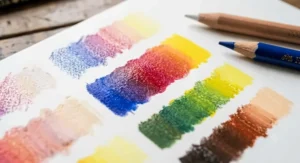
Oil based coloured pencils are coloured pencils whose pigment core is bound primarily with oil rather than wax, giving a harder lead that resists smudging, holds a point longer, and layers without the greasy “wax bloom” haze that plagues cheaper pencils left in a drawer for a few months. They’re the preferred tool of realist and wildlife artists precisely because that harder core supports the dozens of thin layers realism demands.
This guide exists because most “best pencils” listicles are just rewritten spec sheets with an affiliate link bolted on. We’ve done the actual digging — pulling apart what Faber-Castell, Caran d’Ache, Derwent, Holbein, Lyra, Koh-I-Noor and Axus Marco genuinely offer, what real reviewers report after months of use, and where your money is actually well spent. Whether you’re eyeing your first tin of oil based coloured pencils or trying to work out whether the eye-watering Caran d’Ache Luminance justifies its price tag, you’ll find a straight answer here — no fluff, no fictional five-star reviews, just honest analysis grounded in real specs and real aggregated review sentiment. As the Wikipedia entry on coloured pencils notes, the medium has spent a century being underrated by the wider art world — these seven pencils are a big part of why that’s finally changing.
Quick Comparison Table
Before we get into the weeds, here’s the lay of the land — seven genuinely different pencils, sorted roughly from most accessible to most indulgent.
| Pencil | Core Type | Best For | Price Range |
|---|---|---|---|
| Axus Marco Renoir | Oil-based, thick 3.7mm | Beginners wanting an unbreakable core | Under £20 (set of 24) |
| Koh-I-Noor Polycolor | Oil-based, hard | Tightest budget, fine detail | Around £20-30 (set of 24) |
| Lyra Rembrandt Polycolor | Oil-based | Best value step-up from student grade | £25-35 (set of 24) |
| Faber-Castell Polychromos | Oil-based, hard | All-round realism and detail work | £20-160 (tin of 12 to 120) |
| Derwent Lightfast | Oil-based, firm-soft | UK-made archival permanence | £150-260 (larger sets) |
| Holbein Artists’ Colored Pencils | Oil/wax hybrid, soft | Buttery blending and rich colour pop | £180-300+ (larger sets) |
| Caran d’Ache Luminance 6901 | Oil/wax blend | Ultimate lightfastness and smoothness | £200-400+ (larger sets) |
Looking at this spread, the story isn’t really “cheap versus expensive” — it’s texture and purpose. The Axus Marco Renoir and Koh-I-Noor Polycolor sit at the accessible end and are genuinely fine for learning the fundamentals, while Caran d’Ache Luminance and Derwent Lightfast are built for work you intend to sell or frame for decades. The Faber-Castell Polychromos sits almost annoyingly in the middle of everything, which is exactly why it remains the default recommendation for so many working illustrators.
💬 Already got a favourite in mind? Bookmark this page and come back before you buy — the pros-and-cons further down might change your shortlist!
Top 7 Oil Based Coloured Pencils: Expert Analysis
We’ve picked these seven specifically to cover every rung of the ladder — true beginner sets, the mid-range workhorses, and the premium tins that professional illustrators reach for when the client is paying for archival quality. Every one of these is a genuinely oil-based (or oil-dominant) core, verified against manufacturer documentation and independent reviewer testing, not just marketing copy.
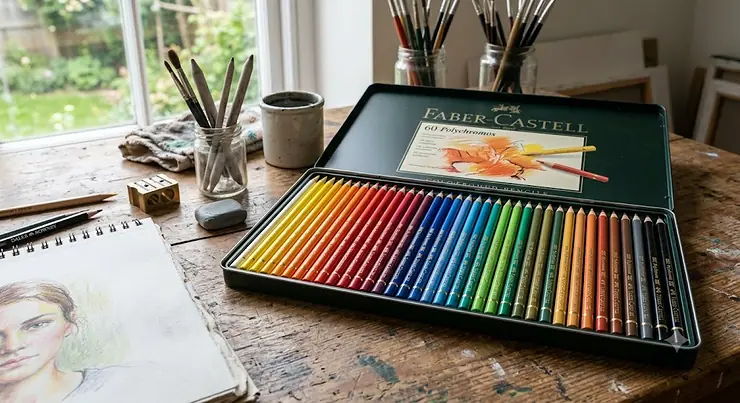
1. Faber-Castell Polychromos — best all-rounder for detail and realism
The standout here is simple: nothing else at this price balances hardness, pigment load and colour range quite so well. Faber-Castell has been making these since 1908, and the core recipe clearly hasn’t needed much fixing since. The 120-colour range is the widest of any oil-based line on this list, and the lead is genuinely hard — hard enough to hold a scalpel-sharp point through hours of fur or feather detail without constant resharpening.
Because the core is oil-bound rather than wax-bound, you can stack ten or fifteen layers without that dull, greasy sheen wax pencils develop under heavy build-up. Based on the spec comparison against its rivals, Polychromos sits at the harder end of the oil-based spectrum — closer to Koh-I-Noor Polycolor than to the softer Caran d’Ache Luminance — which is precisely why animal fur and architectural linework favour it so heavily.
Reviewers consistently report that blending Polychromos requires patience (a colourless blender pencil or gentle burnishing pass helps enormously), and a recurring complaint is that pure blacks and darkest tones can feel slightly chalky next to Caran d’Ache’s richer darks. Weighed against that, the range’s classic status means tutorials, colour charts and swatch libraries are everywhere online, which matters more than it sounds for a beginner trying to learn colour mixing.
Pros:
- ✅ Widest colour range of any oil-based line reviewed here
- ✅ Exceptional point retention for fine detail work
- ✅ Enormous community of tutorials and reference swatches
Cons:
- ❌ Harder core takes practice to blend smoothly
- ❌ Darkest tones can look slightly chalky under heavy layering
Individual pencils sit around £1.30-£1.60, with tins running from roughly £20 for a starter set of 12 up to the £150-160 range for the full 120-colour collection — genuinely good value for a lifetime tool, and open stock means you never have to rebuy a full set just to replace one worn-down green.
2. Caran d’Ache Luminance 6901 — best lightfastness and smoothest blending
What most buyers overlook about Luminance is that it isn’t a pure oil pencil at all — it’s an oil-and-wax blend, which is exactly why it blends like a dream while still resisting the waxy bloom that plagues cheaper wax cores. Swiss-made since the 1990s Luminance development programme, this line earns its reputation from having every single shade independently tested and rated for lightfastness, an unusually transparent claim in an industry where most brands stay quiet on the details.
Softer than Polychromos but firmer than a pure wax pencil like Prismacolor, Luminance lays down colour with almost no pressure, which in practice means less hand fatigue across a long portrait session and smoother gradients straight out of the tin. That softness is a double-edged sword: reviewers note the tips are more prone to snapping on drop, and the core wears down faster than a genuinely hard oil pencil like Koh-I-Noor.
Aggregated review sentiment is remarkably consistent across colouring forums and professional blogs alike: this is the pencil people reach for when a piece is going to be sold, framed, or exhibited, because the lightfastness data removes the guesswork entirely.
Pros:
- ✅ Independently tested lightfastness on every shade
- ✅ Exceptionally smooth, low-pressure blending
- ✅ Rich, saturated darks that hold up under layering
Cons:
- ❌ Most expensive line reviewed here by some margin
- ❌ Softer tips break more easily if dropped or over-pressed
Individual pencils run from roughly £3 to £4 each, and full sets can climb well into the £300-400+ range — genuinely premium territory, best justified once you’re creating work intended to last.
3. Derwent Lightfast — best British-made archival oil pencil
Derwent’s standout advantage is right there in the name: every one of its 100 shades carries a Lightfastness rating designed to meet the demands of gallery and museum-grade work, and it’s made at the historic Cumberland Pencil Company site in the Lake District — a detail British buyers particularly appreciate. Launched only in 2018, it’s the youngest range here, yet it’s already a serious rival to pencils with a century’s head start.
The core sits between Polychromos and Luminance in hardness — oil-based, but noticeably softer and creamier than Faber-Castell’s offering, which reviewers describe as “the point retention of an oil pencil with the lay-down of a wax one.” That combination means fewer sharpening breaks during long sessions without sacrificing the crisp edges realism depends on. What most buyers overlook is that the 100-colour range, while impressive for such a new line, still has genuine gaps — reviewers flag a thin selection of light blues and greens, which can complicate skies and foliage.
Reviewer sentiment leans strongly positive on texture and permanence, with the main recurring gripe being the awkward gaps in certain colour families rather than anything about performance.
Pros:
- ✅ Every shade independently rated for gallery-grade lightfastness
- ✅ Smoother lay-down than harder oil pencils like Polychromos
- ✅ Manufactured in the UK, appealing for British buyers
Cons:
- ❌ Noticeable gaps in light blue and green shades
- ❌ Premium pricing similar to Caran d’Ache Luminance
Prices sit in a similar premium bracket to Luminance, with larger sets typically landing in the £150-260 range depending on tin size — worth it if permanence and a UK-made provenance matter to you.
4. Holbein Artists’ Colored Pencils — buttery soft blending with rich colour pop
Holbein’s standout is texture: this Japanese line combines oil, wax and fat binders into a genuinely unique feel — soft enough to lay down full, opaque colour almost instantly, yet structured enough to avoid the smeariness of a pure wax pencil. First produced in 1993, it’s the newest heritage brand here, and the 150-colour range is the largest on this list.
Because the core releases pigment so readily, colour “pops” off the page with less pressure than almost any rival, which reviewers repeatedly single out as the standout strength — full coverage without the arm ache. Based on the spec comparison, that same softness means the point wears faster, so realism work with fine detail (whiskers, individual hairs) demands more frequent sharpening than a harder pencil like Polychromos.
The honest caveat, and one worth flagging clearly: independent, verifiable lightfastness data for Holbein is thinner and harder to find than for its three premium rivals, so buyers planning to sell or exhibit work should weigh that gap carefully rather than assume parity with Luminance or Lightfast.
Pros:
- ✅ Largest colour range of any line on this list (150 shades)
- ✅ Exceptionally vivid, opaque colour with minimal pressure
- ✅ Available in generous set sizes with genuine open stock in the UK
Cons:
- ❌ Publicly available lightfastness data is limited compared to rivals
- ❌ Softer core wears down faster, needing more frequent sharpening
Individual pencils sit around £2.50-3 each, with the larger 100-150 colour sets often running past £200 — a premium price for a pencil best suited to buyers prioritising feel and vibrancy over documented permanence.
5. Lyra Rembrandt Polycolor — best value step-up from student grade
Lyra’s standout is simple arithmetic: a genuinely oil-based, German-made pencil that performs close to Polychromos territory for a fraction of the outlay. One independent UK reviewer found a 72-colour tin for “a fraction over £1 a pencil” in early 2025 — remarkable value for a core that’s oil-bound rather than the wax found in genuinely cheap sets.
The wide 4mm core means more pigment per stroke and a longer working life before you need to sharpen, and reviewers who came to Polycolor as long-time Polychromos users describe being “pleasantly surprised” by how well it blends and layers, particularly praising its earthy greens and greys for landscape work. What most buyers overlook is that Polycolor isn’t trying to out-perform the premium tier — it’s aimed squarely at the gap between student-grade wax pencils and £100+ professional sets, and in that gap it has very little genuine competition.
Aggregated sentiment consistently frames Polycolor as “not a replacement, but a genuinely good alternative” — worth noting, since that’s a meaningfully different claim to “just as good,” and an honest one.
Pros:
- ✅ Genuine oil-based core at a fraction of premium pricing
- ✅ Wide 4mm core gives strong pigment payoff per layer
- ✅ Widely available in the UK, including useful open stock
Cons:
- ❌ Colour range (up to 72) is narrower than the premium tier
- ❌ Blending ceiling is lower than Luminance or Lightfast
Expect around £25-35 for a set of 24 and £70-90 for the full 72-colour tin — arguably the strongest pound-for-pound value among the oil-based lines covered here.
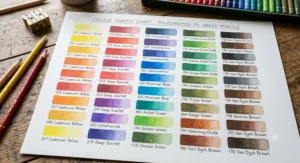
6. Koh-I-Noor Polycolor — hardest core for razor-fine detail on a budget
The Czech-made Polycolor’s standout feature is its hardness — even firmer than Faber-Castell’s Polychromos — which makes it a genuine favourite for artists chasing crisp, controlled linework at the cheapest true oil-based price point on this list. Manufactured by Koh-I-Noor Hardtmuth, a company producing pencils since 1790, this line blends oil with a touch of wax and clay, a formulation the company confirms is oil-dominant despite decades of online confusion about the exact ratio.
Because the core is so hard, it holds a fine point unusually long, which is exactly why detail-focused artists reach for it over softer, pricier alternatives. The trade-off, and it’s a real one, is fragility: reviewers repeatedly flag that the leads snap during sharpening or under firm pressure more than any other pencil on this list, so a gentle hand and a quality sharpener are non-negotiable rather than optional.
Reviewer sentiment on colour vividness is genuinely positive given the price, with the recurring caveat being that blending takes more effort than with softer oil-wax blends like Luminance.
Pros:
- ✅ Cheapest genuinely oil-based line on this list
- ✅ Exceptional point retention for fine, controlled detail
- ✅ Wide 72-colour range available in open stock
Cons:
- ❌ Leads are noticeably prone to snapping while sharpening
- ❌ Blending requires more patience than softer alternatives
UK stockists list individual pencils from around 99p to £1.20, with a tin of 24 typically £20-25 and the full 72-colour tin sitting around £75-100 — a genuinely accessible entry point into true oil-based pencils.
7. Axus Marco Renoir — sturdiest thick-core pick for beginners
The Renoir’s standout is durability: a chunky 3.7mm oil-based core packed into what the manufacturer markets as an unbreakable design, sold in a sturdy iron tin that survives being thrown in a bag rather than babied on a desk. As the newest and most budget-focused entrant here, it’s clearly positioned for beginners, students and colouring-book enthusiasts rather than gallery-bound realism.
That thick core means a genuinely forgiving pencil for anyone still learning pressure control — heavy-handed beginners are far less likely to snap a tip than with the more fragile Koh-I-Noor. Based on the spec comparison against the other budget option here, the trade-off is a narrower colour range and less documented lightfastness data, which matters far less for practice pieces and colouring books than for work destined for a frame.
Given how new this line is relative to century-old rivals like Polychromos, independently verified long-term review data is genuinely thinner — worth being upfront about rather than inventing a track record that doesn’t yet exist.
Pros:
- ✅ Genuinely durable thick core resists snapping
- ✅ Easiest option here for beginners to control
- ✅ Cheapest set price of any pencil on this list
Cons:
- ❌ Narrower colour range than the established brands
- ❌ Long-term lightfastness performance is not yet well documented
A set of 24 typically comes in under £20 on Amazon — a low-risk way to find out whether oil based coloured pencils suit your style before investing in a premium tin.
Top 7 Products: Specs and Value at a Glance
| Product | Core Hardness | Colour Range | Best For | Price Range |
|---|---|---|---|---|
| Faber-Castell Polychromos | Hard | 120 | Detail & realism all-rounder | £20-160 |
| Caran d’Ache Luminance 6901 | Medium-soft | 100 | Lightfastness & blending | £200-400+ |
| Derwent Lightfast | Medium | 100 | UK-made archival work | £150-260 |
| Holbein Artists’ Colored Pencils | Soft | 150 | Buttery colour pop | £180-300+ |
| Lyra Rembrandt Polycolor | Medium-hard | 72 | Value step-up | £25-90 |
| Koh-I-Noor Polycolor | Hardest | 72 | Cheapest true oil core | £20-100 |
| Axus Marco Renoir | Hard, thick | 24 | Beginner durability | Under £20 |
Read across this table and a pattern jumps out: colour range and price roughly track each other, but hardness doesn’t — Koh-I-Noor Polycolor is harder than the far pricier Faber-Castell Polychromos, which tells you hardness is a design choice, not a mark of quality. If your work leans toward fine detail over broad colour coverage, that’s worth remembering before you assume “more expensive” automatically means “better suited to you.”
✨ Ready to build your first oil-based kit? Compare current listings and start with the pencil that actually matches your style — not just your budget.
Practical Usage Guide: Setting Up for Oil-Based Pencil Success
Getting decent results from oil based coloured pencils has less to do with the pencils themselves and more to do with what’s underneath them. Paper matters enormously — a smooth, heavyweight hot-pressed paper (200gsm or above) gives oil pencils something to grip, whereas cheap printer paper simply can’t take more than two or three layers before the tooth gives out and the surface goes shiny and unworkable.
Sharpening technique matters more with oil-based cores than wax ones, because a harder lead chips rather than crumbles under a blunt blade. A manual sharpener with a fresh, quality blade — or a long-point sharpener for extended tip length on detail work — will save you a genuine amount of frustration and wasted pencil, particularly with fragile cores like Koh-I-Noor Polycolor.
The single most common mistake in the first 30 days is pressing too hard, too early. Oil-based pigment builds through repeated light layers, not one heavy pass — pushing hard flattens the tooth of the paper and leaves no room for further colour, which is exactly why beginners often complain their pencils “won’t blend” when the real issue is that the paper’s already saturated. Start light, build gradually, and keep a scrap of the same paper nearby to test pressure and colour combinations before committing to the real piece.
Real-World Scenarios: Which Pencil Suits Your Style?
The weekend hobbyist rediscovering art after years away rarely needs to spend £300 to find out whether they enjoy this again. A set of Lyra Rembrandt Polycolor or Axus Marco Renoir, paired with a decent sketchpad, gives genuine oil-based performance without the anxiety of ruining an expensive tin while relearning pressure control.
The wildlife or botanical illustrator building a portfolio to sell is exactly the buyer for whom lightfastness data isn’t optional — a print sold to a customer that fades within two years is a reputation problem, not just an aesthetic one. Here, Caran d’Ache Luminance or Derwent Lightfast earn their premium price through independently verified permanence, and the smoother blending of both suits the long, subtle gradients wildlife fur and feathers demand.
The detail-obsessed portrait artist working from photo reference typically needs a harder core that survives dozens of thin, controlled layers without losing its point every ten minutes. Faber-Castell Polychromos remains the standard recommendation here precisely because its hardness supports that layering discipline, with Koh-I-Noor Polycolor as a genuinely capable budget alternative for the same working style.
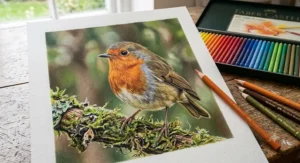
Oil Based Pencils for Realism: Building Depth Through Layering
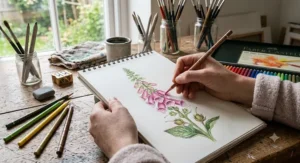
Realism in coloured pencil is built almost entirely through layering — applying thin, controlled passes of colour that gradually accumulate into convincing depth, rather than trying to achieve the final tone in one or two heavy strokes. Oil based pencils for realism work in a fundamentally different way to wax pencils here: the harder core resists sinking too far into the paper’s tooth on the first pass, which leaves room — literally, physical tooth in the paper — for the five, ten or even fifteen subsequent layers a convincing skin tone or fur texture actually requires.
The general principle experienced colour pencil realists follow is dark-to-light or light-to-dark depending on subject, but the constant across both approaches is patience: each layer should be barely visible on its own, building density only through repetition. Reviewers and working illustrators alike describe rushing this process as the single biggest barrier between “competent” and “photorealistic” coloured pencil work — the medium rewards time in a way few others do.
Oil based pencil layering also benefits enormously from working in a consistent, limited palette per layer rather than jumping between wildly different hues, since each new colour interacts optically with everything already laid down. Glazing a warm ochre thinly over a cooler base grey, for instance, shifts the entire undertone without erasing the structure you’ve already built — a technique that simply doesn’t translate the same way with a soft wax pencil that mixes rather than glazes.
Blending Oil Based Coloured Pencils: Techniques That Actually Work
Blending oil based coloured pencils for realism relies on a genuinely different toolkit to wax-pencil blending, precisely because you can’t rely on heat or heavy pressure to melt the pigment together the way you can with a soft wax core. A colourless blender pencil — essentially a binder-only core with no pigment — is the most common tool, pressed firmly over layered colour to push pigment into the paper’s tooth and smooth transitions between tones without adding new colour.
Cotton buds, chamois leather, or a dedicated blending stump can achieve a similar softening effect for broader areas, though reviewers note this works considerably better on softer oil-wax hybrids like Caran d’Ache Luminance or Holbein than on a genuinely hard core like Koh-I-Noor, where the pigment simply doesn’t move as readily. Odourless mineral spirits applied sparingly with a brush can blend oil-based pencils almost like paint, though this is a technique worth practising on scrap paper first — too much solvent lifts pigment entirely rather than blending it.
What most buyers overlook is that blending isn’t really a rescue technique for poor layering — it’s a finishing step. Pencils that have been built up through patient, light layering blend more predictably and smoothly than a heavily pressed, single-pass area, regardless of which brand or blending tool you reach for.
Burnishing Coloured Pencils: The Final Polish
Burnishing coloured pencils is the technique of applying heavy pressure with a light-coloured or colourless pencil over already-layered colour, pushing the pigments together into a smooth, almost polished sheen that eliminates visible paper texture entirely. It’s typically the final step in a realism piece, applied only once the underlying colour structure is fully built — burnish too early and you seal the paper’s tooth, locking out any further layering.
With oil based coloured pencils, burnishing tends to produce a slightly different finish to wax pencils: rather than the glossy, almost plasticky sheen wax burnishing can leave, oil-based cores like Polychromos and Lightfast burnish to a more matte, controlled polish that many realism artists actually prefer for skin tones and fur, since it avoids unwanted glare under gallery lighting. A white pencil, a colourless blender, or even a light grey can all serve as the burnishing tool depending on the tonal effect wanted.
The honest caveat worth flagging: burnishing is genuinely difficult to undo. Reviewers and tutors alike consistently recommend testing the technique extensively on scrap pieces in the same paper stock before attempting it on a finished or near-finished piece, since a heavy-handed burnish over the wrong colour combination can muddy tones that took hours of careful layering to achieve.
Coloured Pencil Realism Techniques Beyond the Basics
Beyond layering, blending and burnishing, several coloured pencil realism techniques separate accomplished work from merely competent work. Underpainting — laying down a full tonal value study in a neutral grey or complementary colour before introducing local colour — helps establish accurate light and shadow before pigment choice complicates the picture, a method borrowed directly from traditional oil painting practice.
Optical mixing, where small, controlled strokes of two or three distinct colours sit side by side rather than being physically blended, can produce a vibrancy that flat blending sometimes flattens out — visible in skin tones especially, where a mix of ochre, pink and pale green strokes reads as convincing flesh from a normal viewing distance far more effectively than a single “skin tone” pencil ever could. Working on toned or coloured paper rather than white is another technique gaining renewed popularity, since a mid-tone ground lets highlights be added with white or pale pencils rather than relying entirely on the paper itself for the lightest values.
Cross-hatching at varying angles, rather than uniform circular shading, can also suggest texture and form more convincingly for surfaces like fabric or tree bark — a technique that rewards experimentation more than any single “correct” method, and one where the harder cores of oil based coloured pencils genuinely shine, since they hold the crisp line quality these directional strokes depend on.
Faber-Castell Polychromos Review: Why It Still Sets the Benchmark
It’s worth pulling Faber-Castell Polychromos out for a closer look, given how consistently it comes up as the default recommendation across nearly every serious coloured pencil comparison published in the last several years. Part of the reason is longevity: a product line that’s been continuously refined since 1908 has had over a century to iron out formulation issues that newer competitors are still working through.
Independent side-by-side comparisons consistently rank Polychromos as the hardest of the major oil-based lines — harder than Derwent Lightfast, and considerably firmer than the oil-wax blend in Caran d’Ache Luminance. That hardness is repeatedly cited by reviewers as the reason it excels specifically at detailed illustration work like animal fur and whiskers, where a softer core would blur crisp individual strands into a smudge. On the Wikipedia lightfastness reference, the underlying science explains why this matters so much for professional work: pigments genuinely do degrade under UV exposure at wildly different rates, and Polychromos’s reputation for stable, well-documented lightfast pigments removes much of that uncertainty for buyers.
Where the honest caveat comes in: Polychromos isn’t the easiest pencil to blend for beginners, and its darkest values can read as slightly chalky compared to Caran d’Ache’s richer blacks. For most working illustrators, though, that trade-off against unmatched detail control, colour range and community support keeps it at the top of the pile — not the flashiest pencil here, but arguably the most dependable.
How to Choose Oil Based Coloured Pencils
Choosing the right set comes down to matching a handful of concrete factors to how you’ll actually use the pencils, rather than simply buying whatever tin has the most colours in it.
- Decide your core hardness preference first. Harder cores like Polychromos or Koh-I-Noor suit fine detail and realism; softer oil-wax blends like Luminance suit broad, smooth blending and painterly work.
- Check whether lightfastness data is actually published. If you plan to sell or exhibit work, prioritise brands like Caran d’Ache and Derwent that publish independently tested ratings per shade.
- Match the colour range to your subject matter. Wildlife and botanical artists benefit from wider ranges (Holbein’s 150, Polychromos’s 120); if you’re colouring for enjoyment, a 24-36 set is genuinely plenty to start.
- Consider open stock availability before you buy. A set you can top up pencil-by-pencil, rather than rebuying an entire tin when your favourite green wears out, saves real money long-term.
- Test your paper alongside your pencil choice. Even the best oil based coloured pencils will disappoint on paper too thin or smooth to hold multiple layers.
- Weigh core fragility against your working style. If you press hard or work quickly, a more forgiving thick core like Axus Marco Renoir will frustrate you less than fragile Koh-I-Noor leads.
- Set a realistic budget band before browsing. Knowing whether you’re shopping the £20 or £300 tier before you start prevents the classic trap of upgrading three times before finding your actual price ceiling.
🔍 Found your criteria? Check current availability on the pencils that match your priorities before prices or stock shift.
Oil Based Coloured Pencils vs Wax Based Pencils
The oil-versus-wax debate isn’t really about which is objectively better — it’s about which working style suits your subject and patience. Wax-based pencils, such as Prismacolor Premier or Derwent Coloursoft, are softer and lay down colour with less pressure, which makes them faster to blend and forgiving for beginners, but that same softness means they crumble more readily and are more prone to developing a hazy “wax bloom” on the paper’s surface after heavy layering.
| Factor | Oil-Based Pencils | Wax-Based Pencils |
|---|---|---|
| Core hardness | Firmer, holds a point longer | Softer, wears down faster |
| Layering capacity | Excellent for many thin layers | Can saturate paper faster |
| Blending speed | Slower, needs technique | Faster, blends readily |
| Wax bloom risk | Minimal to none | Noticeable over time |
| Best suited to | Fine detail, realism | Broad colour, quick coverage |
Reading across this table, the practical takeaway is that oil-based pencils like Faber-Castell Polychromos reward patience with crisper detail and no bloom risk, while wax-based alternatives get you to a finished, blended look faster with less technique to learn. Neither is strictly superior — plenty of professional illustrators keep both in their kit and choose per project, using wax for loose colour studies and oil for the final, exhibition-ready piece.
Common Mistakes When Buying (and Using) Oil Based Coloured Pencils
The most frequent buying mistake is assuming a bigger set number automatically means better value — a 150-colour Holbein set is wasted on someone who’ll only ever use twenty core shades, when that same budget could buy a smaller premium set plus proper paper and a decent sharpener. A related mistake is ignoring open stock availability entirely, then discovering three years later that your most-used green has worn to a stub with no way to replace it individually.
On the usage side, the single most common error is buying a genuinely premium pencil and then using cheap, thin paper that can’t support more than two layers — the pencil gets blamed for “not blending” when the paper simply ran out of tooth. Another recurring problem is sharpening technique: forcing a blunt blade through a hard, fragile core like Koh-I-Noor Polycolor is the single biggest cause of snapped tips reported across reviews, and a genuinely sharp blade or electric sharpener solves it almost entirely.
Finally, many beginners skip swatching new colours onto their actual working paper before starting a piece, which means discovering a colour reads far warmer or cooler than expected only after it’s already down on the good paper — a five-minute test swatch avoids that entirely.
Long-Term Cost & Maintenance
Total cost of ownership for oil based coloured pencils looks different depending on how you shop. A premium tin like Caran d’Ache Luminance carries a steep upfront cost, but genuine open stock availability means you’re only ever replacing individual worn-down pencils rather than an entire set — over several years of regular use, that can actually work out cheaper per completed piece than repeatedly rebuying budget sets that lack open stock and get discarded once a few key colours run out.
Maintenance costs are modest but real: a quality sharpener (electric or a sharp manual blade) is a genuine long-term investment, since a blunt blade is the leading cause of snapped tips on harder cores. Storage matters too — pencils left loose in a bag or exposed to heat can develop core cracking over time, particularly with oil-wax blends like Luminance and Holbein, so a simple case or tin extends working life meaningfully at essentially no cost.
The archival angle deserves a mention here as well. Institutions like Tate invest serious resources into researching pigment permanence precisely because fading is a genuine, measurable phenomenon over decades — which is exactly the reasoning behind paying more for a line like Derwent Lightfast or Caran d’Ache Luminance if your finished work is destined for sale, framing or long-term display rather than a sketchbook.
Features That Actually Matter (And Those That Don’t)
Genuinely important: independently published lightfastness ratings, core hardness suited to your subject matter, and open stock availability — these three factors affect how your work looks in ten years and how much you’ll spend replacing pencils over time. Colour range is important but only up to a point; beyond roughly 70-80 well-chosen shades, additional colours in a 150-piece set are frequently near-duplicates that see little actual use.
Less important than the marketing suggests: tin material and packaging presentation. A metal tin looks impressive on a shelf, but it has no bearing on how the pigment performs on paper, and cardboard packaging from budget brands like Axus Marco or Lyra performs identically once the pencils are in a proper storage case anyway. Similarly, “unbreakable” marketing claims are worth a healthy dose of scepticism — thick cores like the Axus Marco Renoir genuinely do resist snapping better than fragile alternatives, but no wood-cased pencil core is truly unbreakable under enough pressure or a poor-quality sharpener.
Brand heritage, while a nice story, shouldn’t be the deciding factor either. Faber-Castell’s century-plus history is genuinely reassuring for consistency, but Derwent Lightfast proves a line launched as recently as 2018 can compete directly with century-old rivals on the metrics that actually matter — lightfastness, hardness and layering performance.
Frequently Asked Questions
❓ What's the difference between oil based and wax based coloured pencils?
❓ Are oil based coloured pencils good for beginners?
❓ Do oil based coloured pencils need a special sharpener?
❓ Can you blend oil based coloured pencils with solvent?
❓ How many oil based coloured pencils do I actually need to start?
Conclusion
There’s no single “best” oil based coloured pencil, and honestly, be wary of any article that tells you otherwise. What there is, instead, is a genuinely good match for your budget, your subject matter, and how much patience you’ve got for the learning curve — a Faber-Castell Polychromos rewards detail-obsessed realism, a Caran d’Ache Luminance rewards buyers who need documented permanence, and an Axus Marco Renoir or Koh-I-Noor Polycolor lets you find out whether any of this suits you at all without gambling three hundred pounds on the answer.
What ties all seven together, budget to premium, is that oil-based cores genuinely do something wax pencils can’t: they support the patient, many-layered building process that realism depends on, without the greasy bloom that undermines long-term results. Pick the tin that matches where you actually are in your practice — not where the marketing wants you to imagine yourself — and the results will follow far more reliably than any single “miracle” pencil ever could.
Whichever you choose, the fundamentals stay the same: good paper, patient layering, and a willingness to practise blending and burnishing on scrap before committing to the piece that matters. Get those right, and even the most modest set on this list can produce work you’re genuinely proud of.
Recommended for You
- Watercolour Pencils vs Watercolour Paints: 7 Best Picks 2026
- Best Watercolour Pencils 2026: 7 Top Sets Tried & Rated
- Faber-Castell vs Prismacolor: Best Coloured Pencils 2026
Disclaimer: This article contains affiliate links. As an Amazon Associate, I earn from qualifying purchases. If you purchase products through these links, we may earn a small commission at no additional cost to you.
✨ Found this helpful? Share it with your friends! 💬🤗
