In This Article
Stand in front of an art shop wall of coloured pencils for long enough and you’ll start to feel a bit like you’re choosing a wand at Ollivander’s. Every tin promises “buttery,” “vibrant,” “professional grade” — and somewhere on the box, in small print, sits the detail that actually matters: whether that pencil is wax based or oil based. It sounds like a footnote. It isn’t. The binder inside the core decides how the pencil sharpens, how many layers it’ll tolerate before it gives up, whether you’ll be wiping a ghostly haze off your finished piece, and ultimately how your artwork looks in ten years, not just ten minutes.
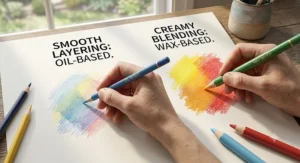
This guide breaks down oil based vs wax based coloured pencils properly — not as a quick dictionary definition, but as a working comparison built from real specs and real, verifiable reviewer sentiment across seven pencils you can actually buy on amazon.co.uk. We’ll cover the binding agent, the difference between an oil pencil vs wax pencil for artists in daily use, when wax bloom shows up (and what to do about it), and which coloured pencil type is best for your particular project, budget and patience level. Prices below are ranges only, since Amazon pricing shifts constantly — always check current price before buying.
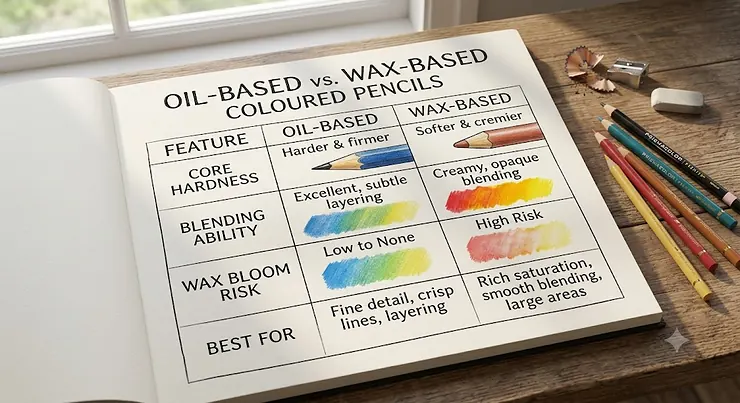
A quick working definition to start: wax based coloured pencils use a wax-heavy binder that produces a soft, easily blended core, while oil based coloured pencils replace most of that wax with oil, giving a firmer core that resists breaking and largely avoids wax bloom. That binder choice also affects lightfastness — how well the finished colour resists fading over years of display — which matters far more than most beginners expect. Everything else in this guide flows from that one distinction, so keep it in your back pocket as we go.
Quick Comparison Table
| Wax Based Coloured Pencils | Oil Based Coloured Pencils | |
|---|---|---|
| Core feel | Soft, buttery, breaks more easily | Firm, dry-ish, resists snapping |
| Blending style | Blends fast, burnishes quickly | Blends gradually, more layers tolerated |
| Wax bloom risk | Higher, especially with heavy layering | Low to negligible |
| Point retention | Wears down faster | Holds a fine point longer |
| Typical price feel | Entry-level to mid-range | Mid-range to premium |
| Best for | Beginners, bold colouring, fast coverage | Detail work, portraits, archival pieces |
Looking at this table, the pattern that jumps out is really a trade-off between speed and control. Wax pencils reward you almost immediately — lay down colour, blend it with a bit of pressure, done — which is exactly why they dominate the adult colouring book market. Oil pencils ask for more patience up front (more layers, more sharpening technique) but pay it back with sharper detail and a drawing that isn’t going to develop a cloudy film on your bookshelf in five years’ time. Neither is objectively “better”; they’re built for different jobs, and most working artists in the UK colouring pencil community end up owning both.
💬 Found this comparison useful? A quick tap on your favourite pick below helps you check today’s price on Amazon UK before you commit!
Top 7 Oil Based and Wax Based Coloured Pencils: Expert Analysis
We’ve deliberately mixed budget, mid-range and premium picks across both binder types, including a proper UK-made option, so there’s a sensible entry point whatever you’re working with.
1. Crayola Signature Blend & Shade — most affordable route into real layering
The standout here is simple: this is the cheapest set on this list that genuinely blends, rather than just colours in flatly. The wax-based core is softer than Crayola’s children’s range, and it lays pigment down smoothly enough to build two or three workable layers before it resists further colour.
Reviewers consistently note the core is noticeably softer and more buttery than Crayola’s standard school pencils, though a minority report occasional wood-splitting during sharpening, which points to inconsistent barrel quality on some batches. Based on the spec comparison with the rest of this list, these are best suited to beginners, colouring-book enthusiasts, or parents buying a first “proper” set for a teenager who’s shown genuine interest — not for anyone chasing gallery-ready detail.
Pros:
- ✅ Genuinely soft, blendable wax core for the price
- ✅ Widely available and easy to top up open stock
- ✅ Forgiving for beginners still learning pressure control
Cons:
- ❌ Limited layering depth compared with artist-grade pencils
- ❌ Some barrels reported to split when sharpening
Expect to pay under £20 for a 24-pencil tin (prices may vary), making Crayola Signature Blend & Shade the easiest “yes” on this list if you just want to find out whether you enjoy coloured pencil work before spending more.
2. Derwent Coloursoft — best UK-made soft wax pencil for bold colour
Derwent is a genuinely British brand (Cumbria-manufactured), and the Coloursoft range was built specifically to compete with the buttery American wax pencils that dominate this category. What most buyers overlook about this model is how concentrated the pigment load is — it’s genuinely one of the more opaque wax pencils around, so fewer passes are needed to get full coverage on darker paper.
The wide, soft strip lays colour down quickly, which is brilliant for big, bold still-life or landscape work but less ideal for tight detail. Aggregated user reviews describe the core as slightly drier than Prismacolor’s while still being easy to lift with a kneaded eraser, and several reviewers mention noticeable dust during sharpening, which is a genuine trade-off for that soft core.
Pros:
- ✅ Highly pigmented, opaque coverage in few layers
- ✅ Genuinely UK-manufactured with reliable local stock
- ✅ Wide colour range including muted, natural tones
Cons:
- ❌ Produces more sharpening dust than average
- ❌ Soft core is prone to breakage if dropped
At around £45-£60 for a 24-pencil tin (check current price), Derwent Coloursoft earns its place as the mid-range wax pick, particularly for UK buyers who’d rather support a domestic brand and skip the import wait.
3. Prismacolor Premier — the benchmark for wax-based blending
If there’s a single pencil most colouring communities default to recommending, it’s this one. The soft, waxy core is famous for near-seamless blending — reviewers repeatedly describe being able to work four or five layers together into a smooth transition before the paper simply won’t take more pigment.
That softness is a double-edged sword, though. The same buttery core that blends so beautifully also breaks easily inside the barrel, meaning a dropped pencil can crumble invisibly until you sharpen it and watch the tip snap off repeatedly. Reviewers consistently report this as the single biggest frustration with the range, alongside a strong tendency toward wax bloom on heavily layered dark areas.
Pros:
- ✅ Exceptional blending and colour transitions
- ✅ Huge 150-colour range including 18 dedicated greys
- ✅ Widely stocked and easy to buy individual colours
Cons:
- ❌ Fragile core breaks easily inside the barrel
- ❌ More prone to wax bloom than firmer pencils
Set prices generally fall in the £30-£45 range for a 24-pencil tin, climbing well beyond that for the full 150-colour set (prices vary by retailer). For anyone specifically choosing a wax based coloured pencil for smooth blending, Prismacolor Premier is still the pencil most others get measured against.
4. Faber-Castell Polychromos — the all-rounder oil pencil for fine detail
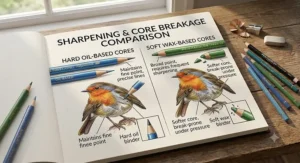
Here’s where the oil pencil vs wax pencil for artists debate gets genuinely interesting. Polychromos swaps most of the wax for oil, producing a firmer, drier core that holds a sharp point far longer than any wax pencil on this list. On paper this means slower blending; in practice it means far more controllable detail work, since the core doesn’t smear the moment you lean on it.
Reviewers who’ve used both brands extensively describe Polychromos as needing more layers to reach the same smoothness Prismacolor achieves in half the passes — but note that once you get there, the result holds up better over time and resists wax bloom almost entirely. It’s a firm favourite for portrait and botanical illustrators who need precise, repeatable line work.
Pros:
- ✅ Holds a fine point through detailed passages
- ✅ Minimal to no wax bloom over time
- ✅ Strong, established 120-colour range
Cons:
- ❌ Requires more layers to achieve full blending
- ❌ Noticeably pricier than entry wax pencils
A 24-pencil tin typically sits in the £45-£60 range, with the full 120-colour set running considerably higher (check current price before buying). If you’re weighing which coloured pencil type is best for controlled, detailed work, Faber-Castell Polychromos is the standard oil-based answer.
5. Caran d’Ache Pablo — best point retention for detailed line work
Swiss-made and genuinely distinctive — Pablo is the only pencil on this list with a hexagonal rather than round barrel, which gives it a noticeably steadier grip during long detail sessions. The oil-based core is softer than Polychromos while still holding its point impressively well, striking a middle ground between “easy to work with” and “precise.”
What most buyers overlook is that Pablo produces very little dust when sharpened, unlike several wax alternatives, which matters if you’re working somewhere you can’t easily brush debris away. Reviewers who’ve used it alongside Caran d’Ache’s flagship Luminance range describe Pablo as “soft enough” without tipping into the extreme softness that makes some premium pencils harder to control.
Pros:
- ✅ Excellent point retention with minimal dust
- ✅ Distinctive hexagonal barrel improves grip control
- ✅ Very good, though not flagship-level, lightfastness
Cons:
- ❌ Premium open-stock pricing per pencil
- ❌ Colour range smaller than budget wax competitors
Open stock pricing tends to sit in the mid-£2 to £3 per pencil range, so a 30-pencil set generally lands somewhere around £70-£90 (prices fluctuate — check current listing). Caran d’Ache Pablo rewards anyone doing fine, repeatable linework who’s outgrown a beginner set.
6. Derwent Lightfast — Britain’s answer to archival oil-based colour
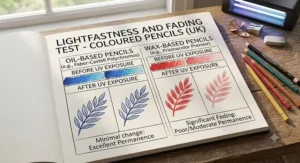
This is Derwent’s flagship, and it was engineered around a single promise: every colour in the range is independently tested to the highest lightfastness rating available, meaning your finished piece genuinely won’t fade over decades of normal display. It’s a rare thing for a mainstream brand to test every colour rather than cherry-pick the easy wins.
The core sits firmly in oil-pencil territory — hard, precise, slow to blend — which reviewers describe as much closer to Polychromos than to Derwent’s own softer Coloursoft line. Based on the spec comparison, this is the pencil to reach for when a piece is genuinely destined for framing or sale, rather than a sketchbook experiment.
Pros:
- ✅ Every colour independently tested for top lightfastness
- ✅ Genuinely UK-manufactured, no import uncertainty
- ✅ Firm core resists breakage in transit and use
Cons:
- ❌ Among the priciest options in this comparison
- ❌ Slower to blend than softer oil or wax pencils
Individual pencils typically retail from around £3-£4 each, so a 24-pencil set generally sits in the £80-£120 range (prices vary — always check current listing). If lightfastness and UK manufacture both matter to you, Derwent Lightfast is the clearest oil-based choice on this list.
7. Caran d’Ache Luminance 6901 — the wax-oil hybrid built for permanence
Luminance sits in its own category: Caran d’Ache blends wax and oil rather than committing fully to either, chasing the smoothest possible transitions while keeping every single colour certified to the ASTM D6901 lightfastness standard. Reviewers who’ve tested it against Pablo describe the blending as the smoothest of any pencil they’ve used — genuinely soft, almost pastel-like laydown with light pressure.
The catch, and it’s a significant one, is price. This is by a wide margin the most expensive pencil on this list, and several long-term reviewers admit they respect it more than they love it, finding the extreme softness occasionally harder to control with precision than a firmer oil pencil like Polychromos.
Pros:
- ✅ Every colour certified to ASTM D6901 lightfastness
- ✅ Exceptionally smooth wax-oil blending
- ✅ High pigment load gives strong coverage with light pressure
Cons:
- ❌ By far the most expensive pencil in this comparison
- ❌ Extreme softness can reduce fine-detail control
A smaller 20-pencil portrait set generally starts upwards of £150, with larger sets comfortably exceeding £300 (check current price, as these fluctuate significantly). Caran d’Ache Luminance is the pencil to save for once you already know coloured pencil work is a long-term pursuit, not a passing hobby.
Top 7 Products at a Glance
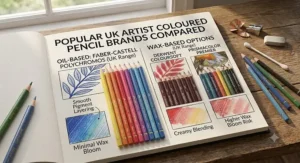
| Product | Binder Type | Price Range | Best For |
|---|---|---|---|
| Crayola Signature Blend & Shade | Wax | Under £20 | Absolute beginners |
| Derwent Coloursoft | Wax | £45-£60 | Bold, opaque UK-made colour |
| Prismacolor Premier | Wax | £30-£45 | Smooth blending on a budget |
| Faber-Castell Polychromos | Oil | £45-£60 | Fine detail and portraits |
| Caran d’Ache Pablo | Oil | £70-£90 | Controlled, dust-free linework |
| Derwent Lightfast | Oil | £80-£120 | Archival, UK-made permanence |
| Caran d’Ache Luminance | Wax-oil hybrid | £150+ | Ultimate lightfastness and blend |
Read across this table and the value story becomes obvious: Crayola Signature Blend & Shade and Prismacolor Premier dominate anyone testing the waters, while Derwent Lightfast and Caran d’Ache Luminance justify their price only once you’re producing work you actually intend to frame or sell. The middle ground — Derwent Coloursoft, Faber-Castell Polychromos and Caran d’Ache Pablo — is where most serious hobbyists eventually settle, often owning a set from each binder type rather than picking a permanent side.
Practical Usage Guide: Preventing Wax Bloom on Coloured Pencil Art
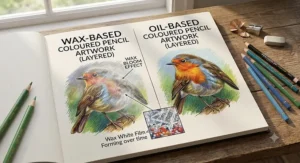
Wax bloom is the cloudy, whitish film that can appear on heavily layered wax-based artwork days or even weeks after you’ve put the pencil down — and if you’ve just discovered it on a finished piece, take a breath, because it’s cosmetic, not damage. Here’s how to keep it from ambushing your next drawing.
- Build colour in thin layers. Multiple light passes bind more evenly than one heavy-handed layer and reduce the amount of excess wax sitting on the surface.
- Ease off the pressure on darker tones. Wax bloom shows up most on dark, heavily burnished areas, so darker colours deserve a lighter touch, applied more times.
- Wipe gently with a soft cloth if it appears mid-drawing. A microfibre cloth or cotton bud lifts the haze without disturbing pigment underneath, provided you don’t scrub.
- Finish with a proper fixative. A fixative made specifically for coloured pencil work seals the surface and stops the wax rising back to the top over time.
- Switch binders for anything archival. If a piece is genuinely destined for sale or framing, an oil-based pencil like Polychromos sidesteps the issue almost entirely.
A common mistake in the first month of using wax pencils is treating wax bloom as a fault in the paper or the pencil, when it’s simply physics: the wax binder settling and rising to the surface. Manage it with the steps above and it stops being frustrating fairly quickly.
Real-World Scenarios: Which Coloured Pencil Type Fits Your Project
The evening colouring-book unwinder. If you’re colouring for twenty minutes before bed a few nights a week, budget and forgiveness matter more than archival permanence. Crayola Signature Blend & Shade or Prismacolor Premier will get you smooth, satisfying results without punishing small technique mistakes.
The portrait artist building a portfolio. Someone working toward gallery submissions or commissioned portraits needs sharp detail and predictable layering over long sessions. Faber-Castell Polychromos or Caran d’Ache Pablo reward the patience that kind of work demands, and neither will develop wax bloom mid-project.
The collector building a piece meant to last. If you’re creating something that will hang on a wall for decades — a wedding commission, a family portrait, a piece heading into a gallery — lightfastness stops being optional. Derwent Lightfast or Caran d’Ache Luminance are built specifically for that brief, even though both cost considerably more upfront.
What Is the Difference Between Oil Based and Wax Based Coloured Pencils?
Oil based and wax based coloured pencils differ in their binding agent — the substance that holds powdered pigment together inside the core. Wax based pencils use a wax-heavy binder, giving a soft, easily blended core prone to wax bloom. Oil based pencils use an oil-heavy binder, producing a firmer, more break-resistant core that largely avoids that haze but takes more layers to blend fully.
That single difference in the binding agent cascades into almost every practical difference you’ll notice while actually drawing: how quickly the tip wears down, how many layers you can stack before the paper “gives up,” how much dust collects on your desk while sharpening, and how the finished piece behaves years later under normal household lighting.
Coloured Pencil Binding Agent and Pencil Core Composition Explained
Every coloured pencil core is built from the same basic recipe: pigment, filler, and a binder to hold it all together, extruded into a thin rod and dried without the kiln-firing graphite pencils go through (which would alter the pigment’s colour). The proportion of wax to oil in that binder is what separates the two families discussed throughout this guide — and it’s worth knowing, since manufacturers rarely spell it out on the packaging itself.
Higher wax content produces the soft, buttery pencils most colouring-book fans reach for instinctively; higher oil content produces the firmer, more precise pencils illustrators lean on for detail. A useful primer on how these binders behave more broadly across art materials is Wikipedia’s overview of binder chemistry, which covers the same wax-versus-oil trade-off found in oil paints and pastels, not just pencils.
Fillers such as kaolin clay also play a quieter role, affecting how smoothly the core extrudes and how much texture it leaves on toothier papers — which is part of why two pencils with an identical binder can still feel noticeably different in the hand.
How to Choose Coloured Pencils: 7 Expert Steps
- Decide your priority first: blending speed or detail control. Wax pencils blend faster; oil pencils hold detail longer. This single choice narrows the field immediately.
- Check the lightfastness rating, not just the marketing copy. Independently tested ranges like Derwent Lightfast or Caran d’Ache Luminance spell this out per colour rather than as a vague claim.
- Buy open stock before committing to a full set. Most artist-grade brands sell single pencils, letting you trial the feel for a few pounds instead of gambling on a full tin.
- Match the core hardness to your paper’s tooth. Rougher papers chew through soft wax cores fast, while smoother papers suit them nicely.
- Factor in your sharpening tolerance. Soft wax cores need frequent, gentle sharpening; firmer oil cores hold a point for noticeably longer stretches.
- Consider whether the piece needs to last. Anything destined for framing or sale should lean oil-based or a certified-lightfast hybrid.
- Budget for the full journey, not just the first tin. Artist-grade colours are often sold open stock, so replacing a used-up favourite doesn’t mean rebuying the whole set.
Which Coloured Pencil Type Is Best? A Buyer’s Decision Framework
If you’re brand new and mostly colouring for relaxation, choose a soft wax pencil because forgiving blending matters more than archival permanence at this stage. If you’re building toward commissioned or gallery work, choose an oil-based or certified-lightfast pencil because the piece needs to survive years of display without fading or clouding. If you genuinely can’t decide, buy one small set of each — most working colourists end up doing exactly that, using wax pencils for loose colour blocking and oil pencils for the fine detail passes on top.
There’s no single universally “best” answer to which coloured pencil type is best, and that’s not a dodge — it’s the honest conclusion every serious reviewer in this space eventually reaches once they’ve used both families extensively.
Oil Pencil vs Wax Pencil for Artists: Detailed Comparison
| Oil Pencil | Wax Pencil | |
|---|---|---|
| Layering ceiling | High — tolerates many passes | Lower — burnishes out sooner |
| Blending speed | Slower, gradual build | Fast, near-immediate |
| Detail retention | Excellent | Weaker on fine lines |
| Wax bloom | Rare | Common on heavy layering |
| Learning curve | Slightly steeper | Beginner-friendly |
The practical upshot for an oil pencil vs wax pencil for artists debate is that oil pencils suit anyone willing to trade a bit of instant gratification for long-term control, while wax pencils suit anyone who wants results fast and doesn’t mind the occasional wipe-down for wax bloom. Neither wins outright, which is exactly why most of the products on this list, from Prismacolor Premier through to Derwent Lightfast, keep selling steadily to entirely different audiences.
✨ Don’t Miss These Exclusive Deals!
🔍 Ready to build your own set? Click through on any pencil above to check today’s availability and pricing on Amazon UK — and start layering colour that actually holds up.
Common Mistakes When Buying Coloured Pencils
Reviewers and forum threads circling this topic tend to repeat the same handful of errors. First, buying the biggest set available before knowing whether you actually enjoy the medium — a 150-colour tin is wasted on someone who colours twice a year. Second, assuming a higher price always means a softer, easier pencil; premium oil pencils are often firmer, not softer, than budget wax alternatives. Third, ignoring lightfastness entirely for a piece that’s actually meant to be displayed, then being disappointed when colours shift within a year or two.
A subtler mistake is buying open-stock singles purely by colour name without checking the binder type, then being confused when two “similar” pencils from different brands behave completely differently on the same paper. Matching binder type to your actual working habits — not just the prettiest tin — solves most of these frustrations before they start.
What to Expect: Real-World Performance on the Page
Specs on a box rarely translate directly to how a pencil actually feels in a two-hour drawing session. In practice, a soft wax pencil like Prismacolor Premier covers paper fast enough that a full A5 sketch can be blocked in within twenty minutes, but you’ll be sharpening more often as the tip rounds off quickly under pressure. A firmer oil pencil like Faber-Castell Polychromos takes noticeably longer to reach the same coverage, often needing five or six thin layers instead of three thick ones, but that same session produces crisper linework that survives close-up scrutiny.
What the spec sheet won’t tell you, but reviewers note repeatedly, is that humidity and paper texture change this experience meaningfully — soft wax pencils get even softer and more prone to smearing in warm, humid rooms, while firmer oil cores stay far more consistent regardless of conditions.
Long-Term Cost & Maintenance: Total Cost of Ownership
The sticker price on a tin is only half the real cost. Soft wax pencils wear down faster and need replacing sooner, particularly your most-used skin tones and greens, which means a “cheaper” set can end up costing more per finished piece over a year of regular use. Firmer oil pencils last considerably longer per pencil, but the higher unit price up front makes the total outlay feel steeper at the checkout, even if it evens out over time.
Storage matters too: wax-based cores are more vulnerable to heat, so leaving a tin in a hot car or on a sun-facing windowsill genuinely shortens their working life, while oil-based cores tolerate this kind of casual mistreatment considerably better. Buying open stock replacements for your most-used colours, rather than a fresh full set each time, is consistently the cheapest way to keep either type topped up long-term. If you want to understand why some individual colours within a range fade faster than others regardless of brand, the Jackson’s Art blog has a clear explainer on why certain fugitive pigments fade faster than others, which is worth bookmarking before you invest in a premium set.
Features That Actually Matter (And Those That Don’t)
Genuinely worth paying for: independently tested lightfastness ratings, a wide colour range with proper tonal spread (not just bright primaries), and consistent core centring so pencils don’t snap the moment you sharpen them. These directly affect how your finished piece looks and how long it lasts.
Largely marketing noise: barrel shape claims about “ergonomic” grip beyond the genuine hexagonal-versus-round difference, exotic-sounding wood species with no real performance benefit, and “professional” labelling on ranges that haven’t published any lightfastness data at all. If a brand won’t tell you how a colour performs under UV exposure, that’s worth noting before you commit serious money to a full set.
Wax Bloom Coloured Pencils Explained: Why It Happens
Wax bloom is a thin, whitish or greyish film that can develop on the surface of a coloured pencil drawing, most commonly over dark, heavily layered or burnished areas. It happens because the waxy binder inside the pencil core gradually rises to the surface as the layers settle, refracting light differently and creating that hazy look. It’s a cosmetic effect, not damage, and it’s entirely reversible.
Oil-based pencils rarely produce it, since there’s simply less wax present to rise to the surface in the first place — which is one of the clearer, most concrete reasons some artists choose an oil pencil vs wax pencil for artists debate outright rather than splitting their kit across both. Pigment stability over time is a topic conservators take seriously well beyond coloured pencils; Tate’s own research papers include a detailed case study on a pigment known for poor lightfastness, which is a genuinely interesting read on why some colours fade far faster than others regardless of the medium.
FAQ
❓ Are oil based or wax based coloured pencils better for beginners?
❓ Do wax based coloured pencils get wax bloom?
❓ Can you mix oil based and wax based coloured pencils in one drawing?
❓ Which coloured pencil brand is best for professional artists?
❓ Are oil based coloured pencils more expensive than wax based ones?
Conclusion
Oil based vs wax based coloured pencils isn’t really a competition with a winner — it’s two different tools solving two different problems. Wax pencils, from budget-friendly Crayola Signature Blend & Shade through to the blending benchmark Prismacolor Premier, get you fast, forgiving colour with a genuine risk of wax bloom on heavier work. Oil pencils, from the reliable Faber-Castell Polychromos to the archival-grade Derwent Lightfast, ask for more patience but deliver detail and permanence that wax simply can’t match, with the wax-oil hybrid Caran d’Ache Luminance sitting in its own premium category entirely.
If you take one thing away from this comparison, let it be this: match the binder to the brief, not to whichever tin looks nicest on the shelf. A relaxing evening colouring session and a commissioned portrait destined for a client’s wall genuinely need different pencils, and now you know exactly which questions to ask before you spend a single pound on either.
Recommended for You
- Oil Based Coloured Pencils: 7 Brilliant Picks for 2026
- Watercolour Pencils vs Watercolour Paints: 7 Best Picks 2026
- Best Watercolour Pencils 2026: 7 Top Sets Tried & Rated
Disclaimer: This article contains affiliate links. As an Amazon Associate, I earn from qualifying purchases. If you purchase products through these links, we may earn a small commission at no additional cost to you.
✨ Found this helpful? Share it with a fellow colouring or drawing enthusiast! 💬🎨
