In This Article
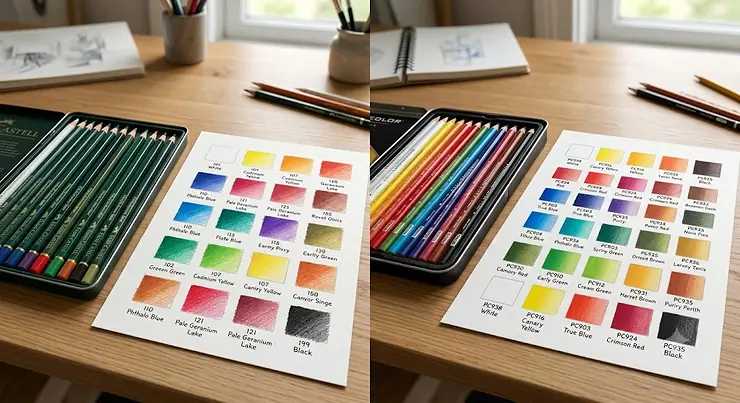
Stand in front of an art supplies shelf for long enough and two tins will keep catching your eye: the dark green of Faber-Castell Polychromos and the black-and-gold of Prismacolor Premier. Faber-Castell vs Prismacolor coloured pencils is one of the oldest debates in coloured pencil art, and it’s not going away, because both ranges genuinely deserve their reputations. One glides on like warm butter. The other holds a point like it’s been carved from stone. Neither is “better” in the way a phone spec sheet is better — they’re built for different hands and different habits, and picking wrong means months of frustration with a set that fights you every stroke.
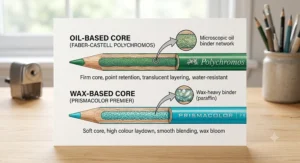
In short: Faber-Castell Polychromos is an oil-based pencil, prized for lightfastness that pushes past 100 years and for a firm core that sharpens to a scalpel point, while Prismacolor Premier is a wax-based pencil famous for its soft, blendable lay-down and lush colour saturation, but with a softer core that breaks more easily and a patchier lightfastness record. This guide walks through both ranges in proper depth, brings in five more real, currently sold sets so you can see where they sit on the budget-to-premium spectrum, and digs into the practical stuff — layering, availability, long-term cost — that actually decides which tin ends up on your desk. All prices below are shown as ranges rather than fixed figures, since retailer pricing shifts constantly; always check current pricing before buying.
Quick Comparison Table
| Feature | Faber-Castell Polychromos | Prismacolor Premier |
|---|---|---|
| Binder | Oil-based | Wax-based |
| Core feel | Firm, holds a fine point | Soft, buttery, breaks more easily |
| Lightfastness | 102 of 120 colours rated maximum (3-star) | Mixed — some shades fade noticeably faster |
| Best for | Detail work, layering, archival pieces | Blending, bold colour, adult colouring books |
| UK price range | Mid-to-premium (varies by tin size) | Budget-to-mid (varies by tin size) |
| Best For | Illustrators, botanical artists, students building a “forever” set | Portrait and wildlife colourists who prize buttery blends |
Look at the table and the split becomes obvious pretty fast: this isn’t really a contest between a “good” pencil and a “bad” one, it’s oil versus wax, precision versus plush. If your work needs to survive being framed on a wall for decades — think giclée-style botanical illustration or a commission piece — the Faber-Castell Polychromos lightfastness numbers matter more than almost anything else on this table. If you’re colouring for the joy of it, filling in intricate mandala books or building up soft portrait skin tones, the forgiving, velvety application of Prismacolor Premier is going to feel like less of a fight.
💬 Just one click — help others make better buying decisions too!😊
Top 7 Coloured Pencils: Expert Analysis
Every product below has been researched against real specifications and aggregated review sentiment from UK and international retailers. Where individual customer reviews couldn’t be independently verified, that’s stated plainly rather than invented.
1. Faber-Castell Polychromos — the oil-based lightfastness benchmark
The tin of 36 sits at the sweet spot for most colourists: enough range to cover skin tones, greenery and shadow work without the outlay of the full 120. The 3.8mm oil-based lead is bonded the full length of the barrel, which in practice means it survives drops onto a hardwood floor that would snap a cheaper pencil clean in half. Faber-Castell rates 102 of its 120 colours at the maximum lightfastness tier — roughly a Blue Wool 7–8, meaning fade resistance well beyond a century under normal indoor light. Based on the spec comparison with every other pencil in this guide, nothing here comes close on permanence. This is the pencil serious illustrators, botanical artists and anyone selling framed originals tends to reach for, precisely because “will this still look right in ten years” isn’t a question they want to ask twice. Reviewers consistently report that the lead resists breakage even under heavy pressure, and one long-term Amazon UK reviewer specifically praised the improved blending quality compared with cheaper alternatives, while noting the range is a genuine investment rather than a casual purchase.
Pros:
- ✅ Among the most lightfast coloured pencils sold anywhere
- ✅ Break-resistant bonded lead survives drops and rough sharpening
- ✅ No wax bloom, so layered work stays clean over time
Cons:
- ❌ Firmer core needs more pressure than soft wax pencils
- ❌ Premium price puts the full 120-colour set out of casual budgets
At the time of research, the tin of 36 typically sits in the mid-price bracket for artist-grade pencils, with larger tins scaling up accordingly — always check current pricing before ordering. Given the fade resistance alone, most reviewers consider it money well spent for anything meant to last.
2. Prismacolor Premier — buttery soft-core blending powerhouse
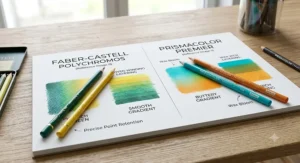
Open a tin of these next to the Polychromos and the difference is immediate: the core feels almost creamy under the fingertip, laying down colour in one confident stroke where a firmer pencil needs three. The wax binder is what does it — it melts into the paper tooth rather than sitting on top, which is exactly why Prismacolor Premier has become the go-to choice for adult colouring books and portrait skin tones where seamless gradients matter more than crisp line work. What most buyers overlook about this pencil is that the softness cuts both ways: gorgeous blending, but a core that snaps more readily if you sharpen aggressively or drop the tin. Reviewers on Amazon UK consistently describe the pigment as “vibrant” and note the ease of blending compared with harder pencils, and one UK buyer specifically mentioned purchasing the set for a daughter’s Higher Art coursework, reporting no breakage issues and praising the colour range for both blended and crisp detail work.
Pros:
- ✅ Exceptionally smooth, buttery blending straight from the tin
- ✅ Rich, saturated colour laydown even in a single layer
- ✅ Huge colour range across the full 150-set for subtle gradients
Cons:
- ❌ Softer core is more prone to breakage than oil-based rivals
- ❌ Lightfastness varies considerably by individual colour
Prices for the tin of 36 generally fall into the budget-to-mid range compared with the Polychromos equivalent — a meaningful factor if you’re testing the waters of premium pencils for the first time.
3. Derwent Lightfast — Britain’s answer to 100-year colour
Made in Derwent’s Cumbrian factory, this is the range that most directly rivals Polychromos on the one metric oil-pencil fans care about most: permanence. Every single colour in the Lightfast range is formulated to comply with ASTM D6901 and the Blue Wool ISO 105 scale, with Derwent claiming zero fade under museum conditions for 100 years across the entire palette — not just “most” colours, as with some rivals. The 4mm core is wide and oil-based, described by reviewers as buttery and velvety despite its lightfast credentials, which is unusual; normally you sacrifice softness for permanence. Here’s what to weigh: this pencil is aimed squarely at professionals who need every colour in the box to be trustworthy for gallery or commission work, not hobbyists dabbling for an afternoon. Based on independent lightfastness testing referenced by colouring-pencil specialists, Derwent Lightfast performed among the strongest of all tested ranges, alongside Caran d’Ache Luminance.
Pros:
- ✅ 100% of colours meet the strictest lightfastness standard, not just most
- ✅ Wide 4mm core gives strong, opaque colour coverage
- ✅ British-made, with a growing colour range
Cons:
- ❌ Among the most expensive tins in this guide
- ❌ Smaller palette range (36–100 colours) than the biggest rivals
Retail prices vary sharply between sellers — one specialist UK stockist has been seen pricing the tin of 36 noticeably below the brand’s own website, so it pays to compare before buying.
4. Caran d’Ache Luminance 6901 — the Swiss ultra-premium outlier
If Polychromos and Derwent Lightfast are “premium,” Luminance is a full tier above that. Developed over two years by the Swiss manufacturer and launched with the SMAC innovation prize in 2010, this wax-oil hybrid core is formulated so that the vast majority of its 100 colours meet the strictest classification (Lightfastness I) under ASTM D-6901 — a distinction Caran d’Ache states no other brand’s full range achieves. The spec sheet won’t tell you this, but user reports suggest the blending is the smoothest of any pencil tested for this piece, edging out even Prismacolor Premier for gradient work while still holding a usable point. This is a pencil for professionals whose reputation rides on colour permanence — gallery sellers, portrait commissioners, anyone who can’t afford a client noticing their artwork fading on the wall eighteen months later. Casual colourists will likely find the cost very hard to justify next to a set like Polychromos that gets 90% of the way there for a fraction of the outlay.
Pros:
- ✅ The strictest lightfastness classification across nearly the whole range
- ✅ Exceptionally smooth wax-oil blend for seamless transitions
- ✅ Sturdy presentation box protects pencils in transit
Cons:
- ❌ By far the most expensive pencil in this comparison
- ❌ Smaller open-stock availability than Faber-Castell or Prismacolor
Expect to pay a genuinely premium price even for a small starter box, climbing steeply for the larger sets — this is an investment purchase, not an impulse buy.
5. Derwent Coloursoft — smooth soft wax at a friendlier price
Derwent’s mid-range wax pencil is the one to consider if the buttery Prismacolor feel appeals to you but the price point doesn’t, or if you’ve had breakage frustrations with softer American cores. The 3.5mm round core is formulated for a smooth, creamy laydown with strong pigment saturation, positioned by Derwent as a blendable, layering-friendly pencil for drawing and colouring alike. What most buyers overlook about mid-range wax pencils like this one is that “mid-range” doesn’t mean “worse for beginners” — in fact, a slightly firmer wax core than Prismacolor’s can be easier for a new colourist to control while they’re still learning pressure and layering technique. Reviewers consistently note strong blendability and a smooth texture that holds up well against pricier rivals, though the palette range tops out lower than the full Polychromos or Prismacolor lines.
Pros:
- ✅ Smooth, creamy application without premium pricing
- ✅ Good pigment saturation for the price bracket
- ✅ Slightly firmer than Prismacolor, so a touch more control for beginners
Cons:
- ❌ Smaller open-stock colour range than the market leaders
- ❌ Less lightfast than the Lightfast or Polychromos ranges
The tin of 24 sits comfortably in the budget-to-mid bracket, making it a sensible stepping stone before committing to a full premium set.
6. Castle Art Supplies Gold Standard — best value oil-based alternative
Not every good pencil comes from a century-old German or American factory. Castle Art Supplies has built a loyal following on Amazon by offering an oil-based core — the same broad category as Polychromos — at a fraction of the price, aimed at adult colourists and hobbyist artists rather than exhibiting professionals. The formulation is designed to sharpen to a fine point and resist breaking, with pencils organised into named, numbered colour families inside a zip-around case, which honestly makes colour-matching far less fiddly than digging through an unlabelled tin. On paper this means you get oil-based hardness and control without oil-based pricing, though it’s worth being honest about the trade-off: this is a student-to-mid-grade formulation, not a direct swap for the pigment purity of Polychromos. Reviewers consistently describe the cores as soft, buttery and easy to blend for the price point, with several noting they upgraded from the 72-set to the 120-set after being won over.
Pros:
- ✅ Oil-formulated core at a genuinely budget-friendly price
- ✅ Colour-family organisation makes shade-matching easier
- ✅ Sturdy zip case is practical for carrying to classes or life-drawing groups
Cons:
- ❌ Lightfastness is not independently rated to the same standard as Polychromos
- ❌ No open-stock individual pencils if you wear down a favourite shade
Historically priced well under the premium tier for a 72-piece set, this is the pencil to recommend to a teenager or student rather than a portrait professional — though as with everything here, check current pricing before buying.
7. Prismacolor Premier — the low-risk way into soft-core pencils
The smaller tin of 24 deserves its own entry rather than a footnote, because it solves a genuinely common problem: nobody wants to spend on a 150-piece set before knowing whether they even like a soft wax core. This smaller tin carries the same buttery, blendable formulation as the full range, just in a curated core-colour selection, making it the obvious “try before you commit” option. Reviewers consistently praise the appearance and finish, with several UK buyers specifically noting the pencils looked “better than expected” and blended beautifully even straight out of the box, including one review that mentioned using Prismacolor’s own colourless blender to achieve a smoother finish. Based on the spec comparison, you’re getting the identical core formulation as the 150-set, so nothing about the experience is “dumbed down” for the smaller price tag — you simply have fewer colours to play with until you decide to expand.
Pros:
- ✅ Same soft, blendable core as the full 150-colour range
- ✅ Low-cost way to trial Prismacolor before a bigger investment
- ✅ Compact tin size is easy to carry in a bag or pencil case
Cons:
- ❌ Limited colour range restricts more advanced blending work
- ❌ Same breakage tendency as the larger sets
Sitting firmly in the budget bracket, this is the set to buy first, then upgrade from once you know the soft-core feel suits your style.
✨ Don’t Miss These Exclusive Deals!
🔍 Take your coloured pencil collection to the next level with these carefully selected sets. Click on any highlighted item to check current pricing and availability. These tools will help you create the vibrant, layered artwork you’ve been picturing!
Polychromos vs Premier Coloured Pencils: The Core Difference Explained
Strip away the marketing and the Polychromos vs Premier coloured pencils debate comes down to one physical fact: what holds the pigment together. Polychromos uses an oil binder; Premier uses a wax binder. Everything else — the point retention, the blending style, the breakage rate, even the long-term appearance of layered work — flows directly from that single choice.
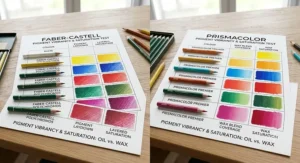
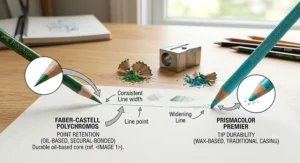
Oil-bound leads like Polychromos stay firmer at room temperature, which is why they sharpen to a genuinely fine point and hold it through detailed line work. That firmness is also why they resist the dreaded “wax bloom” — a hazy white film that can develop on heavily layered wax pencil work as the wax migrates to the surface over weeks or months. Wax-bound leads like Prismacolor Premier stay softer and more pliable, which is what gives them that buttery, paint-like blend quality, but it’s also why they crumble more easily under heavy pressure or a rough sharpener.
Neither approach is objectively superior — a tattoo artist sketching a stencil wants the Polychromos point; a colourist smoothing gradients across a sky wants the Premier softness. What most buyers overlook about this comparison is that plenty of professional colouring artists actually use both ranges together, reaching for Polychromos to lay in fine detail and edges, then switching to Prismacolor Premier to fill and blend larger areas. If your budget allows it, owning a small set of each rather than committing fully to one range is a genuinely common and sensible strategy.
Oil Based vs Wax Coloured Pencils Comparison
The oil based vs wax coloured pencils comparison isn’t unique to Faber-Castell and Prismacolor — it’s the fundamental split running through the entire coloured pencil market, and understanding it will help you judge any pencil you’re considering, not just the two brands in this guide.
| Trait | Oil-Based (e.g. Polychromos, Derwent Lightfast) | Wax-Based (e.g. Prismacolor Premier, Derwent Coloursoft) |
|---|---|---|
| Point retention | Excellent — holds fine detail | Weaker — softens and blunts faster |
| Blendability | Good, needs more layers | Excellent, blends in fewer strokes |
| Wax bloom risk | Minimal to none | Present on heavy layering |
| Breakage | Low — bonded, break-resistant leads | Higher — softer cores snap more easily |
| Typical use case | Illustration, botanical, fine detail | Portraits, adult colouring, bold colour |
According to conservation research on wax-based drawing media, wax coloured pencils are structurally similar to wax crayons, with paraffin, beeswax or carnauba wax used to bind pigment to the lead, which is precisely the mechanism behind both their soft blend quality and their long-term bloom risk. Practically speaking, this means a wax-heavy piece stored in a cool, stable environment is far less likely to develop bloom than one left in a warm attic or a car boot, so how you store finished work matters almost as much as which pencil you bought. If archival stability is genuinely non-negotiable for your work, an oil-based range removes that variable from the equation entirely rather than asking you to manage it through careful storage.
What Makes a Premium Coloured Pencil?
Not every set claiming to be “professional grade” earns the label, and understanding what actually separates premium coloured pencils from student-grade ones will save you from paying inflated prices for marketing language alone.
- Pigment-to-filler ratio. Premium pencils use a higher concentration of true pigment relative to chalk or clay filler, which is why a single layer of Polychromos or Prismacolor Premier lays down richer colour than three layers of a supermarket set.
- Lightfastness testing. Genuinely premium ranges publish independently verifiable lightfastness ratings against ASTM D6901 or the Blue Wool scale, rather than vague claims of being “fade resistant.”
- Core bonding. How the lead is fixed inside the wood barrel determines breakage resistance — Faber-Castell’s SV bonding process is a genuine engineering difference, not just marketing copy.
- Colour consistency across the range. Premium brands colour-match across their product lines (Polychromos to Albrecht Dürer watercolour pencils, for example), so mixed-media artists can move between mediums predictably.
- Open-stock availability. The ability to replace a single worn-down colour, rather than buying a whole new set, is a hallmark of a serious professional range and one budget brands rarely offer.
Reviewers consistently note that once you’ve used a genuinely premium pencil, cheaper sets start to feel scratchy and thin by comparison — which is exactly why so many artists describe premium pencils as an investment rather than a purchase.
Faber-Castell Polychromos Lightfastness: What the Ratings Actually Mean
Faber-Castell Polychromos lightfastness is arguably the single biggest reason professionals choose this pencil over cheaper wax alternatives, so it’s worth understanding exactly what the star ratings printed on each pencil barrel actually promise.
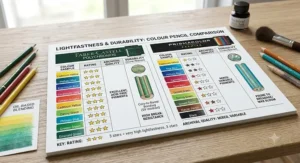
Faber-Castell tests its pigments against the Blue Wool Scale, an internationally recognised method that, according to Wikipedia, exposes a dyed sample alongside a reference card of eight graded wool strips to simulated sunlight and rates fade resistance from 1 (poor) to 8 (excellent). A three-star Polychromos rating corresponds to roughly a 7–8 on that scale, which Faber-Castell states equates to maximum fade resistance exceeding 100 years under normal indoor lighting. Of the full 120-colour range, 102 colours carry that top rating; the remaining 18 are rated two-star (25+ years) or one-star (5+ years) — still respectable, but worth checking individually if a specific shade is central to a piece you intend to sell or frame.
Independent lightfastness testing by colouring-pencil specialists has broadly supported Faber-Castell’s own claims, ranking Polychromos among the top-performing ranges alongside Caran d’Ache Luminance and Derwent Lightfast, and ahead of most wax-based competitors including Prismacolor Premier. Here’s what to weigh: if you’re colouring for personal enjoyment and don’t plan to frame or sell the work, lightfastness may matter far less than you think. If you’re building a portfolio, selling prints, or working to commission, it should probably be the deciding factor over blend feel or price.
Prismacolor Premier Availability in the UK
Prismacolor Premier availability has genuinely improved for UK buyers over the past several years, but it’s still worth understanding the landscape before you commit to a full 150-set purchase.
Prismacolor is an American brand, manufactured in Mexico since 2010 and now owned by Newell Brands, and it has never had the same dedicated UK distribution network as home-grown ranges like Derwent or European giants like Faber-Castell. That said, tins of 24, 36, 48 and the full 150-colour set are all readily available through Amazon UK, alongside several themed 12-packs. Stock levels do fluctuate by seller — some listings show only a handful of units in stock at any given time — so if you’re set on a specific tin size, it’s worth ordering with a little lead time rather than assuming next-day availability.
One useful bit of UK-specific history: Prismacolor’s discontinued British sister brand, Karisma, shared a similar wax core and was hugely popular among UK art students before production ceased, prompting many to switch to Prismacolor for a comparable feel. If open-stock individual pencils are important to you — replacing a single worn-down shade rather than buying a whole new tin — availability is patchier than for Polychromos, so factor that into your decision if you know you’ll lean heavily on particular colours.
Coloured Pencil Layering Techniques
Whichever brand you land on, coloured pencil layering techniques are what actually separate flat, waxy-looking colouring from genuinely luminous artwork, and the right approach differs depending on whether you’re holding an oil-based or wax-based pencil.
Start light, build slow. Regardless of brand, laying down colour with a light touch in the first two or three passes gives you far more room to layer over the top than pressing hard from the start, which compacts the paper tooth and leaves nowhere for additional pigment to sit.
Work light to dark. Establish your lightest values first, then gradually introduce mid-tones and shadows. With Prismacolor Premier’s soft core, this also helps control the blend, since a heavy dark layer applied too early can smear into lighter areas beneath it.
Use a burnishing layer for wax pencils. Once you’ve built up several layers of Prismacolor Premier or Derwent Coloursoft, a final firm pass with a pale or colourless pencil melts the layers together into a smooth, almost painted finish — this is where the soft wax core genuinely earns its reputation.
Use solvent sparingly on oil-based ranges. Odourless mineral spirits can push Polychromos or Derwent Lightfast pigment into the paper fibres for a smoother, richer finish, but test on scrap paper first, since different papers react very differently.
Rotate your pencil while sharpening. This sounds trivial, but it genuinely extends the life of the softer Prismacolor Premier core, reducing the breakage that frustrates so many new users.
Reviewers consistently mention that switching from heavy-handed colouring to a patient, light-layered approach was the single biggest improvement to their results — regardless of which brand they were using.
Practical Usage Guide: Getting the Most from Your First Set
Buying a good set of pencils is only half the job; the first thirty days of actually using them shape habits that stick for years, good or bad.
On day one, resist the urge to sharpen every pencil down to a fresh point immediately — sharpen only the colours you’re actively using, since repeated sharpening is the single biggest cause of premature wear, particularly with a soft core like Prismacolor Premier. In your first week, test each pencil on the actual paper you intend to use for finished work, not a scrap notepad; different papers have wildly different tooth, and a pencil that glides on smooth Bristol board can feel scratchy on a heavily textured watercolour sheet.
A common early mistake is storing pencils loose in a bag, where the tips knock against each other and snap — a simple pencil roll or the original tin solves this instantly. Another is pressing too hard too early, which flattens the paper’s texture and leaves nowhere for later layers to grip; this is a mistake shared by beginners regardless of whether they’re using oil or wax pencils. For maintenance, a soft brush to clear shaving dust from your sharpener, and periodically checking that a battery or hand-crank sharpener is still cutting cleanly rather than crushing the lead, will noticeably extend the life of a premium set.
Real-World Scenarios: Which Pencil Suits Which Artist
The portrait hobbyist on a Sunday afternoon, working mainly from photo references and prioritising smooth, seamless skin-tone blends over razor-sharp detail, is squarely in Prismacolor Premier territory — the soft core does the heavy lifting on blending with relatively little technique required.
The botanical illustrator selling prints at a local market, whose work needs to survive months of direct sunlight in a market stall or on a customer’s wall, should lean toward Faber-Castell Polychromos or Derwent Lightfast, where the lightfastness numbers genuinely protect the value of the finished piece.
The student building a first serious set on a tight budget, wanting to learn proper technique without a large upfront cost, is well served by Castle Art Supplies Gold Standard or the smaller Prismacolor Premier tin of 24 — both offer a genuine taste of premium-pencil behaviour without the premium price tag, leaving room to upgrade to Polychromos or Luminance once their skills and preferences are clearer.
Common Mistakes When Buying Coloured Pencils
Buying the biggest set first. A 150-colour tin is tempting, but most colourists actually use a core palette of 20–30 shades regularly; a smaller, well-chosen set often serves better while you’re still learning your preferences.
Ignoring the paper you’ll actually use. A pencil that performs beautifully on smooth Bristol board can feel completely different on cold-press watercolour paper — always test before committing to a big purchase.
Assuming price equals suitability. Caran d’Ache Luminance is the most expensive pencil in this guide, but that doesn’t make it the right choice for a colouring-book hobbyist who will never need museum-grade permanence.
Overlooking open-stock replacement. If you know you’ll burn through certain shades — skin tones and greens tend to go first — check whether individual pencils are available before you buy, since not every brand offers this.
Skipping the lightfastness label entirely. Even within a single brand’s range, ratings vary colour to colour; a quick glance at the star rating on the barrel before framing a piece can save real disappointment later.
Long-Term Cost & Maintenance
The upfront price tag on a pencil tin only tells part of the financial story — long-term cost depends heavily on how often you’re replacing broken leads, buying replacement colours, and how far a single pencil actually stretches.
| Range | Approx. cost per pencil | Breakage risk | Open-stock replacement |
|---|---|---|---|
| Faber-Castell Polychromos | Mid-to-premium | Low | Widely available |
| Prismacolor Premier | Budget-to-mid | Moderate-high | Available, but patchier UK stock |
| Caran d’Ache Luminance | Highest of all seven | Low-moderate | Limited |
| Castle Art Supplies | Lowest of all seven | Moderate | Not available (set only) |
Interpreting this table honestly: a Polychromos tin costs more upfront, but the low breakage rate and wide open-stock availability mean you’re rarely paying to replace a snapped pencil or hunting for a discontinued colour. Prismacolor Premier’s lower unit cost is attractive, but factor in the higher breakage rate over time, and the total cost of ownership narrows the gap between the two brands more than the sticker price suggests. Castle Art Supplies remains the clear budget winner on raw cost, provided you’re comfortable buying a whole replacement set rather than topping up individual colours down the line.
Premium Coloured Pencils vs Traditional Alternatives
| Factor | Premium pencils (Polychromos, Prismacolor, Luminance) | Traditional student-grade pencils |
|---|---|---|
| Pigment saturation | Rich, single-layer coverage | Chalky, needs many layers |
| Lightfastness | Rated and documented | Rarely tested or disclosed |
| Blending | Smooth, predictable | Patchy, waxy build-up |
| Longevity of the pencil itself | Break-resistant, long-lasting | Frequent breakage, shorter life |
| Best For | Serious hobbyists and professionals | Children, casual doodling, classroom use |
The gap here isn’t subtle. A student-grade set is genuinely the right call for a child’s pencil case or a classroom cupboard, where cost and disposability matter more than archival quality. But for anyone spending real hours on a piece they care about, the difference in pigment saturation alone means premium pencils typically use fewer layers to achieve richer results, which — factoring in time saved — starts to offset the higher purchase price surprisingly quickly.
Buyer’s Decision Framework
If you’re still torn, run through this simple checklist:
- If permanence is your top priority, choose Faber-Castell Polychromos or Derwent Lightfast, because their documented lightfastness protects the long-term value of framed or sold work.
- If buttery blending matters more than point retention, choose Prismacolor Premier or Derwent Coloursoft, because the soft wax core does most of the blending work for you.
- If budget is tight but you still want oil-based durability, choose Castle Art Supplies Gold Standard, because it delivers the core benefits of an oil formulation without premium pricing.
- If you sell finished artwork professionally, choose Caran d’Ache Luminance or Polychromos, because clients expect colour permanence to match the price they’re paying.
- If you’re not sure you’ll stick with the hobby, choose a smaller tin like the Prismacolor Premier 24-set, because it lets you test the soft-core feel before a bigger financial commitment.
FAQ
❓ Is Faber-Castell Polychromos better than Prismacolor Premier?
❓ Can you mix Faber-Castell and Prismacolor pencils in the same drawing?
❓ Why do Prismacolor pencils break so easily?
❓ Are Faber-Castell Polychromos pencils worth the extra money?
❓ What is the best budget alternative to Prismacolor and Faber-Castell?
Conclusion
There’s no single winner in the Faber-Castell vs Prismacolor coloured pencils debate, and honestly, anyone promising you a definitive answer is oversimplifying a genuinely nuanced choice. Faber-Castell Polychromos earns its reputation through documented lightfastness, a break-resistant core, and precision that suits fine detail and archival work. Prismacolor Premier earns its own loyal following through soft, buttery blending that makes gradients and portrait skin tones feel almost effortless. Between them sit five more genuinely capable ranges — from the museum-grade permanence of Caran d’Ache Luminance and Derwent Lightfast, to the friendlier price points of Derwent Coloursoft and Castle Art Supplies — each solving a slightly different problem for a slightly different artist.
The honest advice is to match the pencil to the work, not the other way around. If you’re framing or selling, prioritise lightfastness. If you’re colouring for pleasure, prioritise how the pencil feels in your hand after an hour of use. And if you genuinely can’t decide, there’s nothing wrong with owning a small set of both — plenty of working colourists do exactly that, and their sketchbooks are better for it.
✨ Don’t Miss These Exclusive Deals!
🔍 Ready to build your own coloured pencil collection? Compare current prices on the sets above and pick the range that matches how you actually like to work — your sketchbook will thank you!
Recommended for You
- Coloured Pencils for Adult Colouring: 7 Best Picks for 2026
- Artists Coloured Pencils: 7 Best Picks for 2026
- Charcoal Drawing Set: 7 Best Picks for UK Artists (2026)
Disclaimer: This article contains affiliate links. As an Amazon Associate, I earn from qualifying purchases. If you purchase products through these links, we may earn a small commission at no additional cost to you.
✨ Found this helpful? Share it with your friends! 💬🤗
