In This Article
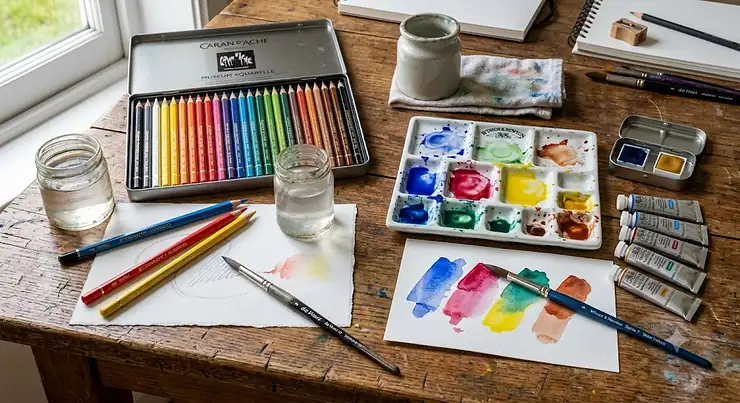
Stand in front of an art shop shelf for more than thirty seconds and you’ll feel it: the quiet tug-of-war between the tidy tin of pencils and the little metal box of pans. Watercolour pencils vs watercolour paints isn’t just a shopping question, it’s a question about how you actually want to spend your Sunday afternoon — controlled and linear, or loose and puddly. Both media end up looking remarkably similar on the paper once the brush comes out, which is exactly why so many beginners get stuck comparing spec sheets instead of thinking about how they draw.
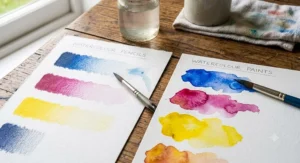
Here’s the short answer, since Google likes a straight one: watercolour pencils are wax or gum-based coloured pencils with water-soluble pigment cores that dissolve into a wash when brushed with water, while watercolour paints are pigment suspended in a gum arabic binder, applied wet from the start via pans or tubes. Pencils give you drawing-level control before the water ever touches the page; paints give you spontaneous, unpredictable blending the moment the brush lands. Neither is “better” in the abstract — it depends entirely on your hands, your patience, and where you like to sketch.
This guide walks through seven genuinely good products currently sold on amazon.co.uk — a mix of pencils and pan/tube paints, spanning budget starter kits to the kind of Swiss-made pencil set a serious illustrator might covet. Every product below gets honest, spec-grounded commentary rather than a rehashed listing, plus the aggregated sentiment real buyers report. As one of the world’s oldest surviving art forms, watercolour has a genuinely long British pedigree — the medium’s roots and terminology are neatly summarised in the Tate’s watercolour glossary entry, if you fancy the art-history context before you buy.
Quick Comparison Table
| Product | Type | Price Range | Best For |
|---|---|---|---|
| Derwent Watercolour Pencils (24) | Pencil | around £15-£20 | Subtle blending & mixed media |
| Derwent Inktense Pencils (24) | Pencil (ink-based) | around £20-£28 | Vivid, permanent colour on fabric/paper |
| Faber-Castell Albrecht Dürer (36) | Pencil | mid-£30s to £45 | Buttery lay-down, portrait/botanical work |
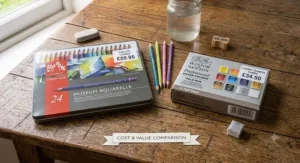
| Caran d’Ache Museum Aquarelle (12/40) | Pencil | £25 (12) to £100+ (40/76) | Archival lightfastness, professional use |
| Sakura Koi Field Sketch Box (12) | Paint (pan) | under £20 | Cheapest true travel kit |
| Winsor & Newton Cotman Sketchers’ Set (12) | Paint (pan) | around £20-£30 | Beginner-friendly pan paint |
| Winsor & Newton Professional Tube Travel Tin (12) | Paint (tube) | £45-£60 range | Studio-grade pigment on the go |
Looking at the spread, the pattern is obvious: pencils cluster in the mid-price band because the “convenience tax” of a solid barrel and lead is baked into every unit, whereas paint sets can be either dirt-cheap (a plastic pan box) or a serious investment (professional tube pigment), with very little in between. If you’re deciding between watercolour pencils or watercolour paints purely on cost of entry, a Cotman pocket set or the Sakura Koi Field Sketch Box wins outright; if archival quality matters more than starting price, the Caran d’Ache Museum Aquarelle and Winsor & Newton Professional tubes justify their premium through pigment load alone.
💬 Found a favourite already? Save this comparison and come back before you check out! 😊
Top 7 Watercolour Pencils and Paints: Expert Analysis
1. Derwent Watercolour Pencils — best all-rounder for gentle washes
The standout here is restraint: these pencils produce soft, almost pastel-like washes rather than the punchy saturation you’d get from ink-based alternatives. Each tin holds 24 hexagonal-barrelled pencils with a 3.4mm water-soluble core, made in Derwent’s Cumbria factory, and the pigment lifts cleanly even after it’s dried on the page. Based on the spec comparison with punchier ranges, what most buyers overlook is that this softness is a feature, not a limitation — it makes the Derwent Watercolour Pencils genuinely forgiving for beginners who are still learning how much water is “too much” on a wash. Reviewers consistently report smooth, break-resistant cores and easy sharpening, with the most common gripe being that the muted palette feels a touch subdued next to Derwent’s own Inktense line. The core skill this set teaches — pencil first, water second — later applies almost unchanged to every other pencil on this list.
Pros:
- ✅ Soft, easily blended cores suit gentle watercolour washes
- ✅ Colour can be re-wetted and moved even once dry
- ✅ Made in the UK with a strong quality-control reputation
Cons:
- ❌ Less vibrant than ink-based watercolour pencils
- ❌ 24-colour range needs supplementing for wider mixing
At around £15-£20 for the 24-tin, this sits firmly as the value benchmark other pencil brands get measured against.
2. Derwent Inktense Pencils — best for permanent, ink-like vibrancy
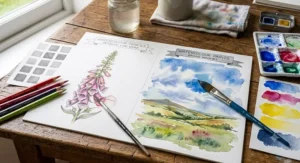
Where the standard Derwent range whispers, Inktense shouts. The core difference is chemical: Inktense uses a water-soluble ink pigment rather than a wax-based one, so once it dries on the paper it becomes genuinely permanent and won’t lift with a second wash. What the spec sheet won’t tell you, but reviewers note, is that this makes Inktense brilliant for layering — you can build up a wash, let it dry, then add crisp linework straight on top without muddying the first layer. That single property is why so many mixed-media artists reach for Derwent Inktense Pencils over ordinary watercolour pencils when a project involves fabric painting or collage, since the colour survives handling and even a gentle wash cycle on cotton. Aggregated review sentiment is strongly positive on colour saturation, with a recurring caution that the permanence means mistakes are much harder to correct than with traditional watercolour pencils.
Pros:
- ✅ Genuinely permanent, ink-like colour once dry
- ✅ Excellent for layering without disturbing earlier washes
- ✅ Works beautifully on fabric as well as paper
Cons:
- ❌ Permanence makes corrections and lifting difficult
- ❌ Pricier per pencil than standard watercolour pencils
Expect to pay somewhere in the £20-£28 range for a 24-tin, making it a reasonable step up rather than a luxury purchase.
3. Faber-Castell Albrecht Dürer — best lay-down and blending feel
Faber-Castell’s flagship watercolour pencil earns its reputation through the lead itself: a thick 3.8mm core bonded the full length of the barrel (their “SV” secural process), which in practice means far fewer snapped tips than cheaper pencils with a loosely glued core. Based on the spec comparison, the high pigment density is what separates this from entry-level ranges — colour transforms into a near-paint-like wash with only a couple of brush strokes, rather than the several passes some budget pencils need. Here’s what to weigh: the 36-pencil tin gives a genuinely usable working palette straight out of the box, which matters more than it sounds, because thin ranges force awkward colour mixing early on. Reviewers repeatedly single out the smoothness of application and the strength of the barrel against breakage, with the main criticism being that the metal tin, while attractive, offers no in-built palette or brush storage for travel.
Pros:
- ✅ Thick, break-resistant 3.8mm water-soluble core
- ✅ High pigment density dissolves into paint-like washes fast
- ✅ 36-colour range covers most mixing needs unaided
Cons:
- ❌ Tin has no built-in mixing palette or brush slot
- ❌ Sits at a noticeably higher price than Derwent’s own range
Sitting in the mid-£30s to £45 bracket, this is the pencil most professional illustrators recommend as a first “serious” upgrade.
4. Caran d’Ache Museum Aquarelle — best for archival lightfastness
This is the pencil that other reviewers use as the ceiling. Caran d’Ache rates every shade against the lightfastness standard summarised on the Blue Wool Scale, and the Museum Aquarelle range is built specifically around pigments that hold their rating even under prolonged light exposure — a genuine concern for anyone planning to sell or frame finished pieces. On paper this means the colour you lay down today should look near-identical in a decade, which ordinary student-grade pencils simply can’t promise. What most buyers overlook is how differently these behave from a standard pencil in dry use alone: the lead is soft enough to feel closer to a graphite drawing pencil than a coloured one, and independent reviewers note the wet wash it produces is “startlingly intense” compared with cheaper alternatives, meaning a little pigment goes further than expected. The trade-off, and it’s a real one, is price — this is a considered purchase rather than an impulse buy, and the smaller 12-colour introductory set exists specifically so newcomers aren’t forced into the full 40 or 76-colour range on day one.
Pros:
- ✅ Exceptional lightfastness rated on an industry-standard scale
- ✅ High pigment concentration produces intense, controllable washes
- ✅ Sold as individual pencils, so the range is fully rebuildable
Cons:
- ❌ Among the most expensive watercolour pencils on the market
- ❌ Intensity takes practice to apply without over-saturating
Prices climb from around £25 for the 12-set introduction pack well past £100 for the full 40-colour box, so this genuinely spans budget tiers depending on set size chosen.
5. Sakura Koi Field Sketch Box — best budget travel paint kit
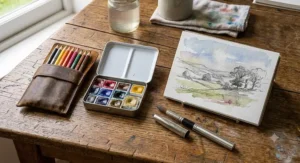
Flip the comparison to paints, and the Sakura Koi Field Sketch Box is the cheapest way into genuine pan watercolour with everything included in one snap-shut case. Twelve half-pan colours sit alongside a refillable 4ml water brush and a small sponge, with the inside of the lid doubling as a mixing palette — practically everything needed for a park bench sketch, for under the price of a single premium pencil tin. Reviewers consistently describe the kit as “propelling” first-timers into the hobby specifically because there’s nothing extra to buy before the first sketch, and the water brush removes the single biggest friction point for beginners: carrying a water pot. Based on the spec comparison with the Cotman set below, Koi’s pigment is noticeably chalkier once dry, and several reviewers note the colours read as slightly less true-to-swatch than the box lid suggests — a fair trade at this price point, but worth knowing before you buy.
Pros:
- ✅ Includes a refillable water brush and sponge in the price
- ✅ Genuinely pocket-sized, ideal for urban sketching on the move
- ✅ Among the lowest-cost complete watercolour kits available
Cons:
- ❌ Pigment can dry slightly chalky compared with premium brands
- ❌ Colours skew a touch less vibrant than the case artwork suggests
Typically priced under £20, this is the set most urban sketching beginners are pointed toward first.
6. Winsor & Newton Cotman Sketchers’ Pocket Set — best beginner pan paint
Cotman occupies the sensible middle ground in Winsor & Newton’s range: the same pigment families as their Professional line, but with some of the costlier single pigments substituted for more affordable near-equivalents. What that means in practice is a set that behaves predictably — reviewers repeatedly call it forgiving for beginners specifically because there’s less variation between how individual colours handle, unlike ranges that mix student and artist-grade pigments in one box. The pocket tin holds 12 half pans plus an integral mixing palette in the lid and a travel brush, and because Cotman hues are colour-matched to the Professional range, skills learned here transfer directly if you later upgrade. Aggregated review sentiment is strongly positive on the palette’s practicality for outdoor work, with the recurring caveat that the muted, “economical” pigments feel visibly less punchy than the Professional tubes reviewed below.
Pros:
- ✅ Predictable, beginner-friendly pigment behaviour across colours
- ✅ Built-in mixing palette and travel brush included
- ✅ Colour-matched to the Professional range for easy upgrading later
Cons:
- ❌ Reduced pigment load versus Winsor & Newton’s Professional range
- ❌ Some colours arrive noticeably more muted than expected
Set your budget around £20-£30, and this remains one of the most-recommended first “real” watercolour sets in the UK.
7. Winsor & Newton Professional Watercolour Tube Travel Tin — best studio-grade portability
This is where paints stop being a beginner’s toy and start behaving like an artist’s tool. The Professional range packs a genuinely wide selection of single-pigment colours rated for archival permanence, with the majority of the range classed AA or A on their own permanence scale — broadly comparable to the high end of the Blue Wool Scale referenced earlier. Because you’re squeezing fresh tube pigment rather than reactivating a dried pan, colour mixing is noticeably more responsive and saturated from the first stroke, which working illustrators cite as the reason they’ll carry the heavier tube tin over a lighter pan box despite the size trade-off. Based on the spec comparison with Cotman, the difference isn’t subtle: reviewers moving up from Cotman consistently describe the jump in tinting strength and transparency as the moment watercolour “clicked” for them. The tin’s integral mixing palette and thumb ring make it genuinely field-ready, not just a studio product repackaged for travel.
Pros:
- ✅ Wide range of archival-rated, single-pigment professional colours
- ✅ Noticeably stronger tinting strength than student-grade ranges
- ✅ Compact tin with integral palette designed for travel use
Cons:
- ❌ Sits at a premium price versus Cotman or pan-based kits
- ❌ Tube format needs more careful cap discipline to avoid drying out
Expect to pay in the £45-£60 range, positioning it as the natural “graduate” purchase once Cotman’s limits start to show.
Watercolour Pencils vs Watercolour Paints: Which Is Better?
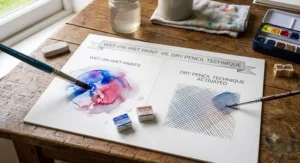
There isn’t a universal winner, and honestly, anyone who tells you otherwise is selling something. The fairer question is which is better for a specific way of working, and the answer splits cleanly along three lines: control, spontaneity, and mess tolerance.
| Factor | Watercolour Pencils | Watercolour Paints |
|---|---|---|
| Control before wetting | High — draw exact lines first | Low — colour moves the moment it’s wet |
| Learning curve | Gentler for precise, detailed work | Steeper for controlling water ratios |
| Mess & setup | Minimal, near-zero water needed until the wash | Requires water pot, palette, drying time |
| Best for | Botanical illustration, portraits, colouring-in-style work | Loose landscapes, skies, spontaneous colour mixing |
The table underlines something reviewers across every product above echo in different words: pencils reward planners, paints reward experimenters. If you sketch on a commute and can’t risk a water spill, the Derwent Watercolour Pencils or Faber-Castell Albrecht Dürer let you draw the whole scene dry and only introduce water once, safely, at your destination. If you love the happy accidents of colour bleeding into colour, nothing pencils offer really replicates what the Winsor & Newton Cotman or Winsor & Newton Professional sets do the second the brush touches the pan.
Many working artists sidestep the argument entirely by owning both — a set of pencils for the underdrawing and detail work, and a compact paint kit for broad washes, which is precisely why the mixed media section further down exists.
Best Watercolour Pencils and Paints for Travel
Travel changes the calculus completely, because weight, spill risk, and set-up time suddenly matter more than colour range. For genuinely portable watercolour pencils, the Derwent Watercolour Pencils and Faber-Castell Albrecht Dürer both travel well dry, needing only a small waterbrush and a pocket sketchbook, with zero risk of leakage in a bag. For paints, the calculation favours anything with an integral palette and a brush built in: the Sakura Koi Field Sketch Box is the lightest true kit here, while the Winsor & Newton Cotman Sketchers’ Pocket Set adds a slightly larger colour range for a modest weight increase.
A genuinely useful trick most packing lists skip: pencils only need topping up with a single reusable waterbrush, while pan paints benefit from a small dabbing sponge to control how wet the brush gets before it hits the pan — without one, colours turn muddier far faster in transit. If your travel plans involve flights, note that half-used tubes of paint are liquids in the eyes of most airline security staff, whereas dry pencils and pans sail through without a second look, which quietly tips many frequent flyers toward pencils or pan sets over tube paint for holiday sketching.
Portable Watercolour Tools: What Actually Matters
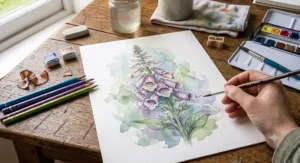
Marketing copy on portable watercolour tools loves to talk up colour count and tin design, but three quieter specs matter more once you’re actually out sketching. First, brush storage: a set with nowhere to clip a brush means you’re one dropped brush away from a ruined afternoon, which is why the built-in slots on the Winsor & Newton Cotman Sketchers’ Pocket Set and the Winsor & Newton Professional Travel Tin earn their keep. Second, palette real estate — the mixing area folded into a tin lid needs to be large enough to actually blend two colours together, not just wet them individually, and cramped budget tins fall down here fastest. Third, and most overlooked, is dry-time tolerance: pan paints can sit unused for months and reactivate instantly with water, while tube paint left open in a bag can dry out and become unusable, a detail the Professional tube set’s owners specifically flag as worth managing.
What doesn’t matter nearly as much as Amazon listings imply is colour count. A tight 12-colour palette from any of the sets above, properly mixed, covers the vast majority of outdoor scenes — the extra 20+ shades in bigger boxes add convenience, not capability.
Mastering the Watercolour Pencil Wash Technique
The single skill that separates a muddy pencil sketch from a genuinely painterly one is water control, and it’s simpler than most tutorials make it sound. Start by laying pencil colour dry, using lighter pressure than feels natural — the water will intensify whatever’s already there, so overworking the dry layer first is the most common early mistake. Once the drawing is complete, load a soft, damp (not soaking) brush and pull it across the pencil marks in the direction of your linework rather than scrubbing in circles, which drags pigment and muddies edges.
For crisper detail, work from light colours to dark, wetting small sections at a time rather than the whole page at once, since large wet areas dry unevenly and can leave hard “watermark” edges known as blooms. If you’re using an ink-based range like Derwent Inktense, remember the permanence means you get exactly one clean pass — plan your darkest values last, because you can’t lift them back out afterwards the way you can with standard wax-based pencils like the Derwent Watercolour range or Faber-Castell’s Albrecht Dürer line. A final trick worth knowing: dipping the pencil tip itself directly into water before drawing produces a much bolder, ink-like line than wetting the paper afterwards, useful for deliberate dark accents rather than broad washes.
Essential Urban Sketching Supplies Beyond the Paint Box
A paint or pencil set is only half the kit that gets an urban sketch finished. Paper matters more than most beginners expect — standard printer paper buckles under even a light wash, so a small hot-press or cold-press watercolour sketchbook, even a cheap one, will outperform any paint or pencil choice on this list if the surface underneath is wrong. A single reusable waterbrush is genuinely non-negotiable for anyone sketching outdoors, since carrying a water pot around a city isn’t realistic; nearly every travel-focused product above assumes you’re pairing it with one.
The wider practice this feeds into has a long, organised history worth knowing about: the global Urban Sketchers movement, which began as an online community and grew into local chapters worldwide, is built specifically around drawing on location rather than from photographs — exactly the workflow these portable pencil and paint sets are designed to support. Beyond paper and brush, a small folding stool or a clip-board to steady the sketchbook solves the single biggest practical problem new urban sketchers report: nowhere comfortable to sit or rest a page mid-sketch.
Mixed Media: Combining Watercolour Pencils With Other Tools
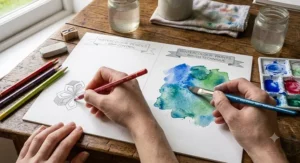
Watercolour pencils genuinely shine when they stop being asked to do everything alone. A common, low-risk starting combination is fineliner pen plus watercolour pencil wash — ink the linework first with a waterproof pen, let it dry fully, then add colour washes over the top without smudging the linework, since the ink stays put while the pencil pigment dissolves around it. Derwent Inktense pencils suit this pairing especially well because their permanence means a second colour layer, or even a light wash of clean water, won’t disturb work that’s already dried.
Collage and fabric work benefit from the same permanence property: Inktense pigment survives being sewn or handled once fully dry, making it a genuine option for textile-based mixed media rather than purely paper-based work. For anyone blending pencils with actual watercolour paint in the same piece, a sensible order of operations is pencil underdrawing and detail first, broad paint washes second, since paint applied first can make it harder to get a crisp, dry pencil line down on top of a still-textured wet surface.
How to Choose Between Watercolour Pencils and Watercolour Paints
- Decide how much control you want before water touches the page. If you need precise lines and shapes locked in first, pencils win outright; if you want colour to move and blend on its own, paints are built for that.
- Weigh your tolerance for mess and setup time. Pencils need almost no setup and dry quickly; paints need a water pot, a palette, and patience while washes dry.
- Think about where you’ll actually use them. Commuting or flying favours dry pencils or solid pans; a fixed sketching spot with room for a water jar suits either equally well.
- Match your budget to the right tier. Entry-level Cotman or Koi paint sets and the standard Derwent pencil range all sit comfortably under £30, while Caran d’Ache and Winsor & Newton Professional represent a genuine step up in cost and pigment quality.
- Consider permanence needs. Fabric, collage, and mixed-media projects benefit from ink-based Inktense pencils; traditional lifting and correcting favours standard wax-based pencils or reworkable pan paints.
- Buy the smaller set first. A 12-colour introductory range in either medium teaches genuine colour mixing far better than an overwhelming 40+ colour box on day one.
Common Mistakes When Buying Watercolour Pencils or Paints
The single most common mistake is buying on colour count alone — a 72-pencil set with a thin, low-pigment core will produce weaker washes than a well-made 24-pencil range, regardless of how impressive the tin looks on a shelf. A close second is ignoring lightfastness entirely, then being disappointed months later when a framed piece fades in a sunny room; checking a set’s lightfastness rating before buying, not after, avoids this completely. Beginners also frequently buy a paint set with no brush included, not realising a poor-quality brush will undercut even excellent pigment by making clean washes almost impossible to control. Finally, several reviewers across the products above flag disappointment when actual colours don’t match the box artwork — a known, if minor, issue worth expecting rather than being surprised by, particularly with budget pan sets.
What to Expect: Real-World Performance
On paper, watercolour pencils and paints look similar — pigment plus water, applied to paper. In practice, the everyday experience differs sharply. A pencil sketch can be started and paused indefinitely without any of the drying-time pressure paint creates; you can draw a scene over three separate coffee breaks with no ill effects. Paint, by contrast, rewards working while a wash is still wet, since re-wetting a dried pan section rarely blends as seamlessly as working the first pass. Expect pencils to feel closer to drawing with occasional colour “reveal” moments when water hits the page, while paint feels immediately more like painting from the first brushstroke, with less forgiving undo options once colour has mixed on the page.
Weather and light also behave differently: outdoor pencil sketches survive a light drizzle far better since the pigment is dry until you choose to wet it, while an open paint palette exposed to unexpected rain can be ruined in seconds. This is a small but real reason travel and urban sketching guides so often lean toward pencils or sealed pan boxes over open tube palettes for unpredictable British weather.
Long-Term Cost & Maintenance
Total cost of ownership tells a different story than the sticker price. A pencil set is essentially “used up” — once a colour is sharpened away, it’s gone, and replacing single pencils from ranges like Faber-Castell or Caran d’Ache (both sold in open stock) costs roughly the same per-unit as buying the full set again. Paint pans, on the other hand, can often be individually replaced far more cheaply once empty, and premium tube ranges like Winsor & Newton Professional last an extraordinarily long time per tube since only a pea-sized amount is needed per wash.
Maintenance differs too: pencils need nothing beyond a sharpener and occasional storage away from damp, while pan paints benefit from an occasional gentle clean of the palette to avoid muddy colour contamination between sessions, and tube paints need caps checked regularly to prevent drying out mid-tube. Measured over several years of regular use, a mid-range paint set like Cotman typically works out cheaper per sketching session than a comparable mid-range pencil set, purely because pigment lasts longer than a physical pencil core — though the gap narrows considerably if you’re buying premium, open-stock pencils rather than replacing an entire tin.
Safety, Lightfastness & Regulations Guide
Most watercolour pencils and paints sold in the UK marketed for general or children’s use fall under the same broad safety framework as other art materials, based on the toy safety standardsthat govern chemical migration and choking-hazard testing for products aimed at younger users, so it’s worth checking a product’s stated age guidance before buying for a child. Adult-marketed artist ranges like Caran d’Ache Museum Aquarelle and Winsor & Newton Professional aren’t generally sold or tested as children’s toys, so always check the packaging rather than assuming blanket compliance either way.
Lightfastness is a separate, non-safety consideration but one collectors should still weigh carefully: as covered earlier via the Blue Wool Scale, a lower-rated pigment isn’t dangerous, it simply fades faster under sustained light, which matters if a finished piece will hang somewhere sunny rather than live in a sketchbook drawer. Reputable manufacturers, including every brand featured in this guide, publish lightfastness ratings per colour on their own websites, and it’s genuinely worth a two-minute check before committing to a large, expensive set built around colours you plan to frame.
Real-World Scenario: Which Sketcher Are You?
The daily commuter. Twenty minutes on a train, no space for water pots, and a strong preference for not explaining a paint stain to fellow passengers. The Derwent Watercolour Pencils or Faber-Castell Albrecht Dürer, used dry for the whole journey and wetted briefly at the destination café, fit this life without friction.
The weekend urban sketcher. A free Saturday morning, a proper sketchbook, and enough time to set up a small palette on a park bench. The Sakura Koi Field Sketch Box or Winsor & Newton Cotman Sketchers’ Pocket Set hit the sweet spot of low weight and genuine colour range for a couple of hours outdoors.
The serious hobbyist building a portfolio. Framing work, entering local exhibitions, or simply wanting materials that won’t fade on a studio wall in five years’ time. This is where Caran d’Ache Museum Aquarelle and the Winsor & Newton Professional Watercolour Tube Travel Tin earn their higher price tags, through archival pigment quality that the casual sketcher genuinely doesn’t need to pay for.
✨ Ready to build your kit? Check current prices and grab the set that matches your sketching style! 🎨
🔍 Don’t Miss These Exclusive Deals! Whichever combination fits your style, click through to check current availability and pricing on each pick above. Building a considered watercolour kit — rather than grabbing the first set on the shelf — genuinely pays off in every sketch you’ll make with it.
Frequently Asked Questions
❓ Are watercolour pencils better than watercolour paints for beginners?
❓ Can you mix watercolour pencils with watercolour paint in the same painting?
❓ Do watercolour pencils work without water?
❓ What is the best portable watercolour set for travel?
❓ How long do watercolour pencils and paints actually last?
Conclusion
Choosing between watercolour pencils and watercolour paints ultimately comes down to how you like to work rather than which medium is technically “better” — and having now compared seven genuinely different products across both categories, the right pick should feel a lot clearer than it did at the top of this article. Budget-conscious beginners are well served by the Derwent Watercolour Pencils or the Sakura Koi Field Sketch Box, both of which teach the fundamentals without a big financial commitment. Anyone chasing permanence and mixed-media versatility should look hard at Derwent Inktense, while those ready to invest in archival-quality colour for framed or exhibited work will get real, measurable value from Caran d’Ache Museum Aquarelle or the Winsor & Newton Professional Watercolour Tube Travel Tin. Wherever you land, remember that a smaller, well-chosen set beaten in with regular practice will always outperform an overwhelming collection left half-used in a drawer.
🎨 Start Your Watercolour Journey Today!
Take the guesswork out of your next art supply purchase — click through on any pick above to check current UK pricing and availability before it changes.
Recommended for You
- Best Watercolour Pencils 2026: 7 Top Sets Tried & Rated
- Faber-Castell vs Prismacolor: Best Coloured Pencils 2026
- Coloured Pencils for Adult Colouring: 7 Best Picks for 2026
Disclaimer: This article contains affiliate links. As an Amazon Associate, I earn from qualifying purchases. If you purchase products through these links, we may earn a small commission at no additional cost to you.
✨ Found this helpful? Share it with your friends! 💬🤗
