In This Article
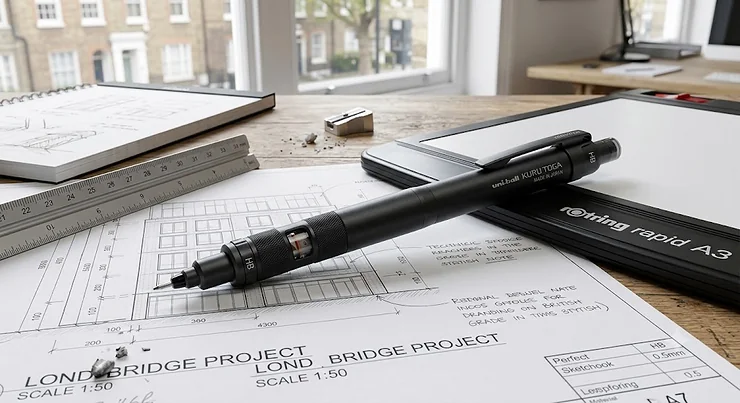
Somewhere between a soggy 2B stub and a £3 biro chewed to bits sits a genuinely useful tool most artists ignore for years: the mechanical pencil. A good mechanical pencil for drawing gives you a fixed, predictable line width from the first mark to the last, with no sharpening breaks, no wonky points, and no digging through a pencil case for “the good one” before it inevitably rolls under the sofa. It holds thin graphite leads inside a barrel, advances them with a click or twist, and — if you pick the right one — completely changes how confident your linework feels.
This guide covers mechanical pencil for drawing options across budget, mid-range and premium price bands, drawn from real specifications, aggregated reviewer sentiment, and honest side-by-side reasoning rather than marketing copy. Broadly speaking, a pencil is any writing or drawing tool built around a solid pigment core inside a protective casing, a definition that covers both traditional wooden pencils and their refillable mechanical cousins, as Wikipedia’s overview of pencils explains in more depth. Whether you’re a technical illustrator working from a straight edge or a sketchbook obsessive who just wants consistent underdrawing lines, there’s a specific tool below built for that job, not a vague “best overall” that quietly underserves everyone.
We’ll compare seven genuine products (no invented models), walk through lead sizes and hardness grades properly, and hand you a decision framework so you’re not left guessing between a 0.5mm and a 0.7mm at the till. Prices shift constantly on amazon.co.uk, so we’ve used ranges throughout rather than exact figures — always check the current price before buying.
Quick Comparison Table
| Pencil | Lead Sizes | Tip Style | Best For | Price Range |
|---|---|---|---|---|
| Pentel GraphGear 1000 | 0.3/0.5/0.7/0.9mm | Retractable sleeve | All-round drafting and sketching | £12–£18 |
| rOtring 600 | 0.35/0.5/0.7mm | Fixed sleeve | Reference-grade precision lines | £25–£35 |
| rOtring 800 | 0.5/0.7mm | Retractable sleeve | Pocket-carry precision work | £40–£55 |
| Staedtler Mars 925 | 0.3/0.5/0.7/0.9mm | Fixed sleeve | Comfortable long sketching sessions | £8–£14 |
| Faber-Castell TK-Fine Vario | 0.35/0.5/0.7/1.0mm | Fixed sleeve, cushioned tip | Switching between writing and drafting | £8–£13 |
| Uni Kuru Toga | 0.3/0.5/0.7mm | Sliding/fixed sleeve | Consistent underdrawing lines | £6–£12 |
| Pentel P205 (Sharp) | 0.3/0.5/0.7/0.9mm | Fixed sleeve | Budget drafting workhorse | £4–£8 |
Looking at the spread above, the cheapest entry (the Pentel P205) and the most expensive (the rOtring 800) actually share the same core job — holding a thin graphite line steady — but differ hugely in materials, weight and mechanism refinement. If you’re testing the waters with mechanical pencils for the first time, the Staedtler Mars 925 or Uni Kuru Toga sit in a genuinely comfortable middle ground where you’re not compromising on build quality just to save money. Buyers who already know they want a retractable tip for a pencil case or rucksack should skip straight to the GraphGear 1000 or rOtring 800 rather than starting with a fixed-sleeve model and switching later.
💬 Found a favourite already? Tap through and compare current prices before they change!😊
Top 7 Mechanical Pencils for Drawing: Expert Analysis
This mechanical drawing pencil review draws on real specifications and aggregated reviewer sentiment gathered from long-term users, art bloggers and stationery specialists, not a single afternoon with each pencil. Where opinions in the community diverge, we’ve said so.
1. Pentel GraphGear 1000 — best all-metal retractable for switching between drafting and sketching
The GraphGear 1000’s dual-action retractor is the headline feature here, and it earns its reputation: a twist of the tip both advances and protects the lead in one motion. The barrel combines a brushed steel finish with a diamond-cut knurled grip section, and Pentel dots it with small rubber inserts for extra hold. In practice, that hybrid grip is what separates it from purely knurled drafting pencils — the rubber pads take the edge off long shading sessions where an all-metal knurl starts to bite into your fingers.
What most buyers overlook about this model is the rotating dial along the barrel that displays which lead grade is currently loaded, so you can confirm your hardness at a glance instead of guessing. That matters more than it sounds: switching between an H for underdrawing and a 2B for shading is common in observational drawing, and a mislabelled lead undermines the whole point of grading in the first place. Reviewers consistently describe it as a genuine hybrid between a technical drafting pencil and a general sketching tool, which is exactly why art schools and architecture students both gravitate toward it.
Aggregated review sentiment is unusually consistent for a mid-priced pencil: it’s routinely cited as one of the highest-rated mechanical pencils on the market, with owners praising the grip, the retracting mechanism and the colour-coded barrel sizes across thousands of independent reviews. The recurring criticism is just as consistent — while the outer body is metal, the internal lead sleeve is plastic, and a handful of long-term users report it eventually cracking under heavy use, alongside a small, fiddly eraser that most artists replace with a separate putty rubber anyway.
Pros:
✅ Dual-action retractor protects the tip in bags and pockets
✅ Colour-coded barrels make switching lead sizes fast
✅ Hybrid grip balances knurled control with rubber comfort
Cons:
❌ Inner lead sleeve is plastic despite the metal body
❌ Included eraser is small and awkward to use
At around £12–£18, the GraphGear 1000 sits comfortably in the mid-premium bracket and earns its price through genuine daily-use durability rather than showroom looks alone.
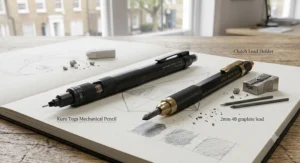
2. rOtring 600 — best fixed-sleeve pencil for reference-grade line precision
The 600 is the pencil other drafting pencils get measured against, and the reasoning holds up under scrutiny. Its hexagonal brass barrel pairs with a knurled metal grip designed specifically to stop the pencil slipping during long stints of use, and the fixed tip means there’s zero wobble to compensate for — every mark lands exactly where the barrel is pointing. That rigidity is precisely why architecture students have used it for decades: when you’re running a line along a straight edge, any play in the tip translates directly into an inconsistent edge on paper.
Based on the spec comparison with retractable alternatives, the trade-off is obvious and worth stating plainly: the exposed sleeve is more precise but less pocket-friendly, since it can bend or catch on things if the pencil is dropped tip-first or jammed carelessly into a bag. What the spec sheet won’t tell you, but long-term owners note, is that this pencil rewards being treated as a dedicated drafting tool rather than an everyday-carry item tossed in with keys and a phone.
Reviewers who’ve used both the 600 and its pricier siblings are candid about the value proposition: the core writing and drawing feel barely changes as you move up the range, which is precisely why the 600 remains the default recommendation for anyone building their first serious drafting kit. A built-in lead grade window running along the barrel lets you track hardness at a glance, a feature the pricier 800 notably drops.
Pros:
✅ Full brass body gives outstanding weight and balance
✅ Fixed sleeve delivers zero tip wobble for ruler work
✅ Lead grade indicator built into the barrel
Cons:
❌ Fixed tip isn’t pocket-safe without a cap
❌ Knurled grip can feel abrasive on multi-hour sessions
Typically priced in the £25–£35 range, the 600 rewards buyers who want the closest thing to a reference-standard drafting pencil without paying for a retractable mechanism they may never need.
3. rOtring 800 — best premium retractable for portable precision work
Think of the 800 as the 600’s answer to “what if I actually need to carry this around?” The core writing experience is nearly identical, but the retractable tip is activated by twisting the knurled section near the base, and independent reviewers consistently describe the mechanism as solid and reassuringly precise in daily use. That retractability is the entire reason to pay the premium: drop a 600 tip-first and you risk bending the sleeve permanently, whereas the 800 tucks its tip away between uses.
Here’s what to weigh before committing to the extra cost: the 800 gives up the 600’s lead grade indicator entirely, a design choice several long-term reviewers find genuinely puzzling given the price gap. If you rotate between lead hardnesses often, that’s a real workflow cost, not a minor gripe. On the plus side, most owners describe the 800’s grip as softer and grippier than the more aggressive knurl on the 600, despite both being cut from metal, which several find makes it the more comfortable option across a full working day.
The recurring theme across independent write-ups is that the 800 is a handsome, heavy, and genuinely expensive drafting pencil best suited to people who specifically need the retractable tip and have already ruled out the cheaper 600 — not a pencil to buy as your very first mechanical pencil.
Pros:
✅ Retractable tip survives bag and pocket carry
✅ Softer knurled grip than the 600 across long sessions
✅ Heavier, more balanced feel favoured for precision control
Cons:
❌ No lead grade indicator, unlike the cheaper 600
❌ Roughly £15–£20 more expensive for a similar core experience
Expect to pay in the £40–£55 range — a genuine investment, and one best made after you’ve confirmed via a cheaper pencil that the drafting-pencil format actually suits your process.
4. Staedtler Mars 925 — best rubber-grip workhorse for long sketching sessions
Where the rOtring pair leans hard into metal-on-metal precision, the Mars 925 takes a lighter, friendlier approach that a lot of sketchers genuinely prefer. Its rubberised grip zone and lighter overall build make it noticeably easier to draw quickly with compared to heavier full-metal drafting pencils, and that’s precisely the appeal for artists doing gesture drawing or extended figure studies where hand fatigue compounds over hours.
Based on the spec comparison, the 925 still hits the core technical-pencil checklist — a rigid metal lead sleeve well suited to rulers and templates, plus an adjustable lead-hardness dial and colour-coded barrels across the size range — while shaving weight and cost compared with the rOtring line. Reviewers consistently note this is the pencil that converts sketchbook users who assumed all drafting pencils were “too heavy and clinical” for expressive linework.
The honest downside, reported across multiple independent reviews, is build longevity at the margins: the plastic eraser cap tends to loosen and detach with repeated handling, particularly when the pencil rattles around loose in a bag. It’s a minor annoyance rather than a functional failure, and most owners simply keep the cap in a separate pouch pocket once it starts working loose.
Pros:
✅ Rubber grip reduces fatigue on multi-hour sketching sessions
✅ Genuinely lightweight compared with metal-bodied rivals
✅ Adjustable lead-hardness dial and 4mm metal sleeve
Cons:
❌ Eraser cap can work loose and detach over time
❌ Rubber grip degrades faster than knurled metal long-term
At £8–£14, the 925 is one of the strongest mid-range mechanical pencil for drawing options available, especially for artists who prioritise comfort over showroom looks.
5. Faber-Castell TK-Fine Vario — best for switching between soft writing feel and rigid drafting control
The Vario’s defining trick is a twist-activated spring in the tip that toggles between a cushioned “soft” setting for writing and a rigid “hard” setting for drafting — and it’s a genuinely useful piece of engineering rather than a gimmick, once you understand when to use each. Owners who switch settings regularly describe using the soft position for prolonged writing and organic, freehand sketching, and the hard position for drafting or drawing more geometric, man-made subjects — meaning a single pencil can flex between a life-drawing session and a technical elevation without swapping tools.
On paper, this means less kit to carry if your practice moves between loose sketching and precise linework in the same session. The fixed metal lead sleeve still gives full stencil and ruler compatibility, and the pressure-absorbing spring mechanism helps prevent lead snapping under a heavy hand even with the cushioning deactivated. Faber-Castell’s dark green hexagonal barrel is also a deliberate nod to the brand’s Castell 9000 wood-cased pencils, giving it a classic look that several reviewers single out as more elegant than the aggressively industrial rOtring aesthetic.
Where opinions split is the grip. Some reviewers find the smooth flared metal section comfortable, while others feel it would benefit from proper knurling, since the current finish forces a slightly higher grip position than they’re used to and can feel a touch loose after months of daily use.
Pros:
✅ Toggle between soft writing feel and rigid drafting control
✅ Pressure-absorbing spring reduces lead breakage
✅ Elegant dark green barrel with genuine heritage design
Cons:
❌ Grip section lacks knurling, which some find too smooth
❌ Lead-type indicator can loosen and rattle over time
Priced around £8–£13, the Vario earns its place for anyone whose practice genuinely spans both loose sketching and precise technical work rather than sitting firmly in one camp.
6. Uni Kuru Toga — best self-sharpening mechanism for consistent underdrawing lines
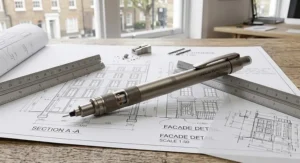
The Kuru Toga solves a problem most artists have simply learned to live with: as you write or draw, lead wears unevenly on one side, creating a flat, chisel-shaped tip that produces inconsistent line widths unless you rotate the barrel constantly by hand. Uni’s engine does that rotation for you automatically — a spring-loaded clutch nudges the lead round a small amount every time you lift the pencil off the page, wearing it down evenly so the point stays consistently sharp without any conscious effort from you.
Here’s the honest trade-off worth understanding before buying one specifically for drawing: artists who rely on a chiselled point to vary line weight and shade with the side of the lead will find the Kuru Toga actively working against that technique, since it constantly rotates the lead back to a fine point. That makes it an outstanding tool for tight underdrawing, technical linework and consistent contour lines, but a poor fit for anyone whose process depends on broad, flat shading strokes straight from the lead’s edge.
Reviewers consistently describe the rotation as unobtrusive in daily use — most people report never noticing the mechanism during normal drawing pressure, and Uni’s own proprietary lead is widely regarded as excellent, though any standard lead of the correct diameter works fine too. Build quality varies by model, with the metal-bodied variants adding genuine heft over the original plastic Kuru Toga for a modest premium.
Pros:
✅ Automatic rotation keeps the tip consistently sharp
✅ Excellent for controlled underdrawing and contour lines
✅ Wide range of grip and body styles at accessible prices
Cons:
❌ Fights against flat-lead shading techniques
❌ Standard plastic models feel less premium than metal rivals
Expect £6–£12 for most standard models, making this one of the best-value mechanical pencil for artists options if your drawing style leans toward precise, linear work rather than broad tonal blocking.
7. Pentel P205 (Sharp) — best budget drafting workhorse for students and everyday use
If you want proof that a genuinely capable drafting pencil doesn’t need a premium price tag, the P205 is the reference case. It’s been in continuous production for decades and remains, by reputation, the pencil that entire cohorts of engineering and architecture students were raised on, becoming the tool many now judge every other pencil against without quite realising it. That kind of longevity in a competitive category tells you something the spec sheet alone can’t.
Functionally, it hits every core requirement: a 4mm fixed sleeve paired with a brass clutch mechanism delivers precise, breakage-resistant lines well suited to technical drawings and detailed sketches, in a body light enough to carry all day without fatigue. Reviewers consistently praise the internal build quality relative to price — the mechanism runs on brass internals, the threaded sections are metal-to-metal rather than plastic-to-metal, and the tip and clip are both metal with a finish that holds up over years of everyday use.
The honest limitation is the plastic barrel, which some long-term owners find slightly cheap-feeling next to metal-bodied rivals, and the notoriously sharp exposed tip — several reviewers note it’s genuinely capable of drawing blood if handled carelessly, which is more a badge of its precision than a real safety concern in normal use.
Pros:
✅ Exceptional durability for a genuinely budget price
✅ 4mm fixed sleeve gives real ruler and stencil precision
✅ Brass internals outlast many pricier plastic-mechanism rivals
Cons:
❌ Plastic barrel feels less premium than metal-bodied rivals
❌ Sharp exposed tip needs careful pocket handling
At roughly £4–£8, the P205 is the pencil to hand a student, or to buy three of and stop worrying about losing one down the back of a desk.
What Is a Mechanical Pencil for Drawing?
A mechanical pencil for drawing is a refillable drawing tool that holds thin graphite leads in a metal or plastic barrel, advancing them via a click, twist, or automatic mechanism so the line width never changes and sharpening is never required. Unlike wooden pencils, the tip stays a constant diameter throughout the lead’s life, which is exactly why technical illustrators and detail-focused sketchers prefer them for consistent, repeatable linework.
How to Choose a Mechanical Pencil for Drawing
- Decide your primary use first. Technical drafting favours a fixed sleeve for rigidity; loose sketching favours lighter bodies and rubber grips that don’t fatigue the hand.
- Pick a lead size that matches your detail level. Finer 0.3mm and 0.35mm leads suit tight technical work; 0.5mm is the most versatile all-rounder; 0.7mm and 0.9mm suit bolder sketching and shading.
- Match the tip mechanism to how you carry it. A fixed sleeve is more rigid but risks bending in bags; a retractable tip costs more but survives pocket and rucksack carry.
- Weigh the barrel material against session length. Full-metal bodies feel premium but add weight that can fatigue the hand over multi-hour sessions; plastic and hybrid grips trade some heft for comfort.
- Consider whether a lead-hardness indicator matters to you. If you switch between H grades for underdrawing and B grades for shading often, a visible indicator saves real time.
- Set a genuine budget band. Anything from roughly £5 to £55 will get you a capable drafting pencil — the difference is refinement and longevity, not baseline function.
- Buy one before buying a set. Grip feel is deeply personal; trial a single pencil in your preferred lead size before committing to a multi-pencil collection.
0.5mm vs 0.7mm Lead for Sketching: Which Should You Choose?
This is the single most common fork in the road for anyone choosing a mechanical pencil for drawing, and the honest answer is that it depends on what you’re actually drawing, not which size is objectively “better.”
| Factor | 0.5mm Lead | 0.7mm Lead |
|---|---|---|
| Line character | Fine, precise, technical | Bolder, more expressive |
| Breakage risk | Higher under heavy pressure | Lower, more forgiving |
| Best for | Detail work, technical drawing, linework | Gesture drawing, broad sketching, shading |
| Typical users | Draughtspeople, illustrators | Life drawing, quick studies |
The 0.5mm lead is the closest thing to an industry default, and for good reason: it balances fine detail against reasonable durability, which is why most of the pencils in our lineup ship with it as standard. Reviewers testing broader tips consistently note that 0.7mm leads sacrifice some precision but gain real forgiveness under heavier pressure, making them the better pick for artists who press hard or work quickly across large sketchbook pages. If you’re torn, buying a pencil that accepts both — like the GraphGear 1000 or Staedtler Mars 925 in their respective lead-size variants — lets you test both without committing twice.
✨ Not sure which lead size fits your style? Check today’s prices on a few and compare in your own sketchbook.
Lead Hardness for Mechanical Pencils: The Complete Grade Guide
Lead hardness for mechanical pencils follows the same H-to-B scale used on wooden drawing pencils, running from very hard, light-marking grades through to very soft, dark ones. As Wikipedia’s entry on pencils outlines, most manufacturers — and almost all in Europe — grade pencils using H for hardness and B for blackness, with F sitting between them to mark a grade that sharpens to a particularly fine point, though there is no single agreed industry standard for exactly how dark or light each grade should read between brands.
In practice, this is what the grades mean for a mechanical pencil loaded for drawing rather than writing:
- 2H–4H: Very light, precise lines ideal for technical drawing, guidelines, and underdrawing that needs to stay invisible beneath ink or paint.
- H–F: A firmer general-purpose line, good for confident contour work that shouldn’t smudge under the hand.
- HB: The all-purpose middle grade — dark enough to read clearly, hard enough to resist heavy smudging.
- B–2B: The most common sketching grade, dark and expressive without excessive softness.
- 4B–6B: Soft, dark leads suited to shading and tonal blocking, though they wear down and smudge faster.
What most buyers overlook is that hardness varies by country of manufacture as much as by labelled grade — Japanese leads from brands like Uni tend to run softer and darker at a given grade than German leads from Staedtler or Faber-Castell, so an HB from one brand can behave closer to a B from another. If your pencil has a lead-grade indicator, as the GraphGear 1000, rOtring 600 and Staedtler 925 all do, use it — it removes the guesswork entirely when switching grades mid-drawing.
Retractable Tip Drafting Pencils: Pros, Cons and When You Need One
A retractable tip drafting pencil pulls its lead sleeve back into the barrel when not in use, protecting both the tip and your bag lining from damage. It’s a genuinely practical feature, but it isn’t free — retractable mechanisms typically add £10–£20 to a pencil’s price over an equivalent fixed-sleeve model and, in some cases, sacrifice a lead-grade indicator to make room for the retracting hardware.
Here’s what to weigh before choosing one: fixed-sleeve pencils like the rOtring 600 or Pentel P205 give slightly more rigid, wobble-free contact with the paper, which matters when running a line against a ruler or French curve. Retractable models like the GraphGear 1000 and rOtring 800 trade a fractional amount of that rigidity for genuine peace of mind in a rucksack, pencil case or coat pocket, where an exposed sleeve risks bending on first contact with something hard.
If you sketch primarily at a desk or drawing board, a fixed sleeve is simpler, slightly cheaper, and loses nothing in practice. If you carry your kit daily — on a commute, between classes, or in a bag with other tools — the retractable tip earns its premium the first time it saves a sleeve from bending.
Mechanical Pencils for Technical Drawing: Precision Features That Matter
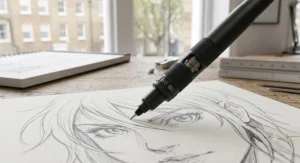
Technical drawing places different demands on a pencil than expressive sketching does, and it’s worth separating the two explicitly. A mechanical pencil for technical drawing needs a longer lead sleeve — typically 4mm or more — so you can see exactly where the line will land against a straight edge, ruler, or stencil without the barrel itself obstructing your view. Every pencil in our lineup with a genuine drafting pedigree, from the rOtring 600 to the Pentel P205, ships with this longer sleeve as standard.
Rigidity matters more here than in sketching, which is why several dedicated drafting pencils favour a fixed sleeve over a retractable one — any play in the tip translates directly into an inconsistent edge when running against a template. A visible lead-grade indicator also earns its keep in technical work specifically, since draughtspeople frequently switch between a hard 2H for guidelines and a firmer HB or H for the final inked-over linework, and mislabelling a lead wastes real time on a drawing that needs to be precise.
Further education providers running observational and technical drawing courses in the UK typically build a proper drawing toolkit around a genuine spread of grades — commonly from around 2H through to 6B, alongside charcoal and other media — specifically so students can explore what each material actually does before settling on preferences, as outlined in West Dean College’s short course guidance on drawing fundamentals. The same logic applies to lead grades within a single mechanical pencil, not just to a full pencil set.
Mechanical Pencils for Artists: What Changes When You’re Sketching, Not Drafting
Artists working from life or imagination have different priorities to draughtspeople, and it shows in which features actually matter. Weight becomes more important than rigidity, since a heavy full-metal barrel that feels precise for ten minutes of technical linework can genuinely fatigue the hand across a two-hour figure-drawing session. This is exactly why the rubber-gripped Staedtler Mars 925 consistently outperforms heavier metal rivals in long-session comfort, even though it’s the less “premium-feeling” pencil of the two on a shelf.
Lead hardness range matters more for artists too. Where a draughtsperson might live almost entirely in the H-to-HB band, an artist doing tonal shading needs comfortable access to softer B grades, and a visible hardness indicator becomes genuinely useful rather than a nice-to-have. Self-sharpening mechanisms like the Kuru Toga’s rotating engine suit artists doing tight, linear underdrawing beautifully, but as covered above, actively work against anyone who shades with the flat edge of a worn-down lead — know your own technique before choosing based on this feature alone.
Finally, grip texture is a genuinely personal decision that spec sheets can’t settle for you. Knurled metal grips like the rOtring pair offer precise control but can feel abrasive across long sessions; rubber and hybrid grips like the GraphGear 1000 or Mars 925 sacrifice a little of that precision for comfort most artists find worth the trade. Beginner and returning-artist courses run through organisations such as City Lit in London generally introduce a range of drawing materials early on for exactly this reason — the “right” tool only reveals itself through hands-on comparison, not a spec sheet.
Practical Usage Guide: Setting Up and Maintaining Your Mechanical Pencil
Getting a new mechanical pencil for drawing performing at its best takes a few minutes of setup that most buyers skip. First, load lead in small batches — two or three sticks at a time rather than filling the barrel completely, since a full tube can jam or fail to advance smoothly in some mechanisms. Click or twist gently until roughly 2–3mm of lead protrudes past the sleeve; extending too much lead at once is the single most common cause of snapped tips in the first week of ownership.
During the first 30 days, resist the urge to press hard while you’re still learning the pencil’s feel — new mechanisms often need a short bedding-in period before the clutch grips consistently, and heavy pressure on an unfamiliar pencil is exactly when accidental snapping happens most. If your pencil has a lead-hardness dial, set it correctly from day one rather than leaving it on the factory default; mismatched indicators are a common, entirely avoidable source of confusion months later.
For ongoing maintenance, periodically remove the eraser cap and blow out graphite dust that accumulates around the clutch mechanism, particularly on pencils that see daily bag or pocket carry. If lead jams in the sleeve, most drafting pencils include a small cleanout rod hidden beneath the eraser specifically for pushing stuck fragments through — check under the cap before assuming the pencil is faulty. Finally, retractable-tip models should be closed whenever not in use; leaving the sleeve extended in a bag is the most common cause of bent tips on otherwise well-maintained pencils.
Real-World Scenarios: Which Pencil Fits Your Drawing Life?
The architecture student on a tight budget, sketching floor plans between lectures and carrying a pencil case that gets thrown around daily: the Pentel P205 or Staedtler Mars 925 covers genuine drafting precision without risking an expensive pencil to campus wear and tear. Both survive rough handling, and neither represents a painful loss if misplaced.
The hobbyist sketchbook artist, drawing in cafes and on commutes several evenings a week, prioritising comfort over technical rigidity: the Uni Kuru Toga or Staedtler Mars 925 in a 0.7mm lead suits fast, expressive linework without the hand fatigue that heavier drafting pencils introduce across a long session.
The working illustrator or design professional, switching daily between precise technical linework and looser concept sketches, carrying kit in a bag between a studio and client meetings: the Pentel GraphGear 1000 earns its premium here specifically because of the retractable tip and the flexibility to swap lead grades on the fly — exactly the combination this use case demands.
Common Mistakes When Buying a Mechanical Pencil for Drawing
The most frequent mistake is buying based on barrel material alone, assuming a heavier, all-metal pencil is automatically “better” than a lighter plastic or hybrid one. Weight that feels premium for five minutes in a shop can become genuinely fatiguing across a two-hour drawing session, and several of the most-loved pencils in our lineup — the Staedtler Mars 925 and Pentel P205 among them — are praised specifically for staying light.
A second common error is buying a fixed-sleeve drafting pencil for daily bag or pocket carry without accounting for tip damage risk. If your pencil regularly travels loose alongside keys, chargers or other hard objects, a retractable model is worth the premium regardless of how precise the fixed alternative feels on a desk.
Third, many first-time buyers overlook lead availability entirely. Standard 0.5mm and 0.7mm HB leads are sold everywhere, but less common sizes like 0.3mm or 0.9mm, and specialist leads matched to particular mechanisms, can be harder to source locally — worth checking before committing to a pencil built around a niche lead size.
Long-Term Cost & Maintenance: Total Cost of Ownership
A mechanical pencil’s real cost isn’t just the upfront price — it’s the pencil plus years of lead and eraser refills weighed against how long a comparable wooden pencil habit would cost. A single mechanical pencil in the £8–£20 range, loaded with a tube of leads costing a few pounds, will comfortably outlast dozens of wooden pencils bought and sharpened down to stubs over the same period, with none of that graphite waste.
Where the maths shifts is with premium models like the rOtring 800: at £40–£55, the pencil itself represents a genuine investment that only pays off in comfort and durability if you’re using it near-daily for years. For occasional sketchers, that premium buys diminishing returns compared with a £10–£15 pencil doing essentially the same core job. Replacement parts also factor in — erasers wear out faster than leads on most models, and buying a small stock of refills alongside your pencil avoids a second delivery wait a few weeks in.
Features That Actually Matter (And Those That Don’t)
Genuinely useful: a visible lead-grade indicator, a long lead sleeve (4mm or more) for stencil and ruler work, and a grip material matched honestly to your session length rather than to how premium it looks on a shelf. These three features consistently separate pencils that get used daily from ones that end up in a drawer after a fortnight.
Frequently overhyped: exotic barrel materials like titanium or brass beyond what’s needed for balance, “nib damper” claims addressing tip wobble that, per multiple independent reviewers, most users never actually notice in the first place, and marketing language around “professional grade” that rarely correlates with any measurable spec difference from a mid-range pencil doing the same job for a third of the price.
FAQ
❓ What lead size is best for a mechanical pencil for drawing?
❓ Is a mechanical pencil better than a wooden pencil for drawing?
❓ Do mechanical pencils need special lead?
❓ What lead hardness is best for shading?
❓ Can I use a mechanical pencil for technical drawing and sketching with the same pencil?
Conclusion
There’s no single best mechanical pencil for drawing — only the right pencil for how you actually work. Draughtspeople and anyone doing precise, ruler-guided linework will get the most out of a rigid, fixed-sleeve pencil like the rOtring 600 or Pentel P205, both of which trade portability for genuine tip stability. Sketchbook artists chasing comfort across long sessions should look toward the lighter, rubber-gripped Staedtler Mars 925 or the self-sharpening convenience of the Uni Kuru Toga, while anyone splitting their week between technical work and looser sketching gets real, tangible value from the GraphGear 1000’s retractable versatility or the Vario’s adjustable tip cushioning.
Whichever you choose, remember that the pencil itself is only half the equation — matching lead hardness to the job, keeping the mechanism clean, and loading leads sensibly will do as much for your linework as the barrel you’re holding. Start with one pencil in a familiar 0.5mm lead, live with it for a few weeks, and let your own hand tell you whether you need the rigidity of a fixed sleeve or the flexibility of a retractable one before building out a wider collection.
✨ Don’t Miss These Exclusive Deals!
🔍 Ready to upgrade your drawing kit? Click through on any pencil above to check current pricing and availability on amazon.co.uk. A genuinely well-matched mechanical pencil is one of the smallest purchases that makes the biggest daily difference to your linework!
Recommended for You
- 0.5 vs 0.7 Mechanical Pencil for Drawing: 7 Picks Ranked (2026)
- Professional Graphite Pencil Set: 7 Top Picks for 2026
- Best Pencil Set for Beginners UK: 7 Top Picks for 2026
Disclaimer: This article contains affiliate links. As an Amazon Associate, I earn from qualifying purchases. If you purchase products through these links, we may earn a small commission at no additional cost to you.
✨ Found this helpful? Share it with your friends! 💬🤗
