In This Article
There’s a particular kind of quiet that settles over a desk when you open a brand-new tin of pencils. The lid clicks, twelve neat soldiers in graduated shades of grey sit waiting, and for a second you forget that you’re also supposed to be choosing the right professional graphite pencil set rather than just admiring the smell of cedar and lacquer. A professional graphite pencil set is a curated collection of pencils spanning multiple hardness grades — typically from around 2H through to 8B or 9B — engineered with break-resistant, evenly bonded cores so artists can move fluidly between fine detail and deep shadow without swapping tools constantly. That’s the textbook definition, anyway. In practice, it’s the difference between a drawing that fights you and one that simply flows.
Here’s the thing nobody tells beginners: the pencil aisle is a minefield of marketing. Every box claims to be “professional,” every tin promises “smooth, rich blacks,” and somehow you’re meant to divine from a cardboard sleeve whether a set will actually hold up to four hours of cross-hatching on a Sunday afternoon. We’ve spent considerable time pulling apart real specifications, genuine aggregated customer sentiment, and the kind of nerdy technical detail that separates a tool you’ll use for a decade from one that’ll end up in a drawer by March.
This guide walks through seven genuinely excellent options — from budget-friendly student-adjacent kits through to the sort of luxury German and Swiss engineering that makes you sit up straighter at your drawing board — alongside the comparison data, grading explanations and buying logic you’ll actually use. Whether you’re chasing top rated graphite pencil sets for a portfolio deadline, hunting for lightfast graphite pencils that won’t fade in a gallery window, or simply trying to work out whether artist grade pencil grades 2H to 9B genuinely matter for your style, you’re in the right place.
✅ As an Amazon Associate, this article contains affiliate links, and I earn from qualifying purchases — full disclosure further down. Let’s get into it.
What Is a Professional Graphite Pencil Set? Quick Comparison Table
Before the deep dive, here’s a snapshot of how our seven contenders stack up. This isn’t meant to replace the detailed analysis below — think of it as the cheat sheet you screenshot before heading to the shops.
| Set | Grade Range | Best For | Price Range | Tin/Case |
|---|---|---|---|---|
| Staedtler Mars Lumograph 100 | 8B–4H (up to 24°) | All-round versatility | £10–£20 | Metal tin |
| Faber-Castell 9000 | 8B–2H (up to 16°) | Fine detail, portraiture | £10–£20 | Tin or card |
| Derwent Graphic | 9B–9H | British-made, blending | £8–£18 | Metal tin |
| Caran d’Ache Grafwood | 9B–4H | Luxury, smooth shading | £45–£80 | Wooden box/tube |
| Tombow Mono Drawing Set | 6B–2H (6-pc) | Precision, clean lines | £15–£25 | Slim tin |
| Koh-I-Noor Toison d’Or | 8B–2H | Value, traditional feel | £10–£18 | Tin |
| Castle Art Supplies 12-Piece | 8B–5H | Beginners stepping up | Under £15 | Tin |
A quick read of that table tells its own story: the spread between “under £15” and “£45–£80” isn’t really about quality so much as it’s about diminishing returns and tactile preference. Based on the spec comparison, the Caran d’Ache commands a genuine premium for cedar wood quality and colour-coded barrels, but several reviewers who’d previously used the Faber-Castell 9000 found the Grafwood leads noticeably softer and faster-wearing — proof that “most expensive” doesn’t automatically mean “best for your hand.” Notice, too, that grade range varies considerably; if your work leans heavily into deep, velvety blacks, a set that tops out at 6B (like the standard Tombow set) will leave you reaching for a separate pencil sooner than one that runs to 9B.
✨ Don’t Miss These Exclusive Deals!
🔍 Take your sketching to the next level with these carefully selected professional graphite pencil sets. Click on any highlighted item to check current pricing and availability — these tools will help you create the kind of confident, expressive drawings you’ve been working towards.
Top 7 Professional Graphite Pencil Sets: Expert Analysis
This is the heart of the guide — seven real, currently available sets spanning budget to premium, each picked apart for what the spec sheet doesn’t tell you. We’ve leaned on genuine aggregated customer-review sentiment throughout rather than inventing anecdotes, because there’s enough real evidence out there without making anything up.
1. Staedtler Mars Lumograph 100
The standout feature here isn’t really one spec — it’s the sheer breadth of the range, which extends to 24 individual degrees from a soft 12B through to a hard 10H, though most boxed sets you’ll find top out around 8B to 4H. The lead is “super-bonded” to the wood casing using Staedtler’s proprietary process, which in plain English means it resists snapping when you sharpen aggressively or drop the pencil onto a hard studio floor — a genuinely useful trait if you’re the sort of artist who sharpens mid-stroke rather than planning ahead. Lead diameter scales with softness too: the softer B grades carry a meatier 3.6mm core for laying down broad tone fast, while the harder grades taper to a finer 2.0mm for crisp linework.
Who should care? Based on the spec comparison, this is the set most likely to become your daily-driver — it’s not the cheapest, not the most luxurious, but it covers an enormous working range without forcing compromise at either end. Reviewers consistently report that the graphite glides with very little resistance — several describe it as feeling “almost plastic-like” against the paper, which sounds odd until you’ve tried a scratchier budget pencil and understand the comparison. One long-term user who tested the set for over a year noted using it for everything from wall-marking DIY jobs to dedicated portrait work, with the dark 8B grade proving essential for deep shadow areas.
Pros: exceptionally wide grade range available; break-resistant bonded lead; smooth, low-friction glide that suits both hatching and blending. Cons: the included metal tin is reportedly on the flimsy side according to several buyers; entry-level 6-pencil sets can feel restrictive if you need the full spread.
In the £10–£20 range depending on pencil count, the Staedtler Mars Lumograph earns its reputation as the safe, sensible all-rounder — genuinely hard to go wrong with as a starting point or a long-term staple.
2. Faber-Castell 9000
Here’s a pencil that Van Gogh is on record as having approved of, which is either a marketing department’s dream quote or a genuinely remarkable piece of pencil history — either way, the Faber-Castell 9000 has been in continuous production since 1905, and that kind of longevity tends to mean a formula that actually works. The standout technical feature is the SV bonding process, which fuses the graphite core fully along the entire length of the wooden shaft rather than just at intervals, making it notably break-resistant during both sharpening and heavy-handed shading sessions.
What the spec sheet won’t tell you, but reviewers note, is how the point retention compares to rival brands. Independent reviewers testing the 9000 alongside other premium pencils found the points held their sharpness for noticeably longer, meaning fewer interruptions for resharpening during detailed work — useful if you’re the type who loses momentum every time you reach for the sharpener. The trade-off, according to the same comparative testing, is that the graphite gets into the tooth of the paper more thoroughly than some softer competitors, producing fewer of those distracting white paper-grain specks in heavily shaded areas.
This is the pencil for artists who prioritise fine detail and control over raw softness — illustrators, technical sketchers, and portrait artists chasing crisp edges. Aggregated sentiment across review platforms consistently praises the smooth, non-scratchy feel even at the softer B grades, with customers specifically highlighting the absence of any gritty or inconsistent patches within individual leads.
Pros: exceptional point retention; consistently smooth graphite with no scratchiness reported; over a century of refined manufacturing. Cons: the darkest grades available in boxed sets typically stop at 8B (lighter than some 9B-topped rivals); jumbo variants with thicker 5.3mm leads aren’t to everyone’s taste.
Sitting around £10–£20 for a 12-pencil tin, the Faber-Castell 9000 represents superb value-for-precision — a strong contender for anyone whose work depends on control as much as tone.
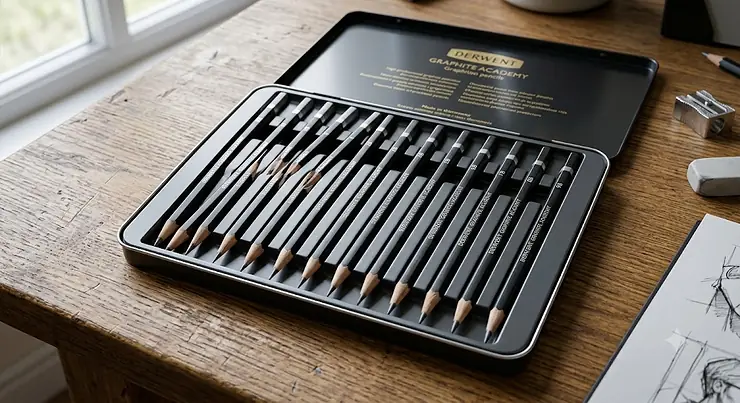
3. Derwent Graphic
There’s something satisfying about using a pencil made roughly twenty miles from where graphite was first dug out of British soil in the 16th century, and Derwent — headquartered in Cumbria since 1832 — leans hard into that heritage, justifiably so. The Derwent Graphic range spans an impressive 20 degrees from 9H through to 9B, with anti-roll hexagonal barrels that fit standard sharpeners and prevent the classic desk-edge pencil-roll disaster.
The hard (H) grades use a 2.2mm core for fine, controlled lines, while the soft (B) grades scale up to a 3.5mm core for fast, confident tonal work — a sensible bit of engineering that most buyers won’t consciously notice but will absolutely feel in use. Reviewers consistently report that the graphite has a slightly chalky, textured quality rather than the glassy glide of some German competitors, which several artists actively prefer because it gives more tactile feedback against the paper surface — you can genuinely feel where you are on the page.
This set particularly suits artists who want to build up tone gradually across large areas, since the texture aids control over pressure and consistency. One independent reviewer noted it was very easy to control tone for flat shading or smooth blends, though flagged that the softer grades smudge a touch more readily than rival brands, meaning a sheet of scrap paper under your drawing hand becomes a near-essential habit.
Pros: huge 20-degree range; British manufacturing heritage; excellent tonal control for shading-heavy work. Cons: softer grades reportedly smudge more easily than some competitors; full 24-pencil sets can feel like overkill for casual sketchers.
At roughly £8–£18 depending on set size, the Derwent Graphic range is a genuinely brilliant mid-range choice — and for UK-based buyers, there’s something to be said for supporting a pencil with roots literally in British hillsides.
4. Caran d’Ache Grafwood
If the Staedtler is the reliable family car, the Caran d’Ache Grafwood is the Swiss watch of graphite pencils — and priced accordingly. The standout feature is genuinely clever: each barrel is colour-coded to its hardness grade, so you can grab a 4B at a glance across a cluttered desk without squinting at tiny printed numbers. It sounds like a small thing until you’ve spent ten minutes hunting through an identical-looking tin mid-drawing.
Here’s what the spec sheet won’t tell you: independent reviewers who’d previously used the Faber-Castell 9000 found the Grafwood graphite noticeably softer across the board, even in the harder grades — a 2H or 4H Grafwood behaves more like an H grade from a competing brand. That’s not a flaw exactly, but it does mean the tips wear down and require resharpening more frequently than some rivals, particularly during detailed work. The 9B at the soft end is genuinely very dark — darker, by most comparative accounts, than several rival 8B pencils — though slightly more prone to an unwanted sheen when heavily layered.
Who is this for? Artists who value tactile pleasure and smooth, buttery blending as much as raw technical output, and who don’t mind sharpening a touch more often in exchange for that feel. It’s a luxury purchase in the genuine sense — reviewers describe a noticeably different, more refined tactile experience compared with cheaper sets, with the caveat that the price difference has to be justified by personal priorities rather than objective necessity.
Pros: colour-coded barrels for fast identification; exceptionally smooth, buttery graphite; genuinely dark 9B option. Cons: softer overall formulation means more frequent sharpening; premium price puts it out of reach for casual buyers.
Expect to pay in the £45–£80 range for a full boxed set, making the Caran d’Ache a considered investment rather than an impulse buy — but one that committed shaders and tonal artists tend to fall for hard.
5. Tombow Mono Drawing Pencil Set
Tombow’s century-plus of manufacturing experience shows in a detail most buyers skim past: the lead core is perfectly centred and adhered throughout the entire wooden casing, not just bonded at the tip, which translates directly into break resistance during sharpening and even wear as the pencil shortens with use. The standard boxed set runs from 6B through to 4H across the wider 12-pencil version, with a tighter six-pencil starter option covering 2H, HB, B, 2B, 4B and 6B.
What stands out in practice is line crispness. Reviewers consistently rate these among the best drawing pencils available, with several long-term users specifically praising how smear-resistant the lines remain even after extended handling — useful for anyone who works flat at a desk rather than on an upright easel, where the drawing hand inevitably drags across earlier marks. The premium black lacquer finish is also reportedly comfortable for extended holding sessions, a small ergonomic touch that matters more than it sounds across a three-hour sketching session.
This set suits precision-focused artists — architectural sketchers, technical illustrators, and anyone whose work depends on clean, controlled mark-making over expressive looseness. One point of caution worth flagging honestly: a handful of more recent reviews suggest the tonal separation between adjacent grades (for instance B versus 6B) has felt less distinct than in earlier production runs, so if exacting grade differentiation matters to your workflow, it’s worth checking current listings carefully.
Pros: excellent smear resistance for clean, controlled lines; comfortable lacquered finish for long sessions; includes a genuinely useful precision eraser in most bundles. Cons: some recent reviews note less pronounced contrast between adjacent grades; standard sets stop at 6B rather than reaching the darkest extremes.
Priced around £15–£25 for the boxed set, the Tombow Mono is the pick for artists who prize precision and tidy line quality above maximum tonal range.
6. Koh-I-Noor Toison d’Or
Founded in 1790 by Joseph Hardtmuth — who, depending on which historical account you trust, may genuinely have beaten Nicolas-Jacques Conté to the clay-and-graphite formula still used today — Koh-I-Noor carries a less flashy reputation than its German and Swiss rivals, but the Toison d’Or range punches well above its price point. The set spans 8B through to 2H across 12 pencils, each housed in durable California cedar with a sleek black finish and clearly marked grading.
The tactile experience is distinctive: reviewers consistently describe the graphite as having a slightly chalky texture, similar in character to Derwent, offering pleasant friction against the paper rather than a frictionless glide. This is a genuine point of personal preference rather than an objective flaw — some artists actively seek out that resistance for better control, while others find Staedtler’s smoother glide preferable. Customers across review platforms specifically highlight good value for money and note the pencils don’t break easily during sharpening, with several describing them as “the equal of many better-known brands” despite the lower price tag.
This set is particularly well suited to artists building their first proper professional kit, or anyone wanting a genuinely capable backup set without committing premium-pencil money. It’s also a sensible choice for art students working through GCSE or A-Level coursework, where budget constraints are real but a flimsy student set simply won’t deliver gallery-ready results.
Pros: strong value for money relative to performance; durable cedar casing resists breakage; distinctive chalky texture some artists prefer. Cons: less brand recognition may matter for some buyers; range tops out at 8B rather than 9B for the very darkest tones.
At roughly £10–£18, the Koh-I-Noor Toison d’Or is arguably the most underrated set on this list — a genuine sleeper hit for value-conscious professionals.
7. Castle Art Supplies 12-Piece Graphite Set
Rounding out the list with the most accessible entry point, the Castle Art Supplies 12-piece set spans roughly 8B through to 5H, housed in a protective tin and aimed squarely at artists stepping up from basic school-supply pencils without yet committing to premium pricing. Castle Art positions itself as developed and tested by in-house artists, and the brand has built a substantial following — reportedly trusted by millions of buyers across its broader art supplies range, which spans everything from sketching kits to coloured pencil sets.
What the price point doesn’t immediately suggest is genuine usability: this isn’t a toy-grade set dressed up in artist packaging. Independent reviewers of Castle Art’s broader graphite and sketching kits have noted solid build quality for the price bracket, with break-resistant cores that hold up to typical classroom or home-studio wear and tear. Where it understandably can’t compete with the premium end of this list is in fine tonal nuance — the gap between, say, a 4B and 6B is reportedly less pronounced than on the Faber-Castell or Derwent, which matters if your work depends on subtle tonal gradation but matters considerably less if you’re still developing fundamental shading technique.
This set particularly suits beginners, students on a budget, or anyone wanting a reliable spare kit to leave in a sketchbook bag without worrying about losing an expensive Caran d’Ache pencil down the back of a sofa. It’s also a sensible gift option for someone just starting to explore drawing seriously.
Pros: genuinely accessible price point; solid break-resistant build quality; reputable brand with strong customer trust signals. Cons: tonal separation between adjacent grades less refined than premium rivals; doesn’t reach the very darkest 9B extremes.
Typically under £15, the Castle Art Supplies set is the sensible launchpad — not the destination, perhaps, but a genuinely capable starting point that won’t hold back a developing artist’s technique.
Practical Usage Guide: Setup, Care and Getting the Most From Your Set
Buying the right tin is only half the job — how you treat those pencils in the first thirty days genuinely shapes how long they last and how well they perform. Here’s what most product listings never bother explaining.
First, resist the urge to sharpen every pencil in the set to a needle point the moment it arrives. Different techniques call for different tip shapes: a blunter, rounded point suits broad tonal shading, while a long, fine point — best achieved with a craft knife rather than a standard barrel sharpener — suits crisp detail work. Many professional artists keep two sharpening methods on hand precisely for this reason. A tub sharpener works fine for daily maintenance, but a sandpaper block lets you shape the point exactly how you want it, particularly useful with the wider 3.6mm-plus cores found in soft grades.
Second, store your set somewhere temperature-stable. Wood-cased pencils can warp slightly in damp or fluctuating conditions, which throws off the lead-to-wood bond and increases breakage risk during sharpening — exactly the failure mode that break-resistant bonding is designed to prevent, undermined by poor storage. A simple desk tin or zip case kept away from radiators or windowsills does the job.
Third, a common first-month mistake is grabbing the darkest pencil in the set straightaway for every task. Soft graphite smudges easily and can muddy fine linework if applied too early in a drawing’s development. Most professional workflows build from hard to soft: block in initial proportions and structure with a 2H or H, then progressively layer darker grades — B, 2B, 4B and beyond — for shadow and depth once the composition is locked in. Skipping straight to an 8B for your opening sketch lines is a classic beginner habit that creates unnecessary smudging headaches later.
Finally, invest in a proper kneadable eraser alongside your set, not just a standard vinyl one. Kneadable erasers lift graphite gently without abrading the paper surface, which matters enormously for highlight work and correcting fine detail without leaving a visible “scrubbed” patch behind. Pair it with a dust-free vinyl eraser for cleaner, larger corrections, and you’ve got a genuinely professional toolkit rather than just a tin of pencils.
💬 Just one click — help others make better buying decisions too! 😊
Real-World Scenarios: Matching Sets to Artists
Specs only tell half the story; matching a set to how you actually work matters more. Here are three realistic profiles drawn from common buying patterns.
The portfolio-building art student, balancing coursework deadlines with a tight budget, typically needs a set that covers a genuinely wide grade range without breaking the bank — the Staedtler Mars Lumograph or Koh-I-Noor Toison d’Or both fit this brief well, offering professional-level versatility at a price that survives a term’s worth of art supply spending. For coursework requiring detailed tonal studies, prioritise a set reaching at least 8B for shadow depth.
The hobbyist portrait artist, drawing a few evenings a week with a focus on fine facial detail and subtle tonal transitions, benefits most from the precision-oriented Faber-Castell 9000 or Tombow Mono — both reward control over raw darkness, and the smoother glide reduces hand fatigue across longer sessions. If budget allows for an occasional treat purchase, adding a single Caran d’Ache 9B pencil open-stock to an existing set can extend the darkest range without the full premium investment.
The committed professional illustrator, working daily and producing client-facing finished pieces, often finds the long-term value calculation tips toward investing in the Caran d’Ache Grafwood or building a hybrid kit — Derwent Graphic for broad tonal blocking, supplemented with Faber-Castell or Caran d’Ache pencils for the detail passes where precision and tactile feel genuinely affect the finished result. At this level, the marginal cost difference between premium and mid-range sets becomes negligible against the hours invested in each piece.
How to Choose a Professional Graphite Pencil Set
Cutting through marketing language, here’s the actual decision-making framework worth using.
- Check the grade range first. A set spanning at minimum 2H to 6B covers most general sketching needs; for serious shading or portrait work, look for sets extending to 8B or 9B at the dark end.
- Consider lead diameter alongside hardness. Thicker cores in soft grades (typically 3.5mm-plus) lay down broad tone faster but wear down quicker, requiring more frequent sharpening — a worthwhile trade-off for shading-heavy work, less so for fine detail.
- Factor in your paper choice. Smoother papers suit harder, more controlled grades; textured or toothy papers grip softer graphite better and reduce shine in heavily layered areas.
- Weigh tactile preference honestly. Some artists prefer a glassy, low-friction glide (Staedtler, Faber-Castell); others prefer textured resistance (Derwent, Koh-I-Noor). This is genuinely personal and worth testing with a cheap open-stock pencil before committing to a full set.
- Look at break-resistance claims critically. Bonded-core construction (mentioned by Staedtler, Faber-Castell and Tombow) genuinely reduces sharpening breakages — useful evidence to look for in product descriptions rather than just price.
- Don’t over-buy grade count for your actual workflow. A 24-degree set sounds impressive but most working artists settle into a core rotation of six to eight grades; a focused 12-pencil set often serves better than an unwieldy 24-pencil tin.
- Budget for accessories alongside the pencils. A decent kneadable eraser, sharpener and blending stump typically add £10–£15 to the total spend but meaningfully improve results from day one.
Artist Grade Pencil Grades 2H to 9B Explained
The H-and-B grading system trips up more beginners than almost anything else in the art supplies world, so it’s worth untangling properly. The scale runs from the hardest grades (9H, rarely needed outside technical drafting) down through a midpoint at HB and F, and on to the softest, darkest grades (up to 9B, occasionally 12B in specialist ranges). The H stands for hardness — more clay in the graphite-clay mixture produces a harder, lighter-marking core. The B stands for blackness — more graphite relative to clay produces a softer, darker, smudgier core, a system whose origins trace back to early 19th-century pencil manufacturing.
For most artists working with a professional graphite pencil set, the practically useful range sits between 2H and 9B. A 2H is firm enough for clean, light construction lines that won’t smudge under a resting hand but still register clearly enough to follow. Moving through F and HB gets you the familiar “everyday pencil” feel — versatile but rarely the star of a finished piece. From B through to 4B, you’re in classic sketching territory: confident outlines, mid-tone shading, and the workhorse grades most artists reach for instinctively. Push into 6B, 8B and 9B and you’re chasing genuine depth — the velvety blacks that anchor a composition’s darkest shadows, though these grades demand a lighter touch since over-pressing risks burnishing the paper to an unwanted shine.
It’s worth noting that grading isn’t perfectly standardised across manufacturers — an HB from one brand can feel noticeably different from another’s, as the Caran d’Ache comparison above demonstrates. Treat the H/B scale as a useful relative guide within a single manufacturer’s range rather than an absolute, interchangeable measurement across brands.
Lightfast Graphite Pencils: What Permanence Really Means
Here’s a genuinely common point of confusion: artists shopping for lightfast graphite pencils sometimes assume graphite itself fades over time the way certain pigments do. In practice, pure graphite is chemically stable and inherently lightfast — it’s an inert form of carbon that doesn’t break down or shift in tone under UV exposure the way many coloured pigments can. So why does the phrase “lightfast graphite pencils” come up at all in buying searches?
The honest answer involves what surrounds the graphite, not the graphite itself. Genuine archival concerns with graphite drawings tend to centre on three things: paper acidity (acidic paper yellows and degrades over years, taking the drawing with it), fixative use (spray fixatives can slightly alter the sheen or tooth interaction with graphite if applied unevenly), and smudging or surface abrasion over time rather than chemical fading. If you’re framing or selling finished graphite work, the genuinely high-leverage decisions are acid-free, archival-quality paper and proper UV-filtering glass in framing — not hunting for a specially “lightfast” graphite formulation, since standard professional graphite from any reputable manufacturer in this guide is already stable in that sense.
Where lightfastness genuinely does matter is if you’re working in mixed media — combining graphite with coloured pencil or watercolour pencil elements within the same piece, where the coloured components can fade differently over time. In that scenario, checking the lightfast rating specifically on any colour additions (rather than the graphite portion) becomes the relevant research task.
Professional Sketching Pencils vs Student-Grade Sets
The gap between a genuine professional graphite pencil set and a student-grade equivalent isn’t always obvious from packaging alone, so it’s worth spelling out concretely. Student sets typically use a single, less-refined graphite formulation across a narrower grade range — often just HB, 2B and 4B — manufactured to a price point that prioritises low cost over consistency between individual pencils in a batch.
Professional sketching pencils, by contrast, are formulated with finer-milled graphite and more tightly controlled clay ratios, producing more consistent darkness and smoothness within each specific grade, and crucially, more consistent differentiation between adjacent grades — the practical difference between a 2B and 4B should be immediately visible, which isn’t always true of cheaper alternatives. The bonding process linking core to casing also tends to be more robust in professional ranges, directly reducing breakage during sharpening — a real, measurable difference rather than marketing fluff, evidenced by the SV and super-bonded processes detailed throughout the product reviews above.
That said, the line has blurred somewhat in recent years. Budget-adjacent ranges like Castle Art Supplies now offer genuinely usable break-resistant cores at student-friendly prices, meaning the binary “cheap and bad versus expensive and good” framing doesn’t entirely hold up anymore. The more useful distinction for buyers is grade range and consistency rather than price alone — a genuinely professional-grade pencil set should comfortably span at least six distinct, clearly differentiated grades and hold a sharpened point through sustained use.
Staedtler Mars Lumograph 100: An In-Depth Review
Given how frequently the Mars Lumograph comes up in searches and recommendations, it deserves a closer, dedicated look beyond its entry in the main product roundup above. Reviewers who’ve used the standard Lumograph 100 pencils extensively, including over sustained year-long testing periods, describe the graphite as having a distinctly low-friction, almost glassy glide — to the point where some compare the sensation to drawing with a slightly soft plastic core rather than traditional graphite. This is genuinely divisive: some artists adore it precisely because it requires minimal pressure to lay down rich tone, reducing hand fatigue across long sessions, while others who prefer more tactile resistance (fans of the chalkier Derwent or Koh-I-Noor texture) find it almost too slick.
A particularly useful comparative data point comes from reviewers who’ve also tested the related Staedtler Mars Lumograph Black range — a separate product line using a harder, carbon-blend formulation. Those pencils produce noticeably more friction and a slightly chalky resistance against paper, the opposite tactile experience to the standard Lumograph 100, despite sharing branding. This matters practically: if you’ve tried “a Staedtler” before and disliked the feel, it’s worth checking which specific Lumograph variant you used, since the two ranges feel genuinely different in hand.
On darkness, the standard 8B grade included in most boxed sets is reported as satisfyingly deep, though several long-term reviewers specifically choose the 12-pencil set that includes 8B over the alternative 12-pencil configuration that tops out at 6B, precisely because that extra depth matters for finished shadow work. The metal tin, while functional, has drawn some criticism in aggregated reviews for feeling slightly flimsy relative to the quality of pencils inside — a small but consistently mentioned gripe worth factoring into your expectations rather than a dealbreaker.
Taken together, the Staedtler Mars Lumograph earns its reputation as a genuinely dependable workhorse rather than an exciting specialist tool — and for most buyers building their first proper professional kit, dependable is exactly what’s needed.
Common Mistakes When Buying a Graphite Set for Professional Artists
A handful of buying mistakes show up repeatedly in review patterns and forum discussions, worth flagging honestly before you spend.
The first is buying based purely on pencil count rather than grade range. A 40-piece “art set” stuffed with charcoal sticks, pastel pencils and blending stumps might contain only four or five actual graphite pencils — fine for a beginner exploring multiple media, frustrating if you specifically wanted a dedicated, comprehensive graphite range. Always check the breakdown of what’s actually included, not just the headline piece count.
The second is overlooking lead diameter variation within a set. As detailed earlier, softer grades typically use thicker cores; if you’re buying open-stock individual pencils to supplement an existing set rather than a boxed kit, mismatched diameters across pencils from different ranges can mean inconsistent sharpening results, which catches out buyers mixing and matching brands without checking specs first.
The third, and perhaps most common, is assuming “professional” branding guarantees suitability for your specific technique. A set optimised for crisp detail work (Faber-Castell, Tombow) won’t necessarily satisfy an artist who works in loose, expressive, heavily blended tonal passages — and vice versa. Reading aggregated review sentiment for texture and feel, not just darkness and durability claims, genuinely helps avoid buyer’s remorse here.
Finally, many buyers underestimate accessory costs and arrive at checkout having budgeted only for the pencil tin itself. A genuinely complete professional kit needs a quality sharpener, kneadable eraser, and ideally a blending stump or two — budgeting an extra £10–£15 alongside the pencil set itself avoids an awkward second order a week later.
Long-Term Cost & Maintenance: Total Value Over Time
Sticker price tells an incomplete story. A £12 student-adjacent set that needs replacing every few months due to inconsistent grading or excessive breakage can genuinely cost more over a year than a £20 professional set used carefully and replenished open-stock as individual pencils wear down.
Most professional graphite pencils, used at a typical sketching pace of a few hours weekly, last considerably longer than buyers expect — a single pencil, sharpened sensibly rather than aggressively, can realistically provide months of use before needing replacement, particularly the harder grades which wear more slowly than soft, dark pencils used for heavy shading. This is where open-stock availability becomes genuinely relevant to long-term cost: brands like Faber-Castell, Caran d’Ache, Derwent and Staedtler all sell individual pencils separately, meaning you’re not forced to rebuy an entire boxed set the moment your most-used grade (typically 2B or 4B for most artists) runs short.
Maintenance costs beyond the pencils themselves are modest but worth factoring in: sharpener blades dull and benefit from periodic replacement, and kneadable erasers eventually become saturated with graphite and lose their lifting effectiveness, typically needing replacement every few months of regular use. Total annual cost for a committed hobbyist sketching weekly, accounting for pencil replacement and accessories, typically settles somewhere in the £20–£40 range regardless of which tier of set you initially bought — meaning the upfront price difference between budget and premium options matters far more for first-purchase affordability than for genuine long-term total cost of ownership.
Safety, Sustainability & UK Regulations
For UK buyers, it’s worth knowing that graphite pencils sold here fall under specific legal safety requirements, regardless of brand. The Pencils and Graphic Instruments (Safety) Regulations 1998 set out requirements covering the materials used in pencils, crayons and similar articles sold in the UK, referencing the BS EN 71-3 toy safety standard for permissible substance limits. This is why you’ll see “not suitable for children under three” warnings on many sets despite graphite itself being non-toxic in normal use — the regulation concerns choking hazards from small parts and coating composition rather than the graphite core itself.
On sustainability, most major manufacturers featured in this guide — Staedtler, Faber-Castell, Derwent and Caran d’Ache among them — now source wood casings from forests certified under the FSC’s responsible forestry standard, and use water-based rather than solvent-based lacquer coatings. If environmental sourcing matters to your purchasing decision, this information is typically stated clearly on product listings or manufacturer websites, and is worth a quick check before buying, particularly for budget ranges where sourcing transparency varies more widely.
Graphite itself, as a naturally occurring form of carbon, carries minimal environmental concern compared to many art materials — it’s the wood casing, lacquer, and packaging where sustainability claims genuinely differentiate one brand from another.
Frequently Asked Questions
❓ What is the best professional graphite pencil set for beginners?
❓ How many pencils do I need in a graphite set?
❓ What grade pencil is darkest?
❓ Are expensive graphite pencils actually worth it?
❓ Do graphite pencils need to be lightfast?
Conclusion
Choosing a professional graphite pencil set genuinely doesn’t need to feel like decoding a foreign language, even though the marketing copy on most boxes seems determined to make it feel that way. Strip away the jargon and you’re left with a handful of honest questions: how wide a grade range do you actually use, do you prefer a smooth glide or textured resistance, and how much are you willing to spend for marginal improvements in consistency and feel? The Staedtler Mars Lumograph and Faber-Castell 9000 remain dependable, well-evidenced choices for most working artists; the Derwent Graphic offers genuine British heritage alongside excellent tonal control; the Caran d’Ache Grafwood rewards committed shaders willing to pay for tactile luxury; and the Koh-I-Noor and Castle Art Supplies options prove convincingly that budget needn’t mean compromise on the fundamentals.
What matters most, ultimately, is matching the set to how your hand actually moves across paper — something no spec sheet can fully predict, but which the aggregated experience of thousands of real reviewers, distilled throughout this guide, can at least point you towards with genuine confidence.
✨ Don’t Miss These Exclusive Deals!
🔍 Ready to build your kit? Check current prices and availability on any of the seven sets above — your sketchbook is waiting.
Recommended for You
- 0.5 vs 0.7 Mechanical Pencil for Drawing: 7 Picks Ranked (2026)
- Mechanical Pencil for Drawing: 7 Top Picks Tested for 2026
- Best Pencil Set for Beginners UK: 7 Top Picks for 2026
Disclaimer: This article contains affiliate links. As an Amazon Associate, I earn from qualifying purchases. If you purchase products through these links, we may earn a small commission at no additional cost to you.
✨ Found this helpful? Share it with your friends! 💬🤗
