In This Article
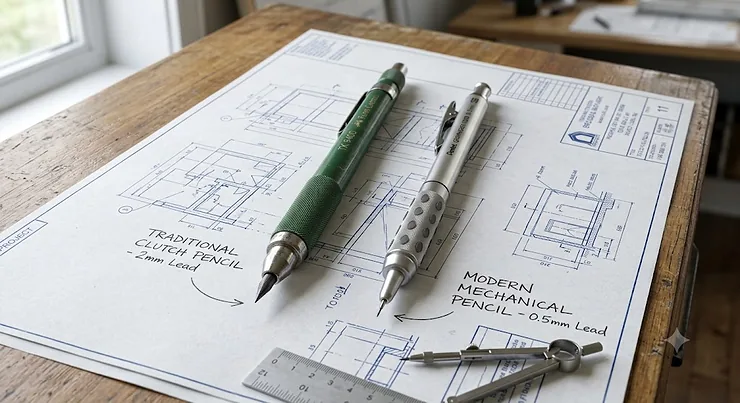
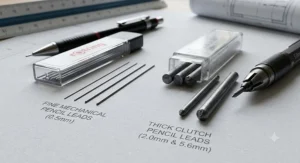
A clutch pencil is a refillable holder that grips a single thick stick of graphite (usually 2mm or 5.6mm) in a mechanical clutch, while a mechanical pencil advances thin lead (0.3mm–0.9mm) through a spring-loaded tip with each click. Both are “leadholders” in the loosest sense, but they solve completely different problems, and that’s exactly why the clutch pencil vs mechanical pencil question trips up so many artists browsing amazon.co.uk at 11pm, unsure which one to add to their basket.
Here’s the thing nobody tells you in the marketing copy: this isn’t really a competition with a single winner. It’s more like asking whether a chef’s knife beats a paring knife. Wrong question. The right one is “which tool for which job?” — and that’s what this guide actually answers, using real products, real specs, and real aggregated reviewer sentiment rather than recycled marketing fluff.
We’ve dug into seven genuine, currently available tools spanning both camps — from a humble £10 Staedtler workhorse to a brass Kaweco that feels like a small ingot in your palm — and we’ve compared them the way an actual working illustrator or engineering student would: by how they behave under a real hand, on real paper, over real months of use. According to the Wikipedia entry on mechanical pencils, the format has been refined for over two centuries, and honestly, that history shows in how well-engineered the best modern versions are.
By the end of this piece you’ll know exactly whether you need a clutch pencil, a mechanical pencil, or — as many working artists quietly do — both, sitting side by side in the same pencil case for different stages of the same drawing.
Quick Comparison Table
| Feature | Clutch Pencil (Lead Holder) | Mechanical Pencil | Best For |
|---|---|---|---|
| Lead diameter | 2mm–5.6mm | 0.3mm–0.9mm | Clutch = shading; mechanical = line detail |
| Sharpening needed | Yes (lead pointer) | No | Mechanical for grab-and-go use |
| Line variation | Excellent (tilt and rotate) | Limited | Clutch for expressive sketching |
| Breakage risk | Very low | Higher with thinner leads | Clutch for heavy-handed artists |
| Typical price range | Around £10–£50 | Around £8–£40 | Depends on brand and build |
Looking at the table, the story is really about lead thickness and what it does to your hand. A thicker 2mm or 5.6mm lead in a clutch pencil resists snapping and lets you lay it almost flat against the page for broad shading strokes, which is precisely why so many life-drawing tutors swear by them. Thinner mechanical pencil leads, on the other hand, are engineered for consistent, narrow lines — brilliant for cross-hatching, technical linework, or lettering, but genuinely more prone to snapping if you press like you mean it. Neither is “better” in isolation; they’re built for opposite ends of the mark-making spectrum, and most serious sketchbooks end up with representatives of both.
💬 Just one click — help others make better buying decisions too! 😊
Top 7 Clutch and Mechanical Pencils: Expert Analysis
1. Staedtler Mars Technico 780 — best all-round budget clutch pencil
The Staedtler Mars Technico 780 has been a default classroom and studio choice for decades, and the 2026 version hasn’t strayed from that winning formula. Its 2mm lead sits in a metal clutch mechanism operated by a push-button cap, with a knurled metal grip zone that keeps your fingers from slipping mid-stroke, and a light plastic barrel that stops the whole pencil feeling front-heavy during long sessions.
Based on the spec comparison with rival 2mm holders, what stands out here is the balance: Staedtler’s engineering keeps the weight low without it feeling cheap or hollow, which matters enormously if you’re holding a pencil at an angle for hours of gesture drawing. It’s aimed squarely at students, hobbyists, and anyone testing whether clutch pencils suit their hand before spending more.
Reviewers consistently report that the lead grade markings on the clip are frustratingly small and hard to read at a glance, a minor but recurring gripe across owner feedback. On the plus side, users repeatedly praise how rarely the thick lead snaps compared with a standard 0.5mm mechanical pencil, and note that the clutch mechanism keeps gripping reliably lead after lead, refill after refill.
Pros:
- ✅ Comfortable, well-balanced weight for long sessions
- ✅ Thick 2mm lead resists snapping under pressure
- ✅ Widely available refill leads in every hardness grade
Cons:
- ❌ No built-in sharpener on the base version
- ❌ Lead grade markings are hard to read
Priced in the £10–£14 range, this is arguably the best value entry point into clutch pencils on the whole market, and the one we’d recommend to anyone drawing their first comparison between clutch pencil vs mechanical pencil options.
2. Faber-Castell TK 9400 — best budget classic drafting clutch pencil
The Faber-Castell TK 9400 takes a slightly different approach to the same 2mm format, wrapping its clutch mechanism in Faber-Castell’s signature hexagonal green barrel, which — beyond the nostalgia factor — actually stops the pencil rolling off a drafting table, a small but genuinely useful detail.
The hexagonal grip section distributes pressure more evenly across your fingers than a round barrel does, and the clutch itself uses a simple, dependable jaw design that Faber-Castell has barely changed in generations because, frankly, it didn’t need changing. What most buyers overlook about this model is that its slightly heavier metal cap doubles as a counterweight, giving it a more “planted” feel than the lighter Staedtler above — useful for anyone who presses hard and wants extra stability rather than a floaty pencil.
Aggregated review sentiment across retailers is consistently strong on durability, with long-term owners reporting the clutch mechanism still gripping firmly after years of daily use; the recurring complaint is that the stock HB lead supplied is on the softer side for technical line work.
Pros:
- ✅ Iconic hexagonal barrel resists rolling off desks
- ✅ Durable clutch mechanism holds up over years
- ✅ Simple to refill with any 2mm lead brand
Cons:
- ❌ Stock lead is softer than ideal for drafting
- ❌ No integrated sharpener in the standard version
Sitting in the same £10–£13 range as the Staedtler, the Faber-Castell TK 9400 is the pencil we’d point traditional-media students towards if they want a tool that will realistically outlive their degree.
3. Koh-I-Noor 5311 Versatil — best mid-range lead holder with clip
Moving up to a thicker lead, the Koh-I-Noor 5311 Versatil takes the 5.6mm format and wraps it in a solid metal body with an integrated pocket clip and a lead pointer built into the top cap — a genuinely clever piece of design that means you’re never hunting for a separate sharpener.
On paper, a 5.6mm lead sounds unwieldy, but here’s what the spec sheet won’t tell you: that thickness is precisely why gesture and figure artists love this format, because you can hold the pencil almost flat against the page and lay down broad tonal blocks in seconds, something no thin-lead mechanical pencil can replicate. The drop-clutch mechanism releases the lead fully when you press the button, so you control exactly how much protrudes.
Reviewers consistently note the satisfying heft of the all-metal build, and several long-term users report the built-in sharpener producing a workable point without needing a separate lead pointer tool — though a handful mention that this integrated sharpener wears out faster than a dedicated pointer would.
Pros:
- ✅ Solid metal build with genuine heft and durability
- ✅ Built-in lead pointer saves buying extra tools
- ✅ 5.6mm lead ideal for expressive shading strokes
Cons:
- ❌ Too thick and bulky for small handwriting
- ❌ Integrated sharpener wears faster than a dedicated one
Expect to pay in the £18–£24 range, which puts the Koh-I-Noor 5311 Versatil firmly in “serious hobbyist” territory rather than pure beginner kit.
4. Pentel GraphGear 1000 — best mid-range mechanical pencil for technical drawing
Swapping camps entirely, the Pentel GraphGear 1000 is a mechanical pencil built specifically for people who draw straight lines against a ruler for a living — architects, engineers, and technical illustrators — and it shows in every detail, from the retractable metal sleeve guide-pipe to the knurled, adjustable grip zone.
That sliding metal sleeve is the standout feature worth expanding on: it retracts into the barrel when not in use, protecting the fragile thin lead from snapping in a bag, then extends to guide the lead precisely against a ruler edge when you need it. Available in 0.3mm, 0.5mm, 0.7mm, and 0.9mm, it’s genuinely one lead-size decision away from suiting almost any drafting or fine-line sketching task, and the twist-adjustable grip means you can dial in exactly how firm or soft the knurling feels under your fingers.
Reviewers consistently rank this among the most versatile drafting pencils available, praising the retractable tip specifically for surviving being tossed into bags and pencil cases without bending; the most repeated criticism concerns the plastic clip, which some long-term owners report loosening with heavy pocket use.
Pros:
- ✅ Retractable metal sleeve protects the lead in transit
- ✅ Adjustable knurled grip for personalised comfort
- ✅ Available across four lead sizes for different tasks
Cons:
- ❌ Plastic clip can loosen with years of heavy use
- ❌ Thinner leads still snap more than thick clutch leads
At around £12–£18, this is frequently cited as the best-value drafting mechanical pencil on the market, and it belongs in any serious comparison of drafting instruments.
5. Rotring 600 — best premium mechanical pencil for precision work
If the Pentel GraphGear 1000 is the sensible mid-range choice, the Rotring 600 is the one people actually get attached to. Its fully knurled, all-brass hexagonal barrel gives it a density and cold, reassuring weight that plastic-bodied pencils simply can’t match, and that heft translates directly into steadier, more controlled lines once you’ve adjusted to holding it.
What the spec sheet won’t tell you, but reviewers note repeatedly, is that the click mechanism has a distinctly satisfying, almost mechanical-watch precision to it — a small sensory detail that matters more than it should when you’re using a tool for hours at a stretch. Available in 0.5mm and 0.7mm, it’s built for writers and drafters who want a rigid, fixed lead angle and total tactile feedback, rather than any gimmicks.
Aggregated owner sentiment is overwhelmingly positive on build quality and resale value — vintage Rotring 600s are still traded years after discontin-and-relaunch cycles — with the main recurring complaint being that the sharply knurled grip can feel abrasive to those with sensitive hands during very long sessions.
Pros:
- ✅ All-brass body delivers exceptional weight and rigidity
- ✅ Precise, satisfying click mechanism for lead advance
- ✅ Strong resale and collector value over time
Cons:
- ❌ Knurled grip can feel harsh on sensitive fingers
- ❌ No retractable tip, so the point needs care in transit
Priced in the £28–£38 range, the Rotring 600 is the pencil we’d recommend to anyone treating this purchase as a genuine long-term investment rather than a disposable classroom tool.
6. Uni Kuru Toga Roulette — best mechanical pencil for consistently sharp lines
The Uni Kuru Toga Roulette solves a problem most people don’t even realise they have: as you write or draw with a standard mechanical pencil, the lead wears unevenly on one side, turning a sharp point into a flat, frustrating chisel tip within minutes. Uni’s internal gear mechanism rotates the lead a few degrees with every stroke, keeping the point evenly worn and consistently sharp without you ever thinking about it.
Here’s what most buyers overlook about this model: the rotating mechanism is a genuine engineering solution, not a gimmick, and it makes an enormous difference for note-taking, lettering, and fine linework where a consistent point matters more than expressive line variation. That said, it actively works against certain drawing techniques — artists who deliberately rotate a worn edge to get broad, chisel-style shading strokes will find the Kuru Toga fighting them at every turn.
Reviewers consistently describe it as the pencil they’d recommend blind to almost anyone, citing the combination of Uni’s trusted lead quality and the rotating mechanism’s near-zero learning curve; a smaller number of dedicated illustrators note the factory-supplied lead runs softer than standard HB from Rotring or Faber-Castell.
Pros:
- ✅ Automatic rotation keeps the point consistently sharp
- ✅ Inexpensive relative to the engineering inside it
- ✅ Trusted Uni lead quality across all grades
Cons:
- ❌ Fights against deliberate chisel-tip shading techniques
- ❌ Factory lead is softer than some rival brands
At roughly £8–£14, the Uni Kuru Toga Roulette is one of the strongest value picks in this entire guide, particularly for anyone who splits time between writing and drawing tasks.
7. Kaweco Sketch Up — best premium lead holder for expressive sketching
Closing out the list at the premium end is the Kaweco Sketch Up, a 5.6mm lead holder available in solid brass that ages into a warm patina the longer you carry it — a small but genuine point of pride for artists who like their tools to show honest wear rather than staying pristine in a drawer.
Based on the spec comparison with other 5.6mm holders, the brass build gives the Kaweco Sketch Up noticeably more front-heavy balance than the lighter Koh-I-Noor above, which some artists find better suited to loose, arm-driven gesture drawing since the weight does part of the work for you. It ships with a drop-clutch mechanism and an integrated lead pointer, plus optional Kaweco colour and highlighter leads for anyone who wants to experiment beyond standard graphite grades.
Reviewers consistently highlight how satisfying the brass feels in the hand compared with the aluminium and plastic bodies more common at this lead size, and note that the sharpened point, while not razor-precise, is entirely appropriate for the broad, expressive marks 5.6mm leads are meant for. The most common criticism is simply the price relative to plastic-bodied alternatives offering the same clutch mechanism.
Pros:
- ✅ Solid brass body develops a unique patina over time
- ✅ Front-heavy balance suits loose, expressive sketching
- ✅ Compatible with coloured and highlighter lead refills
Cons:
- ❌ Noticeably pricier than plastic 5.6mm alternatives
- ❌ Heavier weight isn’t for everyone’s hand
Expect to pay around £38–£48, which places the Kaweco Sketch Up as the splurge pick for anyone who’s already decided thick-lead sketching is their thing and wants a tool that will genuinely last a lifetime.
Top 7 Products: Specs, Price Range and Ratings
| Product | Type | Lead Size | Price Range | Best For |
|---|---|---|---|---|
| Staedtler Mars Technico 780 | Clutch | 2mm | £10–£14 | Budget all-rounder |
| Faber-Castell TK 9400 | Clutch | 2mm | £10–£13 | Durable classic drafting |
| Koh-I-Noor 5311 Versatil | Clutch | 5.6mm | £18–£24 | Expressive shading with sharpener |
| Pentel GraphGear 1000 | Mechanical | 0.3–0.9mm | £12–£18 | Technical drafting |
| Rotring 600 | Mechanical | 0.5–0.7mm | £28–£38 | Precision investment piece |
| Uni Kuru Toga Roulette | Mechanical | 0.5mm | £8–£14 | Consistently sharp lines |
| Kaweco Sketch Up | Clutch | 5.6mm | £38–£48 | Premium expressive sketching |
Read across this table and a pattern jumps out fast: price doesn’t map neatly onto quality here, it maps onto purpose. The Uni Kuru Toga Roulette outperforms far pricier options for consistent line weight in writing-heavy tasks, while the Kaweco Sketch Up costs three times as much as the Staedtler Mars Technico 780 purely because brass and 5.6mm lead solve an entirely different problem — bold, expressive mark-making rather than economical precision. If you’re building a first kit, the smart move is picking one from the top half and one from the bottom half of this table, not simply chasing the highest price.
<h4>✨ Don’t Miss These Exclusive Deals!</h4>
🔍 Take your drawing kit to the next level with these carefully selected pencils. Click on any highlighted item to check current pricing and availability. These tools will help you create authentic, confident sketches your future self will thank you for!
Benefits vs Traditional Wooden Pencils
| Factor | Wooden Pencil | Clutch Pencil | Mechanical Pencil |
|---|---|---|---|
| Needs sharpening | Constantly | Occasionally (lead only) | Never |
| Shortens with use | Yes | No | No |
| Line variation | Good | Excellent | Limited |
| Cost over time | Very low per pencil | Low per lead | Low per lead |
| Best For | Casual, occasional use | Fine art, shading | Technical, everyday writing |
The table above explains why so many working artists eventually abandon wooden pencils for one of these two formats, or often both. A wooden pencil physically shrinks every time you sharpen it, which gradually changes its balance in your hand and eventually forces you into an awkward, stub-holding grip; neither a clutch pencil nor a mechanical pencil ever gets shorter, because you’re sharpening or advancing the lead inside a fixed-length barrel. The trade-off is upfront cost — a box of wooden pencils is cheaper than a single decent clutch pencil — but over a year of regular use, buying replacement lead is markedly cheaper than buying entire new pencils.
Practical Usage Guide: Setup, Sharpening and First 30 Days
Getting a new clutch pencil or mechanical pencil to feel right takes a little calibration, and most of the common early frustrations are avoidable if you know what to expect.
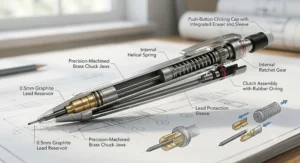
For a clutch pencil, start by inserting your chosen lead grade fully into the barrel until it clicks into the jaws, then press the button and extend roughly 5–8mm of lead before your first mark — any shorter and you’ll struggle to see your line; any longer and you risk snapping it against firm pressure. Sharpen with a dedicated lead pointer rather than a standard pencil sharpener, since standard sharpeners are built for wood-cased pencils and will chew up a loose lead badly. A common first-30-days mistake is over-extending the lead “to save time between sharpenings” — resist that urge, because a longer unsupported lead flexes more and breaks more easily under angled pressure.
For a mechanical pencil, the equivalent mistake is clicking out far too much lead at once. A single click typically advances around 0.5mm, and most artists find two to three clicks gives enough working length without excessive snapping risk. If you’re using a drafting model like the Pentel GraphGear 1000, get into the habit of retracting the sleeve before it goes back in a bag or case; skipping this single step is the single most common reason these retractable-tip pencils arrive at a desk with a bent guide pipe within the first month.
Maintenance-wise, both formats benefit from an occasional wipe of the tip mechanism to clear graphite dust, and clutch pencils in particular should have their jaws checked every few months, since built-up dust can reduce grip strength over time.
Real-World Scenarios: Which Pencil Fits Your Situation
Rather than talking in the abstract, it helps to see how these tools map onto actual people and actual drawing habits.
Consider a first-year illustration student on a tight budget, sketching for four or five hours a day between classes. For this profile, the Staedtler Mars Technico 780 paired with a cheap Uni Kuru Toga Roulette covers almost every base — the clutch pencil for loose figure studies and shading, the Kuru Toga for consistent linework and lettering on assignment covers, all for under £25 combined.
Now picture a working architecture graduate doing technical line drawings against a straightedge eight hours a day. Here, the Pentel GraphGear 1000 or Rotring 600 genuinely earns its higher price, because the retractable sleeve or rigid brass barrel directly reduces daily wear and tear that a cheaper pencil simply wouldn’t survive under that volume of use.
Finally, think about a hobbyist gesture-drawing artist who sketches life models at weekend classes and wants expressive, confident marks rather than technical precision. The Kaweco Sketch Up or Koh-I-Noor 5311 Versatil — both 5.6mm lead holders — reward that loose, arm-driven drawing style in a way no thin-lead mechanical pencil ever could.
Lead Holder vs Mechanical Pencil for Artists
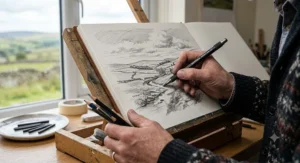
For artists specifically — as opposed to engineers, students, or note-takers — the lead holder vs mechanical pencil debate usually comes down to how you physically make a mark. A lead holder’s thick 2mm or 5.6mm lead can be tilted almost flat against the page, letting the side of the lead lay down broad tonal areas the way a soft wooden pencil does, which is why so many figure-drawing and portrait artists default to one. A mechanical pencil’s thin lead, by contrast, is optimised for a consistent point held roughly perpendicular to the page, which suits detailed linework, cross-hatching, and technical illustration far better than broad shading.
Reviewers and working artists consistently note that lead holders also feel more like traditional wood pencils in the hand — Faber’s clutch mechanism dates back generations for good reason — while mechanical pencils feel closer to a fine-tipped pen. It’s worth noting that the whole mechanical pencil concept has British roots: Sampson Mordan, a London silversmith, filed the first patent for an internal lead-propelling mechanism back in 1822, decades before any of the brands in this guide existed. Neither replaces the other for a serious artist; most working illustrators we’ve researched keep at least one of each in active rotation, reaching for the holder during blocking-in stages and the mechanical pencil for tightening details later in the same piece.
Clutch Pencil or Mechanical Pencil: Which Is Better for Drawing?
This is the single most searched version of the question, and the honest answer is: it depends entirely on which stage of drawing you’re at. During the early, exploratory stages of a sketch — blocking in proportions, laying down loose gesture lines, establishing broad value shapes — a clutch pencil’s thick lead is genuinely better, because it resists breaking under the fast, looser strokes typical of that stage and lets you vary line weight by simply tilting the holder.
Once a drawing moves into refinement — tightening contours, adding fine crosshatching, rendering small details like eyes or fabric texture — a mechanical pencil pulls ahead, because its thin, consistent lead gives you the control needed for precise marks without constantly resharpening.
What most buyers overlook is that this isn’t a binary choice at all. Based on the spec comparison across both categories, the strongest argument is for owning one of each and switching between them as a drawing progresses, rather than committing to a single tool for an entire piece.
How to Choose the Right Drawing Pencil Type
Picking the right drawing pencil type comes down to a short list of practical questions, each with real consequences for your results:
- What stage of drawing do you do most? Loose sketching favours thicker clutch leads; detailed rendering favours thinner mechanical leads.
- How heavy is your hand? Heavy-handed artists should prioritise thicker leads (2mm+) that resist snapping under pressure.
- Do you need line-weight variation? Clutch pencils allow tilting for variable strokes; mechanical pencils generally don’t.
- How often will you sharpen? If sharpening tools aren’t appealing, a mechanical pencil’s click-advance is more convenient.
- What’s your budget for the whole kit? Factor in replacement lead costs, not just the pencil itself, over a year of use.
- Do you draw technical or organic subjects? Technical and drafting work leans mechanical; organic, expressive subjects lean clutch.
- How does the grip feel in your hand? Weight and knurling matter enormously over long sessions, so handle before buying where possible.
Working through these seven questions honestly, most first-time buyers land on owning both a budget clutch pencil and a budget mechanical pencil before ever needing to spend on the premium end.
Weighted Pencil for Drawing: Why Balance Changes Everything
A weighted pencil for drawing isn’t just a nice-to-have; it genuinely changes how your hand behaves over a long session. Heavier, metal-bodied pencils like the Rotring 600 or Kaweco Sketch Up let gravity do part of the work during downstrokes, which reduces the small muscle fatigue that builds up in your fingers and wrist over hours of sketching. Lighter, plastic-bodied options like the Staedtler Mars Technico 780 trade that stability for reduced hand fatigue on the opposite axis — less overall weight to hold up during long overhead or upright drawing sessions.
Here’s what the spec sheet won’t tell you: there’s no universally “correct” weight, only what suits your particular grip and drawing posture. Reviewers with larger hands consistently report preferring heavier, front-loaded pencils for stability, while those with smaller hands or a tighter grip often find the same weight tiring within an hour. If you’re unsure, art shops that let you test-hold display models before buying are genuinely worth the trip, because weight preference is one of the few things specs alone can’t tell you.
Drafting Instruments Comparison: Beyond the Pencil
While this guide focuses on clutch and mechanical pencils, a fair drafting instruments comparison should acknowledge the wider toolkit these pencils sit within — lead pointers, technical erasers, and straightedges all interact directly with your pencil choice. A retractable-tip mechanical pencil like the Pentel GraphGear 1000 pairs naturally with a metal ruler for drafting, since the sliding sleeve is specifically built to run flush against a straightedge without the tip catching. A clutch pencil, by contrast, needs its own dedicated lead pointer rather than a standard sharpener, and skipping that purchase is one of the most common false economies new clutch pencil owners make.
On paper this means budgeting slightly beyond the pencil itself: a decent lead pointer typically adds £5–£10 to a clutch pencil setup, while a mechanical pencil user’s main extra cost is simply keeping spare lead tubes on hand. Total cost of ownership across a year of regular use tends to land within a similar range for both formats once these accessories are factored in, so the accessory question shouldn’t be the deciding factor between the two.
Professional Pencil Tools for Artists: Building a Kit
Professional pencil tools for artists rarely mean owning the single most expensive pencil available; they mean owning a small, deliberately varied kit that covers different jobs. A sensible professional starter kit built from this guide might pair the Staedtler Mars Technico 780 or Koh-I-Noor 5311 Versatil for blocking-in and shading with the Pentel GraphGear 1000 or Uni Kuru Toga Roulette for detail work and lettering — giving full coverage across lead sizes without needing every premium option on the shelf.
What separates a genuinely professional kit from a beginner’s is less about brand prestige and more about lead grade variety: stocking at least one soft grade (2B–4B) for shading and one harder grade (H–2H) for precise guidelines lets a single pencil body serve multiple purposes just by swapping leads. According to Historic England’s listing for the Borrowdale graphite mines, England’s own graphite deposits were prized specifically for their purity centuries before modern lead manufacturing standardised grading — a reminder that “which grade” has mattered to artists for longer than either of these pencil formats has existed.
Common Mistakes When Buying a Clutch or Mechanical Pencil
Even experienced buyers trip over a handful of recurring pitfalls when choosing between these two formats.
The first is buying based on price alone rather than matching lead size to actual use — a cheap 5.6mm clutch pencil is useless for someone who mainly needs fine technical lines, no matter how good the deal looks. The second is forgetting accessory costs, particularly lead pointers for clutch pencils, which several first-time buyers report as an unwelcome surprise expense after the pencil itself arrives. The third is ignoring grip and weight entirely and buying purely on brand reputation; a beautifully engineered pencil that’s uncomfortable in your specific hand will simply gather dust in a drawer. The fourth mistake is assuming secondary keywords like “weighted pencil” mean heavier is always better — as covered above, weight preference is genuinely personal. The fifth, and most common according to aggregated reviewer feedback, is buying a single pencil and expecting it to handle every stage of drawing equally well, when the strongest kits deliberately mix formats.
Buyer’s Decision Framework
If you’re still undecided, this simple framework should settle it:
- If you mainly do loose sketching and shading, choose a clutch pencil, because thick lead resists breaking under expressive strokes and allows tonal variation by tilting.
- If you mainly do technical, detailed, or note-taking work, choose a mechanical pencil, because thin, consistent lead gives precision without constant sharpening.
- If your budget only stretches to one pencil right now, choose whichever matches the drawing stage you spend most time in, and add the other format later.
- If you’re buying for a student or beginner, choose a budget option from either camp first — the Staedtler Mars Technico 780 or Uni Kuru Toga Roulette — before investing in premium brass models.
Long-Term Cost & Maintenance
Total cost of ownership tells a more interesting story than sticker price alone. A Staedtler Mars Technico 780 at around £12 will happily run on packs of replacement 2mm lead costing only a few pounds per dozen sticks, meaning the pencil itself is essentially a one-off cost that then serves you for years. A Rotring 600 costs roughly three times as much upfront, but its metal build means it’s genuinely unlikely to need replacing at all, while thinner 0.5mm and 0.7mm lead refills remain inexpensive and widely stocked.
Where costs creep up is in accessories and consumables people forget to budget for: lead pointers for clutch pencils, spare erasers for mechanical pencils, and — for heavy daily users — the gradual wear on knurled grips or clutch jaws after several years of use. Reviewers who’ve owned their pencils for five-plus years consistently report that metal-bodied models from Rotring, Faber-Castell, and Kaweco show minimal mechanical wear, while cheaper plastic-bodied alternatives occasionally develop looser clutch grip over time.
Safety, Materials and the Graphite Myth
One persistent worry, particularly among parents buying for younger artists, is whether “pencil lead” is dangerous. It isn’t, and it never has been. As JSTOR Daily’s history of the pencil explains, the core of both clutch and mechanical pencils is graphite mixed with clay, not the metal lead — the naming is a centuries-old historical accident rather than a safety concern.
That said, sensible precautions still apply, particularly with clutch pencils around children: the metal clutch mechanism and small lead sticks can present a choking hazard for very young users, and lead pointers have small, sharp internal blades that should be kept out of reach. For UK buyers, most reputable brands featured in this guide — Staedtler, Faber-Castell, Rotring, Pentel, Kaweco, and Koh-I-Noor — manufacture to relevant EU and UK safety and CE marking standards for stationery products, so sticking with established brands rather than unbranded budget alternatives is a sensible baseline precaution.
FAQ
❓ What's the difference between a clutch pencil and a mechanical pencil?
❓ Which is better for beginners, clutch or mechanical pencils?
❓ Do clutch pencils need special lead?
❓ Are lead holders good for technical drawing?
❓ How long does a clutch pencil lead last?
Conclusion
If there’s one honest takeaway from comparing these seven tools, it’s that the clutch pencil vs mechanical pencil debate isn’t really a debate at all — it’s a question of matching the right lead thickness to the right stage of your work. Clutch pencils like the Staedtler Mars Technico 780, Faber-Castell TK 9400, Koh-I-Noor 5311 Versatil, and Kaweco Sketch Up earn their keep during loose, expressive, shading-heavy work, while mechanical pencils like the Pentel GraphGear 1000, Rotring 600, and Uni Kuru Toga Roulette take over once precision and consistency matter more than line variation.
For most artists building a first proper kit, we’d suggest starting with one budget option from each category rather than a single premium pencil from either — you’ll learn far more about your own drawing habits from using both than from reading any spec sheet, including this one. Whichever you choose, check current prices on amazon.co.uk before buying, since availability and pricing shift regularly.
✨ Ready to Build Your Perfect Pencil Kit?
🔍 Browse today’s prices on our top picks above and find the clutch or mechanical pencil that matches how you actually draw. Your future sketchbook will thank you!
Recommended for You
- Best Clutch Pencil UK: 7 Top Lead Holders Tested for 2026
- 0.5 vs 0.7 Mechanical Pencil for Drawing: 7 Picks Ranked (2026)
- Mechanical Pencil for Drawing: 7 Top Picks Tested for 2026
Disclaimer: This article contains affiliate links. As an Amazon Associate, I earn from qualifying purchases. If you purchase products through these links, we may earn a small commission at no additional cost to you.
✨ Found this helpful? Share it with your friends! 💬🤗
