
In This Article
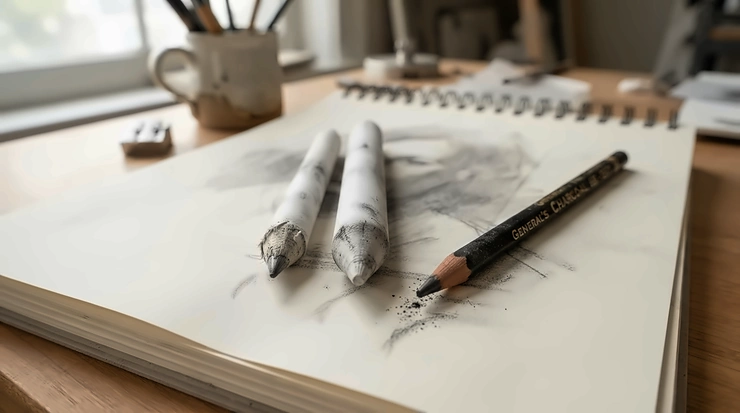
Tortillon vs blending stump, in plain terms: a tortillon is a tapered, usually hollow roll of paper with a single working point, built for small, precise smudging. A blending stump is a dense, solid, double-ended paper wand that covers larger areas with softer transitions. Both shift graphite, charcoal and pastel without the grease of your fingertips.
That’s the tidy version. The messy truth is that the two names get swapped constantly. The Wikipedia entry on the tortillon describes a stump as longer, more tightly wrapped and pointed at both ends, with the tortillon hollow and slightly different in texture. Yet plenty of shops slap “tortillon” on anything tapered and made of paper. So the tortillon vs blending stump question is really two questions: what is this thing actually made like, and what do you need it to do?
This guide answers both. You’ll get an honest art tool comparison of seven real, UK-available products, from three-for-a-few-quid stump packs to a pen that blends without any paper at all. We’ll unpick the blending tool differences that actually show up on the page and walk through a proper shading technique. We’ll also settle the question that sends most people searching: which stump for detail work? If you’ve ever smudged a carefully drawn eyelash into a grey thumbprint, consider this your rescue kit.
A quick note on method. Everything below comes from published specifications, manufacturer guidance and genuine customer reviews I could find at the time of research. Where a product had too few verifiable reviews, I say so rather than pad the gap. Prices are ranges only, so check the current price on each product page.
Tortillon vs Blending Stump at a Glance
Before meeting the products, here’s the core tortillon vs blending stump comparison boiled down to one table.
| Feature | Tortillon | Blending Stump |
|---|---|---|
| Construction | Tapered roll of paper, usually hollow | Dense, tightly wound, solid paper |
| Working ends | One point | Two points |
| Typical size | Narrower and shorter | Thicker and longer |
| Texture on the page | Firmer, slightly more textured finish | Softer, smoother finish |
| Best at | Small areas, tight corners, precise shading | Larger areas, smooth gradients |
| Main risk | Tip crushes if held upright | Over-blending into muddy, flat tone |
| Best For | Eyelids, lashes, tiny highlights | Skies, skin planes, backgrounds |
The table shows a trade-off between reach and coverage. A tortillon gets into spaces a stump physically can’t, but it takes more effort to keep a tone even. A stump does the opposite: it gives you smooth sweeps quickly, but pushes you towards over-blending if you’re not careful. Most drawers of kit end up needing both, which is why the single-tool tortillon vs blending stump debate rarely has a winner.
💬 Just one click — help others make better buying decisions too!😊
Top 7 Blending Tools Compared: Expert Analysis
I’ve ordered these from budget to premium, with one non-paper alternative at the end. Every one is a real product, and I’ve framed the analysis around what each spec means in practice. Listings and pack contents vary between sellers, so check that the product page matches what’s described here.
1. Royal Blending Stumps 3-Pack — cheapest way to try stumps
Think of this as the “try before you commit” option: three soft paper stumps for roughly the price of a bus fare.
The listing describes soft rolled paper with pointed ends. The fine tips are meant for lifting or blending colour in small areas, and the broad side of the tip covers larger ones. Soft paper moves graphite and charcoal readily and forgivingly, but it also means the tips dent and fray sooner than on tightly wound stumps. The maker suggests medium-grit sandpaper for re-pointing, a sensible habit to adopt from day one.
Based on the spec description, this suits beginners who don’t yet know whether blending will become a habit. It also suits anyone wanting sacrificial stumps for messy charcoal work, where a nicer tool would be wasted. The listing mentions charcoal and pastels rather than graphite, so test on scrap paper if you draw in pencil. Don’t expect pinpoint control, because for tiny areas a true tortillon or a sharpened narrow stump will beat it.
I couldn’t find enough verifiable customer reviews for this specific pack to summarise honestly, so treat it as a low-risk experiment rather than a proven crowd favourite.
Pros:
- ✅ Very low cost per stump
- ✅ Fine tip plus broad side in one tool
- ✅ Suits charcoal and chalk pastel work
Cons:
- ❌ Soft paper wears down quickly
- ❌ Limited size range for detail work
Price range: around £3 or under at the time of research (check current price). Verdict: excellent value as a trial, less compelling as a long-term kit.
2. Daler-Rowney Simply Blending Sticks & Tortillons (10-piece) — both tool types in one pack
This is the only product here that lets you run your own tortillon vs blending stump experiment on a single drawing.
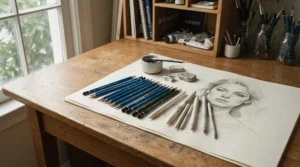
The pack mixes double-ended, pencil-shaped blending sticks with single-ended tortillons that have elongated points. It runs to ten pieces across seven sizes, and one UK trade listing puts the sticks at roughly 116-140mm and the tortillons at roughly 70-90mm. In practice, that means a tortillon for the eyelid crease and a stick for the cheek without swapping brands or paper types. The elongated tortillon tips reach tighter than any stump can.
Daler-Rowney positions its Simply range as affordable kit for newcomers, students and hobbyists, which matches the build. This is a learning tool: it shows you, through use, which shape suits your hand.
On a UK retailer’s page, five reviews were mostly five-star, praising value and the range of sizes. One three-star reviewer said the sticks wear out too quickly, which fits the trade-off you’d expect from paper tools at this price.
Pros:
- ✅ Sticks and tortillons in one pack
- ✅ Seven sizes for different areas
- ✅ Low cost per piece
Cons:
- ❌ One reviewer reports fast wear
- ❌ Listings differ on exact piece breakdown
Price range: roughly £3-£6 depending on retailer. Verdict: the best value-for-learning pick on the list.
3. Derwent Paper Stumps Set — smooth rice paper in three sizes
Derwent’s headline is the material: compressed rice paper, which the brand says blends more smoothly than ordinary paper.
The set contains three stumps from 5.5mm to 10.5mm in diameter, each with a point at each end. That 5.5mm tip is slim enough for an iris or a small cast shadow, while the 10.5mm barrel sweeps across a cheek or a sky wash in a few strokes. When tips clog, Derwent’s own advice is to re-point them on a sandpaper block. Derwent’s launch page for the set also points to a video tutorial from one of its artists, a handy extra for newcomers.
My analysis: this is the cleanest “one set, three jobs” purchase here. You get small, medium and large coverage without needing a separate tortillon, although it won’t reach as fine as a dedicated tortillon tip.
Reviewers on a UK art retailer’s page describe the stumps as among the best they’ve found for graphite and pastel blending. Another reports easy, effective blending with pencil work. It’s a small sample, but a consistent one.
Pros:
- ✅ Three genuinely useful diameters
- ✅ Smoother rice-paper finish
- ✅ Easy to clean and re-point
Cons:
- ❌ No ultra-fine tortillon-style tip
- ❌ Small pool of verifiable reviews
Price range: around £4-£5 at the time of research. Verdict: superb value, and the safest all-rounder.
4. Faber-Castell Paper Wiper Blending Stump — blends and lifts in one tool
This one is sold individually, and it’s pitched for both blending and correcting.
Retailer listings describe a stump about 14cm long and 1cm wide, suitable for soft pastel, graphite and charcoal. The brand says it can be cleaned on a sandpaper block or a kneaded eraser (putty rubber). That thicker barrel is a clue about its strength: broad planes and quick tonal sweeps. The tip, meanwhile, can lift graphite or charcoal to create highlights, treating the stump a bit like an eraser that draws.
That makes it appealing if you think of blending and erasing as the same gesture, which charcoal artists often do. If your priority is tiny, precise detail, though, a 1cm body is more bulk than you want.
I couldn’t verify enough customer reviews for this stump to summarise them honestly.
Pros:
- ✅ Lifts and corrects as well as blends
- ✅ Gentle on paper compared with fingers
- ✅ Cleans with a putty rubber or sandpaper
Cons:
- ❌ Sold singly, so dearer per stump than sets
- ❌ Thick body is less suited to tiny areas
Price range: typically a few pounds for a single stump; check current price. Verdict: a strong specialist pick for charcoal and lifting, not a first-time all-rounder.
5. Cretacolor Stumps Blending Set of 5 — a five-size ladder
If your drawings range from pocket-sized studies to A3 portraits, five sizes give you a full “ladder” of coverage.
The set brings five different sizes of paper stick with an ergonomic shape and a soft finish. A UK retailer describes them as suitable even for delicate surfaces, and recommends them for water-soluble pencils, crayons and pastels. In practice, a soft finish tends to be kinder to paper tooth, with less risk of burnishing a shiny patch, while the size range lets you cover fine and broad work without reaching for separate tortillons.
Here’s what to weigh: this set is a step up for artists who regularly move between scales, such as a portrait with fine facial features against a large soft background. If you only ever draw small, a three-size set is plenty.
Reviews I could verify were too thin to summarise fairly, so judge it on the specification and brand reputation rather than crowd consensus.
Pros:
- ✅ Five sizes cover most blending tasks
- ✅ Soft finish suits delicate surfaces
- ✅ Established art-materials brand
Cons:
- ❌ Costs more than simpler three-stump packs
- ❌ Limited verifiable review depth
Price range: around £7 at the time of research. Verdict: worth it if you work across scales, overkill if you don’t.
6. Caran d’Ache Blending Stump — the dense, precise premium stump
This is the “grown-up” stump: tightly rolled compressed paper with a point at each end.
Caran d’Ache offers its stumps in 70mm and 140mm lengths, and one retailer lists a diameter of about 1cm. The paper feels like a firm blotting-paper pencil, and the brand says it works graphite in a way that’s non-aggressive to your support. It can be sharpened with a sandpaper block, a knife or even a large pencil sharpener. Density matters here: a firmer stump holds its point longer and gives a more predictable transfer of graphite, but it asks for a lighter hand. Caran d’Ache’s own blending guide makes light pressure its first rule.
Based on the spec comparison, this suits graphite portraitists who want predictability and are happy to pay a little extra per stump. It’s less compelling for pastel dust, where a cheaper, softer stump does the job.
Only one review turned up on a UK retailer listing, which isn’t enough to draw a trend from.
Pros:
- ✅ Dense paper holds a point well
- ✅ Choice of 70mm or 140mm lengths
- ✅ Sharpens with a regular pencil sharpener
Cons:
- ❌ Costs more than multipack stumps
- ❌ Firmer feel needs a lighter touch
Price range: around £3.50-£4.50 per stump. Verdict: premium by stump standards, fair for graphite specialists.
7. Derwent Blender Pens — paper-free option for the tiniest details
Not every fine detail blending tool is made of paper, and this pair proves it.
The pack holds two pens with 2mm and 4mm bullet nibs, spirit-based and designed for both colour and graphite pencils. Retailer descriptions say they dissolve the wax in coloured pencils for a velvety finish, and more pencil can be layered on top. A 2mm nib is narrower than any paper tool in this list, so it can blend inside a gap no tortillon will fit. The catch is that solvent changes the surface rather than simply moving dry pigment, so it’s not a like-for-like swap for a dry stump.
My analysis: coloured pencil artists and card-makers get the most from these, while pure graphite or charcoal artists should treat them as a secondary tool.
On Hobbycraft’s listing, 13 reviews average 4.1 out of 5. Reviewers praise how easily they smooth pencil work, though one notes that tips pick up marks and transfer them onto other colours.
Pros:
- ✅ 2mm nib reaches tiny areas
- ✅ Smooths coloured pencil strokes well
- ✅ Extra pencil can go over the top
Cons:
- ❌ Tips can pick up and transfer pigment
- ❌ Not a direct replacement for dry stumps
Price range: around £6-£7 at the time of research. Verdict: a clever specialist, but pair it with a dry stump or tortillon.
Top 7 at a Glance
| Product | Type | Size/Format | Price Range | Best For |
|---|---|---|---|---|
| Royal Blending Stumps 3-Pack | Soft paper stumps | 3 stumps | Around £3 or under | Trying stumps cheaply |
| Daler-Rowney Simply Blending Sticks & Tortillons | Sticks and tortillons | 10 pieces, 7 sizes | Roughly £3-£6 | Learning which shape suits you |
| Derwent Paper Stumps Set | Rice paper stumps | 3 sizes, 5.5-10.5mm | Around £4-£5 | All-round graphite and pastel |
| Faber-Castell Paper Wiper Blending Stump | Single stump | About 14cm long | A few pounds each | Blending and lifting charcoal |
| Cretacolor Stumps Blending Set of 5 | Paper stumps | 5 sizes | Around £7 | Artists working across scales |
| Caran d’Ache Blending Stump | Dense paper stump | 70mm or 140mm | Around £3.50-£4.50 each | Predictable graphite work |
| Derwent Blender Pens | Solvent blender pens | 2mm and 4mm nibs | Around £6-£7 | Coloured pencil fine detail |
Looking at the table, the Derwent Paper Stumps Set and the Daler-Rowney Simply Blending Sticks & Tortillons give the widest coverage per pound, one with cleaner build and the other with more variety. If your budget is tight, the Royal Blending Stumps 3-Pack is the lowest-risk experiment. Premium buyers should note that the Caran d’Ache Blending Stump and the Cretacolor Stumps Blending Set of 5 reward specific habits rather than offering broader capability.
Shading Technique: How to Blend With a Tortillon and a Blending Stump
A good shading technique makes cheap blenders look expensive. A bad one makes expensive blenders look like fingers. Here’s a practical sequence that works with any tool above.
- Build tone first, blend second. Lay down light, even layers with a soft pencil. Blending can only move graphite that’s already there.
- Use a clean stump for light values. A stump loaded with graphite deposits that graphite wherever it goes, so keep one clean for highlights and one “dirty” one for mid-tones.
- Start broad, finish fine. Use a stump’s side to unify large areas, then switch to a tortillon or narrow stump for edges. The tortillon-versus-stump choice happens here, at the edges.
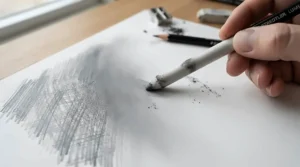
- Hold the tortillon at an angle. Used upright, the tip gets pushed back into itself and blunts, according to one drawing guide, so work with the side of the point.
- Alternate pencil and blending. Caran d’Ache suggests alternating between the two to build depth without saturating the paper.
- Stop before it goes smooth. Over-blending flattens fine gradations into muddy tone, so leave a little grain in places.
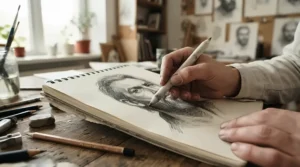
Derwent’s stump launch page points to a video tutorial if you’d rather watch than read. The one habit worth forming early is to rotate the tool as you go, so a fresh patch of paper meets the drawing each time.
Which Stump for Detail Work? Three Real-World Scenarios
“Which stump for detail work?” has no single answer. It depends on scale, medium and how often you draw. Here are three typical profiles matched to products, with the reasoning.
Scenario A: the portrait student on roughly £10. You’re drawing A4 faces in graphite, three evenings a week, and need to blend eyelids, lips and nostrils. The Daler-Rowney Simply Blending Sticks & Tortillons gives you tortillon-style tips for the tight spots and sticks for cheeks. Add the Derwent Paper Stumps Set if budget allows, because its 5.5mm stump is the slimmest paper barrel on this list.
Scenario B: the botanical illustrator working small. You draw in coloured pencil on A5 paper, with petals and veins smaller than a pea. A paper tool may be too coarse here, so the Derwent Blender Pens with their 2mm nib are the natural fit. Test on scrap first, since the solvent changes how the layers sit.
Scenario C: the large charcoal sketcher. You work at A2 on landscapes, blending skies and lifting highlights. The thicker Faber-Castell Paper Wiper Blending Stump or the 140mm Caran d’Ache Blending Stump gives you reach, and the Cretacolor Stumps Blending Set of 5 covers the odd small area. Fine tortillon work rarely matters at this scale.
If you only remember one thing: match the tip to the smallest area you draw, then buy size up from there.
Blending Problems and Fixes
Most blending frustrations come from a handful of repeatable mistakes. Here are five common problems and what usually fixes them.
- Muddy, flat greys. You’ve over-blended. Lift highlights back with a kneaded eraser (putty rubber) and restore contrast with fresh pencil. Next time, stop one pass earlier.
- Streaky tone. A dirty tip is depositing old graphite unevenly. Rub the tip on a clean area of kneaded eraser, or re-point it on sandpaper.
- Blunt, squashed tortillon tip. You’ve been holding it upright. Angle it and use the side of the point. The Daler-Rowney Simply Blending Sticks & Tortillons give you spares to practise with.
- Shiny, burnished patches. Too much pressure. Use a softer stump such as the Cretacolor Stumps Blending Set of 5 and let the paper’s tooth do the work.
- Smudging lines you wanted to keep. Work from light to dark and blend away from crisp edges, not across them.
For pigment-heavy mistakes, a stump used like an eraser can pull tone back out, which is where the Faber-Castell Paper Wiper Blending Stump earns its keep.
✨ Ready to Pick Your Blender?
🔍 Take your drawing to the next level with these carefully chosen tools. Click any highlighted product name to check current pricing and availability. A few well-chosen stumps will give your shading the smooth, controlled finish you’ve been chasing!
How to Choose Between a Tortillon and a Blending Stump
Here’s a simple checklist for choosing, in the order I’d work through it.
- Match the tip to your smallest detail. If your smallest detail is under about 5mm, you want a tortillon or the narrowest stump you can find.
- Read the listing, not the title. Sellers use “tortillon” and “stump” interchangeably, so check for one point or two, and for a diameter in mm.
- Count the points. Double-ended stumps give you two points to sharpen before the tool needs replacing.
- Match the tool to the medium. Dry graphite, charcoal and pastel suit paper tools; coloured pencil may suit something like the Derwent Blender Pens.
- Consider your paper. Rougher paper keeps texture even after blending, so a softer stump is gentler on tooth.
- Buy a size ladder, not a single tool. A set such as the Derwent Paper Stumps Set beats one stump for versatility.
- Budget for a sandpaper block. It’s the cheapest way to extend every tool’s life.
Work through those seven in order and the tortillon vs blending stump decision usually makes itself.
Blending Tool Differences: What Changes on the Page
The real blending tool differences aren’t about the name. They’re about shape, density and softness, and each one changes your marks.
Shape and taper decide how small a space you can reach. A tortillon’s tight cone gets into narrow gaps, while a stump’s broader barrel covers area quickly.
Density decides how long the tip lasts and how it feels. Tightly wound stumps, like the Caran d’Ache Blending Stump, hold a point and feel firm. Softer ones, like the Royal Blending Stumps 3-Pack, move pigment readily but wear faster.
Softness decides the finish. One art shop’s staff, quoted by The Art League, describe stumps as softer and more velvety than tortillons, which suits broad areas. Meanwhile, Wikipedia emphasises the hollow-versus-solid distinction, so sources don’t agree on exactly how they’re made.
My reading of the disagreement is that brands use the terms loosely, so physical specs matter more than labels. That’s why the Daler-Rowney Simply Blending Sticks & Tortillons is useful: it separates the two types within one pack, with double-ended sticks and single-ended tortillons. Pressure sensitivity is the final difference, since tortillons reward angled, light contact, and stumps forgive broader strokes.
Art Tool Comparison: Paper Blenders vs Fingers, Tissue and Blender Pens
Paper stumps aren’t the only way to blend, so here’s an honest art tool comparison of the usual options.
| Tool | Precision | Smoothness | Main Risk | Best For |
|---|---|---|---|---|
| Tortillon | High | Moderate | Tip crushes if held upright | Tiny areas, edges |
| Blending stump | Moderate | High | Over-blending to mud | Gradients, large areas |
| Fingertip | Low | High | Skin marks the paper | Quick, rough blends |
| Tissue or cotton bud | Low to moderate | Moderate | Fibres, uneven pressure | Soft pastel, quick fixes |
| Derwent Blender Pens | Very high | High | Tips pick up pigment | Coloured pencil detail |
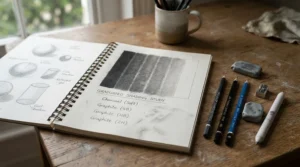
Derwent itself says paper stumps are cleaner than fingers and more accurate. That’s easy to believe, since a fingertip is a blunt instrument with a built-in grease supply. For graphite and charcoal, stumps remain the most predictable all-round choice, while the Derwent Blender Pens win on precision for coloured pencil. If you’re choosing only one tool category for dry media, stumps beat fingers and tissue on control.
Features That Actually Matter (And Those That Don’t)
Blending tools look simple, so marketing tends to fill the gap with noise. Here’s what’s worth your attention.
Features that matter:
- Tip diameter. The number printed in millimetres is more honest than any marketing adjective. The Derwent Paper Stumps Set spells it out at 5.5mm to 10.5mm.
- Firmness. A firmer tool holds a point, a softer one blends faster. Neither is “better”.
- Re-pointability. If you can restore a tip with sandpaper or a pencil sharpener, the tool lasts longer.
- Size variety. A ladder of sizes beats duplicates of one.
Features that don’t:
- Piece count. Thirty identical stumps are less useful than five different ones.
- “Professional” labels. They’re not regulated and tell you nothing about the paper.
- Pretty packaging. The tip is what touches your drawing.
If you want a quick rule: spend on variety and tip quality, not on volume. A modest Cretacolor Stumps Blending Set of 5 will usually serve you better than a giant, unbranded multipack.
Common Mistakes When Buying and Using Blending Tools
A few patterns trip up beginners and seasoned artists alike.
- Buying one type only. A bag of stumps leaves detail work unserved. Pair stumps with at least one narrow tortillon.
- Trusting the title. Check the description for the number of points and the diameter before assuming what you’re getting.
- Using one stump for everything. A tool loaded with dark graphite will dirty your highlights. Keep separate “dark” and “light” tools.
- Blending too early. Smudging before your tonal structure is set just spreads uncertainty around.
- Over-blending. A drawing guide warns that over-blending with stumps can create muddy areas and flatten fine gradations into flat tone.
- Skipping maintenance. Dirty tips streak. A sandpaper block costs very little.
The most expensive mistake is also the most common: buying on price per piece and ignoring fit. A cheap pack that doesn’t include a small enough tip means you’ll buy again anyway.
Long-Term Cost and Maintenance
Blending tools are consumables, not heirlooms, but good maintenance stretches their lives considerably.
Start with the numbers. A five-piece set at around £7, like the Cretacolor Stumps Blending Set of 5, works out at roughly £1.40 a piece. If each stump survives even five drawings after cleaning, you’re paying pennies per drawing. A single stump like the Caran d’Ache Blending Stump costs more per piece, but its denser paper may suit you if you value consistent points.
Cleaning follows a simple escalation. Rub the tip on a kneaded eraser (putty rubber) first, then use sandpaper to remove dirty outer layers. For stumps like the Faber-Castell Paper Wiper Blending Stump, the brand itself recommends a sandpaper block or kneaded eraser. Caran d’Ache’s blending guide adds that a pencil sharpener can restore a stump’s original precision. A craft knife works as a last resort.
Remember that these are inexpensive, replaceable tools. If cleaning takes longer than drawing, bin the stump and start a new one. Store them flat in a pencil case, point-protected, and label dark and light ones so they don’t mix.
Tortillon vs Blending Stump for Beginners, Portrait Artists and Coloured Pencil Fans
Which is the best fine detail blending tool for you depends on how you draw.
Beginners: start with the Daler-Rowney Simply Blending Sticks & Tortillons. The mix teaches you which shape feels natural, and the low cost means mistakes don’t sting.
Portrait artists: the combination of a Derwent Paper Stumps Set (for planes of the face) and a narrow tortillon from the Daler-Rowney pack covers most needs. Graphite specialists who value predictability might choose the Caran d’Ache Blending Stump.
Coloured pencil artists: the Derwent Blender Pens offer the finest reach and the smoothest finish. Keep a dry paper stump around for graphite underdrawing.
Charcoal and pastel artists: the broad Faber-Castell Paper Wiper Blending Stump doubles as a lifting tool, and the Royal Blending Stumps 3-Pack is a sensible sacrificial choice for dusty media.
Artists working across scales: the Cretacolor Stumps Blending Set of 5 is the tidy answer. Whatever your style, resist the urge to pick a “winner” in the tortillon vs blending stump contest. Pick a pairing instead.
FAQ
❓ Is a tortillon better than a blending stump for fine detail?
❓ Can I use a blending stump instead of a tortillon on small areas?
❓ How much should I spend on a tortillon vs blending stump set in the UK?
❓ Do blending stumps work on coloured pencil?
❓ How often should I replace a blending stump?
Conclusion
So, tortillon vs blending stump: who wins? Neither, and both. A tortillon earns its keep on eyelids, lashes and tiny highlights, while a blending stump wins on skies, skin planes and smooth gradients. The names are used loosely, so the real decision is about tip size, firmness and how often you’ll re-point.
If you want my shortlist based on the research above: the Derwent Paper Stumps Set is the safest all-rounder, and the Daler-Rowney Simply Blending Sticks & Tortillons is the best way to learn which shape suits your hand. The Royal Blending Stumps 3-Pack is the cheapest experiment, the Cretacolor Stumps Blending Set of 5 suits artists working across scales, and the Caran d’Ache Blending Stump suits graphite purists. The Faber-Castell Paper Wiper Blending Stump is for lifters and charcoal fans, and the Derwent Blender Pens are the specialist pick for coloured pencil detail. Whichever you choose, add a sandpaper block and a kneaded eraser and you’re set.
Recommended for You
- Blending Brush For Graphite Drawing: 7 Flawless Picks (2026)
- Blending Supplies For Artists: 7 Best Budget Picks (2026)
- Tortillon Set For Beginners: 7 Proven Picks For UK Artists (2026)
Disclaimer: This article contains affiliate links. As an Amazon Associate, I earn from qualifying purchases. If you purchase products through these links, we may earn a small commission at no additional cost to you.
✨ Found this helpful? Share it with your friends! 💬🤗
