In This Article
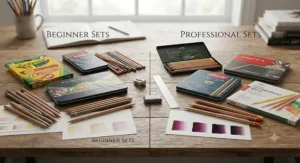
Stand in front of the pencil aisle at any UK stationer and you’ll see the same puzzle: a tin of twelve for a few pounds sitting next to a wooden box that costs more than a week’s shopping. So what’s actually going on between cheap vs expensive coloured pencils, and is the pricier tin genuinely doing something the budget one can’t?
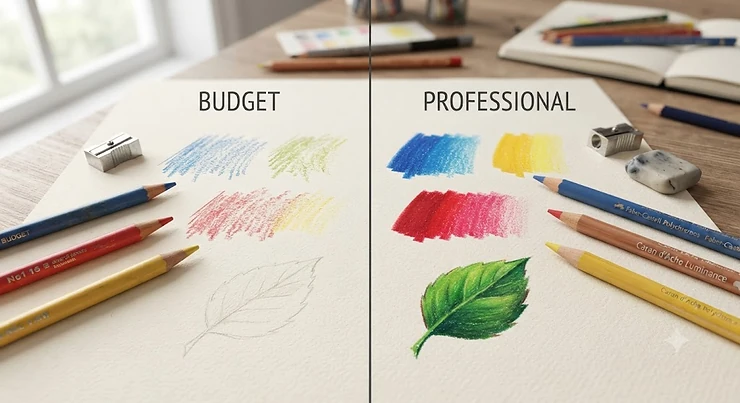
In short: cheap vs expensive coloured pencils differ mainly in pigment concentration, core softness, binder quality and lightfastness — the amount of true colour packed into the core, how smoothly it lays down and blends, and how long that colour survives daylight before fading. Budget sets use more filler and less pigment; professional sets use less filler and considerably more pigment, which is why the difference shows up the moment you press pencil to paper.
This isn’t a “premium is always better” pitch, though. Plenty of hobbyists genuinely don’t need a £70 tin, and plenty of art students waste money upgrading before they’ve outgrown their student set. What follows is a properly researched, product-by-product breakdown — seven real sets spanning pocket-money budget to serious artist-grade — with honest analysis of where the money goes, when it’s worth spending it, and when it categorically isn’t.
Quick Comparison Table
| Pencil | Type | Core | Price Range | Best For |
|---|---|---|---|---|
| Crayola Colouring Pencils | Budget | Wax, hard | Under £10 | Young children, first sets |
| Staedtler Noris Colour 185 | Budget | Wax, medium | £8-£15 | Schoolwork, everyday sketching |
| Derwent Academy Colouring Pencils | Budget | Wax, medium | £10-£18 | Students stepping up from toy pencils |
| Faber-Castell Colour Grip | Mid-range | Wax, soft-medium | £15-£28 | Long colouring sessions, ergonomics |
| Derwent Coloursoft | Mid-range | Wax, soft | £20-£38 | Vivid colour, big fills, blending |
| Prismacolor Premier | Premium | Wax, very soft | £25-£48 | Illustration, buttery blending |
| Faber-Castell Polychromos | Premium | Oil, hard | £30-£55 | Detail work, portraits, lightfast archival pieces |
Reading this table left to right tells its own story: as price climbs, cores generally get softer (with the notable exception of oil-based Faber-Castell Polychromos, which stays hard but trades that for precision and durability). The mid-range tier is where most improving hobbyists land, because sets like the Faber-Castell Colour Grip and Derwent Coloursoft deliver a genuine pigment jump over budget pencils without the premium price tag. Meanwhile the two artist-grade sets, Prismacolor Premier and Faber-Castell Polychromos, aren’t really competing with the budget end at all — they’re solving a different problem entirely: professional, sellable, archival-quality work.
💬 Found a set you like the look of already? Scroll down to the full breakdown — every product below links straight through so you can check current pricing and availability.
Top 7 Coloured Pencils: Expert Analysis
1. Crayola Colouring Pencils — best true budget starter set for kids
The Crayola Colouring Pencils are the pencil most British households already own, and there’s a reason they’ve barely changed formula in decades: they work reliably for what they’re built to do. The hard wax core resists snapping in small hands, and the pre-sharpened tips mean a set can go straight from packet to page without a trip to the sharpener.
Specs-wise, you’re looking at a firm, moderately pigmented wax core in sets typically running from 12 to 100 colours. That hardness is deliberate — it survives being dropped, chewed, and pressed far too hard by an over-enthusiastic six-year-old, at the cost of laying down noticeably less pigment per stroke than any other pencil on this list.
Based on the spec comparison, this is unambiguously a children’s pencil rather than a beginner-artist pencil, and that’s fine — it’s not trying to be anything else. Reviewers consistently note strong durability and low breakage as the standout strengths, with the trade-off being flat, papery colour that needs several layers to look saturated. For colouring books, school projects and anyone under about age ten, it remains hard to beat on value.
Pros:
- ✅ Extremely durable core that resists snapping
- ✅ Reliable pre-sharpened points straight from the box
- ✅ Widely available and genuinely low-cost per pencil
Cons:
- ❌ Pale, low-pigment colour needs heavy layering
- ❌ Limited blendability compared with every other pencil here
Typically found well under £10 for a 36-50 pack, the value proposition here is about durability and accessibility rather than artistic performance — check current price for the specific pack size, as larger tins scale up in cost.
2. Staedtler Noris Colour 185 — sturdiest hexagonal barrel under £15
Staedtler Noris Colour 185 pencils borrow their instantly recognisable black-and-yellow hexagonal barrel from the brand’s famous graphite pencils, and that shape isn’t just branding — the “Super-Hexagonal” barrel genuinely resists rolling off a desk and cracking on impact.
The core sits a notch softer than Crayola’s, delivering slightly richer colour laydown, and the water-based lacquer coating on the barrel is worth flagging for anyone buying for schools: it means no solvent smell and an FSC-certified wood body. Break-resistant core technology, which bonds the lead more securely inside the barrel, is the headline engineering feature, and it does noticeably reduce the “snap two millimetres from the tip” problem that plagues cheaper barrels.
What most buyers overlook about this set is that it sits in an odd middle ground — tougher and slightly more pigmented than a pure toy-shop pencil, but still clearly student-grade rather than artist-grade in terms of blend quality. Reviewers consistently report that the barrels survive school-bag abuse far better than most rivals in this price bracket, while colour depth remains modest against anything mid-range or above.
Pros:
- ✅ Break-resistant core survives drops and pressure
- ✅ FSC-certified wood with water-based lacquer finish
- ✅ Comfortable slightly-larger hexagonal grip
Cons:
- ❌ Colour saturation still trails mid-range pencils
- ❌ Blending needs real effort and patience
Sitting in the £8-£15 range depending on set size, this is a sound pick for classrooms, homework, and anyone who wants a tougher pencil without jumping tiers on price.
3. Derwent Academy Colouring Pencils — best UK-made step up from toy-shop pencils
Derwent Academy Colouring Pencils come from a genuinely British pencil-making heritage — Derwent has manufactured pencils in Cumbria since the 1930s — and the Academy range is explicitly positioned as the affordable, school-friendly entry point into that lineage.
The hexagonal barrel and break-resistant core are similar in concept to Staedtler’s approach, but the pigment load sits noticeably higher, closer to what you’d expect from a light mid-range pencil than a true budget one. Based on the spec comparison, this is the strongest all-round “first real set” on a tight budget: the core is soft enough to blend with reasonable success, yet durable enough to survive a school pencil case.
What the spec sheet won’t tell you, but reviewers note, is that colour consistency between individual pencils in a set can vary slightly batch to batch — a known quirk of budget-adjacent lines rather than a dealbreaker. For a student who has outgrown Crayola but isn’t ready to spend artist-grade money, this is frequently the recommended next step, and it’s why art teachers across the UK keep sets of these in supply cupboards.
Pros:
- ✅ Noticeably richer pigment than pure budget pencils
- ✅ Break-resistant core in a durable hexagonal barrel
- ✅ Trusted British manufacturing heritage
Cons:
- ❌ Smaller colour range than mid-range and premium lines
- ❌ Occasional batch-to-batch colour inconsistency reported
Expect to pay in the £10-£18 range for a set of 24, which places it as arguably the best value jump on this entire list for anyone testing whether they actually enjoy coloured pencil work.
4. Faber-Castell Colour Grip — best ergonomic grip for long sessions
The Faber-Castell Colour Grip takes the raised-dot triangular grip zone from Faber-Castell’s famous graphite pencils and applies it to a properly pigmented wax-based colour core, and it’s this ergonomic detail that defines the whole product.
Here’s what to weigh: the triangular barrel with its textured grip genuinely reduces hand fatigue during long colouring sessions, which matters more than it sounds once you’re two hours into an adult colouring book or a detailed mandala. The core itself is soft-medium, laying down noticeably more saturated colour than anything in the budget tier, and it blends with moderate ease using layering or a colourless blender.
Reviewers consistently note the grip as the single most-mentioned feature in customer feedback — people either love it for comfort or find the triangular shape slightly unusual after years of round pencils. On pigment, aggregated review sentiment is positive but measured: strong for the price point, though clearly a step below Derwent Coloursoft or the two premium picks on this list in terms of raw saturation.
Pros:
- ✅ Ergonomic triangular grip reduces hand fatigue
- ✅ Solid mid-range pigment and reasonably smooth laydown
- ✅ Available in sets up to 60 colours for range
Cons:
- ❌ Grip shape divides opinion versus traditional round barrels
- ❌ Blending trails true artist-grade wax pencils
Priced in the £15-£28 range depending on set size, this is a strong pick specifically for anyone who colours for long stretches at a time and finds standard round barrels uncomfortable.
5. Derwent Coloursoft — best soft, vivid wax core under £30
Derwent Coloursoft does exactly what the name promises: a genuinely soft wax core with a thick lead diameter designed to deposit maximum pigment with minimum pressure, and independent comparison testing has repeatedly flagged it as one of the more vivid wax-based options below premium pricing.
The thicker core means fewer, bolder strokes fill an area faster than harder pencils, which is a real practical advantage for big background fills or fast colouring-book work. On paper this means less hand strain per square inch covered, though it comes with a familiar wax-pencil trade-off: softer cores blunt faster and are more prone to snapping if you sharpen them to an aggressive point.
Aggregated review sentiment consistently praises the vibrancy and blendability, with independent brand comparisons placing Coloursoft’s layering capacity and white-pigment opacity ahead of several rivals in its price bracket, while also noting it’s more susceptible to wax bloom — a hazy film that can appear over heavily layered dark areas — than harder-core pencils. For anyone who wants premium-adjacent colour without premium pricing, this is consistently one of the most recommended sets in the mid-range tier.
Pros:
- ✅ Genuinely vivid, high-opacity pigment for the price
- ✅ Thick soft core covers large areas quickly
- ✅ Strong layering and blending performance
Cons:
- ❌ Softer core wears down and snaps more easily
- ❌ More prone to wax bloom on heavy dark layering
Typically sitting in the £20-£38 range for a 24-72 colour tin, Coloursoft represents one of the clearest “worth the upgrade” cases on this entire list.
6. Prismacolor Premier — best buttery blending for illustration
Prismacolor Premier is arguably the most recognisable name in artist-grade coloured pencils worldwide, prized for a soft, wax-based core that lays down thick, buttery colour and blends with minimal effort — the pencil equivalent of soft-serve ice cream compared with the firmer textures further down this list.
The 3.8mm core is genuinely thick by industry standards, and that generous pigment-to-binder ratio is precisely why illustrators and colouring-book enthusiasts gravitate toward it: colour saturates almost immediately, and burnishing (pressing hard with a light or colourless pencil to fuse layers into a smooth sheen) produces professional-looking finishes with relatively little technique. Available in a 150-colour range, it offers one of the widest palettes of any brand on the market.
Reviewers consistently note two things in the same breath: exceptional blending and colour payoff, and a softer core that breaks more readily, especially with vigorous sharpening or a drop onto a hard floor. What most buyers overlook is that Prismacolor’s lightfastness varies considerably shade to shade — some colours are genuinely archival, others fade faster — so anyone selling finished work should check individual colour ratings rather than assuming the whole set performs equally.
Pros:
- ✅ Exceptionally smooth, buttery blending performance
- ✅ Rich, highly saturated colour with minimal pressure
- ✅ Enormous 150-shade range for serious colour mixing
Cons:
- ❌ Softer core is more prone to breakage
- ❌ Lightfastness varies significantly between individual shades
Typically priced in the £25-£48 range for smaller sets, with larger 150-colour tins running considerably higher, this is squarely aimed at illustrators and colouring enthusiasts who prioritise blend quality over precision detail.
7. Faber-Castell Polychromos — best oil-based precision and lightfastness
Faber-Castell Polychromos has been in continuous production since 1908, and that century-plus track record shows in the consistency of the oil-based core: harder than every other pencil on this list, which sounds like a downside until you feel what it does for fine detail work like fur, hair, or crisp architectural lines.
The oil-based binder — as opposed to the wax base used by every other product here — is the key technical distinction. It holds a needle-sharp point far longer between sharpenings, resists the wax bloom problem entirely, and layers up gradually rather than saturating in one or two strokes, which rewards patient, methodical shading. Independent testing has found that the majority of the 120-colour range carries the highest available lightfastness rating, meaning finished work resists fading for decades under normal display conditions rather than months.
Reviewers consistently describe blending as slower and more deliberate than wax-based rivals — you build colour in thin layers rather than one thick pass — but note that the payoff is unmatched control and archival permanence. What the spec sheet won’t tell you is that this harder core is genuinely more forgiving of mistakes: because pigment goes down more gradually, it’s easier to correct or lighten an area than with a soft, heavily saturated pencil.
Pros:
- ✅ Outstanding lightfastness across most of the 120 colours
- ✅ Holds a fine point for precise, detailed work
- ✅ Resists wax bloom due to oil-based formulation
Cons:
- ❌ Blends more slowly and needs patient layering
- ❌ Full 120-colour collection is a genuine investment
Small sets start in the £30-£55 range, while the complete 120-shade tin runs considerably higher — check current price before committing, as full collections vary widely by retailer and packaging.
What Is the Difference Between Cheap and Expensive Coloured Pencils?
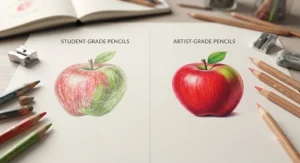
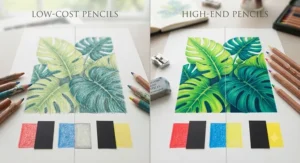
The core difference between cheap vs expensive coloured pencils comes down to four measurable factors: pigment concentration, core softness, binder quality, and lightfastness rating. Budget pencils use more filler (typically kaolin clay or chalk) and less actual colourant, while artist-grade pencils maximise pigment and minimise filler, which is why a single stroke from a premium pencil looks darker and richer than three layers of a budget one.
That difference isn’t marketing spin. As the reference guide on colored pencil composition explains, concentration of pigment in the core, the wood used, lightfastness, and core softness are the primary determinants of both quality and market price. Everything else — barrel shape, packaging, brand prestige — is secondary to those four variables.
Pigment Load: Cheap vs Professional Pencils Explained
Pigment load is the single biggest driver of the price gap when comparing pigment load cheap vs professional pencils side by side, and it’s worth understanding precisely what it means rather than treating it as vague marketing language. Every coloured pencil core is a mixture of colourant, binder (wax or oil), and filler material that bulks out the mixture and keeps costs down.
Budget pencils like Crayola Colouring Pencils and Staedtler Noris Colour 185 use a higher proportion of filler relative to pigment, which is precisely why they need multiple layers to achieve a saturated colour and why that colour still looks slightly chalky or pale even after heavy layering. Premium pencils like Faber-Castell Polychromos and Prismacolor Premier flip that ratio, packing considerably more true pigment into the same volume of core.
The Colored Pencil Society of America, the industry body behind much of the standardised testing in this space, has worked with manufacturers and materials scientists on the ASTM D6901 lightfastness specification, which exists precisely because pigment quality and concentration vary so dramatically between brands and price tiers. This isn’t a subjective “premium feels nicer” claim — it’s measurable, and it’s the entire reason artist-grade pencils cost what they do. Higher pigment concentration also means a single premium pencil often outlasts several budget pencils in terms of usable strokes per pound spent on raw colour coverage, even though the unit price looks steeper upfront.
Is It Worth Spending More on Coloured Pencils?
Whether it’s worth spending more on coloured pencils genuinely depends on what you’re using them for, and the honest answer is: not always, but often, if you’re doing anything beyond casual colouring-book work. Here’s how to weigh it up properly rather than defaulting to “expensive is better.”
If you colour occasionally, work mostly in colouring books with pre-printed lines, or you’re buying for a child, the jump in cost rarely translates into a proportional jump in enjoyment. A Derwent Academy Colouring Pencils set will do the job at a fraction of the cost, and the difference in finished result is genuinely marginal for that use case.
If you’re sketching original work, layering skin tones, building realistic shading, or planning to sell or frame finished pieces, the calculation flips. Reviewers consistently note that artist-grade pigment load and lightfastness genuinely change what’s achievable — smoother gradients, richer darks, and colour that won’t visibly fade on a wall within a few years. Based on the spec comparison across this list, the Derwent Coloursoft tier is where most improving hobbyists get the best return: a real, noticeable jump in vibrancy and blendability without artist-grade pricing.
Student vs Artist Grade Coloured Pencils: What Actually Changes
Comparing student vs artist grade coloured pencils properly means looking past the price tag to what physically changes inside the pencil. It isn’t just “better quality” in a vague sense — three specific things shift measurably between the two grades.
| Factor | Student Grade | Artist Grade |
|---|---|---|
| Pigment concentration | Lower, more filler | High, minimal filler |
| Lightfastness | Often unrated or low | Individually rated, often archival |
| Core consistency | Can vary batch to batch | Tightly controlled |
| Best For | Derwent Academy, learning basics | Faber-Castell Polychromos, saleable work |
Interpreting that table: the pigment and lightfastness rows explain almost all of the price difference on their own, while core consistency is the quieter factor that matters more than beginners expect — a student pencil that lays down unevenly makes it genuinely harder to learn smooth blending technique, ironically working against the very skills a beginner is trying to build. A useful UK-focused breakdown of these tier differences, including how brands like Derwent structure their own ranges from student to professional, is available from this independent coloured pencil comparison guide, which is worth a read if you’re deciding between ranges within a single brand rather than across brands entirely.
The practical takeaway: student-grade pencils are genuinely fine for learning fundamentals like layering, blending order, and value control. Where they fall short is in the final 10-20% of polish that separates a good practice piece from gallery-ready work.
Blendability: How Student Pencils Compare to Artist Grade
Blendability student pencils achieve is real but limited, and understanding why helps explain a lot of beginner frustration with budget sets. Blending works by physically pushing pigment particles together and into the tooth (texture) of the paper, either through layering multiple colours or burnishing with pressure.
Student-grade pencils like Staedtler Noris Colour 185 and Crayola Colouring Pencils have harder, lower-pigment cores, which means there’s simply less colourant available to move around when you blend — you can layer for a long time and still see the paper’s texture showing through. Mid-range pencils like Faber-Castell Colour Grip blend noticeably better because the softer core deposits more pigment per stroke, giving blending tools more material to work with.
At the top end, Prismacolor Premier‘s soft wax core is frequently cited by reviewers as the easiest blending experience on the market, while Faber-Castell Polychromos blends differently rather than worse — its oil-based core requires more patience and more layers, but produces exceptionally smooth results once you build up enough colour. What most buyers overlook is that blending technique matters almost as much as pencil grade: a skilled artist can coax reasonable blends out of student pencils, and a beginner can still get patchy results with premium ones. The pencil lowers the skill ceiling required, but it doesn’t remove the need for technique entirely.
✨ Take Your Colouring to the Next Level
🎨 Whichever tier you’re shopping in, click through on any pencil above to check current pricing and availability before you buy — stock and set sizes shift regularly, and grabbing the right pack size first time saves a returns headache later.
How to Choose Coloured Pencils
Working through these seven criteria in order will get you to the right set faster than scrolling endless review videos:
- Decide your primary use case first. Colouring books, original sketching, and professional illustration each favour different softness and pigment levels — don’t buy for a use case you don’t actually have.
- Check the binder type. Wax-based pencils (most of this list) blend easily and feel soft; oil-based pencils like Faber-Castell Polychromos hold detail better and resist wax bloom.
- Look at core diameter. Thicker cores (Derwent Coloursoft, Prismacolor Premier) cover ground faster; thinner, harder cores suit fine detail.
- Consider open stock availability. Being able to buy individual replacement pencils, rather than a whole new set, saves real money on the colours you’ll burn through fastest (usually skin tones, black, and a couple of blues).
- Match lightfastness to the project. Sketchbook practice doesn’t need archival pigment; framed or sold work absolutely does.
- Factor in barrel comfort for long sessions. If you colour for hours at a time, ergonomic barrels like the Faber-Castell Colour Grip genuinely reduce fatigue.
- Set a realistic budget band and stick to the sweet spot within it. The biggest jump in real-world quality happens moving from budget to mid-range; the jump from mid-range to premium is smaller and matters most for professional or archival work.
Common Mistakes When Buying Coloured Pencils
Even experienced buyers fall into a handful of predictable traps when choosing between cheap vs expensive coloured pencils, and most are easy to avoid once you know what to look for.
The first is buying the biggest set available on the assumption that more colours equals better value. A 150-colour premium set is wasted on someone who hasn’t yet used up a 24-colour budget tin — better to buy a smaller premium set or open-stock individual colours than overspend on range you won’t touch for months. The second common mistake is assuming price alone signals lightfastness; as covered above, some premium pencils vary shade-to-shade, so it’s worth checking individual colour ratings rather than trusting the price tag as a blanket guarantee.
A third mistake, particularly common with first-time buyers, is ignoring paper compatibility. Cheap, thin printer paper pills and tears under heavy layering regardless of how good the pencil is, which unfairly makes a decent pencil look bad. Finally, plenty of buyers skip trying before committing to a full 100+ colour premium set — buying a small starter tin or a handful of open-stock pencils first is the cheapest way to find out whether a brand’s core hardness and blending style actually suits your hand.
Practical Usage Guide: Getting the Most From Any Set
Whichever tier you buy into, a few setup and maintenance habits noticeably extend both the life of your pencils and the quality of your results.
Start by sharpening properly from day one: a good-quality handheld or manual sharpener designed for coloured pencils (rather than a cheap graphite sharpener) reduces core breakage significantly, particularly with softer cores like Prismacolor Premier and Derwent Coloursoft. In the first 30 days, resist the urge to sharpen to an ultra-fine point on soft pencils — a slightly blunter tip is more durable and, for filling larger areas, actually more efficient.
Store pencils flat rather than upright in a jar where possible; this reduces core stress and long-term warping inside the barrel, especially in warmer rooms. For blending, build colour in thin layers rather than pressing hard immediately — this is the single most common beginner mistake, and it applies whether you’re using a £5 tin or a £50 one. If you notice a hazy film developing on heavily layered wax-based work (that’s wax bloom, most common with Derwent Coloursoft and Prismacolor Premier), a soft cloth gently buffs it away without damaging the artwork underneath. Finally, keep a scrap sheet of the same paper you’re working on nearby to test colour combinations before committing them to the final piece — it costs nothing and prevents the most common source of regret in coloured pencil work.
Real-World Scenarios: Which Pencils Suit Which Artist
Matching a real situation to a real product tends to cut through decision paralysis faster than any spec sheet.
If you’re a parent buying for a seven-year-old who mainly colours in books at the kitchen table, Crayola Colouring Pencils or Staedtler Noris Colour 185 cover the need completely — durability and low cost matter far more here than blend quality the child won’t notice yet. If you’re a college art student on a tight budget who needs to practise layering and colour theory daily without destroying your bank account, Derwent Academy Colouring Pencils or the Faber-Castell Colour Grip strike the right balance between real technique development and affordability.
If you’re a hobbyist who’s outgrown your starter set and colours several evenings a week — adult colouring books, botanical studies, portrait practice — Derwent Coloursoft delivers a genuine step up in satisfaction without artist-grade pricing. And if you’re building a body of work you intend to sell, exhibit, or frame, where fading and professional finish genuinely matter, Faber-Castell Polychromos or Prismacolor Premier are the sets that reviewers and working illustrators return to again and again, depending on whether you prioritise precision (Polychromos) or blend speed (Premier).
Upgrading From Budget Coloured Pencils: A Buyer’s Decision Framework
Upgrading from budget coloured pencils doesn’t have to mean jumping straight to a £50 tin, and a simple decision framework makes the next step much clearer.
If your current frustration is pale, chalky colour that won’t saturate no matter how many layers you add, your problem is pigment load, and the fix is a mid-range set like Derwent Coloursoft or Faber-Castell Colour Grip — both solve this specifically without a huge price jump. If your frustration is that colours won’t blend smoothly and edges look streaky, that’s a core-softness problem, and Prismacolor Premier is purpose-built to fix exactly that. If your frustration is that fine detail looks blobby or you can’t get a sharp enough line for eyes, whiskers, or hair, the issue is core hardness, and Faber-Castell Polychromos‘s oil-based formula is the direct answer.
A simple priority checklist: identify the one thing that annoys you most about your current pencils, match it to the category above, and buy a small set or open-stock pencils in that range before committing to a full collection. This targeted approach almost always produces more satisfaction per pound spent than a blanket upgrade to “the most expensive option available.”
Long-Term Cost & Maintenance: The Real Value Equation
| Consideration | Budget Tier | Mid-Range Tier | Premium Tier |
|---|---|---|---|
| Cost per pencil (approx.) | Lowest | Moderate | Highest |
| Strokes of usable colour per pencil | Fewer (softer needed for saturation) | Good | Best (high pigment load) |
| Open stock replacement | Rarely available | Sometimes available | Usually available |
| Best For | Crayola, occasional use | Derwent Coloursoft, regular hobbyists | Polychromos, professional/archival work |
Looking at the table, the “cost per pencil” figure is genuinely misleading on its own, because a premium pencil’s higher pigment concentration means fewer layers are needed to reach full saturation — so the effective cost per finished drawing narrows the gap considerably compared with the sticker price. Open-stock availabili
Pulling together an honest budget coloured pencil review across the three cheapest sets on this list: Crayola Colouring Pencils, Staedtler Noris Colour 185, and Derwent Academy Colouring Pencils all do exactly what their price point promises, and none of them pretend otherwise.
Crayola wins on pure durability and accessibility for young children, but genuinely can’t compete on pigment with anything else here — that’s an honest trade-off, not a flaw. Staedtler Noris Colour 185 improves on barrel durability and consistency for a modest step up in price, making it a sound classroom or homework pencil. Derwent Academy Colouring Pencils is, based on the spec comparison and aggregated reviewer sentiment, the strongest all-round budget performer of the three, offering a meaningfully richer pigment load than the other two while staying comfortably under £20 for a starter set. If you’re genuinely torn between budget options, Derwent Academy is the one most reviewers and art educators recommend as the best “outgrow-proof” starting point.
FAQ
❓ Is it worth spending more on coloured pencils for a beginner?
❓ What's the actual difference between student and artist grade coloured pencils?
❓ Do expensive coloured pencils really blend better than cheap ones?
❓ How long do artist-grade coloured pencils actually last?
❓ Can cheap coloured pencils be used for serious artwork?
Conclusion
There’s no single right answer to cheap vs expensive coloured pencils — there’s only the right answer for what you’re actually going to do with them. A child colouring at the kitchen table doesn’t need archival lightfastness, and a professional illustrator building a portfolio can’t afford to work without it. What matters is matching pigment load, core softness, and lightfastness to your real use case rather than defaulting to the most expensive tin on the shelf out of habit.
Across the seven sets covered here, the honest pattern holds: Crayola Colouring Pencils and Staedtler Noris Colour 185 serve genuine budget needs well; Derwent Academy Colouring Pencils is the standout value pick for anyone stepping up seriously; Faber-Castell Colour Grip and Derwent Coloursoft deliver the biggest real-world quality jump for the money; and Prismacolor Premier and Faber-Castell Polychromos earn their premium pricing through pigment, blend quality, and lightfastness that budget cores simply can’t replicate. Buy for the work you’re actually doing today, not the artist you might become — you can always upgrade later, and by then you’ll know exactly which specific frustration you’re solving for.
Recommended for You
- Cheap Coloured Pencils UK: 7 Budget Sets Worth Buying in 2026
- 7 Best Coloured Pencil Sets for Beginners in 2026 (UK Guide)
- Oil Based vs Wax Based Coloured Pencils: 7 Proven Picks (2026)
Disclaimer: This article contains affiliate links. As an Amazon Associate, I earn from qualifying purchases. If you purchase products through these links, we may earn a small commission at no additional cost to you.
✨ Found this helpful? Share it with your friends! 💬🤗
