In This Article
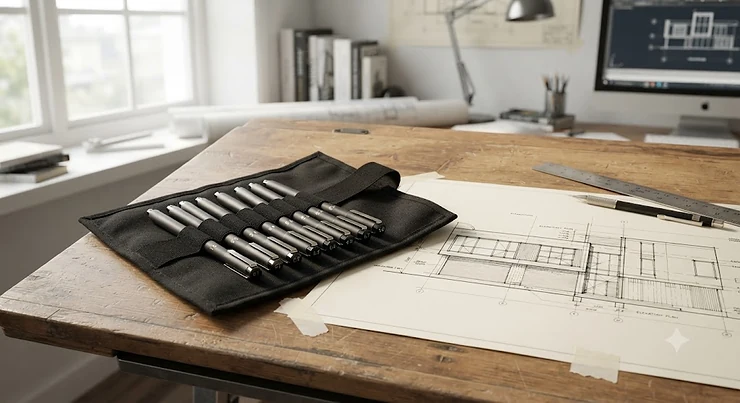
Somewhere between a biro that skips and a fountain pen that leaks onto your cuff sits the humble fineliner — quietly the most underrated tool in any stationery drawer. If you’ve ever hunted for the best fineliner pens and drowned in a sea of near-identical black tubes with baffling numbers on the side (0.03? 0.5? What do these even mean?), you’re not alone. The market is stuffed with options, and the difference between a pen that becomes your daily companion and one that dries out in a drawer by March often comes down to details nobody explains clearly.
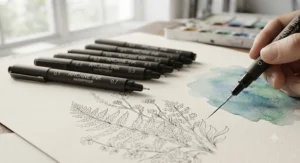
This guide cuts through that noise. We’ve researched seven genuinely good fineliner pens spanning budget, mid-range and premium territory, dug into real specifications, and pulled together what actual reviewers report after weeks (sometimes years) of daily use. Whether you’re bullet journaling, sketching, annotating exam notes, or just tired of ballpoints that smudge under your palm, there’s a pen here that fits. We’ll also unpack the two questions that trip up almost everyone new to fineliners — pigment ink vs dye ink, and why line width (mm) matters more than you’d think — so you’re buying with your eyes open, not just your gut.
What Is a Fineliner Pen?
A fineliner is a felt- or fibre-tipped pen with a narrow, metal-clad nib designed for consistent, precise lines — typically between 0.03mm and 1.0mm wide. Unlike ballpoints, fineliners use free-flowing ink (either pigment- or dye-based) delivered through a porous tip, which is why they glide rather than drag. As Wikipedia’s overview of marker pens notes, this category covers everything from disposable sketching pens to refillable technical drafting tools, and the terminology varies wildly by country — what’s a “fineliner” in the UK might be a “sign pen” elsewhere.
Quick Comparison Table
Before we get into the weeds, here’s the shortcut version. If you read nothing else, read this.
| Pen | Ink Type | Line Width Range | Price Range | Best For |
|---|---|---|---|---|
| Staedtler Pigment Liner | Pigment (archival) | 0.05mm–1.0mm | £2–£20 (single–set) | All-rounder, students & professionals |
| Sakura Pigma Micron | Pigment (archival) | 005–08 (0.2mm–0.8mm approx.) | £2.50–£20 | Beginners wanting precision |
| Faber-Castell Pitt Artist Pen | India ink (pigment) | XXS–B (ultra-fine to brush) | £2–£25 | Illustration & mixed media |
| Stabilo Point 88 | Water-based dye | 0.4mm fixed | £1–£18 | Colour coding, budget buyers |
| Uni Pin Fine Line | Pigment (Super Ink) | 0.03mm–0.8mm + brush | £2–£28 | Technical drawing & watercolour |
| Tombow Mono Drawing Pen | Pigment | 005–08 | £2–£14 | Smooth journaling & manga |
| Staedtler Triplus Fineliner | Water-based dye | 0.3mm fixed | £1–£20 | Colour variety, planners |
A quick read of that table tells its own story: pigment-ink pens dominate the “archival” end of the market, while the two dye-based options — Stabilo Point 88 and Staedtler Triplus Fineliner — trade permanence for eye-watering colour ranges and pocket-friendly prices. Neither approach is objectively “better”; it depends whether you need your lines to survive a house fire in a filing cabinet, or you just want your bullet journal to look nice this month. We’ll unpack exactly why that distinction matters in the pigment ink vs dye ink section below.
💬 Found a pen that matches your workflow already? Skip ahead — otherwise, keep scrolling for the full breakdown.
Top 7 Fineliner Pens: Expert Analysis
We’ve deliberately mixed budget, mid-range and premium picks here, because the “best” fineliner pen genuinely depends on what you’re doing with it. A calligrapher and an architecture student have almost nothing in common, pen-wise.
1. Staedtler Pigment Liner — the archival gold standard
If there’s a pen that stationery obsessives argue about the least, it’s this one. The Staedtler Pigment Liner uses genuinely archival, acid-free pigment ink, and Staedtler’s own CAP OFF technology means it survives being left uncapped for roughly 12 hours without drying out — a real mercy if, like most of us, you get distracted mid-sentence. Available across a striking eleven-to-twelve line widths from 0.05mm hair-fine up to a bold 1.0mm, plus a chisel tip, it’s genuinely one pen family that scales from tiny technical annotation to bold sketch outlining.
What most buyers overlook about this pen is the barrel design: it’s a touch wider than rivals like the Sakura Pigma Micron, with a matte, subtly textured grip that makes long writing sessions noticeably less fatiguing on the hand. A detailed UK stationery review highlights the metal clip and consistent line quality across the whole width range as standout features, alongside the pen’s flight-proof pressure regulation — handy if you sketch on planes. Reviewers on retailer sites consistently report that the ink dries fast enough to avoid smudging even on cheaper copier paper, though a handful note that the thinnest 0.05mm tip is fragile if you press hard.
Pros:
- ✅ Genuinely archival, acid-free pigment ink
- ✅ Widest size range of any pen on this list
- ✅ Comfortable, well-marked barrel for long sessions
Cons:
- ❌ Ultra-fine 0.05mm tip is delicate under pressure
- ❌ Costs more per pen than dye-based rivals
Individual pens sit around £2–£3, while multi-size sets run roughly £15–£20 range. Given the archival ink and range, that’s solid value for anyone who writes or draws seriously.
2. Sakura Pigma Micron — best for beginners chasing precision
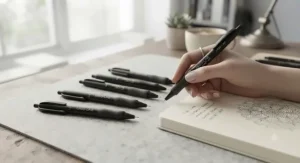
The Sakura Pigma Micron is the pen most likely to appear in a comic artist’s pencil case, and for good reason. Its pigment-based ink is acid-free, waterproof, fade-resistant and, crucially for anyone dabbling in mixed media, pH neutral — meaning it won’t slowly degrade the paper it’s sitting on. Sizes run from an almost absurdly fine 005 up through 08, giving you a genuine spread from hairline detail to bold underlining in a single family.
On paper this means beginners get room to grow: start with a 05 or 08 for confident everyday writing, then experiment with the 003 once your hand’s steadier. Reviewers who’ve tested it against the Staedtler Pigment Liner side by side often note the Micron’s slightly crisper black and marginally smoother glide on very smooth paper, though the reverse is true on textured stock. A common thread in aggregated feedback is that the tips hold their shape well even with regular ruler use, which matters if you’re drafting layouts rather than freehand sketching.
Pros:
- ✅ Huge size range for beginners to experiment with
- ✅ Archival, waterproof, pH-neutral ink
- ✅ Trusted by manga and comic artists worldwide
Cons:
- ❌ Slightly pricier than Staedtler at the wider tip sizes
- ❌ Tips can fray if used constantly on rough watercolour paper
Single pens typically fall in the £2.50–£3.50 range, with sets of assorted sizes closer to £12–£20. For a first “proper” fineliner, it’s hard to go wrong here.
3. Faber-Castell Pitt Artist Pen — the illustrator’s premium choice
Where the previous two pens are workhorses, the Faber-Castell Pitt Artist Pen leans into artistry. It uses genuine India ink — pigment-based, waterproof once dry, and lightfast — packaged in a design that’s odourless and pH neutral. The size range stretches from XXS (extra-extra-superfine) right through to a soft brush tip, which is unusual; most fineliners stop at a fixed fine width, but Faber-Castell lets you move seamlessly from precise linework to expressive brush strokes without switching pen families entirely.
What the spec sheet won’t tell you, but reviewers note repeatedly, is how well the India ink behaves under watercolour washes once fully dry — it simply doesn’t budge, which is exactly what illustrators and architecture students need when layering colour over line art. This is genuinely a premium pick: the brush-tip variants and wallet sets cost more than most rivals here, but for anyone doing paid illustration work or serious portfolio pieces, the versatility earns its keep.
Pros:
- ✅ Widest tip-style range (fine to full brush) on this list
- ✅ India ink holds firm under watercolour washes
- ✅ Odourless formula, comfortable for long studio sessions
Cons:
- ❌ Premium pricing, especially for brush-tip variants
- ❌ Overkill if you only need basic note-taking
Individual pens sit around £2–£3, while curated wallet sets of eight or more climb toward the £18–£25 range. Worth it if illustration is genuinely your thing.
4. Stabilo Point 88 — Europe’s best-selling budget fineliner
Here’s where the pigment ink vs dye ink conversation gets interesting. The Stabilo Point 88 uses water-based dye ink rather than pigment, and it shows — this isn’t an archival pen, and Stabilo doesn’t claim otherwise. What it does instead is colour, spectacularly. With a fixed 0.4mm line width but a colour range stretching into the dozens (some retailers list up to 65 shades), it’s become the default choice for colour-coded students, bullet journalers and anyone who thinks in highlighter-adjacent categories.
Here’s what most buyers overlook: that fixed 0.4mm width is actually a strength for beginners, because you’re not paralysed by choosing between eleven sizes — you just pick a colour and go. The hexagonal barrel is genuinely comfortable for long writing stretches, and the metal-encased tip holds up well against rulers and stencils despite the low price. One recurring theme in aggregated reviews is mismatched cap colours between very similar shades, a minor but real annoyance if you’re colour-sorting by eye.
Pros:
- ✅ Enormous colour range for coding and creativity
- ✅ Extremely comfortable hexagonal grip
- ✅ Among the cheapest fineliners on this list
Cons:
- ❌ Dye ink is not archival or fully lightfast
- ❌ Only one fixed line width available
Individual pens are typically around £1–£1.50, with wallets of 10–30 pens ranging roughly £10–£18. For colour-hungry beginners on a budget, it’s genuinely brilliant value.
5. Uni Pin Fine Line — best value for technical and watercolour work
The Uni Pin Fine Line, from Uni-ball, is the pen that quietly does everything the premium brands do at a friendlier price point. It uses Uni’s proprietary Super Ink — waterproof, fade-resistant, and genuinely archival-quality — across a size range from 0.03mm needle-fine right up to 0.8mm plus a brush tip. Steel-supported nibs keep their shape under the kind of pressure that would flatten a cheaper tip within weeks.
Based on the spec comparison with the Staedtler Pigment Liner and Sakura Pigma Micron, the Uni Pin holds its own on every archival metric while typically undercutting both on set pricing — a detail that’s easy to miss unless you’re actively comparing per-pen costs. It’s particularly well regarded for watercolour work: once the ink is dry, you can paint straight over the linework without any bleed or smudge, which is exactly why art college shops stock it alongside premium alternatives. Reviewers frequently mention it as an underrated pick precisely because it lacks the brand recognition of Staedtler or Sakura despite comparable performance.
Pros:
- ✅ Archival-quality, watercolour-safe ink at a lower price
- ✅ Steel-supported nibs resist wear
- ✅ Widest affordable size range including a brush tip
Cons:
- ❌ Less widely stocked in UK high-street shops
- ❌ Brush tip variant needs a lighter hand to control
Single pens run around £2–£2.50, and full 12-pen sets typically land in the £20–£28 range — genuinely competitive for the archival quality on offer.
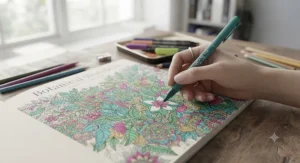
6. Tombow Mono Drawing Pen — smoothest ink flow for journaling
The Tombow Mono Drawing Pen is the pen people switch to and then quietly stop buying anything else. Its pigment-based black ink is smudge- and water-resistant once dry, delivered through a long metal tip that Tombow specifically engineers for consistent flow even under firm pressure. Sizes split into two families — a Fine set (005, 01, 03, 05) for detail work and a Bold set (02, 04, 06, 08) for punchier lines — covering most everyday needs between them.
Reviewers who’ve used both this and the Sakura Pigma Micron for years tend to describe the Mono as the smoother writer of the two, with less resistance dragging across the page, which matters enormously if you’re journaling daily rather than sketching occasionally. What most buyers overlook is how well it performs in humid conditions — the ink resists the slight smearing that can plague cheaper drawing pens on damp days. The trade-off is a narrower size spread than Staedtler or Uni Pin, so dedicated technical draughters may find themselves wanting an extra size or two.
Pros:
- ✅ Exceptionally smooth, low-drag ink flow
- ✅ Reliable performance in humid conditions
- ✅ Reasonably priced for a pigment-ink pen
Cons:
- ❌ Fewer size options than Staedtler or Uni Pin
- ❌ Bold and Fine sizes sold as separate sets
Single pens are typically £2–£2.50, with four-pen sets around £10–£14 — solid mid-range value.
7. Staedtler Triplus Fineliner — best colour variety for planners
Rounding out the list, the Staedtler Triplus Fineliner is the dye-ink counterpart to Staedtler’s own archival pigment liner, and the two couldn’t be more differently purposed. Fixed at a 0.3mm line width, it uses water-based ink that dries in about a second and offers only slight water resistance — this is not the pen for archival documents. What it is, is colourful: the range runs to dozens of shades, all housed in a distinctive triangular barrel designed for comfortable extended grip, particularly popular among people who do a lot of handwriting.
Here’s what most buyers overlook: that triangular shape genuinely reduces hand fatigue compared with round-barrelled dye pens, something planner and bullet-journal communities mention constantly in aggregated feedback. The trade-off, as with the Stabilo Point 88, is that the dye ink can smear slightly under highlighters and isn’t remotely archival — so treat it as a decorative, everyday-writing pen rather than one for anything you need to last decades.
Pros:
- ✅ Ergonomic triangular barrel reduces hand fatigue
- ✅ Vast colour range ideal for planners and trackers
- ✅ Fast-drying, slightly water-resistant ink
Cons:
- ❌ Not archival — dye ink fades over time
- ❌ Smears slightly under highlighter pens
Single pens sit around £1–£1.50, with large multi-colour sets typically in the £10–£20 range depending on pack size.
Full Spec Comparison: The Top 7 Products
| Pen | Ink Type | Archival? | Colour Range | Price Range | Rating Signal |
|---|---|---|---|---|---|
| Staedtler Pigment Liner | Pigment | Yes | Limited (mostly black) | £2–£20 | Consistently praised |
| Sakura Pigma Micron | Pigment | Yes | Limited (colour sets exist) | £2.50–£20 | Artist favourite |
| Faber-Castell Pitt Artist Pen | India ink | Yes | Wide | £2–£25 | Premium, illustration-focused |
| Stabilo Point 88 | Dye | No | Extensive (up to 65) | £1–£18 | Widely used, budget favourite |
| Uni Pin Fine Line | Pigment | Yes | Limited | £2–£28 | Underrated, strong value |
| Tombow Mono Drawing Pen | Pigment | Yes | Limited | £2–£14 | Smooth-flow favourite |
| Staedtler Triplus Fineliner | Dye | No | Extensive | £1–£20 | Planner community favourite |
Looking at that table, a clear split emerges: five of the seven pens — Staedtler Pigment Liner, Sakura Pigma Micron, Faber-Castell Pitt Artist Pen, Uni Pin Fine Line and Tombow Mono Drawing Pen — are pigment-based and archival, while Stabilo Point 88 and Staedtler Triplus Fineliner trade permanence for colour range and price. If your work needs to survive filing, framing or scanning years from now, stick to the archival five; if you’re colour-coding a diary you’ll replace next January, the dye pens are genuinely better value.
Pigment Ink vs Dye Ink: What Actually Matters
This is the single most misunderstood distinction in fineliner shopping, so let’s clear it up properly. Pigment ink suspends solid colour particles in a liquid carrier; once dry, those particles sit on the paper surface and don’t dissolve back into water, which is why pigment pens like the Staedtler Pigment Liner and Sakura Pigma Micron are waterproof and fade-resistant. Dye ink, by contrast, is fully dissolved in the liquid — it produces richer, more vibrant colours (hence why brands like Stabilo Point 88 and Staedtler Triplus Fineliner lean so heavily on huge colour ranges) but remains vulnerable to water and UV fading long-term.
Based on the spec comparison across all seven pens here, the practical rule of thumb is this: if a document, sketch or record needs to survive years of handling, sunlight, or accidental spills, choose pigment. If you’re colouring a weekly planner you’ll bin in December, dye ink’s brighter palette and lower cost make more sense. Winsor & Newton’s UK guide to ink permanence notes that even within pigment-based formulations, lightfastness ratings vary — so “pigment” alone isn’t a guarantee of true archival quality, though it’s a strong indicator. Reviewers testing both ink types under identical conditions consistently find that pigment inks resist smudging under highlighter pens far better than dye-based alternatives, a detail that matters enormously for anyone who colour-codes notes.
Understanding Line Width (mm): A Buyer’s Cheat Sheet
Line width is the specification that trips up more first-time buyers than any other, mostly because manufacturers label it inconsistently — some use millimetres directly (0.3mm), others use a numbering system (Sakura’s “005” or “08”) that doesn’t map obviously onto anything. Here’s the practical translation:
| Labelled Size | Approximate Width | Best Use |
|---|---|---|
| 0.03mm–0.1mm | Hair-fine | Tiny detail, technical drafting, manga screentone |
| 0.2mm–0.3mm | Extra fine | Handwriting, note annotation, fine sketching |
| 0.4mm–0.5mm | Fine (most common) | Everyday writing, general sketching, journaling |
| 0.6mm–0.8mm | Medium/bold | Underlining, bold outlines, poster lettering |
| 1.0mm+ | Broad | Heavy outlining, block lettering |
What most buyers overlook is that a single line-width number doesn’t tell the whole story — paper texture changes how a line reads. On rough watercolour paper, a 0.3mm nib can lay down a line that looks closer to 0.5mm on smooth cartridge paper, simply because the fibres catch more ink. Reviewers who’ve tested identical widths across brands consistently note that the Staedtler Pigment Liner and Uni Pin Fine Line run marginally truer to their stated width than dye-based pens like the Staedtler Triplus Fineliner, whose fixed 0.3mm can bloom slightly wider on absorbent paper. If you’re buying your first set, a 0.3mm–0.5mm pen covers roughly 80% of everyday writing and sketching needs — start there before investing in the extremes.
Fineliner Pens for Beginners
If you’re newly into journaling, sketching, or just tired of your current pen collection, the temptation is to buy the biggest multi-size set available. Resist it. Here’s a leaner approach that actually works for people starting out.
Start with a single mid-width pen — a 0.3mm or 0.5mm from either the Sakura Pigma Micron or Stabilo Point 88, depending on whether you want archival permanence or a splash of colour. Both are widely regarded as forgiving, beginner-friendly starting points precisely because they don’t demand a steady, practised hand the way ultra-fine 0.03mm tips do. Once you’ve used that one pen daily for a few weeks and have a feel for how much pressure it needs, expand outward: add a second, contrasting width for detail or emphasis, then consider whether you actually need pigment ink’s archival properties or whether dye ink’s brighter colours suit your project better.
A common beginner mistake, according to aggregated reviewer feedback, is pressing too hard on thin nibs, which splays the fibre tip and ruins the line quality within weeks. If you notice your handwriting naturally presses firmly into the page — check the back of a written sheet for raised indentation — start with a slightly broader 0.5mm–0.7mm pen rather than anything below 0.3mm, and your pens will last considerably longer.
✨ Don’t Miss These Exclusive Deals!
🔍 Take your stationery collection to the next level with these carefully selected fineliner pens. Click on any highlighted item to check current pricing and availability. These pens will help you create the authentic, precise journals and sketches you’ve been aiming for!
Archival Quality Explained: Why It Matters for Your Work
“Archival quality” gets thrown around loosely in stationery marketing, so it’s worth being precise about what it actually means. A genuinely archival ink is acid-free (so it won’t chemically degrade the paper over decades), lightfast (resistant to UV fading), and typically waterproof once dry. Pigment-based pens like the Staedtler Pigment Liner, Sakura Pigma Micron, Faber-Castell Pitt Artist Pen, Uni Pin Fine Line and Tombow Mono Drawing Pen all meet this bar to varying degrees, while dye-based pens like Stabilo Point 88 and Staedtler Triplus Fineliner explicitly don’t claim archival status.
Why does this matter beyond artists? Anyone keeping records, filling in family history documents, annotating legal paperwork, or building a sketchbook they hope to still enjoy in twenty years should care. Institutions that manage genuinely permanent paper records take this seriously — guidance on record creation and permanent ink consistently recommends good permanent black ink or archival pens over standard dye pens, specifically because dye ink degrades and can even affect the paper it sits on over long storage periods. If you’re archiving anything that matters — from a research journal to a family recipe book — the modest extra cost of a pigment pen over a dye one is genuinely worth paying. For everyday to-do lists and colour-coded planners you’ll replace within the year, that extra archival insurance is simply unnecessary spend.
How to Choose the Best Fineliner Pens
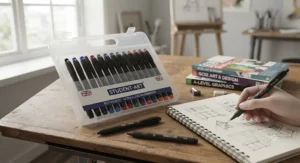
Cutting through the marketing, here’s the actual decision process worth following, based on the spec and review comparison above:
- Decide if permanence matters. If your work needs to last, prioritise pigment ink over dye — full stop.
- Pick a starting line width. For general use, 0.3mm–0.5mm covers most needs; go thinner only for detail work you’re already confident with.
- Check the tip material. Metal-clad tips (found on Staedtler, Uni Pin and Tombow pens) survive ruler and stencil use far better than unshielded fibre tips.
- Consider your paper. Textured watercolour paper wears tips faster than smooth cartridge or copier paper — factor that into how many pens you’ll need.
- Weigh colour needs against archival needs. You genuinely can’t maximise both in one pen family; decide which matters more for this specific project.
- Buy a single pen before committing to a set. Test the feel and flow before spending on a full range you might not use.
- Factor in cap-off time. If you’re forgetful about recapping, pens like the Staedtler Pigment Liner (roughly 12 hours uncapped) will forgive you more than cheaper alternatives that dry out in minutes.
Common Mistakes When Buying Fineliner Pens
Even careful shoppers stumble on a handful of recurring traps here. The most common is assuming every “fine” or “extra fine” label means the same width across brands — as covered above, it genuinely doesn’t, and buying based on the word “fine” alone rather than the actual millimetre spec leads to disappointment. A close second is buying an enormous multi-pack before establishing whether you’ll actually use every width; reviewers frequently mention half-used 24-pen sets gathering dust because only three or four sizes ever got picked up regularly.
Another frequent misstep is choosing dye-based colour sets like the Staedtler Triplus Fineliner for work that later needs to be scanned, photocopied, or kept long-term, only to discover the colours have shifted or bled after a few years. Finally, plenty of buyers skip checking whether a pen is genuinely waterproof versus merely “water-resistant” — the two terms sound similar but behave very differently once you add a watercolour wash or an accidental coffee spill.
Fineliners vs Traditional Ballpoint & Gel Pens
| Feature | Fineliners | Ballpoint Pens | Gel Pens |
|---|---|---|---|
| Line consistency | Very high | Moderate (skips when low) | High |
| Drying speed | Fast, low smudge | Moderate | Slow, smudge-prone |
| Archival ink options | Yes (pigment variants) | Rarely | Occasionally |
| Best for detail work | Excellent | Poor | Moderate |
| Typical price per pen | £1–£3 | £0.50–£2 | £1–£3 |
The analysis here is fairly clear-cut: fineliners win decisively on line consistency and detail work, which is exactly why they’ve become the default for sketching, technical annotation and precise handwriting. Ballpoints remain cheaper and more forgiving for rough daily scribbling since they don’t dry out if left uncapped, while gel pens sit in an awkward middle ground — vivid colour like a fineliner, but slower drying times that invite smudging, especially for left-handed writers dragging their hand across the page. If precision and permanence matter more to you than raw ink vibrancy, fineliners are the clear winner.
Practical Usage Guide: Getting the Most from Your Fineliners
Getting real longevity out of a fineliner comes down to a handful of habits most people never think about. First, always recap immediately after use, even with forgiving pens like the Staedtler Pigment Liner — cap-off time is a safety margin, not a target. Second, store pens horizontally rather than upright nib-down; gravity pooling ink at the tip over months can cause blotting when you next uncap it. Third, avoid pressing hard on ultra-fine tips (0.03mm–0.1mm); let the ink do the work rather than forcing the line, which both preserves tip shape and reduces hand fatigue over long sessions.
For maintenance beyond day-to-day care, rotate through your pen collection rather than leaving some untouched for months — fibre tips that sit unused for long stretches are more prone to drying unevenly than ones in regular rotation. If you notice a pen skipping or laying down patchy colour, try scribbling firmly on scrap paper for a few seconds before your actual work; this often re-primes the ink flow. Common first-30-days mistakes include buying a huge multi-size set and immediately testing every width on the same page (which tells you little about how each performs in actual use) and storing pens in direct sunlight or a hot car, which accelerates ink degradation regardless of whether it’s pigment or dye-based.
Real-World Scenarios: Which Fineliner Fits Your Life
Picture three different people shopping for the same “best fineliner pens” search. A college student annotating dense reading needs speed and reliability above all — the Sakura Pigma Micron in a 0.3mm–0.5mm width suits daily, heavy-use annotation without drying out mid-lecture. A freelance illustrator building a portfolio, working across sketches, watercolour washes and client-facing artwork, needs the versatility of the Faber-Castell Pitt Artist Pen‘s range from XXS to brush tip, since one pen family can carry an entire project from thumbnail to finished piece.
Meanwhile, a bullet-journal enthusiast who colour-codes everything from workouts to birthdays cares far more about range and vibrancy than archival permanence, making Stabilo Point 88 or the Staedtler Triplus Fineliner genuinely better fits despite their non-archival ink — because the journal gets replaced every twelve months anyway, permanence simply isn’t the priority it would be for the illustrator or the archivist. Matching the pen to the actual use case, rather than chasing the single “best” pen in the abstract, is the difference between a purchase that gets used daily and one that ends up in a drawer.
Problem → Solution: Fixing Common Fineliner Frustrations
Problem: Ink bleeding through thin paper. Solution: switch to a pigment-based pen like the Uni Pin Fine Line or Tombow Mono Drawing Pen, both of which are formulated to sit on the surface rather than saturate the fibres, and consider slightly heavier paper (100gsm+) if bleed persists.
Problem: Tip splaying or fraying after a few weeks. Solution: reduce writing pressure and switch to a metal-clad tip pen such as the Staedtler Pigment Liner, whose reinforced nib resists deformation far better than unshielded fibre tips.
Problem: Colours fading after storage. Solution: this is almost always a dye-ink issue — swap colour sets like the Staedtler Triplus Fineliner for archival alternatives if the work needs to last, and keep finished pieces out of direct sunlight regardless of ink type.
Problem: Smudging under highlighters. Solution: pigment-based pens resist this far better than dye pens; if you must use dye-based colour pens like Stabilo Point 88, let the ink fully cure for a few minutes before highlighting over it.
Problem: Pens drying out between uses. Solution: prioritise pens with documented cap-off tolerance, such as the Staedtler Pigment Liner’s roughly 12-hour window, and always store capped pens horizontally to prevent ink pooling at the tip.
Long-Term Cost & Maintenance
Fineliners are disposable by design, which makes total cost of ownership more about usage frequency than any single purchase. A daily journaler working through a 0.3mm–0.5mm pigment pen might exhaust one Sakura Pigma Micron every two to three months depending on paper texture and pressure, putting annual spend somewhere in the £10–£15 range for a single-pen habit — genuinely modest against the cost of, say, a fountain pen’s ongoing ink refills. Colour-coding enthusiasts running through a full Stabilo Point 88 wallet see costs rise with the number of colours in rotation, though the lower per-pen price partly offsets that.
Where cost-per-use gets interesting is comparing archival and non-archival pens for work that needs to last: replacing a faded dye-based journal entry years later costs far more in time and frustration than the few extra pence a pigment pen would have cost upfront. For professional or archival use, the Uni Pin Fine Line‘s combination of lower set pricing and genuine archival ink quality gives it a notably strong long-term value profile compared with premium alternatives like the Faber-Castell Pitt Artist Pen, whose brush-tip variants command a real premium for capabilities casual users may never fully use.
FAQ
❓ What line width is best for everyday handwriting?
❓ Are fineliner pens the same as felt-tip pens?
❓ Do fineliner pens dry out if left uncapped?
❓ Is pigment ink better than dye ink for fineliners?
❓ Can fineliner pens be used with watercolour paint?
Conclusion
There’s no single best fineliner pen — only the best fineliner pen for what you’re actually doing. If permanence and precision matter, the Staedtler Pigment Liner and Sakura Pigma Micron remain genuinely dependable, archival-quality choices that suit everything from note-taking to fine illustration. If you’re chasing colour and don’t need decades of longevity, Stabilo Point 88 and the Staedtler Triplus Fineliner deliver enormous value for very little outlay. And if you want the versatility to move between precise linework and expressive brush strokes, the Faber-Castell Pitt Artist Pen earns its premium price tag.
Whichever direction you go, start with a single pen in a mid-range width before committing to a full set — it’s the cheapest, lowest-risk way to find out whether a pen actually suits your hand and your habits. The best fineliner pens aren’t the ones with the flashiest packaging; they’re the ones still sitting on your desk, uncapped and in daily use, six months from now.
Recommended for You
- Cheap vs Expensive Coloured Pencils: 7 Picks Tested for 2026
- Cheap Coloured Pencils UK: 7 Budget Sets Worth Buying in 2026
- 7 Best Coloured Pencil Sets for Beginners in 2026 (UK Guide)
Disclaimer: This article contains affiliate links. As an Amazon Associate, I earn from qualifying purchases. If you purchase products through these links, we may earn a small commission at no additional cost to you.
✨ Found this helpful? Share it with your friends! 💬🤗
