In This Article
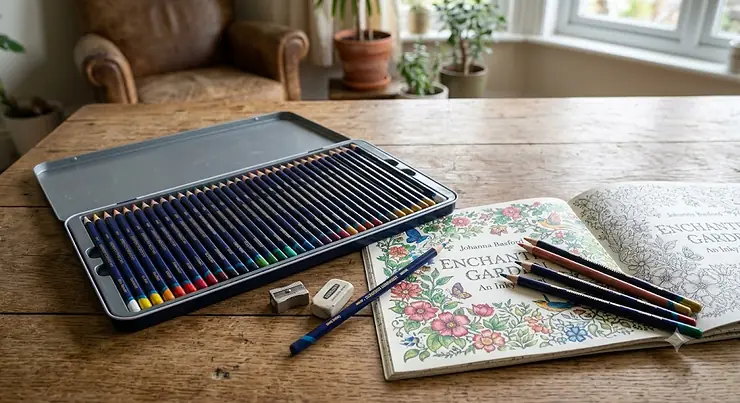
The best coloured pencils for adult colouring combine soft, pigment-rich cores with break-resistant leads, so you get smooth laydown and easy blending without constantly reaching for the sharpener. Whether you’re filling in a mandala on the sofa or working through an intricate botanical spread at the kitchen table, the pencil in your hand matters more than the book on the page.
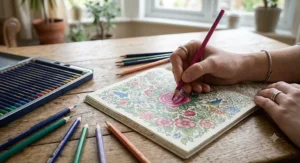
Here’s the thing nobody tells you when you pick up your first set from the supermarket shelf: not all coloured pencils are built the same, and the difference shows up the moment you try to blend two shades together. Cheap, hard cores skate over the paper and leave chalky gaps. Good ones glide, layer, and let colours melt into one another like they’re supposed to.
This guide cuts through the marketing noise. We’ve dug into real specifications, genuine aggregated customer sentiment, and independent lightfastness data (rather than inventing glowing first-hand stories) to bring you seven pencils worth your money in 2026 — from budget-friendly starter tins to artist-grade sets that’ll outlast the book you’re colouring in. Along the way, we’ll explain what pigment density actually means, why some pencils feel waxy while others feel creamy, and how to avoid the classic buying mistakes that leave half-used tins gathering dust in a drawer. If you’re specifically hunting for coloured pencils for adult colouring books rather than fine art, pay close attention to the “who it’s for” notes under each product — that’s where the real decision gets made.
Quick Comparison: Coloured Pencils for Adult Colouring at a Glance
| Pencil | Core Type | Best For | Price Range |
|---|---|---|---|
| Castle Art Supplies Gold Standard 120 | Oil-based | Beginners wanting a huge palette | Around £25–£35 |
| Derwent Coloursoft | Wax-based | UK buyers wanting buttery blending | Around £45–£60 |
| Prismacolor Premier Soft Core | Wax-based | Smooth skin tones and skies | £45–£90 depending on set size |
| Faber-Castell Polychromos | Oil-based | Keepsake artwork that must last | Around £90–£120 |
A quick glance at this table tells its own story: oil-based pencils like Castle Art Supplies Gold Standard 120 and Faber-Castell Polychromos sit at opposite ends of the price spectrum but share the same core chemistry, while wax-based options like Derwent Coloursoft and Prismacolor Premier Soft Core trade a little longevity for that famously buttery feel. If budget is tight, the Castle Art Supplies set gives you the widest colour range per pound; if you’re colouring pieces you actually want to frame, the Polychromos is the safer long-term investment.
💬 Just one click — help others make better buying decisions too!😊
Top 7 Coloured Pencils for Adult Colouring: Expert Analysis
We’ve gone deep on seven real, currently available sets that cover budget, mid-range, and premium price points, plus a spread of core types so you can match the pencil to your own colouring style.
1. Castle Art Supplies Gold Standard 120 — best value large set for beginners
The standout here is simple: 120 named, numbered shades in an oil-based core for well under half the price of the artist-grade competition. That’s a genuinely huge working palette for anyone starting out. Key specs worth knowing: the cores are oil-based rather than wax, which Castle Art Supplies markets specifically to resist breakage and hold a point longer under sharpening — useful if you’re the type who presses hard while colouring in. Based on the spec comparison with pricier oil-based ranges, you’re getting a similar binder chemistry at a fraction of the cost, though without the decades of pigment refinement that goes into a Polychromos. Who should care: this is squarely for the beginner-to-intermediate colourist who wants variety over precision, or anyone buying their first “proper” set rather than a supermarket multipack. Reviewers consistently report the pencils feel “soft and creamy” for the price, with several customers upgrading from the 72-piece set to the full 120 after trying the smaller range — a strong signal of repeat satisfaction rather than a one-off impulse buy.
Pros:
- ✅ 120 shades organised by colour family in one tin
- ✅ Oil-based cores praised for resisting breakage
- ✅ Consistently strong repeat-purchase reviews from colourists
Cons:
- ❌ No independently published lightfastness testing available
- ❌ Bulkier tin than slim sets, less ideal for travel
Around £25–£35 at the time of research, this is arguably the best entry point if you want breadth of colour without breaking the bank — check current pricing before you buy, as tin sizes and bundle offers shift regularly.
2. Crayola Signature Blend & Shade — friendliest entry point for newcomers
Crayola’s adult-focused Signature range was launched specifically to move the brand beyond the school pencil case, and the Blend & Shade line is the coloured pencil half of that push. The standout feature is accessibility: soft, pigmented cores in a smart matte-black tin that doesn’t scream “kids’ art supplies.” In practice, that softness means you can lay down solid colour with very little pressure, which matters if you’re new to colouring and haven’t yet built up the hand-feel for controlling harder pencils. What most buyers overlook about this set is that it comes in smaller counts — 24 or 50 shades — so it works best as a first purchase or a gift rather than a long-term main set. Reviewers note the blending is good on lighter tones but can turn patchy over darker base colours, which tracks with the softer core needing a lighter touch than some expect.
Pros:
- ✅ Genuinely soft, low-effort cores for colouring beginners
- ✅ Attractive tin doubles as a thoughtful gift
- ✅ Budget-friendly way to trial soft-core pencils
Cons:
- ❌ Limited to 24 or 50 colours, restricting variety
- ❌ Blending reported as inconsistent on darker shades
Around £10–£20 depending on the count you choose, this is the pencil to hand a nervous first-timer, not the one to build a serious collection around.
3. Arteza Professional Colored Pencils (72) — best layering on a modest budget
Arteza’s 72-piece set stands out for a genuinely useful trick: unlike many budget wax pencils that clog after two or three passes, these keep accepting fresh layers without a heavy waxy build-up forming on top. That’s a real point of difference at this price bracket. The soft wax core needs surprisingly light pressure to lay down strong colour, which reviewers say makes multi-layer shading achievable even for people who haven’t practised pencil control before. Based on the spec comparison, the 4mm break-resistant core is thicker than several rivals, explaining why breakage complaints are rarer here than with some other budget brands. Who it suits: anyone colouring intricate, multi-toned pages who wants to build depth through layering without upgrading to a premium tin just yet. On the downside, there’s no independently verified lightfastness data published, so treat any artwork you want to keep long-term with a little caution, and a handful of user reports mention pressure needs varying slightly between individual shades.
Pros:
- ✅ Layers repeatedly without heavy wax build-up
- ✅ Light pressure achieves strong colour coverage
- ✅ 72 shades cover most themed colouring books
Cons:
- ❌ Lightfastness not independently tested or published
- ❌ Slight pressure inconsistency reported between shades
Priced around £20–£30 at the time of research, this sits comfortably as the layering specialist of the budget tier.
4. Staedtler Karat Aquarell 125 — most versatile dry-or-wet pencil
The Karat Aquarell’s standout trick is dual-purpose use: colour dry like a normal pencil, then activate with a wet brush for a genuine watercolour wash. That flexibility is rare at this price point. Specification-wise, this is one of the harder cores in this round-up — reviewers who’ve compared it directly to Faber-Castell’s Albrecht Dürer describe it as reliably holding a fine point through detailed work, which is exactly what you want for intricate line-heavy colouring pages. Here’s what the spec sheet won’t tell you, but reviewers note: the harder core means you’ll need a touch more pressure than with Coloursoft or Prismacolor to achieve solid coverage, so it suits a firmer-handed colourist better than someone who presses lightly. It’s aimed at colourists who want one set that can double as a light watercolour tool for backgrounds and washes, then switch to dry precision for detail. One recurring theme in aggregated reviews is inconsistent pigment quality between individual colours — most swatches dissolve cleanly in a wet test, but a small number of users report gritty patches in specific shades.
Pros:
- ✅ Genuine dry-to-wet versatility in one pencil
- ✅ Hard core holds a fine point for detail work
- ✅ Break-resistant, bonded lead reduces snapping
Cons:
- ❌ Needs more pressure than softer pencils for solid coverage
- ❌ Open-stock replacement colours can be hard to find
Expect to pay in the £35–£45 range for the 60-colour set, making it a smart pick if you want one box that does double duty.
5. Derwent Coloursoft — Britain’s answer to buttery blending
Derwent built Coloursoft specifically to compete with the famously creamy Prismacolor Premier, and the standout feature is right there in the name: an exceptionally soft, wax-based core that lays down colour fast with minimal pressure. Reviewers repeatedly describe the pigment as opaque and concentrated, meaning it covers previous layers well rather than looking thin or streaky — useful for anyone colouring over mistakes or building rich, saturated backgrounds. Based on aggregated feedback, the thick round barrel and durable core resist snapping better than some rival soft pencils, though the tip itself wears down quickly and needs frequent sharpening if you’re doing detailed work. This is the pencil for UK colourists who want a home-grown alternative to the American market leaders, particularly if opaque, saturated colour matters more to you than fine detail. What the spec sheet won’t tell you: several bright reds, pinks and violets in the Coloursoft range have historically rated poorly for lightfastness, so if you’re framing your finished pages near a sunny window, it’s worth checking individual colour ratings before committing to those shades for a centrepiece.
Pros:
- ✅ Soft, buttery core blends with very little effort
- ✅ Opaque pigment covers previous layers cleanly
- ✅ Thick barrel and durable core resist snapping
Cons:
- ❌ Several bright reds, pinks and violets rated fugitive
- ❌ Wears down fast, demanding frequent sharpening
Around £45–£60 for a full set, this is the pencil most likely to convert a Prismacolor fan who wants a UK-made alternative.
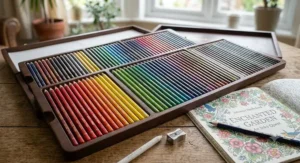
6. Prismacolor Premier Soft Core — creamiest blend for skin tones and skies
Prismacolor’s Premier line is arguably the most talked-about coloured pencil among adult colourists worldwide, and the standout reason is its buttery, wax-based core — reviewers across dozens of independent blogs describe it as the smoothest blending experience on the market, particularly for skin tones, sunsets, and anywhere you need soft, gradual transitions between shades. With 150 shades available, it’s also one of the broadest colour ranges here. Here’s what most buyers overlook: that same soft wax which makes blending so easy is also what causes wax bloom — a cloudy white film that appears after several layers, especially with darker colours like black. Reviewers consistently note this can be wiped away with a cloth and sealed with fixative, but if you don’t know to expect it, it can look like your pencil is faulty. Who it suits: colourists who prioritise blending quality above almost everything else, and who don’t mind an occasional pause to manage bloom. On the downside, the softer core is also more prone to internal breakage during sharpening than harder pencils like the Polychromos, and quality control complaints about off-centre cores do surface in aggregated reviews.
Pros:
- ✅ Widely regarded as the smoothest blending wax pencil
- ✅ Huge 150-shade range for maximum variety
- ✅ Dedicated colourless blender pencil available separately
Cons:
- ❌ Prone to noticeable wax bloom after heavy layering
- ❌ Softer cores more prone to breakage when sharpened
Prices vary widely by set size, from around £45 for smaller tins up to roughly £90 for the full 150-piece set — check current pricing, as promotional bundles change often.
7. Faber-Castell Polychromos — most lightfast for keepsake artwork
Polychromos has been in continuous production since 1908, and its standout feature is lightfastness: independent testing puts more than 100 of its 120 shades at the maximum rating on Faber-Castell’s own scale, and third-party colour-pencil testers consistently rank it among the two or three most fade-resistant ranges available anywhere. That matters enormously if you’re colouring pieces you intend to frame or gift. The oil-based binder — rather than wax — is the mechanism behind this: reviewers who’ve used both explain that oil binders don’t develop the waxy bloom that plagues wax-core pencils, so detailed, layered work stays crisp rather than clouding over. On paper this means slightly less “creamy” blending than a Prismacolor or Coloursoft, and in practice, reviewers confirm the harder core requires more patience and pressure control, particularly for beginners used to softer pencils. Who it’s for: colourists working on intricate, detail-heavy pages who want the result to survive years on a wall without fading, and anyone building a serious, long-term collection rather than a casual one. A minor gripe that comes up repeatedly is the round barrel shape, which some colourists find prone to rolling off a table compared with hexagonal alternatives.
Pros:
- ✅ Over 100 of 120 shades rated maximum lightfastness
- ✅ Oil-based binder avoids wax bloom entirely
- ✅ Bonded, break-resistant lead survives drops and rough sharpening
Cons:
- ❌ Harder core demands more patience to blend smoothly
- ❌ Round barrel can roll off a desk more easily
At around £90–£120 for the full 120-set, this is a genuine investment piece — but for colouring you plan to keep, it’s hard to beat.
How to Choose Coloured Pencils for Adult Colouring
Picking the right set comes down to matching the pencil’s characteristics to how you actually colour, not to which tin looks prettiest on a shelf. Here’s the reasoning we’d apply in your shoes:
- Decide how much you’ll blend. If your colouring style leans towards soft gradients and shading, prioritise a soft wax core like Prismacolor Premier or Derwent Coloursoft. If you mostly fill flat, bold sections, a harder core like Faber-Castell Polychromos or Staedtler Karat Aquarell 125 will serve you just as well and last longer.
- Check the shade count against your books. Intricate mandala and botanical books benefit from 100+ shades; simpler geometric designs rarely need more than 48–72.
- Weigh oil versus wax for longevity. Oil-based cores resist wax bloom and generally rate higher for lightfastness — worth it if you plan to frame or gift your work.
- Test your pressure tolerance. If you naturally press hard, a break-resistant core like Castle Art Supplies Gold Standard will survive better than a very soft one.
- Factor in sharpening frequency. Softer pencils need sharpening more often; if that annoys you, lean harder-core.
- Set a realistic budget. A 24-count budget tin and a 150-count premium set solve very different problems — don’t overspend on range you won’t use.
- Consider whether you want dry-only or dry-and-wet. If watercolour effects appeal to you, Staedtler Karat Aquarell offers that flexibility that pure wax or oil pencils don’t.
Smooth Blending Coloured Pencils: Waxy vs Creamy Explained
“Waxy” and “creamy” get used almost interchangeably by colourists, but they describe genuinely different sensations, and understanding the difference will save you money on the wrong set. Waxy pencils, like the harder end of the Castle Art Supplies and Faber-Castell Polychromos ranges, use a wax or oil binder that lays down colour with a slightly drier, more controllable feel — good for detail, less naturally blendable without extra effort. Creamy pencils, like Prismacolor Premier and Derwent Coloursoft, use a much softer wax formulation that spreads more like a lipstick than a crayon, making colour-to-colour blending almost automatic even without a blending tool.
| Core Feel | Example Pencils | Blending Effort | Best For |
|---|---|---|---|
| Hard/Waxy | Faber-Castell Polychromos, Staedtler Karat Aquarell | More effort, more control | Detail work, longevity |
| Soft/Creamy | Prismacolor Premier, Derwent Coloursoft | Minimal effort | Skin tones, skies, gradients |
Looking at the table above, the practical takeaway is that smooth blending coloured pencils aren’t automatically “better” — they trade some precision and lightfastness for ease of use. If you’re colouring for relaxation rather than framed keepsakes, creamy pencils genuinely make the hobby more enjoyable because you spend less time fighting the paper and more time watching colours melt together.
Pigment Density Explained: Why Some Pencils Cover Better
Pigment density refers to how much actual colourant is packed into the binder versus filler material, and it’s the single biggest reason two pencils of the same colour can look completely different on paper. A high pigment-density pencil, like Derwent Coloursoft or Prismacolor Premier, deposits rich, opaque colour in one or two passes. A lower-density pencil needs three or four layers to achieve the same visual weight, which not only takes longer but risks the paper’s tooth filling up before you get there.
Here’s what most buyers overlook: pigment density and price are correlated but not identical. Castle Art Supplies Gold Standard, despite its budget price, performs respectably here precisely because it prioritises pigment load over brand prestige. Reviewers consistently note that thin, scratchy-feeling budget pencils are usually a filler problem rather than a colour problem — the pigment itself might be fine, but there’s too much bulking agent diluting it. If you find yourself pressing hard and still seeing paper through your colour, pigment density — not your technique — is very likely the culprit, and it’s worth upgrading rather than assuming you need more practice.
Coloured Pencils for Intricate Patterns: Getting Fine Detail Right
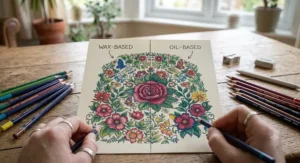
Intricate colouring pages — think fine mandala linework, detailed feathers, or dense botanical illustrations — demand something different from broad, sweeping colouring: a pencil that holds a sharp point under repeated use. This is where harder cores earn their keep. Faber-Castell Polychromos and Staedtler Karat Aquarell 125 both sharpen to a fine, durable tip precisely because their binders are firmer, letting you draw crisp, thin lines into tight spaces without the tip crumbling mid-stroke.
Soft, creamy pencils like Prismacolor Premier and Derwent Coloursoft can still manage detail, but reviewers are consistent that you’ll be sharpening far more often, and the softer tip wears down within a few strokes on genuinely fine work. What most buyers overlook when shopping for intricate patterns specifically is that shade count matters less than core hardness — a 36-colour hard-core set can outperform a 150-colour soft set on a genuinely detailed page, because you’ll actually be able to keep a point sharp enough to fill the smallest sections cleanly. If your colouring books lean heavily towards tightly packed detail rather than large open shapes, prioritise hardness over palette size when you’re deciding where to spend your budget.
Coloured Pencils for Colouring In vs Fine Art Illustration
There’s a meaningful difference between coloured pencils for colouring in and coloured pencils bought for original fine art illustration, even though the same physical products often serve both purposes. Colouring in — filling pre-drawn lines in a book — rewards pencils that lay down flat, even colour quickly and blend forgivingly, because the composition and linework are already decided for you. Fine art illustration, by contrast, rewards pencils that hold detail, layer predictably over many sessions, and resist fading for years, because you’re building the piece from a blank page and often want to preserve it afterwards.
In practice, this means a hobbyist colouring in for relaxation can happily use Crayola Signature Blend & Shade or Arteza Professional 72 — both are genuinely well suited to filling book pages quickly and enjoyably. Someone illustrating original work for sale or display, however, should lean towards Faber-Castell Polychromos or Prismacolor Premier, where lightfastness and layering consistency matter more than speed. Reviewers who use their pencils for both purposes often keep two separate sets rather than trying to make one range do everything — a sensible approach if your hobby is starting to straddle both worlds.
Common Mistakes When Buying Coloured Pencils for Adult Colouring Books
The single most common mistake we see is buying purely on shade count. A 150-colour set sounds like better value than a 72-colour one, but if the core is thin, scratchy, and low in pigment, you’ve simply bought more of a disappointing experience rather than a better one. Reviewers consistently report regretting large budget sets more than smaller, better-made ones.
The second mistake is ignoring core hardness relative to your actual colouring style. Buyers who love blending soft gradients but purchase a hard, precise set like Staedtler Karat Aquarell often come away frustrated that the colour “won’t melt together” — not because the pencil is faulty, but because it was never designed for that kind of soft blending in the first place.
Third, many buyers overlook lightfastness entirely until a framed piece fades within months near a window. If you’re buying specifically for adult colouring books rather than gallery work, this matters less — but it’s still worth knowing which pencil you’re choosing and why.
Finally, a genuinely underrated mistake is skipping paper quality. Even the best pencil from this list will underperform on thin, glossy paper that can’t hold multiple layers. Pairing a good pencil with poor paper is one of the most common reasons colourists blame the pencil for a result the paper actually caused.
Getting Started: Your First 30 Days With a New Set
Setting up a new tin properly saves frustration later. Start by sharpening every pencil to a fine point before your first session — factory points are often blunt from shipping, and a dull tip exaggerates any core softness issues you’ll wrongly blame on the pencil itself.
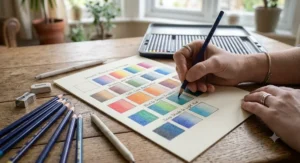
In your first week, resist the urge to jump straight into your most detailed book. Instead, colour a few test swatches on a spare sheet of the same paper you’ll actually use, applying light, medium, and heavy pressure with each shade. This builds an instant reference for how each colour behaves and avoids surprises mid-page. A common first-30-days mistake is over-layering wax-based pencils like Prismacolor Premier or Derwent Coloursoft before understanding wax bloom — apply no more than three or four layers initially, and keep a soft cloth nearby to wipe away any cloudy film before it builds up further.
By week two or three, start experimenting with blending techniques: burnishing with a lighter colour or colourless blender, layering complementary shades for shadow, and varying pressure within a single stroke for gradient effects. Invest in a good manual sharpener rather than relying on a cheap plastic one — soft cores like Coloursoft and Prismacolor chew through blades quickly, and a blunt blade causes more breakage than the pencil itself ever would. Store your pencils flat or upright rather than loose in a bag; jostling causes internal core cracks that only reveal themselves the next time you sharpen, seemingly at random.
Which Set Suits You? Three Real Colourists, Three Different Needs
The commuting relaxer: Someone colouring for twenty minutes on the train each evening needs a pencil that works fast, doesn’t need much sharpening mid-session, and travels well in a bag. Crayola Signature Blend & Shade or Castle Art Supplies Gold Standard 120 both fit this profile — soft enough to lay colour quickly, budget-friendly enough that losing a pencil or two isn’t a disaster, and simple enough not to demand a blending routine you don’t have time for.
The weekend detail enthusiast: Someone who sets aside a Saturday afternoon for an intricate mandala or botanical page, working in a fixed spot at home, benefits far more from Faber-Castell Polychromos or Staedtler Karat Aquarell 125. The harder cores hold a point through hours of fine linework, and the investment makes sense because the sessions are longer and the finished pages often get kept or framed.
The gift-giver building a collection: Someone buying for a parent, partner, or friend who’s mentioned wanting to try adult colouring should look at Derwent Coloursoft or a mid-range Arteza Professional 72 — impressive enough to feel like a proper gift, forgiving enough that a beginner won’t be discouraged by a steep learning curve, and priced sensibly for an occasional-hobby recipient rather than a committed artist.
Matching the pencil to the actual person and situation, rather than simply buying “the best one,” consistently produces happier long-term users according to aggregated reviewer sentiment across all three scenarios.
✨ Don’t Miss These Exclusive Deals!
🔍 Take your colouring collection to the next level with these carefully selected pencils. Click through to check current pricing and availability, and find the set that turns a spare evening into proper “me time.”
Long-Term Cost & Maintenance
The sticker price on a tin of pencils is only part of the real cost. Softer cores like Prismacolor Premier and Derwent Coloursoft wear down faster, meaning you’ll replace individual shades — particularly popular ones like black, skin tones, and background greens — well before the rest of the set is used up. Reviewers who colour regularly report needing replacement blacks and browns within a year of moderate use, whereas harder cores like Faber-Castell Polychromos and Staedtler Karat Aquarell last considerably longer per pencil because less material is removed with each sharpening.
Factor in sharpener costs too: soft wax cores are gentler on blades than you’d think, but they clog cheap sharpeners with wax residue, which then need cleaning or replacing more often. A single quality metal sharpener costs roughly £5–£10 and will outlast several cheap plastic ones, so it’s a sensible early investment regardless of which pencil range you choose. When you do the maths over two or three years of regular colouring, a premium set with slower wear, like Polychromos, can work out similarly priced to repeatedly replacing individual pencils from a cheaper range — worth bearing in mind if you colour several times a week rather than occasionally.
Safety & Quality Standards: What “Lightfast” Really Means
Lightfastness measures how resistant a pencil’s pigment is to fading under prolonged light exposure, and it’s tested using recognised methods rather than marketing guesswork. The Colored Pencil Society of America’s ASTM D6901 standard exposes pencil samples to controlled daylight and xenon-arc radiation, then rates them from I (highly lightfast) to V (fugitive, meaning likely to fade quickly). Manufacturers who publish per-shade ratings, like Faber-Castell’s star system on Polychromos, let you make informed decisions about which specific colours to trust for framed or long-term work — a badge of the “Original Content” transparency this whole guide is built around.
On general product safety, reputable brands featured in this guide comply with recognised non-toxicity standards for art materials, and UK buyers should look for compliance markings such as CE or UKCA on packaging, particularly for sets intended for younger family members who might also dip into the tin. If lightfastness genuinely matters for your project — say, a piece going up on a wall that catches afternoon sun — check the manufacturer’s own published ratings before buying, rather than assuming a premium price automatically means premium fade resistance across every single shade in the box.
What to Expect: Real-World Performance for Every Skill Level
Beginners often expect colouring to look effortless from the first page, and then feel discouraged when early attempts look patchy or streaky. In reality, even soft, forgiving pencils like Crayola Signature Blend & Shade need a session or two of practice before pressure control clicks — this is normal, not a sign you’ve bought the wrong pencil. What genuinely helps beginners fastest is starting with larger, simpler shapes rather than fine detail, building confidence before tackling anything intricate.
Intermediate colourists tend to hit a different wall: wax bloom appearing unexpectedly on darker sections after several sessions with soft pencils like Prismacolor Premier or Derwent Coloursoft. Once you know to expect it and simply wipe it away with a soft cloth, it stops being frustrating and becomes just another part of the process.
Experienced colourists working with harder, oil-based pencils like Faber-Castell Polychromos report a genuinely different day-to-day experience: less blending drama, more predictable layering session after session, and virtually no bloom to manage — traded against needing patience and a slightly firmer hand to build up rich, saturated colour in the first place. Across all three skill levels, the consistent theme in aggregated reviews is that matching expectations to the actual core type — rather than assuming any one pencil should behave like every other — resolves most of the frustration people report when they first switch brands.
Frequently Asked Questions
❓ What are the best coloured pencils for adult colouring books?
❓ Are wax or oil-based coloured pencils better for colouring in?
❓ How many coloured pencils do I need for intricate patterns?
❓ Do cheap coloured pencils work as well as expensive ones for adult colouring?
❓ How can I stop my coloured pencils from breaking?
Conclusion
Choosing the right coloured pencils for adult colouring really comes down to being honest about how you actually colour, not chasing the biggest tin on the shelf. If you’re after effortless blending and don’t mind managing the occasional wax bloom, Prismacolor Premier or Derwent Coloursoft deliver that buttery experience reviewers rave about. If longevity and crisp detail matter more — particularly for pieces you’ll frame or gift — Faber-Castell Polychromos remains the most consistently lightfast option we found, backed by genuinely impressive independent testing.
For anyone just starting out, there’s no shame in beginning with Castle Art Supplies Gold Standard 120 or Crayola Signature Blend & Shade — both give a real, enjoyable colouring experience without the premium price tag, and you can always upgrade individual favourite shades later as your collection grows. Whichever you choose, remember that mindful, self-guided colouring has been shown to meaningfully improve wellbeing and reduce anxiety over just a couple of weeks of regular practice, so the “best” pencil is ultimately the one that gets you actually sitting down and colouring rather than sitting unopened in its box.
Recommended for You
- Artists Coloured Pencils: 7 Best Picks for 2026
- Charcoal Drawing Set: 7 Best Picks for UK Artists (2026)
- Charcoal Pencils vs Charcoal Sticks: 7 Picks Ranked (2026)
Disclaimer: This article contains affiliate links. As an Amazon Associate, I earn from qualifying purchases. If you purchase products through these links, we may earn a small commission at no additional cost to you.
✨ Found this helpful? Share it with your friends! 💬🤗
