In This Article
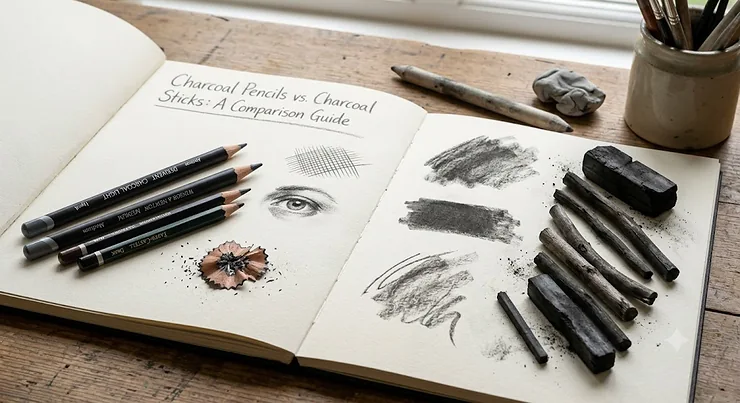
Stand in front of an art shop shelf and you’ll spot the problem straight away: one box promises “precision,” the other promises “expression,” and you just wanted to draw a bowl of fruit. charcoal pencils vs charcoal sticks is one of those debates that sounds trivial until you’ve ruined a good sheet of paper with the wrong tool. Charcoal is a black, crumbly drawing material made of carbon, traditionally produced by heating willow twigs without oxygen, and it comes in two very different formats — a wood-cased pencil for controlled marks, or a naked stick for sweeping, expressive tone. Neither is objectively superior. They solve different problems.
This guide is built on real UK-available products, genuine spec comparisons, and aggregated review sentiment rather than guesswork. Tate’s glossary of art terms describes charcoal as a crumbly, carbon-based sketching material that can also stand as a finished artwork in its own right — which tells you something important before we go further: this medium was never meant to behave like graphite. Understanding that distinction is the whole game.
Over the next sections we’ll compare seven genuine products spanning budget, mid-range and premium options, explain exactly when a pencil earns its keep and when a stick wins outright, and walk through practical techniques, common buying mistakes, and a decision framework you can actually use at the till. Whether you’re kitting out a first sketchbook or filling gaps in an established figure drawing supplies kit, you’ll leave with a shortlist, not just more questions.
Charcoal Pencils vs Charcoal Sticks: Quick Comparison
Before the deep dive, here’s the shape of the decision in one table.
| Feature | Charcoal Pencil | Charcoal Stick | Best For |
|---|---|---|---|
| Control | High — sharpens to a point | Low to moderate | Pencils: portraits, detail |
| Coverage speed | Slow | Fast | Sticks: large-scale shading |
| Mess level | Low | High, dusty | Pencils: travel, classroom |
| Blendability | Moderate | Excellent | Sticks: soft tonal transitions |
| Typical price range | around £6-£18 per set | around £5-£13 per box | Both: budget-friendly starts |
Reading that table, the pattern is clear: charcoal pencils vs charcoal sticks isn’t really a fight, it’s a division of labour. A pencil gives you the same fine-line discipline as a graphite pencil but with charcoal’s characteristic soft black, while a stick sacrifices that precision for raw coverage and a texture no pencil core can fully replicate. Most working artists, honestly, own both — the pencil roughs in the eyes and mouth, the stick blocks in the hair and background in under a minute.
💬 Found this comparison useful? Just one click to share it — help other artists pick the right tool the first time!
Top 7 Charcoal Pencils and Charcoal Sticks: Expert Analysis
We’ve researched seven genuine products sold in the UK, spanning pencils, natural willow sticks, and compressed formats, so you can see exactly how the theory plays out with real materials.
1. General’s Charcoal Pencil Set (557BP) — best budget starter set
The General’s Charcoal Pencil Set is the pencil most beginners are quietly recommended by tutors, and the reason is simple: it removes decision fatigue. The set bundles three black charcoal pencils in 2B, 4B and 6B, plus a white charcoal pencil for highlights and a kneaded eraser, all pre-sharpened in incense cedar casings. In practice, that spread of hardness gives you a workable tonal range straight out of the box — 2B for structural lines, 6B for deep shadow — without needing to buy grades separately. Based on the spec comparison, this is one of the few sub-£15 sets that includes a white pencil, which matters more than it sounds: working light back into dark charcoal is how you get believable form on toned paper. Reviewers consistently note the cedar casing sharpens cleanly, a detail cheaper unbranded pencils often fumble. It suits absolute beginners and anyone building a first figure drawing supplies kit who doesn’t yet know which hardness they prefer.
Pros:
- ✅ Pre-sharpened cedar casing sharpens cleanly
- ✅ Covers full tonal range from 2B to 6B plus white
- ✅ Budget-friendly entry point for beginners
Cons:
- ❌ No very hard grade for fine architectural line work
- ❌ US-made stock can be slower to restock from some UK sellers
Priced under £15 in most UK listings, the General’s Charcoal Pencil Set earns its keep as a genuine first purchase rather than a compromise.
2. Faber-Castell Pitt Charcoal Pencils — best for fine detail work
If precision is your priority, the Faber-Castell Pitt Charcoal Pencils are the obvious mid-range step up. Sold in packs of three, they’re waxfree and grease-free, made from compressed charcoal bound with soot and clay to produce a genuinely deep, matte black line rather than the slightly grey cast some natural charcoal gives. What most buyers overlook about this pencil is that “compressed” doesn’t just mean darker — it also means a firmer core that holds a point longer through detail passes like eyelashes or fabric creases. That firmness is exactly why this pencil, not a stick, belongs in your hand for facial features. Aggregated review sentiment on this one is mixed rather than uniformly glowing: several UK buyers report the core can feel crumbly and prone to snapping under normal sharpening pressure, which is a fair complaint given the brand’s premium positioning. Reviewers who avoid over-pressing the sharpener tend to report smoother results.
Pros:
- ✅ Deep, waxfree black line true to compressed charcoal
- ✅ Firm core holds a fine point for linework
- ✅ Trusted German maker with over 250 years in pencils
Cons:
- ❌ Some reviewers report a crumbly, breakage-prone core
- ❌ Sold only in small packs of three per hardness
Expect to pay somewhere in the £6-£9 range, positioning this as an affordable step into “proper” detail charcoal without a premium price tag.
3. Derwent Charcoal Drawing Pencils, Set of 6 — most versatile pencil range
The Derwent Charcoal Drawing Pencils set is a genuinely British-made option — Derwent has manufactured pencils in Cumbria for generations — and the set structure reflects a company that understands tonal range better than most. You get light, medium and dark charcoal grades plus a tinted charcoal white, all built around a 4mm core, with a sharpener included in the tin. Here’s what the spec sheet won’t tell you outright: that 4mm core is noticeably chunkier than typical graphite leads, which means less snapping when you bear down for dark shadow work, and the wood casing genuinely does survive a rucksack better than a naked stick ever could. This is the set to reach for if you want one pencil range that handles a full portrait from light modelling to near-black shadow without swapping tools mid-drawing. It suits intermediate students moving beyond a single-hardness starter set.
Pros:
- ✅ Sturdy wood casing survives bags and rucksacks
- ✅ Six-pencil range from light to dark plus tinted white
- ✅ Includes sharpener, ready to use immediately
Cons:
- ❌ Still snaps under genuinely heavy pressure like any charcoal core
- ❌ Costs more per pencil than own-brand student sets
At around £12-£18, it sits comfortably as a mid-range choice for anyone serious about pencil-based charcoal work.
4. Winsor & Newton Artist Willow Charcoal Sticks — best value stick pack
Moving into sticks, the Winsor & Newton Artist Willow Charcoal Sticks pack is the natural entry point, and Winsor & Newton’s own manufacturing note matters here: the willow is specially baked to produce an even line of consistent intensity, which is a real weakness in cheaper unbranded sticks that burn unevenly and leave patchy marks. This particular pack contains twelve sticks across an assortment of thin, medium and thick lengths, so you’re not locked into one diameter for an entire session. On paper this means you can rough in a full composition with the thick end, then flip to a thinner piece for contour lines, all from one box. Reviewers report the sticks hold up well in transit — several specifically mention they don’t break easily in a pencil case, which is a common failure point for natural charcoal generally. It’s a strong, no-nonsense choice for anyone testing whether stick work suits their process before investing further.
Pros:
- ✅ Baked willow gives a consistent, even line
- ✅ Assorted thin, medium and thick sticks in one box
- ✅ Reviewers note strong resistance to breakage in transit
Cons:
- ❌ Assorted lengths mean some individual sticks are quite short
- ❌ Natural willow still produces more dust than compressed sticks
Typically priced in the £6-£10 range, this is the sensible first stick purchase for anyone stepping away from pencils.
5. Coates Willow Charcoal — best premium natural willow stick
For a genuinely heritage British product, Coates Willow Charcoal is hard to beat. The Coate family has specialised in growing willow on the Somerset Levels in southwest England since 1819, and the manufacturing process — boiling rods to soften the bark, then kiln-firing them for around ten hours — hasn’t fundamentally changed in two centuries. You can read more about the estate’s own account of the process on Coates Charcoal’s official site. What that heritage buys you in practice is a stick sorted precisely by diameter, from delicate 2-3mm sticks for fine detail through to chunky 12-14mm sticks for broad tonal blocking, rather than a mixed bag of whatever came off the production line. Reviewers consistently praise the depth of black and the “velvety” quality of the mark, and one long-time art graduate reviewer noted it carried them through both a BA and MA course. Because sticks are sold by single diameter rather than assorted, you’ll want to know roughly what you’re drawing before you buy — but that specificity is exactly why illustrators repurchase it.
Pros:
- ✅ English-grown Somerset willow with two centuries of heritage
- ✅ Reviewers rate the depth of black above rival brands
- ✅ Sold by precise diameter for technique-matched buying
Cons:
- ❌ The thinnest 2-3mm sticks are genuinely delicate
- ❌ Sold in single-diameter boxes rather than mixed assortments
Prices sit around £5-£9 depending on diameter and box size — solid value for a heritage material of this quality.
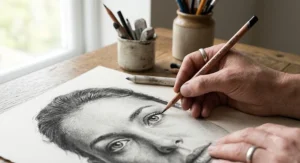
6. Conté à Paris Compressed Charcoal, Box of 12 — best for bold, dark blacks
Where willow sticks give you softness, the Conté à Paris Compressed Charcoal box goes the other direction: five graded hardnesses — HB, B, 2B, 3B and 4B — compressed into a firmer, more predictable stick. Conté’s own product notes describe it as offering a rich, deep, intense black that’s stronger than regular willow charcoal, and that it can work more like a graphite lead, offering finer detailing with a smoother laydown than natural sticks manage. Based on that spec comparison, this is the stick to reach for when a drawing needs genuinely solid blacks rather than atmospheric grey — think dramatic still life shadow, not a loose gesture sketch. One long-time reviewer, having used Conté’s chalk products for decades, called the compressed charcoal “just as good” as their previous favoured brand, and praised how well it combined with vine charcoal and pastel in mixed sessions. It’s a strong pick for anyone whose willow sticks keep feeling too pale.
Pros:
- ✅ Five graded hardnesses from HB to 4B in one box
- ✅ Firm compressed core resists the crumbling common in willow
- ✅ French maker with roots tracing back to the 1790s
Cons:
- ❌ Compressed formula loses some of willow’s soft, dusty texture
- ❌ Round profile rolls off a tilted desk easily
Expect a price in the £9-£13 range, which is reasonable given you’re effectively buying five hardness grades in a single box.
7. Faber-Castell Pitt Charcoal Set (24 pieces) — best all-in-one combo kit
The final pick is for anyone who’s read this far and still can’t decide — because the Faber-Castell Pitt Charcoal Set simply refuses to make you choose. The 24-piece set bundles three compressed charcoal pencils (soft, medium, hard), three natural charcoal pencils, natural charcoal sticks in two thicknesses, eight compressed charcoal sticks spanning extra-soft to hard, plus a blending stump and eraser. What most buyers overlook about combo sets like this is that the value isn’t really the piece count, it’s the elimination of guesswork: you get to physically compare pencil versus stick, natural versus compressed, side by side on the same page, and work out your own preference before spending more. That’s genuinely useful pedagogically, and it’s why art tutors often suggest a set like this over a single-format purchase for students still finding their process. The trade-off is straightforward: you’re paying for breadth, not depth in any one format.
Pros:
- ✅ Combines pencils, natural sticks and compressed sticks in one box
- ✅ Widest hardness range of any single set on this list
- ✅ Includes blending stump and eraser, no extra buys needed
Cons:
- ❌ Higher upfront cost than a single-format set
- ❌ Some overlap is wasted if you already know your preferred format
At around £20-£28, it’s the priciest entry here, but it’s genuinely the most efficient way to test the whole charcoal pencils vs charcoal sticks question in one purchase.
Getting Started: Setup, First Strokes and Early Mistakes
Charcoal rewards a little upfront preparation. Start with textured paper — a smooth cartridge sheet will feel slippery and won’t hold pigment the way a toothy surface does. Tape your paper to a board at a slight incline; charcoal dust falls, and gravity is doing half the blending for you whether you like it or not. In the first thirty days, the single most common mistake is over-committing to dark tones too early: block in your lightest shapes first, then build darkness in layers, because charcoal is far easier to add than to fully remove. Keep a kneaded eraser nearby for lifting highlights rather than a plastic eraser, which tends to smear the pigment further into the paper’s tooth. Fixative spray, applied in thin layers outdoors or near an open window, locks in progress between sessions — skip this step and a week-old drawing can smudge if you so much as breathe on it awkwardly.
Real-World Scenarios: Matching Charcoal Supplies to Your Practice
Picture three different artists. First, a college student commuting to weekly life-drawing classes with limited bag space: the Derwent Charcoal Drawing Pencils set travels cleanly in a pencil case, survives being dropped in with textbooks, and covers a full tonal range without extra kit. Second, an evening-class hobbyist working from photographs at home with no time pressure: the Faber-Castell Pitt Charcoal Set combo kit rewards the slower pace, letting them experiment with formats across several sittings. Third, a portrait-focused amateur chasing crisp likeness work: the pairing of Faber-Castell Pitt Charcoal Pencils for eyes and lips with Coates Willow Charcoal for hair and background gives sharp detail exactly where it’s needed and soft atmosphere everywhere else. None of these three is “correct” — the right kit follows the environment and the subject, not the other way round.
Problem to Solution: Fixing Common Charcoal Drawing Frustrations
Charcoal has a reputation for being messy and unforgiving, but most complaints trace back to a handful of fixable habits. If your darks look muddy rather than rich, you’re likely pressing too hard too early — layer instead of gouging. If highlights won’t lift cleanly, switch from a plastic eraser to a kneaded one and dab rather than rub. If your pencil keeps snapping on the sharpener, you’re probably using a standard graphite sharpener with too shallow a blade angle; a dedicated art sharpener or careful knife-sharpening reduces breakage significantly. If a finished piece smudges days later, that’s simply a missing fixative step, not a flaw in the medium. And if sticks feel unmanageably crumbly, try snapping them into shorter lengths first — a shorter stick flexes less under pressure and is genuinely less prone to snapping mid-stroke.
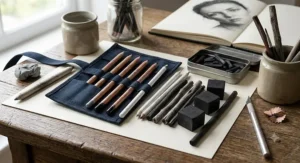
When to Use a Charcoal Pencil vs a Stick
The honest answer to when to use charcoal pencil vs stick comes down to scale and intention, not skill level. Reach for a pencil whenever the mark needs to end somewhere specific — an eyelid crease, a strand of hair, the edge of a jawline. Reach for a stick whenever the mark needs to cover ground fast and blend into what’s next to it — a shadowed wall, a mass of hair, an out-of-focus background. Many working drawings actually move between the two multiple times in a single session: block the whole composition loosely with a stick in under two minutes, then switch to a pencil once you’ve located where the detail actually needs to live. Treating this as a sequence rather than a single choice tends to produce more confident, less laboured drawings.
Charcoal Pencil for Detail Work: What Actually Matters
Choosing a charcoal pencil for detail work comes down to core firmness more than brand prestige. A softer core, like the 6B end of the General’s Charcoal Pencil Set, gives rich, dark marks but dulls quickly, meaning frequent re-sharpening mid-detail. A firmer, compressed core, like the Faber-Castell Pitt Charcoal Pencils, holds its point far longer, which matters enormously when you’re working small features like eyes or fabric folds where a blunt tip ruins the line. The other overlooked factor is casing quality: a pencil that splinters when sharpened wastes material and interrupts flow at exactly the wrong moment. Test-sharpen before a big session, not during one.
Charcoal Stick for Broad Shading: Covering Ground Fast
A charcoal stick for broad shading earns its place the moment you need to cover more than a few square centimetres in one gesture. Lay the stick on its side rather than its tip, and you can shade an entire background or drapery fold in seconds rather than minutes of pencil cross-hatching. Natural willow sticks like Coates Willow Charcoal give a softer, more atmospheric grey-black that blends beautifully with a finger or blending stump, while compressed sticks like Conté à Paris Compressed Charcoal hold darker, more solid tone if the composition calls for genuine black rather than soft grey. Either way, keep a rag nearby — broad shading generates far more loose dust than pencil work, and that dust is your best blending tool if you catch it before it falls off the page.
Charcoal Drawing Techniques for Beginners: Five Exercises to Build Control
Charcoal drawing techniques for beginners genuinely don’t require expensive kit — they require repetition with a handful of core moves. First, practise the side-stroke: lay a stick flat and drag it to lay down an even tonal field. Second, practise the point-stroke with a sharpened pencil for confident contour lines. Third, try lifting highlights out of a dark field with a kneaded eraser rather than drawing white in. Fourth, practise blending with a finger, a paper stump, and a dry brush, and compare the texture each leaves. Fifth, work a single still-life object from light to dark three separate times, timing yourself, to build speed alongside control. None of these exercises needs more than the General’s Charcoal Pencil Set and a single Coates Willow Charcoal stick to complete.
Figure Drawing Supplies: Building a Kit That Works From Life
A working figure drawing supplies kit needs to survive movement, time pressure and repeated sessions, which changes the calculus slightly from still-life work. Life models rarely hold a pose for more than twenty minutes, so speed matters as much as precision — most life-drawing regulars keep at least one stick, such as the Winsor & Newton Artist Willow Charcoal Sticks, for rapid gestural warm-ups, alongside a firmer pencil like Derwent Charcoal Drawing Pencils for the longer, more considered poses later in a session. A putty eraser, a torn newsprint pad, and a small clip board round out a kit that fits in one bag and survives being carried on public transport to a weekly class.
Charcoal Mark-Making: Beyond the Basic Line
Charcoal mark-making rewards experimentation well beyond the standard line-and-shade approach most beginners default to. Try dragging a stick’s broken edge across textured paper for a scratchy, granular mark that no pencil can replicate. Try loading a rag with loose dust and wiping it across the page as a mid-tone base before drawing into it, light and dark, from that mid-point — a technique many life-drawing tutors teach specifically because it avoids the “starting from white” trap that makes beginner drawings look flat. Try combining a Conté à Paris Compressed Charcoal stick’s crisp edge with a softer Coates Willow Charcoal stick’s smudge in the same composition for contrast between sharp and atmospheric passages.
How to Choose Between Charcoal Pencils and Charcoal Sticks
- Identify your primary subject — portraits and detail-heavy work lean pencil, landscapes and gesture work lean stick.
- Consider your working speed — sticks cover area faster, which matters for timed life sessions.
- Weigh mess tolerance — sticks generate significantly more dust than pencils.
- Check your paper’s tooth — heavily textured paper suits sticks, smoother paper suits pencils.
- Set a realistic budget — a single mid-range set from either format outperforms two cheap ones.
- Think about portability — pencils survive bags better than naked sticks.
- Buy one combo set, like the Faber-Castell Pitt Charcoal Set, if you genuinely can’t decide yet.
Common Mistakes When Buying Charcoal Art Supplies
The most frequent buying mistake is purchasing a single hardness grade and assuming it will cover an entire drawing — charcoal, like graphite, needs a tonal range to look convincing, so a lone HB pencil or one medium stick will always feel limiting. The second is ignoring paper entirely and blaming the charcoal when marks look thin or won’t build up; smooth printer paper simply can’t hold pigment the way a textured sketchbook can. The third is buying the cheapest unbranded stick set available, which often burns unevenly and produces patchy, inconsistent marks compared with a baked, quality-controlled product like Winsor & Newton Artist Willow Charcoal Sticks. Finally, many first-time buyers skip fixative spray entirely, only to find a finished piece has smudged beyond repair within days.
Long-Term Cost and Maintenance: Charcoal vs Other Drawing Media
Charcoal compares favourably on cost-per-use against most other fine art drawing media once you look past the initial receipt. A single stick, such as one from Coates Willow Charcoal, can shade several full A4 compositions before it’s exhausted, and a set like Derwent Charcoal Drawing Pencils typically lasts many months of regular sketching before needing replacement, since each pencil holds considerably more material than an equivalent graphite lead. The main ongoing cost isn’t the charcoal itself but consumables around it — paper, fixative spray, and replacement erasers — which is worth budgeting for separately rather than assuming the initial set purchase covers everything. Maintenance is minimal: store sticks in a dry, padded box to reduce breakage, and keep pencils away from extreme heat, which can soften the binder in compressed cores.
Safety, Materials and UK Sourcing: What to Know Before You Buy
Charcoal art supplies are broadly low-risk, but a few practical points are worth knowing. Products like Coates Willow Charcoal typically conform to ASTM D4236, the standard covering safe labelling of art materials, which is a reasonable baseline to check for on any box before buying, particularly if it will be used by younger students. Charcoal dust is a mild inhalation irritant in poorly ventilated spaces during heavy, prolonged use, so working near an open window during broad shading sessions is sensible rather than excessive caution. Fixative sprays are aerosol-based and should always be used outdoors or in a well-ventilated area, following the manufacturer’s instructions on the can. None of these products require special UK import documentation for personal use, and all seven featured here are readily available through UK-based sellers and Amazon’s UK marketplace.
Frequently Asked Questions
❓ Which is better for beginners, charcoal pencils or charcoal sticks?
❓ Can you mix charcoal pencils and charcoal sticks in one drawing?
❓ Do charcoal pencils need sharpening like graphite pencils?
❓ What's the difference between compressed and natural charcoal sticks?
❓ How much does a decent charcoal drawing kit cost in the UK?
✨ Don’t Miss These Exclusive Deals!
🔍 Take your charcoal drawing practice further with the picks above — check current pricing and availability on each one, and build a kit that actually matches how you work, not just what’s on the shelf.
Conclusion
The charcoal pencils vs charcoal sticks question was never really about picking a winner — it’s about matching the tool to the mark you’re trying to make. Pencils, like the General’s Charcoal Pencil Set, the Faber-Castell Pitt Charcoal Pencils and the Derwent Charcoal Drawing Pencils, give you control and portability for detail-driven work. Sticks, like the Winsor & Newton Artist Willow Charcoal Sticks, Coates Willow Charcoal and Conté à Paris Compressed Charcoal, give you speed and atmosphere for broad, expressive passages. And if you’d rather test both before committing, the Faber-Castell Pitt Charcoal Set combo kit removes the guesswork entirely. Whichever you choose, remember that charcoal has been central to Western drawing practice for centuries precisely because it rewards this kind of layered, experimental approach — start light, build dark, and don’t be afraid of the mess. According to Art UK’s own glossary of art terms, charcoal remains one of the oldest mediums used by visual artists, and that longevity says more about its versatility than any single product review ever could.
Recommended for You
- 7 Best Charcoal Pencils for Drawing in 2026 (UK Guide)
- Willow Charcoal vs Compressed Charcoal: 7 Best Picks (2026)
- Compressed Charcoal Sticks for Drawing: 7 Best Picks (2026)
Disclaimer: This article contains affiliate links. As an Amazon Associate, I earn from qualifying purchases. If you purchase products through these links, we may earn a small commission at no additional cost to you.
✨ Found this helpful? Share it with your friends! 💬🤗
