In This Article
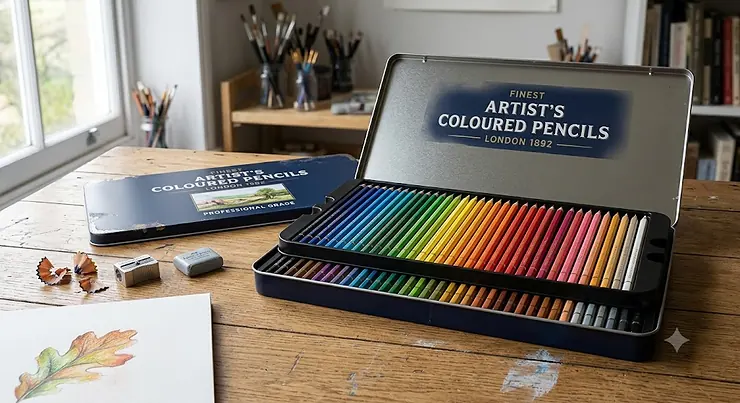
Somewhere between the pencil tin and the finished drawing, a small miracle happens — waxy pigment turns into skin tones, feathers, storm clouds. But get the wrong artists coloured pencils and that miracle stalls: colours chalk up, favourite hues vanish in sunlight within a year, and the “professional” set you saved up for behaves like a child’s stationery cupboard reject. Artists coloured pencils are wood-cased drawing tools with a high-pigment wax or oil core, built for layering, blending and archival permanence rather than casual colouring-in. The gap between a decent set and a genuinely good one isn’t marketing fluff — it’s chemistry, and it shows up on the paper.
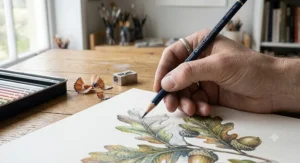
This guide cuts through the tins and star ratings to focus on what actually matters: pigment load, binder type, and — because so many buyers get burned here — lightfastness. We’ve dug into real specs, aggregated review sentiment, and independent testing rather than repeating manufacturer copy, because “Original Content” should mean something. Whether you’re chasing professional coloured pencils for gallery-bound botanical work or hunting for coloured pencils for illustration deadlines, you’ll find honest, use-case-matched advice below, including where lightfast coloured pencils genuinely earn their premium and where you can save money without regret.
Quick Comparison Table
| Pencil | Core Type | Lightfastness | Price Range | Best For |
|---|---|---|---|---|
| Faber-Castell Polychromos | Oil-based | Excellent (most colours) | £1.60–£3 per pencil | All-round detail work |
| Caran d’Ache Luminance | Wax-oil hybrid | Exceptional, all colours | £4–£7 per pencil | Archival, gallery pieces |
| Derwent Lightfast | Oil-based | 100% of range | £3.50–£4.50 per pencil | Guaranteed permanence |
| Prismacolor Premier | Soft wax | Mixed across the range | 60p–£1.30 per pencil | Blending, illustration |
| Derwent Procolour | Medium wax | Good, better than Coloursoft | £1–£1.80 per pencil | Versatile all-rounder |
| Koh-I-Noor Polycolor | Oil-with-wax | Very good on most hues | 60p–90p per pencil | Budget artist-grade |
| Holbein Artists’ Colored Pencils | Wax-oil-fat blend | Uneven, check per colour | £1.50–£2.50 per pencil | Soft blending, unusual hues |
Looking across the table, the split is really about priorities: if permanence is non-negotiable, Derwent Lightfast and Caran d’Ache Luminance are the only two ranges where every single colour clears the bar, while Prismacolor Premier wins on buttery blending at the cost of a patchier lightfastness sheet. Budget-conscious artists shouldn’t assume cheaper means worse — Koh-I-Noor Polycolor punches well above its price point on both fronts. We’ll unpack exactly why each of these differences matters once you’re actually holding a pencil over paper.
💬 Found a pencil that’s calling your name already? Take a peek at current pricing before the tin sells out.
Top 7 Artists Coloured Pencils: Expert Analysis
1. Faber-Castell Polychromos — best all-round lightfastness for the price
The standout here is consistency: Faber-Castell has been refining this oil-based formula for over a century, and it shows in how evenly the range performs. The 3.8mm core is bonded along its entire length using Faber-Castell’s SV process, which is a fancy way of saying the lead won’t snap loose inside the barrel when you drop it — a genuinely common failure point in cheaper pencils. Each pencil carries its own star-rated lightfastness marking, and independent colour-by-colour testing has found more than a hundred of the 120 shades rate as excellent, with only a couple of outliers behaving as fugitive.
Based on the spec comparison, Faber-Castell Polychromos suits artists who value control over sheer softness — the firmer, oil-based core holds a point for longer stretches of detailed hatching, which matters for botanical illustrators and portrait artists chasing crisp linework. Reviewers consistently report that the round barrel, while comfortable, does roll off sloping desks more than hexagonal alternatives, and that the texture sits noticeably harder than Caran d’Ache or Prismacolor, though it still blends respectably thanks to its oil base. What most buyers overlook is that this firmness is actually an advantage for layering many thin coats without the surface turning to mush.
Pros:
- ✅ Near-total lightfastness across the 120-colour range
- ✅ Break-resistant core rarely snaps inside the barrel
- ✅ Holds a fine point for extended detail work
Cons:
- ❌ Round barrel rolls off angled drawing boards
- ❌ Firmer texture needs more pressure to blend fully
Sets run from around £15 for a starter tin to £150+ for the full 120-colour collection, and given the lightfastness-to-cost ratio, the mid-size 60-tin represents strong value for anyone serious about longevity.
2. Caran d’Ache Luminance — best for guaranteed archival permanence
Every colour in this Swiss-made range is systematically tested for lightfastness before it ever reaches a tin, which is precisely why Luminance carries the steepest price tag on this list. The wax-oil hybrid core delivers what independent reviewers repeatedly describe as the smoothest transitions of any pencil tested, with a velvety, almost creamy laydown that resists wax bloom far better than pure-wax competitors.
Here’s what to weigh: this is a pencil built for museum-conditions permanence, not for economy. If you’re selling original artwork — commissioned portraits, pet portraits, pieces destined for a client’s wall for decades — the reasoning changes completely, because a faded piece six months after sale is a reputational disaster no discount can fix. Reviewers consistently note the palette leans toward bold, saturated hues and is comparatively short on muted earth tones and greys, so botanical or wildlife artists sometimes supplement with another brand for those subtler shades. On paper this means Luminance excels at vibrant subjects but may need a companion set for nuanced natural colouring.
Pros:
- ✅ Every single colour is independently lightfastness tested
- ✅ Exceptionally smooth wax-oil blend resists wax bloom
- ✅ Superb for fine detail despite the soft laydown
Cons:
- ❌ Among the most expensive pencils available anywhere
- ❌ Palette is thinner on muted greys and earth tones
Full sets can run into the £250+ range, though smaller 20 and 40-piece boxes bring the entry price down considerably — check current price and set size carefully before buying.
3. Derwent Lightfast — best for artists who need zero fading, guaranteed
Derwent built this range specifically to solve a problem: their older wax-based lines had strong colour but patchy permanence. Lightfast is the fix — every one of the 100 colours is tested to the ASTM D-6901 standard and rated LF1, Derwent’s highest classification, with the claim that colour will not visibly shift for up to 100 years under museum conditions. The oil-based core is genuinely rich and opaque, laying down colour that behaves closer to oil paint than to a typical pencil, especially when blended with oil-based mediums.
What most buyers overlook about this range is how narrow the palette is by design — because every colour must pass the lightfast threshold, notoriously fugitive hues like the brightest pinks and purples simply aren’t included, so you’re working from a curated 100 rather than the 150+ some competitors offer. Aggregated user feedback is largely glowing on colour saturation and smoothness, though a recurring complaint is occasional lead breakage during sharpening, which is a fair trade-off given how firmly Derwent has committed to permanence over everything else. Made in Britain, this is arguably the purest expression of what lightfast coloured pencils should mean.
Pros:
- ✅ 100% of colours rated LF1, the highest lightfast grade
- ✅ Rich, opaque, near-paint-like colour laydown
- ✅ Manufactured in Britain to a documented ASTM standard
Cons:
- ❌ Narrower palette than some rival premium ranges
- ❌ Occasional lead breakage reported during sharpening
Individual pencils sit around £3.50-£4.50, with full boxed sets reaching into premium territory — worth it specifically for work you intend to frame, sell or exhibit.
4. Prismacolor Premier — best for buttery blending and bold illustration colour
Prismacolor’s soft wax core is the reason so many illustrators cut their teeth on this brand: it lays down thick, saturated colour almost effortlessly, and blends into smooth gradients with minimal pressure. The trade-off, and it’s a well-documented one, is wax bloom — a hazy white film that can rise over heavily layered areas as the wax slowly oxidises. It wipes away with a soft cloth and a light fixative keeps it from returning, but it’s a maintenance step this pencil simply demands that oil-based rivals don’t.
Reviewers consistently note that lightfastness is inconsistent rather than absent — Prismacolor publishes an ASTM D6901 rating chart, and pencils marked I or II are considered properly lightfast, while a meaningful chunk of the 150-colour range falls outside that. Based on the spec comparison, this makes Prismacolor Premier a fantastic choice for coloured pencils for illustration work destined for print or digital reproduction, where the original artwork’s decades-long fade resistance matters less than how vibrant it looks under a scanner today. For pieces meant to hang on a wall for years, cross-check the lightfast chart before committing to specific colours.
Pros:
- ✅ Exceptionally soft, blendable, richly pigmented core
- ✅ Huge 150-colour range available, including open stock
- ✅ Ideal for illustration work reproduced digitally or in print
Cons:
- ❌ Prone to wax bloom after multiple heavy layers
- ❌ Soft core breaks more easily than firmer oil-based rivals
Prices sit in the mid-range, roughly 60p to £1.30 per pencil depending on set size, making this one of the more accessible “premium-name” options around.
5. Derwent Procolour — best versatile all-rounder for growing artists
Derwent positioned Procolour deliberately between their harder Artists range and their notoriously soft Coloursoft line, and the result is a pencil that suits almost any drawing style without demanding you learn its quirks first. The medium wax core holds a usable point far longer than Coloursoft while still blending more readily than the firmer oil-based options further up this list — a genuinely useful middle ground for artists still developing a personal technique.
What the spec sheet won’t tell you, but user reports suggest, is that Procolour’s brighter colours — the yellows, oranges and warm reds — deliver noticeably more intensity than its darker greens and blues at the same pressure, so first-time users often find their initial layers come out darker than intended and need to ease off. Reviewers frequently pair Procolour with Faber-Castell Polychromos or Derwent Coloursoft as a complementary set, using Procolour for the bulk of the work and switching in a softer or harder pencil for specific effects. Lightfastness sits comfortably above Derwent’s older Coloursoft range but below the dedicated Lightfast line, which is exactly the compromise you’d expect from a mid-tier all-rounder.
Pros:
- ✅ Genuine middle ground between hard and soft cores
- ✅ Holds a point noticeably longer than Coloursoft
- ✅ Strong pigment intensity, especially in warm colours
Cons:
- ❌ Colour intensity varies more than expected between hues
- ❌ Lightfastness trails the dedicated Lightfast range
Set prices land around £1-£1.80 per pencil, with 72-colour tins offering the best value if you’re building a working studio set rather than just testing the water.
6. Koh-I-Noor Polycolor — best budget pick that still earns “artist grade”
Made in the Czech Republic by a company with roots stretching back to 1790, Koh-I-Noor Polycolor is the range most likely to surprise sceptical buyers who assume anything under £1 a pencil must cut serious corners. The oil-with-wax core lays down colour with minimal pressure, and independent colour-chart reviews rate the majority of its 72 shades as excellent to very good on lightfastness — genuinely competitive figures for the price bracket.
Based on the spec comparison, the hexagonal barrel is a small but real advantage for anyone who works at an angled drawing board, since round-barrelled pencils have an irritating habit of rolling straight onto the floor mid-stroke. Aggregated review sentiment frequently draws a direct comparison to Faber-Castell Polychromos, noting the laydown creaminess sits somewhere between Polychromos and Prismacolor — smoother than the former, firmer than the latter. The main recurring gripe in user feedback is fragility during sharpening, with some reviewers reporting cores that snap unexpectedly, so a gentle, sharp blade is worth the extra care.
Pros:
- ✅ Excellent lightfastness on most of the 72-colour range
- ✅ Genuinely low cost per pencil for artist-grade quality
- ✅ Hexagonal barrel prevents rolling off tilted boards
Cons:
- ❌ Reports of core breakage during sharpening
- ❌ Colour names aren’t printed on every pencil barrel
At roughly 60-90p per pencil, this is the set we’d point beginners and budget-conscious professionals toward first, before spending significantly more elsewhere.
7. Holbein Artists’ Colored Pencils — best for unusual pastels and ultra-soft blending
Holbein brings genuinely different chemistry to the table: a wax, fat and oil blend that Japanese manufacturer has refined for decades, producing a core reviewers repeatedly describe as some of the smoothest and creamiest available, distinct even from Prismacolor’s soft wax feel. The 150-colour range leans hard into pastel shades and a handful of fluorescents rarely found in Western ranges, which makes it a genuine palette-expander rather than a straight substitute for pencils you already own.
Reviewers consistently note that lightfastness information is frustratingly hard to source — Holbein doesn’t publish an easy public colour chart, and the only guidance available is the star rating printed on each pencil itself, with roughly two-thirds of the range rated highly lightfast and the remainder more variable. On paper this means Holbein rewards artists who are prepared to do a little homework before committing a colour to a piece meant to last, rather than grabbing any shade at random. What most buyers overlook is that the extreme softness, while glorious for blending, means the point wears down fast, so expect to sharpen more often than with firmer oil-based alternatives.
Pros:
- ✅ Uniquely creamy core distinct from other soft-wax pencils
- ✅ Distinctive palette of pastels and fluorescents
- ✅ FSC-certified wood casing on a substantial 7.8mm barrel
Cons:
- ❌ Lightfastness data is difficult to find per colour
- ❌ Very soft core wears down and needs frequent sharpening
Import costs from Japan or specialist UK stockists push prices toward the £1.50-£2.50 per pencil range, positioning Holbein as a premium purchase best suited to artists chasing something genuinely different from the usual big four brands.
Practical Usage Guide: Getting the Most From Your Pencils
New tin in hand, the first thirty days are where most bad habits form — and where most avoidable breakages happen. Start by sharpening gently: a simple hand-held sharpener treats soft cores like Prismacolor Premier and Holbein Artists’ Colored Pencils far more kindly than an electric or crank sharpener, which generates heat and torque that soft wax cores don’t handle well. For oil-based pencils such as Faber-Castell Polychromos or Derwent Lightfast, a slightly firmer, high-quality sharpener blade prevents the crumbling that a blunt one causes.
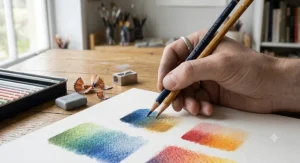
Layering technique matters more than colour selection in the early weeks. Build colour gradually with light pressure across several passes rather than pressing hard on the first stroke — this is especially true with wax-based pencils prone to wax bloom, since thin layers oxidise less visibly than one thick, heavy-handed application. Store pencils horizontally in their original tin or a dedicated roll rather than upright in a pot, which reduces the repeated knocks that crack cores invisibly inside the wood.
A common first-month mistake is testing every colour straight out of the box on cheap printer paper — do this instead on a scrap of the actual paper stock you’ll use for finished work, since tooth and absorbency change how pigment behaves dramatically. Finally, if you’re working with any wax-cored range, keep a workable fixative to hand from day one rather than waiting until bloom appears; a light spray between layers costs seconds and saves a finished piece.
Real-World Scenarios: Matching Pencils to How You Actually Work
The weekend botanical illustrator, working from a garden studio a few times a month, doesn’t need the fastest-drying or most expensive option — she needs colours that won’t fade on the wall five years from now. For this profile, Derwent Lightfast or Caran d’Ache Luminance justify their price precisely because botanical work tends to be sold, gifted or exhibited, and a faded foxglove painting is a lasting disappointment.
The freelance illustrator on a tight magazine deadline, working digitally-scanned pieces reproduced within days of completion, has almost the opposite priority. Speed of colour laydown and blend quality matter enormously; long-term lightfastness on the physical original barely registers, since the published version is a scan. Prismacolor Premier genuinely shines here — its soft, fast-blending core suits the pace of commercial illustration work.
The student or hobbyist building a first serious set on a modest budget should resist the urge to buy the priciest tin on the shelf. Koh-I-Noor Polycolor or a smaller Derwent Procolour tin delivers genuine artist-grade performance without the £150+ commitment, leaving room to discover personal preferences before investing further.
How to Choose Artists Coloured Pencils
What is the best way to choose artists coloured pencils? The short answer: match the core type and lightfastness rating to how the finished piece will be used, then confirm blending style through a small test set before committing to a full collection. Beyond that quick answer, a handful of criteria consistently separate a happy purchase from a regretted one.
- Decide how the finished piece will live. Framed and sold work demands genuinely lightfast pencils; digital or print-reproduced illustration has far more flexibility.
- Test core hardness before buying a full set. Firmer oil-based pencils suit detail; soft wax cores suit broad, buttery blending.
- Check published lightfastness data, not marketing language. “Professional quality” on a box means nothing without an ASTM D-6901 or Blue Wool Scale rating behind it.
- Factor in barrel shape for your working posture. Hexagonal barrels resist rolling on angled boards; round barrels feel more comfortable for extended sessions.
- Buy open stock where possible before a full set. Most premium brands sell individual pencils, letting you replace favourites rather than repurchasing an entire tin.
- Budget for paper too. Even the best pencil underperforms on cheap, low-tooth paper that can’t hold multiple layers.
- Consider a two-brand approach. Many working artists pair a firm, lightfast oil pencil for detail with a softer wax pencil for blending — nobody says you must pick just one.
Artist Grade vs Student Grade Pencils: What the Price Difference Actually Buys
The gap between artist grade vs student grade pencils isn’t marketing spin — it’s measurable in pigment concentration, binder quality and lightfastness testing rigour. Student-grade ranges typically use a higher proportion of filler and dye-based colourants, which keep costs down but fade faster and lay down thinner, more transparent colour. Artist-grade pencils like those covered above use pigment-heavy cores, often the same pigment families used in artist-grade paints, bonded with wax or oil that’s been formulated specifically for smooth, opaque, repeatable laydown.
| Factor | Student Grade | Artist Grade |
|---|---|---|
| Pigment concentration | Lower, more filler | High, minimal filler |
| Lightfastness testing | Rarely published per colour | Usually rated per colour (ASTM D-6901) |
| Core durability | More prone to crumbling | Reinforced bonding (e.g. Faber-Castell’s SV process) |
| Typical price | Under 30p per pencil | 60p-£7 per pencil |
| Best for | Practice, sketchbooks, learning | Finished, sold or exhibited work |
Reading across this table, the honest verdict is that student-grade pencils are not “bad” — they’re appropriately priced tools for practice, sketchbook work, and learning fundamentals where fading and thin coverage genuinely don’t matter. The mistake is using student-grade pencils for a commissioned or exhibited piece and discovering the disappointment only after the work has faded; if a piece has any chance of being sold, framed, or kept long-term, stepping up to artist grade from the outset avoids that entirely.
Understanding Colour Fastness Rating Systems
What does a colour fastness rating on a pencil actually mean? It’s a standardised measure — usually ASTM D-6901 or the Blue Wool Scale — of how much a pigment visibly fades under prolonged light exposure, expressed as a simple star or numeric grade so buyers don’t need a chemistry degree to interpret it. According to background research on the medium, colour pencil quality is largely determined by pigment concentration and the lightfastness of those pigments, alongside core softness and casing durability — which is precisely why manufacturers now compete openly on published lightfastness charts.
In practice, Blue Wool Scale ratings run 1 (least stable) to 8 (most stable), with anything below 6 generally considered unsuitable for work intended to last decades. ASTM D-6901’s own system groups pencils into Category I and II as “lightfast,” with III, IV and V representing degrees of fading risk. As the Jackson’s Art Blog on fugitive pigments explains, lightfastness is genuinely complex and only one aspect of overall pigment permanence — so a three-star pencil from one brand and another from a competitor aren’t automatically directly comparable unless both cite the same testing standard. Cross-referencing a brand’s published chart against independent reviews, rather than trusting the tin alone, remains the most reliable approach.
✨ Ready to check current colour charts and pricing for yourself?
Wax Bloom on Coloured Pencils: Causes, Fixes and Prevention
Wax bloom is the pale, cloudy haze that can rise over heavily layered wax-based coloured pencil work weeks or months after completion, and it’s one of the most common frustrations reported by users of soft-core ranges like Prismacolor Premier. Here are the fixes that actually work, based on aggregated user experience and manufacturer guidance.
Problem 1: Bloom appearing on a nearly finished piece. Solution — gently wipe the affected area with a clean, soft cloth; the bloom sits on the surface rather than in the pigment itself, so it lifts away without disturbing the colour underneath.
Problem 2: Bloom returning within weeks of cleaning it off. Solution — apply a workable fixative between layers as you work, then a final fixative once the piece is complete, sealing the wax surface from air exposure that triggers oxidation.
Problem 3: Heavy layering refusing to accept further colour. Solution — switch briefly to a firmer oil-based pencil such as Faber-Castell Polychromos for the final detail pass, since oil-based cores are far less prone to blooming and can sit cleanly over a waxy base layer.
Problem 4: Uncertainty over which colours are worst affected. Solution — reviewers consistently flag darker shades, particularly black and near-black tones, as the most bloom-prone, so budget extra fixative applications specifically for those areas.
Problem 5: Wanting to avoid the issue entirely from the outset. Solution — choose an oil-based or wax-oil hybrid range like Caran d’Ache Luminance or Derwent Lightfast, both of which resist bloom formation far better than pure soft-wax pencils by design.
Best Coloured Pencils for Illustration Work
Illustration work has a different set of demands to fine art destined for a gallery wall, and coloured pencils for illustration should be judged accordingly: speed of colour laydown, blending ease, and how vividly the piece scans or photographs typically outrank multi-decade lightfastness. Prismacolor Premier remains the go-to recommendation here — its soft, heavily pigmented core covers paper quickly, which matters when a deadline is measured in hours rather than weeks.
That said, illustrators working in ranges intended for print reproduction shouldn’t dismiss firmer pencils entirely. Faber-Castell Polychromos and Koh-I-Noor Polycolor both hold a sharp point far longer, which suits detailed character work, technical illustration, or editorial pieces where crisp linework needs to survive dozens of small revisions before a final scan. Reviewers who work across both styles often keep a soft-core set for backgrounds and broad colour fields, switching to a harder pencil for faces, text, and fine detail — a hybrid approach that plays to each core type’s genuine strengths rather than forcing one pencil to do everything.
Long-Term Cost & Maintenance: What You’ll Actually Spend
Coloured pencils get consumed with use in a way paint doesn’t, so total cost of ownership matters more here than the sticker price alone. A working artist using a 72-colour set several times a week will typically replace their most-used shades — blacks, browns, skin tones — well before the rest of the tin, which is exactly why open-stock availability matters as much as the initial price.
| Range | Full Set Price (approx.) | Open Stock Available | Cost Per Replacement Pencil |
|---|---|---|---|
| Faber-Castell Polychromos | £100-£160 (120 colours) | Yes | £1.60-£2 |
| Caran d’Ache Luminance | £150-£260+ (76-100 colours) | Yes | £4-£7 |
| Derwent Lightfast | £250-£350 (100 colours) | Yes | £3.50-£4.50 |
| Koh-I-Noor Polycolor | £45-£55 (72 colours) | Limited | 60p-90p |
The clear takeaway is that Faber-Castell Polychromos and Koh-I-Noor Polycolor offer the gentlest long-term replacement costs alongside genuine open-stock availability, while Caran d’Ache Luminance and Derwent Lightfast, though excellent, mean every replacement pencil is a meaningfully larger outlay. For a working professional getting regular commissions, that ongoing cost is often justified by the archival guarantee; for a hobbyist, it’s worth honestly weighing against how often a specific colour actually runs out.
Common Mistakes When Buying Artists Coloured Pencils
The single most common mistake is buying the largest set available before knowing your own preferred technique — a 150-colour tin is wasted money if half those colours never get touched because your style leans toward tight, monochrome detail rather than broad, colourful fields. Buying open-stock singles or a modest 24-colour starter set first, then expanding deliberately, avoids this almost entirely.
A second frequent error is ignoring lightfastness until after a piece has already faded, at which point nothing can be done. Reviewers who’ve been through this repeatedly recommend checking a brand’s published lightfastness chart before the first purchase, not after a disappointing outcome. A third mistake is assuming price alone indicates quality — as the Koh-I-Noor Polycolor entry above demonstrates, some genuinely artist-grade pencils sit at a fraction of premium-brand pricing. Finally, many buyers overlook paper entirely, pairing excellent pencils with thin, low-tooth paper that simply can’t hold the number of layers a good pencil is capable of producing.
Safety and Compliance for Coloured Pencils in the UK
Coloured pencils sold in the UK, including those marketed at children as well as artists, fall under product safety frameworks that cover both mechanical construction and chemical content. Under the Toys (Safety) Regulations 2011, products intended for or likely to be used by children under fourteen must meet defined mechanical, chemical and labelling requirements before sale in Great Britain, with CE or UKCA marking indicating compliance. Artists’ ranges pitched squarely at adult professionals are generally outside strict toy-safety scope, but reputable manufacturers such as Faber-Castell, Derwent and Caran d’Ache still test their pencils to relevant safety standards and clearly label age suitability on packaging.
For households where both children and adults use the same pencil tin, it’s worth checking packaging for an age recommendation before assuming a premium “artist” set is automatically appropriate for younger family members, since some professional-grade cores contain pigments or solvents not formulated with small children in mind.
Frequently Asked Questions
❓ What is the difference between artist grade vs student grade pencils?
❓ Do lightfast coloured pencils really not fade?
❓ How do I stop wax bloom coloured pencils issues on finished art?
❓ What is a good colour fastness rating pencils buyer should look for?
❓ Are professional coloured pencils worth it for beginners?
Conclusion
There’s no single “best” among artists coloured pencils — only the best match for what you’re actually making and how long it needs to last. If permanence is the priority, Derwent Lightfast and Caran d’Ache Luminance remain the only ranges guaranteeing every colour clears the archival bar, while Faber-Castell Polychromos offers nearly the same confidence at a friendlier price. For fast, buttery illustration work, Prismacolor Premier still earns its reputation despite the wax bloom trade-off, and Koh-I-Noor Polycolor proves that genuine artist-grade performance doesn’t require a premium budget. Derwent Procolour and Holbein Artists’ Colored Pencils round out the list for artists wanting either a dependable all-rounder or a genuinely distinctive palette.
Whichever set you choose, the research above should mean one less regret in a year’s time — no unexpected fading, no wasted money on colours you’ll never touch, and a set genuinely suited to the work you actually make.
✨ Ready to start building your own set? Check current availability and pick the range that matches how you actually draw.
Recommended for You
- Charcoal Drawing Set: 7 Best Picks for UK Artists (2026)
- Charcoal Pencils vs Charcoal Sticks: 7 Picks Ranked (2026)
- 7 Best Charcoal Pencils for Drawing in 2026 (UK Guide)
Disclaimer: This article contains affiliate links. As an Amazon Associate, I earn from qualifying purchases. If you purchase products through these links, we may earn a small commission at no additional cost to you.
✨ Found this helpful? Share it with your friends! 💬🤗
