In This Article
Charcoal has been the artist’s shorthand for drama since long before anyone had heard of graphite. There’s something almost primal about it — a stick of burnt wood dragging a shadow across paper, no batteries, no software update required. If you’ve spent any time hunting for charcoal pencils for drawing, though, you’ll know the shelf (virtual or otherwise) is a genuinely confusing place. Soft, medium, hard, natural, compressed, willow, oil-based — the jargon multiplies faster than a sketchbook fills up with abandoned self-portraits.
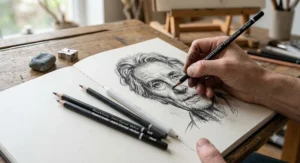
So, what is a charcoal pencil? It’s compressed or natural charcoal encased in a wood (or paper) barrel, giving you the deep, velvety blacks of loose charcoal with far more control, less mess on your hands, and a point you can actually sharpen for detail work.
This guide cuts through that noise. We’ve researched seven genuinely well-regarded charcoal pencils for drawing sold on amazon.co.uk, from pocket-money starter sets to the kind of French-made pencils that have been quietly perfecting the craft since before the Eiffel Tower existed. Along the way, we’ll dig into grades, blending, portrait work, and precise linework, because — as the good people at Tate point out — charcoal’s crumbly, carbon-based nature means it behaves rather differently to a standard graphite pencil, and knowing that difference changes how you shop.
Quick Comparison Table
Short on time? Here’s the lie of the land before we go deep on each pick.
| Pencil | Charcoal Type | Grades Available | Best For | Price Range |
|---|---|---|---|---|
| Faber-Castell Pitt Compressed Charcoal Pencils | Compressed | Soft, medium, hard | All-round grade practice | around £6–£9 |
| Derwent Charcoal Pencil Tin | Natural | Light, medium, dark + white | Versatile mid-range kit | £9–£13 range |
| General Pencil Company Charcoal Kit | Mixed | 2B, 4B, 6B + white | Complete beginner starter set | around £10–£15 |
| Cretacolor Nero Oil-Based Charcoal Pencils | Oil-treated compressed | Extra-soft, soft, medium | Precise, smudge-proof lines | £8–£12 range |
| Conté à Paris Charcoal Sketching Pencils | Compressed | 1B–3B typical range | Portrait tonal depth | around £12–£18 |
| Koh-I-Noor Gioconda Charcoal & Chalk Set | Mixed charcoal/chalk | Charcoal, sepia, white chalk | Mixed-media tonal work | £10–£14 range |
| Staedtler Mars Lumograph Black Carbon Pencils | Carbon-charcoal blend | HB–8B | Razor-sharp precise lines | around £11–£16 |
Looking at the spread above, there’s a clear pattern: the softer, more crumbly natural charcoal pencils (like the Derwent Charcoal Pencil Tin) lend themselves to expressive, tonal work, while the oil-treated or carbon-blend options (Cretacolor Nero, Staedtler Mars Lumograph Black) trade a little of that smudgy drama for control and precision. Budget-conscious beginners aren’t shortchanged either — the General Pencil Company Charcoal Kit packs grade variety and accessories into one of the cheapest entry points on this list, while Faber-Castell‘s compressed trio remains the benchmark that specialist retailers judge everything else against.
💬 Found a pencil that’s already caught your eye? Scroll down to see it in action — or jump straight to checking current pricing on Amazon.
Top 7 Charcoal Pencils for Drawing: Expert Analysis
1. Faber-Castell Pitt Compressed Charcoal Pencils — best all-round grade set for beginners and pros alike
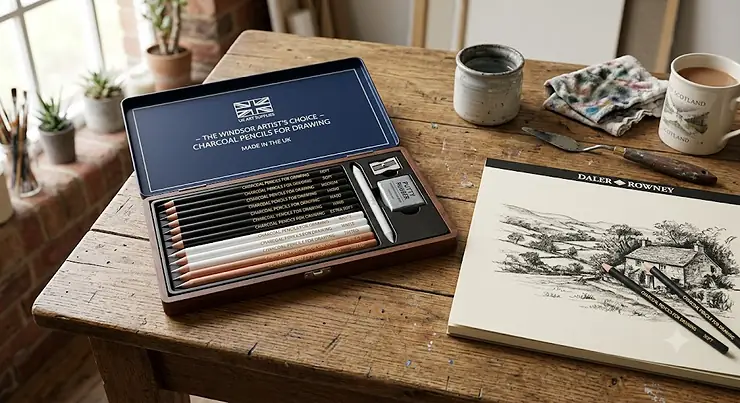
The Faber-Castell Pitt Compressed Charcoal Pencils come as a trio — soft, medium and hard — and that simple grading structure is exactly why they’ve become something of an industry default. Each pencil houses oil-free compressed charcoal (a mix of soot and clay) inside a PEFC-certified wood barrel, which means you get a genuinely deep, bluish-black line without the greasy residue some charcoal sticks leave behind.
What most buyers overlook about compressed charcoal pencils is that the “compressed” part matters more than the brand name on the barrel — it’s what gives you that dense, almost inky black that willow charcoal simply can’t match, while still being soft enough to blend with a stump or tissue. Beginners get a forgiving medium grade to learn on, while the hard grade rewards anyone working towards crisp architectural detail or fine portrait linework.
Reviewers consistently note the smooth, gritty-free laydown and the fact these sharpen cleanly with a standard craft knife rather than crumbling apart, which is a common complaint levelled at cheaper compressed charcoal. A recurring gripe is that the hard grade can feel almost graphite-like in comparison to true willow sticks, which won’t suit artists chasing maximum smudge and texture.
Pros:
- ✅ Genuinely deep, oil-free black across all three grades
- ✅ Sharpens cleanly without excessive crumbling
- ✅ Trusted, widely stocked German brand with consistent quality control
Cons:
- ❌ Hard grade can feel less expressive than natural charcoal
- ❌ Sold only as a fixed three-pencil set, not individually
At around £6–£9 for the set, the Faber-Castell Pitt Compressed Charcoal Pencils represent about as safe a starting point as charcoal drawing gets — solid value whether you’re testing the waters or restocking a well-used pencil case.
2. Derwent Charcoal Pencil Tin — best versatile mid-range kit with built-in highlights
British brand Derwent built its reputation on graphite in the Lake District, and that pencil-making pedigree shows in the Derwent Charcoal Pencil Tin, a six-piece set housing one light, two medium and two dark charcoal pencils, plus a white pastel pencil for highlights, all in a smart tin with a built-in sharpener.
Here’s what the spec sheet won’t tell you outright: including a genuine highlight pencil in the set is a small but clever decision, because charcoal drawing lives and dies on contrast, and most competing sets leave you fumbling for a separate white pastel. The three tonal grades — Derwent doesn’t use the traditional B-scale here, opting instead for light/medium/dark — cover the range from delicate atmospheric grey through to properly dense black.
Based on the spec comparison with rival tins, the natural charcoal core (mixed with fine clays rather than oils) means these blend beautifully with a finger or stump, though that same softness makes them a touch more prone to snapping if you’re heavy-handed with the sharpener. Aggregated customer sentiment describes the tin as durable for travel and praises the sharpener quality, while some note the pencils wear down faster than expected during long shading sessions.
Pros:
- ✅ Includes a genuine white highlight pencil, not just blacks
- ✅ Three tonal grades cover a wide dramatic range
- ✅ Sturdy travel tin with built-in sharpener
Cons:
- ❌ Softer natural charcoal cores can snap under heavy pressure
- ❌ No true “hard” grade for fine detail work
At £9–£13, the Derwent Charcoal Pencil Tin earns its mid-range price through sheer usability — you’re getting a genuinely complete little kit rather than just three sticks in a box.
3. General Pencil Company Charcoal Kit — best complete starter set on a budget
Manufacturing charcoal since 1889, General Pencil Company has quietly become the pencil that specialist reviewers reach for first, and the General Pencil Company Charcoal Kit (often listed as the Gen 15) is built specifically with newcomers in mind. Typical sets bundle 2B, 4B and 6B charcoal pencils with a white pastel pencil, sharpener, kneaded eraser and a paper blending stump — everything needed to start except the paper itself.
What most first-time buyers overlook is how much that bundled kneaded eraser matters. Charcoal lifts beautifully with the right eraser, letting you carve highlights straight out of dark shading, but a standard rubber just smears it — so including one isn’t a throwaway extra, it’s core to how the medium is actually meant to work.
Reviewers consistently flag the smooth, forgiving quality of the 2B and 4B grades as ideal for anyone still getting used to how differently charcoal handles compared with graphite, while the 6B produces genuinely deep blacks that punch above the set’s modest price. A common thread in feedback is that this kit is explicitly a learning set rather than a professional’s daily driver — which, frankly, is exactly what it’s marketed as.
Pros:
- ✅ Complete kit — pencils, eraser, sharpener and blending stump included
- ✅ 6B grade delivers surprisingly deep blacks for the price
- ✅ Forgiving grades ideal for building confidence
Cons:
- ❌ Not intended as a long-term professional set
- ❌ Bundled accessories are basic rather than premium
Priced around £10–£15 for the complete kit, the General Pencil Company Charcoal Kit is arguably the single best-value entry point on this list for anyone who has never picked up charcoal before.
4. Cretacolor Nero Oil-Based Charcoal Pencils — best for water-resistant, smudge-proof precision
The Cretacolor Nero Oil-Based Charcoal Pencils take a different approach entirely. Rather than pure compressed or natural charcoal, Nero pencils use an oil-infused formula that produces a glossy, water-resistant stroke — meaning once it’s down, it stays down, resisting accidental smudges far better than standard charcoal.
Based on the spec comparison with other pencils on this list, that oil content is the whole story here: it trades some of charcoal’s traditional “lift and correct” ease for permanence and precision, which matters enormously if you’re layering ink washes or working in mixed media where a stray elbow could otherwise ruin hours of shading. The typical set spans extra-soft, soft and medium grades, giving a genuine tonal range without straying into the crumbly territory of natural willow charcoal.
What reviewers and forum discussions consistently mention is the near-graphite smoothness of the line, alongside a caveat worth taking seriously — because the marks resist blending with a standard stump, correcting mistakes is trickier than with natural charcoal, so this isn’t the pencil for artists who like to smudge and rework extensively.
Pros:
- ✅ Water-resistant, smudge-proof finish once applied
- ✅ Smooth, glossy black ideal for precise, deliberate lines
- ✅ Combines well with ink and other water media
Cons:
- ❌ Harder to blend or correct once the mark is made
- ❌ Oil content can clog cheaper sharpeners
At £8–£12, the Cretacolor Nero Oil-Based Charcoal Pencils are a smart pick specifically for artists who want charcoal’s tone without charcoal’s usual fragility.
5. Conté à Paris Charcoal Sketching Pencils — best historic French craftsmanship for portrait work
Conté à Paris has been making artists’ materials since 1795 — a fact that’s easy to toss around as marketing trivia, but here it genuinely reflects over two centuries of refined manufacturing. The Conté à Paris Charcoal Sketching Pencils wrap compressed charcoal in a traditional casing, typically spanning a soft-to-medium range suited to tonal, atmospheric portrait work.
Here’s what most spec sheets won’t spell out plainly: Conté’s formulation tends to sit between the glossy density of oil-based pencils and the crumbly openness of pure willow charcoal, giving portrait artists a middle ground that blends smoothly under a stump while still holding a workable point for eye and lip detail. That balance is precisely why so many life-drawing tutors point students towards this brand early on.
Aggregated review sentiment praises the traditional, slightly chalky character of the line and its exceptional blendability, particularly for skin-tone gradients and soft shadow transitions. A recurring observation, however, is that these pencils are less widely stocked in UK high-street shops than Derwent or Faber-Castell, so buyers sometimes rely more heavily on online ordering.
Pros:
- ✅ Excellent blendability for skin tones and soft gradients
- ✅ Long manufacturing heritage reflected in consistent quality
- ✅ Ideal middle-ground density for portrait tonal work
Cons:
- ❌ Less common in UK bricks-and-mortar art shops
- ❌ Premium pricing compared with domestic brands
Typically priced in the £12–£18 range, the Conté à Paris Charcoal Sketching Pencils justify the premium for anyone whose main interest is portraiture rather than general sketching.
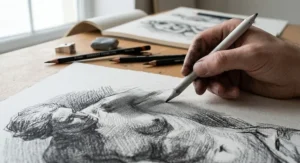
6. Koh-I-Noor Gioconda Charcoal & Chalk Pencil Set — best for mixed-media tonal range
The Koh-I-Noor Gioconda Charcoal & Chalk Pencil Set, manufactured in the Czech Republic, typically bundles charcoal alongside sepia and white chalk pencils — essentially handing you an entire limited tonal palette rather than just black and grey. The 4.2mm lead diameter housed in mature wood casing sharpens down to genuinely fine points for detail work.
What most buyers overlook here is that mixing charcoal with sepia and chalk isn’t a gimmick — it echoes the “trois crayons” technique used by old-master draughtsmen, letting you build warmth into shadows and add convincing highlight tone without switching mediums entirely. Reviewers consistently mention the set’s versatility for figure studies where a single black-and-white palette feels flat.
Based on aggregated feedback, the charcoal pencil within the set performs comparably to other natural charcoals on this list — smooth, reasonably dark, blends well — while the genuine draw is the sepia and chalk pairing rather than the charcoal alone. Some buyers note that if pure charcoal density is your only priority, dedicated charcoal-only sets edge this one out.
Pros:
- ✅ Combines charcoal, sepia and chalk for a fuller tonal palette
- ✅ Fine 4.2mm lead sharpens well for detail
- ✅ Excellent for figure studies and warm-toned shading
Cons:
- ❌ Charcoal alone is less dark than dedicated compressed sets
- ❌ Smaller pencil count if you only want black tones
At £10–£14, the Koh-I-Noor Gioconda Charcoal & Chalk Pencil Set rewards artists who want to expand beyond monochrome without buying separate sepia or chalk pencils.
7. Staedtler Mars Lumograph Black Carbon Pencils — best for razor-sharp precise lines
Rounding out the list, the Staedtler Mars Lumograph Black Carbon Pencils blend graphite with charcoal-like carbon pigment, spanning grades from HB through to 8B in a typical six-pencil tin. The result is a pencil that lays down deep, near-charcoal black tones while sharpening to a genuinely fine, controllable point — something pure charcoal often resists.
What the spec sheet won’t tell you, but plenty of technical illustrators will, is that this carbon-graphite hybrid formula exists specifically to solve charcoal’s biggest practical limitation: precision. Standard charcoal crumbles at a fine point, but the Mars Lumograph Black holds an edge closer to a graphite pencil, making it the obvious choice whenever a brief calls for crisp linework alongside deep tonal shading — architectural sketching, detailed figure outlines, or technical illustration with dramatic shadow.
Reviewers consistently highlight the smooth, break-resistant lead and the useful HB–8B range for building tone gradually, while a common observation is that purists chasing the specific crumbly texture of true willow or compressed charcoal will find this pencil feels closer to graphite in hand, even if the tonal result reads as charcoal-black on paper.
Pros:
- ✅ Holds a fine point far better than pure charcoal
- ✅ Six-grade range (HB–8B) for controlled tonal building
- ✅ Break-resistant lead suited to detailed, precise work
Cons:
- ❌ Texture feels closer to graphite than traditional charcoal
- ❌ Less dramatic smudge/blend than natural charcoal sticks
Priced around £11–£16, the Staedtler Mars Lumograph Black Carbon Pencils are the pick to reach for whenever precise lines matter as much as rich, dark tone.
Setting Up Your First Charcoal Drawing Kit
Getting started with charcoal pencils for drawing doesn’t require an art-school budget, but it does need a bit of forethought. Start with a textured drawing paper — smooth cartridge paper lets charcoal skate around rather than grip, so something with a bit of “tooth” (rougher surface) holds the particles far better. Alongside your pencils, you’ll want a kneaded eraser, a blending stump or tortillon, and a fixative spray for finished pieces.
In your first thirty days, the most common mistake is pressing too hard, too early. Charcoal builds tone in layers; heavy-handed beginners often flatten their darkest values in the first five minutes, leaving nowhere left to go for real depth. A better habit is working light to dark, testing each grade’s range on scrap paper before committing to your actual drawing.
Maintenance is refreshingly low-effort: keep pencils in a case to prevent the fragile cores snapping, sharpen with a craft knife or dedicated charcoal sharpener rather than a standard pencil sharpener (which tends to crumble softer grades), and always fix finished work outdoors or near an open window, since charcoal dust genuinely is best kept out of your lungs during extended studio sessions.
If you’d rather learn hands-on than by trial and error, local adult-education providers often run short courses dedicated entirely to the medium — this charcoal drawing course, for example, covers hatching, blending and lifting techniques with guided practice, which can shortcut months of solo experimentation.
Real-World Scenarios: Matching Charcoal Pencils to Your Drawing Life
Picture three very different artists. First, a college student sketching between lectures, working in a battered A5 pad on the bus home — for them, the General Pencil Company Charcoal Kit makes sense: cheap, complete, and forgiving of imperfect conditions.
Second, a hobbyist portrait painter working weekend life-drawing sessions at a local art group, chasing smooth skin-tone gradients — the Conté à Paris Charcoal Sketching Pencils or Derwent Charcoal Pencil Tin suit this use case perfectly, since both blend generously under a stump.
Third, an illustrator producing detailed editorial work with tight deadlines who needs consistent, precise linework alongside dramatic shading — here, the Staedtler Mars Lumograph Black Carbon Pencils or Cretacolor Nero Oil-Based Charcoal Pencils are the more sensible investment, trading some traditional charcoal texture for reliability and control.
None of these are the “correct” answer in isolation — they’re simply matched to frequency of use, environment, and the specific demands of each drawing practice, which is really the whole point of understanding grades and formulas before you buy.
Problem → Solution: Fixing the Most Common Charcoal Pencil Mistakes
Problem: Marks look muddy and grey instead of rich black. This is almost always a pressure or grade issue — swap to a softer grade like the dark pencil in the Derwent Charcoal Pencil Tin, and build tone in layers rather than pressing hard once.
Problem: Pencils keep snapping when sharpened. Natural charcoal cores are genuinely fragile. Use a sharp craft knife at a shallow angle rather than a rotary sharpener, and consider the more break-resistant Staedtler Mars Lumograph Black if snapping is a recurring frustration.
Problem: Can’t get crisp, fine details. Pure willow or very soft charcoal simply won’t hold a point. Reach for a harder grade — the hard pencil in the Faber-Castell Pitt Compressed Charcoal Pencils set — or switch entirely to the Cretacolor Nero for its precision-friendly oil formula.
Problem: Smudging happens accidentally during long sessions. A light coat of workable fixative between sessions solves this, or switch your linework layer to the smudge-resistant Cretacolor Nero Oil-Based Charcoal Pencils.
Problem: Highlights look flat or non-existent. Most sets include a white pencil for exactly this reason — don’t skip it. The Derwent Charcoal Pencil Tin and General Pencil Company Charcoal Kit both bundle one, and a kneaded eraser can lift additional highlights straight out of dark shading.
👉 Ready to build a kit that actually solves these problems? Check current prices and availability on the picks above before you start your next drawing.
How to Choose Charcoal Pencils for Drawing
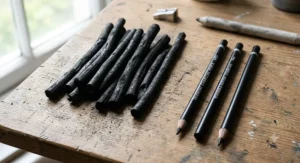
Choosing well comes down to a handful of practical questions, worked through in order:
- Decide your primary use case first. Portrait work favours softer, more blendable pencils; technical or architectural sketching favours harder, precision-holding formulas like the Mars Lumograph Black.
- Check the grade range included. A set spanning at least soft, medium and hard (or an equivalent B-scale) gives you far more tonal flexibility than a single-grade pencil.
- Consider natural versus compressed versus oil-based charcoal. Natural charcoal (Derwent, Conté à Paris) blends beautifully but smudges easily; compressed (Faber-Castell) gives deeper black with more structure; oil-based (Cretacolor Nero) trades blendability for precision and durability.
- Factor in accessories. Beginners benefit hugely from a bundled kneaded eraser, blending stump and sharpener — buying these separately adds up quickly.
- Think about paper compatibility. Charcoal needs some surface tooth to grip properly; smooth paper will undersell even the best pencil.
- Weigh price against frequency of use. Occasional sketchers rarely need premium French or German sets; committed portrait artists will likely feel the difference in blend quality.
- Read aggregated review sentiment, not star ratings alone. Recurring specific complaints (snapping, poor blending, chalky residue) tell you far more than an average score ever will.
A common mistake buyers make at this stage is choosing purely on price, then discovering the cheapest set lacks the grade range needed for genuine tonal depth — false economy that often means buying a second, better set within weeks anyway.
Soft, Medium and Hard Charcoal Pencil Grades Explained
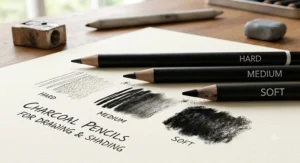
Charcoal itself, as Wikipedia’s overview of the material explains, is produced by heating carbon-rich material in the near-absence of oxygen — a process that dates back millennia and explains why its density and darkness vary so much depending on how it’s made. Grade labelling in charcoal pencils works a little differently to the familiar HB-to-9B graphite scale, and that trips up a surprising number of newcomers. Soft charcoal pencils contain a higher proportion of pure carbon relative to binder, producing darker, more crumbly, easily smudged marks — ideal for broad shading and dramatic tonal areas. Hard charcoal pencils pack in more binder (typically clay), yielding a lighter, more controlled line that holds a sharper point but never quite reaches the same inky depth.
Medium grades sit sensibly between the two, and for good reason: charcoal’s matte, crumbly character is precisely what gives it a richer, more expressive tonal range than a smoother, shinier graphite line — but that same crumbliness means grade choice matters more here than with most drawing pencils.
Here’s what most buyers overlook: a full three-grade set (like the Faber-Castell Pitt Compressed Charcoal Pencils) isn’t just about having “options” — it mirrors how experienced artists actually work, sketching a rough underdrawing in a harder grade, building mid-tones in medium, then reserving the softest grade exclusively for the darkest accents. Trying to do all three jobs with a single medium pencil is technically possible but produces flatter, less dimensional results.
Charcoal Pencils for Portraits: What Actually Matters
Portrait work asks something quite specific of a charcoal pencil: smooth, controllable gradients across skin tones, without harsh transitions between light and shadow. This is where softer, natural charcoal genuinely earns its reputation — the Conté à Paris Charcoal Sketching Pencils and the darker grades in the Derwent Charcoal Pencil Tin both blend generously under a stump or tissue, letting you feather shadow gradually rather than in abrupt bands.
What most beginners overlook when tackling portraits is how much blending tool choice affects the final result as much as the pencil itself. A stiff blending stump pushes charcoal into paper fibres more aggressively than a soft tissue or finger, and switching between them mid-drawing lets you vary edge softness across a face — crisp at the hairline, soft beneath the cheekbone.
Reviewers working specifically in portraiture consistently favour pencils with a slightly chalkier, less oily formula for exactly this reason — oil-based options like Cretacolor Nero hold precise lines beautifully but resist the generous smudging that convincing skin tones typically demand.
Charcoal Pencils for Beginners: Building Confidence Without Overwhelm
Starting out with charcoal pencils for beginners genuinely differs from starting with graphite, and that’s worth setting expectations around early. Charcoal is messier, less forgiving of accidental smudges from a resting hand, and darkens far faster per stroke than most people expect coming from pencil sketching.
The honest advice here: begin with a complete, forgiving kit rather than buying pencils and accessories piecemeal. The General Pencil Company Charcoal Kit bundles exactly what a first-timer needs — pencils, eraser, sharpener, blending stump — removing the guesswork about which accessories actually matter early on.
A common early mistake is treating charcoal like a fancier pencil and pressing just as hard as you would with an HB graphite. Charcoal’s pigment-to-binder ratio means far lighter pressure achieves the same visual darkness, so beginners consistently overshoot their tonal range in the first few sessions. Reviewers and tutors alike note that practising a simple tonal scale — a strip shaded from lightest to darkest — before attempting a full drawing solves this faster than any amount of reading about technique.
Charcoal Pencil for Precise Lines vs Soft Blending Charcoal
There’s a genuine trade-off at the heart of charcoal pencil selection, and it’s worth confronting directly rather than pretending one pencil does everything brilliantly. As Jackson’s Art Supplies puts it in their comparison of graphite and charcoal, charcoal’s matte, crumbly character gives it a richer, more expressive tonal range than a smoother, shinier graphite line — but that expressiveness is exactly what makes precision harder to achieve. A charcoal pencil for precise lines — think the Staedtler Mars Lumograph Black Carbon Pencils or the harder grade within the Faber-Castell Pitt Compressed set — sacrifices some of charcoal’s signature crumbly softness in exchange for a point that survives detailed, controlled work.
Soft blending charcoal, by contrast — natural charcoal like the Derwent Charcoal Pencil Tin or Conté à Paris Charcoal Sketching Pencils — excels at generous, expressive tonal transitions but simply won’t hold a fine point for long, however carefully you sharpen it.
Based on the spec comparison across both camps, the practical answer for most artists isn’t choosing one exclusively but understanding which job each grade is doing in a single drawing: precise pencils establish structure and edges, soft pencils fill in atmosphere and shadow. Reviewers working across both styles consistently report keeping at least one pencil from each camp in their kit, using them in sequence rather than as rivals.
Blending Charcoal Pencil Marks: Tools and Techniques That Actually Work
Blending charcoal pencil marks well is arguably the single skill that separates a flat, chalky sketch from a genuinely convincing tonal drawing. A blending stump or tortillon offers the most control, letting you push charcoal into paper fibres in small, deliberate areas — ideal for facial features or fine shadow transitions.
For broader areas, many artists use a soft tissue or even a clean finger, which spreads tone more loosely and organically, though it does transfer oils from skin that can slightly affect how subsequent layers take. What most tutorials won’t mention explicitly is that blending direction matters: dragging a stump consistently in the direction of your form (following the curve of a cheek, say) reads as far more natural than random circular rubbing.
A recurring complaint in aggregated reviews of oil-based pencils like Cretacolor Nero is that their smudge-resistant formula genuinely resists this kind of blending — which is precisely why choosing natural or compressed charcoal for your soft-shadow layers, and reserving oil-based pencils purely for crisp final details, tends to produce the most balanced results. Once blended, always fix your work; unfixed charcoal will continue to shed and smear indefinitely, undoing hours of careful blending in seconds.
“Blending is where charcoal stops being a drawing tool and starts being a painting one.”
Benefits vs Traditional Willow Charcoal Sticks
| Factor | Charcoal Pencils | Traditional Willow Sticks |
|---|---|---|
| Control & precision | High — sharpenable point | Low — broad, crumbly marks |
| Mess factor | Moderate | High |
| Tonal depth | Good to excellent (compressed) | Excellent, very soft |
| Portability | Excellent — case-friendly | Fragile, breaks easily in transit |
| Best For | Detail work, portraits, precise lines | Loose underdrawing, expressive gesture sketches |
The table above makes the trade-off fairly clear: willow sticks remain unbeaten for fast, loose, expressive underdrawing, but charcoal pencils win decisively on control, portability and precision — which is exactly why most artists end up keeping both in their kit rather than choosing one exclusively. If your drawing style leans towards tight, deliberate rendering, pencils are the sensible default; if you’re blocking in gestural life-drawing poses at speed, sticks still have their place.
FAQ
❓ What is the best charcoal pencil for beginners?
❓ Are charcoal pencils better than charcoal sticks?
❓ How do you stop charcoal pencil drawings from smudging?
❓ What's the difference between soft and hard charcoal pencils?
❓ Can charcoal pencils be used for portrait drawing?
Conclusion
Charcoal pencils for drawing reward a bit of upfront research precisely because the medium behaves so differently depending on grade and formula. Beginners are genuinely best served starting with a complete, forgiving kit like the General Pencil Company Charcoal Kit, while portrait artists chasing smooth tonal gradients should lean towards natural charcoal such as the Conté à Paris Charcoal Sketching Pencils or Derwent Charcoal Pencil Tin. Anyone prioritising precise, controlled linework alongside deep tone will get more consistent results from the Staedtler Mars Lumograph Black Carbon Pencils or the smudge-resistant Cretacolor Nero Oil-Based Charcoal Pencils, and the ever-reliable Faber-Castell Pitt Compressed Charcoal Pencils remain a sound, versatile middle ground whatever your skill level.
Ultimately, the “best” charcoal pencil is simply the one whose grade, formula and accessories match how and what you actually draw — not the one with the shiniest packaging. Take current prices, availability and your own drawing habits into account, and you’ll land on a set that earns its place in your kit for years.
Recommended for You
- Willow Charcoal vs Compressed Charcoal: 7 Best Picks (2026)
- Compressed Charcoal Sticks for Drawing: 7 Best Picks (2026)
- Best Willow Charcoal 2026: 7 Sticks UK Artists Actually Love
Disclaimer: This article contains affiliate links. As an Amazon Associate, I earn from qualifying purchases. If you purchase products through these links, we may earn a small commission at no additional cost to you.
✨ Found this helpful? Share it with your friends! 💬🤗
