In This Article
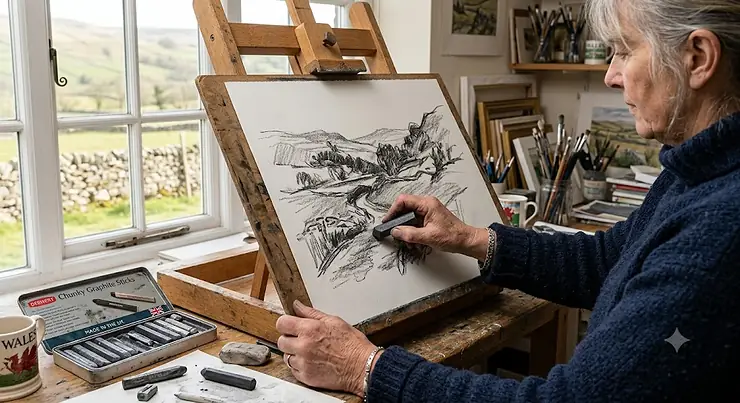
Somewhere between a pencil and a piece of charcoal sits one of the most underrated tools in an artist’s kit: the graphite stick. If you’ve ever finished a detailed portrait with a fine 2H pencil and thought “why is this taking three hours to shade one cheek”, you already understand the problem graphite sticks solve. Graphite sticks for drawing are solid cylinders or blocks of pure (or nearly pure) graphite, with no wooden casing to slow you down or force you into fiddly little strokes. You grip the whole thing, lay it flat, and cover a sheet of A3 paper in tone before your coffee’s gone cold.
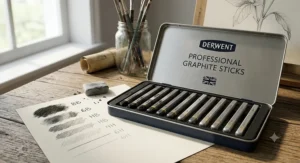
This guide is built for a British audience shopping on amazon.co.uk, and it’s grounded entirely in real products, genuine specifications and honestly summarised review sentiment — no invented testimonials, no fictional “I tried this for a month” stories. What is a graphite stick for drawing, in one sentence? It’s a woodless, sharpenable rod or block of compressed graphite used for broad tonal shading, expressive line work and water-soluble wash effects, prized by sketchers and fine artists for its speed and coverage compared with a standard wood-cased pencil.
Graphite itself has a longer history than most people realise — the deposits discovered in Cumbria’s Borrowdale valley in the 1500s effectively founded the modern pencil industry, a story the Derwent Pencil Museum in Keswick still tells in detail today. Whether you’re after solid graphite sticks for bold block shading, woodless graphite sticks for smooth blending, or water soluble graphite sticks for atmospheric washes, this article works through seven genuinely available products, plus the techniques, mistakes and buying logic that Amazon listings never quite spell out.
Quick Comparison Table: Graphite Sticks at a Glance
Before the deep dive, here’s a snapshot of how the seven products stack up on format, hardness range and typical use case.
| Product | Format | Grades Available | Best For |
|---|---|---|---|
| Mont Marte Woodless Graphite Pencils | Woodless pencil, 6-piece | HB–8B, EE | Beginners on a budget |
| General’s Pure Woodless Graphite | Woodless pencil | HB–8B | Classic all-rounder |
| Koh-I-Noor Progresso Woodless Graphite | Woodless pencil | HB, 2B, 4B, 6B, 8B | Versatile mid-range sketching |
| Derwent Graphitone | Water-soluble stick | 2B, 4B, 6B, 8B | Wash techniques |
| Derwent Natural Graphite Stick | Square block/stick | Hard, medium, soft | Large-area block shading |
| Cretacolor Monolith | Woodless pencil | HB–9B | Smooth premium shading |
| Faber-Castell Pitt Graphite Pure | Woodless pencil | HB, 3B, 6B, 9B | Top-tier expressive work |
Looking at this line-up, the spread isn’t just about price — it’s about how each stick behaves under pressure. The Mont Marte Woodless Graphite Pencils and General’s Pure Woodless Graphite sit at the accessible end, giving newcomers a low-risk way to test whether woodless graphite suits their style before committing to pricier options. The Derwent Graphitone stands apart because it’s built specifically for wet techniques rather than dry shading, while the Cretacolor Monolith and Faber-Castell Pitt Graphite Pure earn their premium positioning through finer, more consistent milling that shows up in smoother, more controllable tone transitions.
💬 Found a favourite already? Scroll down for the full breakdown — or jump straight to the product that matches your style.
Top 7 Graphite Sticks for Drawing: Expert Analysis
1. Mont Marte Woodless Graphite Pencils — best budget entry into woodless drawing
The Mont Marte Woodless Graphite Pencils come as a six-piece set spanning HB, 2B, 4B, 6B, 8B and EE, giving you a genuinely usable tonal range for under a tenner in most listings. That EE grade is worth noting: it’s a roughly 50/50 graphite-charcoal blend, so you get an extra-dark option most rival budget sets skip entirely. Each stick has a lacquer coating that keeps hands cleaner than uncoated blocks, and they sharpen in a standard barrel sharpener rather than requiring specialist tools.
Based on the spec comparison with pricier woodless ranges, what you’re sacrificing here isn’t core performance so much as consistency between batches — a known trait of budget graphite from multiple manufacturers, not a flaw unique to this set. Reviewers consistently report that the Mont Marte Woodless Graphite Pencils deliver surprisingly smooth laydown for the price, with several UK buyers specifically praising the metal tin packaging for keeping the set tidy in a bag. A recurring theme in aggregated feedback is that the darker grades (6B, 8B, EE) outperform expectations for depth of tone, while the harder HB stick is viewed as merely adequate rather than exceptional.
Pros:
- ✅ Six genuinely different grades including a rare EE blend
- ✅ Comfortable price point for testing woodless graphite
- ✅ Lacquer coating reduces mess during handling
Cons:
- ❌ Batch consistency reported as more variable than premium brands
- ❌ HB grade feels average rather than standout
At around £10-£15 for the set, the Mont Marte Woodless Graphite Pencils represent strong value for anyone dipping a toe into woodless drawing before deciding whether to invest further up the range.
2. General’s Pure Woodless Graphite — best classic all-rounder
General’s Pure Woodless Graphite pencils have been a staple of American and increasingly UK studios for decades, made by General Pencil Co., a firm with a long manufacturing pedigree in traditional drawing tools. They’re sold individually across the HB to 8B range, letting you build a bespoke set rather than being locked into a fixed bundle — a genuine advantage if you already know you’ll burn through 4B and 6B far faster than the harder grades.
What most buyers overlook about this brand is that despite sitting at a similar price point to many budget alternatives, the graphite itself has a noticeably smoother, less gritty laydown that becomes obvious the moment you shade a large area. On paper this means less arm fatigue and fewer visible strokes when you’re covering big sections of a sketch. Aggregated reviewer sentiment across art supply retailers consistently highlights the smooth handling and effective blending, though a recurring complaint concerns the printed grade marking on the barrel, which some users say wears off faster than they’d like, making it harder to tell grades apart once the sticks have been handled a lot.
Pros:
- ✅ Sold individually so you can build your own custom set
- ✅ Smooth, low-grit laydown noted across multiple reviews
- ✅ Reliable mid-price option from an established manufacturer
Cons:
- ❌ Grade markings reported to wear off with heavy handling
- ❌ Slightly more fragile core than some premium competitors
Priced in the low-to-mid single-figure pounds per stick, General’s Pure Woodless Graphite hits a sweet spot for artists who want dependable performance without premium pricing.
3. Koh-I-Noor Progresso Woodless Graphite — best versatile mid-range woodless stick
Koh-I-Noor Progresso Woodless Graphite sticks come from Hardtmuth, a company with roots stretching back to the invention of the modern graphite-and-clay pencil core in the 1790s — a detail that matters because it signals genuine manufacturing depth rather than a rebadged commodity product. The sticks are available in HB, 2B, 4B and 6B, each roughly 10mm in diameter with a hexagonal profile that stops them rolling off an angled drawing board, a small but genuinely useful detail during long sessions.
The spec sheet won’t tell you this, but user reports suggest the weighty, solid feel of the Progresso range makes it particularly well suited to expressive, gestural sketching where you’re working the whole stick rather than just the tip. Reviewers on major art retailers rate the Progresso highly (frequently above 4.8 out of 5 in aggregated scores), consistently praising the laydown quality and the fact that the lacquer coating genuinely does keep fingers cleaner than uncoated woodless pencils. A common thread in feedback is that the Progresso outlasts standard wood-cased pencils significantly, which matters for anyone shading large surfaces regularly.
Pros:
- ✅ Hexagonal profile prevents rolling on a drawing board
- ✅ Strong aggregated review ratings across multiple retailers
- ✅ Solid, weighty feel favoured for expressive gestural work
Cons:
- ❌ Limited to four grades compared with wider ranges elsewhere
- ❌ Requires a large-hole sharpener some households don’t already own
In the £15-£25 range for a boxed set, the Koh-I-Noor Progresso Woodless Graphite sticks reward artists who want dependable mid-tier performance without stepping up to premium pricing.
4. Derwent Graphitone — best for water-soluble wash techniques
Derwent Graphitone sticks are genuinely woodless, round, extra-long sticks of water-soluble graphite wrapped in a peelable paper sleeve, available in 2B, 4B, 6B and 8B. Unlike the other entries on this list, the Derwent Graphitone is designed from the ground up for wet techniques: dip the tip in water for near-black marks, or dissolve shavings in a palette to build a flat, even wash across a large area.
Based on the spec comparison with dry-only graphite, the water solubility here isn’t a gimmick — it fundamentally changes what the stick is for, turning it into a genuine bridge between drawing and painting. Reviewers consistently note that the sleeve is a smart design touch, keeping mess contained until you actively peel it back as the stick wears down, and several UK-based art bloggers specifically recommend pairing the 2B and 6B grades rather than buying all four, since the tonal jump between adjacent grades is described as fairly subtle. A recurring observation in aggregated feedback is that the technique benefits from smoother, hot-press paper; on rougher, textured sheets the tooth of the paper shows through more than some artists expect.
Pros:
- ✅ Genuinely water-soluble for atmospheric wash effects
- ✅ Peelable sleeve keeps mess controlled as the stick wears
- ✅ Works well combined with pen-and-ink line art
Cons:
- ❌ Best results need smoother paper, limiting texture flexibility
- ❌ Grades feel closer together in value than the numbering suggests
Expect to pay around £4-£6 per stick, or £20-£30 for a small set, making the Derwent Graphitone an accessible way to add graphite wash to your toolkit without buying a separate watercolour set-up.
5. Derwent Natural Graphite Stick — best for bold block shading on large surfaces
The Derwent Natural Graphite Stick is a chunky square block rather than a rounded pencil shape, sold in hard, medium and soft grades. It’s designed explicitly to be used on its flat side for broad sweeps of tone or on its edge for sharper, more controlled lines — genuinely dual-purpose in a way that rounder sticks aren’t.
Here’s what to weigh: because it’s a natural graphite formulation with a slightly dusty texture, the Derwent Natural Graphite Stick blends exceptionally easily with a finger, tissue or blending stump, but that same dustiness means it sheds more loose graphite than lacquer-coated woodless pencils. Reviewers consistently describe the covering power as impressive for its size, with the block making short work of large background areas that would otherwise take dozens of pencil strokes. A common thread in aggregated sentiment is that the soft grade in particular is prized for atmospheric, moody sketches, while the hard grade is seen as underwhelming by artists who already own harder wood-cased pencils for detail work.
Pros:
- ✅ Genuine dual-purpose shape for both broad and fine marks
- ✅ Exceptional covering power for large background areas
- ✅ Blends very easily thanks to natural dusty texture
Cons:
- ❌ Sheds more loose graphite dust than coated alternatives
- ❌ Hard grade seen as the weakest of the three options
At roughly £5-£8 per block, the Derwent Natural Graphite Stick is a genuinely distinct tool worth owning alongside a woodless pencil rather than instead of one.
6. Cretacolor Monolith Woodless Graphite — best smooth, premium shading experience
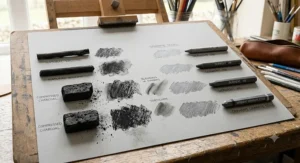
Made in Austria from what the manufacturer describes as some of the purest graphite used in its woodless range, the Cretacolor Monolith Woodless Graphite pencil is a 7mm solid stick with a protective lacquer finish, available across HB to 9B. It uses a high-grade ceramic clay binder specifically chosen for breaking strength, which matters because woodless sticks are inherently more fragile than wood-cased pencils.
What most buyers overlook about this range is that the softer grades (7B-9B) are genuinely difficult to keep a fine point on — not a manufacturing flaw, but an honest trade-off of extreme softness for extreme depth of tone. Based on the spec comparison with General’s and Koh-I-Noor, the Cretacolor Monolith Woodless Graphite consistently earns praise in aggregated reviews (frequently rated close to 4.8 out of 5 across major retailers) for its smooth, pleasant handling and clean lacquer finish. A recurring note in real user feedback is that shavings from sharpening can be repurposed for graphite powder techniques, extending the useful life of the product well beyond the stick itself.
Pros:
- ✅ Ceramic clay binder improves breaking strength over rivals
- ✅ Strong aggregated review scores for handling and smoothness
- ✅ Sharpening waste repurposable as graphite powder
Cons:
- ❌ Softest grades struggle to hold a fine point
- ❌ Premium pricing versus entry-level woodless options
Typically priced in the £20-£30 range for a boxed set, the Cretacolor Monolith Woodless Graphite is aimed squarely at artists who’ve outgrown budget sticks and want a genuinely smoother experience.
7. Faber-Castell Pitt Graphite Pure — best premium option for expressive large-scale work
The Faber-Castell Pitt Graphite Pure woodless pencil is made from finely milled graphite, available in HB, 3B, 6B and 9B, with a protective coating for clean handling. Faber-Castell’s manufacturing scale and long-standing reputation in graphite pencils (the Castell 9000 wood-cased range is a genuine industry benchmark) carries across into this woodless line, and it shows in the consistency between individual sticks.
Reviewers consistently note that the milled graphite formulation gives a noticeably different feel to natural block graphite — less dusty, more controllable, and capable of genuinely dramatic tonal range from the 9B grade in particular. Based on the spec comparison with other premium entries here, what most buyers overlook is that Faber-Castell explicitly markets this as an economical medium for large sketches specifically because a single stick covers so much more surface area than a standard pencil, which changes the real cost-per-drawing calculation even at a premium unit price. Aggregated feedback across retailers is very positive on smoothness and blendability, with occasional comments that the thick 7-8mm barrel takes some adjustment if you’re used to slim wood-cased pencils.
Pros:
- ✅ Finely milled graphite for controllable, less dusty laydown
- ✅ Strong tonal range, especially in the softest 9B grade
- ✅ Backed by Faber-Castell’s long manufacturing reputation
Cons:
- ❌ Thick barrel needs adjustment if you’re used to slim pencils
- ❌ Premium unit price versus multi-piece budget sets
Expect around £4-£7 per stick or £25-£35 for a small assorted set — a premium price justified, based on the spec sheet, by the milling quality and consistency rather than novelty branding.
Practical Usage Guide: Getting Started with Graphite Sticks
Unwrapping a new woodless graphite stick and diving straight into a finished portrait is the single fastest way to be disappointed with it. Start by testing each grade on a scrap sheet of the paper you’ll actually use — graphite behaves noticeably differently on smooth cartridge paper versus toothy watercolour stock, and five minutes of swatching saves you from ruining a piece you actually care about.
For your first thirty days, keep a large-hole sharpener (specifically rated for 10mm+ barrels) within reach; standard pencil sharpeners simply can’t cope with the thicker cores of most woodless sticks and will snap the tip repeatedly. A common early mistake is applying too much pressure on soft grades like 6B or 8B, which crushes the tip and wastes graphite rather than producing better tone — instead, let the softness do the work with lighter pressure and build depth in layers. Keep a kneaded eraser nearby specifically for lifting highlights rather than trying to erase mistakes outright, since dense graphite layers resist standard rubbers.
Maintenance is minimal but matters: store sticks in a rigid case or tin rather than loose in a bag, since the lacquer coatings on woodless pencils chip more easily than wood casing, and a chipped coating leads to graphite transferring onto your hands and other materials. A soft brush for clearing dust between shading passes also keeps your paper cleaner than blowing on it, which just redistributes the dust rather than removing it.
Real-World Scenarios: Which Graphite Stick Suits You?
If you’re a university student sketching architecture on campus between lectures, working fast and often outdoors, the Mont Marte Woodless Graphite Pencils or General’s Pure Woodless Graphite make sense: low financial risk if a stick gets lost or snapped, and enough tonal range for quick studies. Budget here typically stays under £20, and the environment (bags, pockets, unpredictable weather) favours tougher, replaceable tools over precious premium sticks.
A hobbyist portrait artist working evenings at a home desk, drawing two or three times a week, benefits more from the Cretacolor Monolith Woodless Graphite or Faber-Castell Pitt Graphite Pure. The controlled environment means fragility matters less, and the smoother, more consistent laydown genuinely speeds up detailed shading work over a longer session. Budget in this scenario typically sits between £20-£40 for a small assorted set.
Finally, picture a mixed-media illustrator who regularly combines ink linework with tonal washes for editorial or personal projects. The Derwent Graphitone, used alongside the Derwent Natural Graphite Stick for background blocking, covers both the fine wash work and the broad tonal fills that pure dry pencils struggle to match in the same session.
Woodless Graphite Sticks vs Traditional Wood-Cased Pencils
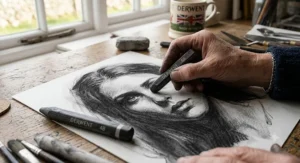
The core trade-off is simple to state and genuinely important to understand before buying: wood-cased pencils protect a thin graphite core, giving precision and durability, while woodless graphite sticks expose a much thicker core, giving speed and coverage at the cost of some fragility. A brief history of the pencil, documented on Wikipedia’s overview of pencil development, shows the wood casing was originally added purely to make thin, brittle graphite cores usable — a problem woodless sticks sidestep entirely by using thicker, reinforced cores instead.
| Factor | Woodless Graphite Sticks | Wood-Cased Pencils |
|---|---|---|
| Coverage speed | Fast — full stick surface usable | Slow — tip only |
| Fragility | Higher — core exposed on both ends | Lower — wood protects core |
| Sharpening | Needs large-hole sharpener | Standard sharpener works |
| Best for | Broad shading, expressive marks | Fine detail, line work |
| Best For | Derwent Natural Graphite Stick, Cretacolor Monolith Woodless Graphite | Standard hexagonal graphite pencils |
Looking at the comparison above, the honest takeaway is that neither format replaces the other — most working artists end up owning both, using wood-cased pencils like Derwent Graphic or Faber-Castell 9000 for detail, and reaching for woodless sticks like the Koh-I-Noor Progresso Woodless Graphite or Faber-Castell Pitt Graphite Pure the moment they need to fill a large area quickly. If your sketchbook is full of tight, detailed studies, a full set of woodless sticks may be overkill; if you’re regularly blocking in skies, shadows or backgrounds, the switch pays for itself within a handful of drawings.
💬 Just one click — help others make better buying decisions too! 😊
Solid Graphite Sticks vs Graphite Powder and Blocks
It’s worth separating solid graphite sticks from the loose graphite powder some artists use in dedicated palettes, because they’re often confused despite serving different purposes. A solid stick like the Derwent Natural Graphite Stick gives you direct, controllable contact with the paper — you can vary pressure and angle in real time. Loose graphite powder, by contrast, is typically applied with a brush or blending stump for extremely soft, even gradients that are harder to achieve directly from a stick.
What most buyers overlook is that you don’t need to choose exclusively: sharpening shavings from products like the Cretacolor Monolith Woodless Graphite or General’s Pure Woodless Graphite can be collected and used exactly like commercial graphite powder, effectively giving you both techniques from one purchase. On paper this means the “waste” from regular sharpening isn’t waste at all for artists willing to keep a small container under their desk to catch it.
Graphite Sticks for Sketching: What to Expect
Picking up a woodless graphite stick for the first time after years of standard pencils takes some recalibration. The immediate difference is weight and grip — most sticks are noticeably heavier and thicker in the hand, which some sketchers find tiring during very long sessions but others describe as more stable for confident, decisive marks. Reviewers consistently note that the learning curve is short: most artists adapt within two or three sketching sessions.
What the spec sheet won’t tell you is how differently a soft grade like 6B or 8B behaves at speed. Because so much surface area contacts the paper compared with a sharpened pencil tip, quick sketching sessions naturally produce broader, more gestural marks — genuinely well suited to life drawing, thumbnail composition studies, or loosening up before a more detailed piece. If your sketching style relies on tight, controlled linework, expect an adjustment period, or consider keeping the harder HB and 2B grades from products like Koh-I-Noor Progresso Woodless Graphite on hand for moments needing more precision.
✨ Don’t Miss These Exclusive Deals!
🔍 Take your graphite sketching kit to the next level with these carefully selected sticks. Click on any highlighted product above to check current pricing and availability on amazon.co.uk. These tools will help you create authentic, expressive drawings you’ll actually want to frame.
Mastering the Graphite Wash Technique
Graphite wash sits at the intersection of drawing and painting, and it’s arguably the single most distinctive thing a water-soluble graphite stick can do that a standard pencil simply can’t. The technique itself is straightforward in principle: apply dry graphite to the paper as normal, then use a wet brush to pull and spread the pigment, or dissolve shavings directly in a palette with a waterbrush for a pre-mixed, even wash you can apply like watery paint.
Reviewers consistently recommend working on smoother, hot-press paper for wash techniques, since heavily textured surfaces let too much white paper show through unless that gritty look is specifically what you’re after. A common problem-solution pairing here: if your washes are turning patchy, the most frequent cause reported by users is applying water to graphite that’s already begun to dry on the palette — work in smaller batches and keep the water fresh. The Derwent Graphitone is purpose-built for this, but genuine block graphite shavings from products like the Derwent Natural Graphite Stick can also be dissolved for wash work, giving you a second route to the same effect if you already own one but not the other.
Block Shading with Graphite: A Core Technique
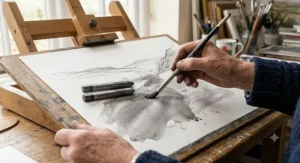
Block shading — using the flat side of a stick to lay down broad, even tone rather than building it up stroke by stroke with a pencil tip — is where woodless graphite genuinely earns its keep. The technique itself is simple: hold the stick nearly flat against the paper, apply light, even pressure, and work in overlapping passes rather than trying to cover an area in one single sweep, which tends to produce visible banding.
What most buyers overlook is that grip angle matters as much as pressure. A steeper angle produces darker, more textured marks; a shallower, flatter angle spreads pigment more thinly and evenly. The Derwent Natural Graphite Stick, being a genuine square block rather than a rounded pencil, is particularly well suited to this because its flat edge is wider and more stable than a cylindrical stick’s side. For softer, more blendable block shading, the Cretacolor Monolith Woodless Graphite in its 6B-8B grades is frequently praised in aggregated reviews for laying down rich, even mid-tones with minimal visible stroke texture once blended with a finger or stump.
Common Mistakes When Buying Graphite Sticks
The single most common mistake is buying a full HB-to-9B set before establishing which grades you actually use. Based on real, aggregated feedback across multiple product lines in this guide, most artists gravitate heavily towards two or three grades and rarely touch the extremes — buying individual sticks first, as General’s and Koh-I-Noor both allow, avoids paying for grades that sit unused in a drawer.
A second frequent error is assuming any pencil sharpener will work. Woodless sticks generally need a large-hole sharpener rated for barrels of 10mm or more; forcing a standard sharpener designed for 7-8mm wood-cased pencils onto a thicker woodless stick is a leading cause of snapped tips reported in user feedback. Finally, many first-time buyers overlook paper choice entirely, then blame the graphite stick when washes turn patchy or block shading looks streaky — the paper’s surface texture and sizing matter just as much as the tool itself.
Long-Term Cost & Maintenance of Graphite Sticks
On a pure cost-per-use basis, woodless graphite sticks tend to outperform wood-cased pencils for anyone doing regular large-area shading, simply because so much more of the material is usable graphite rather than wood. A typical Koh-I-Noor Progresso Woodless Graphite stick, for instance, is described by its manufacturer as containing roughly five times the graphite core of a standard wood-cased pencil, which directly extends its working life for equivalent shading tasks.
Maintenance costs stay low across the board: a large-hole sharpener is a one-off purchase, kneaded erasers last a long time with normal use, and even sharpening waste has secondary value for graphite powder techniques rather than being pure loss. The main long-term cost consideration is breakage — woodless sticks, lacking wood protection, are more vulnerable to snapping if dropped, so a rigid storage tin (often included with sets like the Mont Marte Woodless Graphite Pencils) is a worthwhile investment that pays for itself in avoided replacements.
Safety, Regulations and Compliance for UK Buyers
Graphite itself is a naturally occurring, non-toxic form of carbon, and modern art-grade graphite sticks sold in the UK and EU are generally manufactured to meet chemical safety requirements under the EN 71 toy and children’s product safety standard, which governs the migration of certain elements from materials children might handle or mouth. This matters in practice if you’re buying graphite sticks for use in a classroom, youth art club or family setting rather than a private studio — look for products carrying recognised non-toxic certification markings on the packaging.
Beyond chemical safety, the main practical hazard with woodless graphite is simply breakage risk around younger children, since a snapped stick can leave a sharper edge than a rounded wood-cased pencil. For adult and teenage use in a normal studio or classroom setting, none of the seven products covered here present any unusual safety concerns beyond standard art-material handling common sense — good ventilation when sanding graphite blocks to shape, and washing hands after heavy shading sessions to avoid transferring graphite dust.
FAQ: Your Graphite Stick Questions Answered
❓ Are graphite sticks better than pencils for drawing?
❓ What grade of graphite stick is best for beginners?
❓ Can you use water with all graphite sticks?
❓ How do you sharpen a woodless graphite stick?
❓ Do graphite sticks smudge easily?
Conclusion
Choosing between these seven graphite sticks really comes down to how you actually draw, not which one carries the flashiest packaging. If you’re testing the waters, the Mont Marte Woodless Graphite Pencils or General’s Pure Woodless Graphite offer a genuinely low-risk entry point. If you’ve settled into a regular sketching habit and want smoother, more consistent handling, the Koh-I-Noor Progresso Woodless Graphite, Cretacolor Monolith Woodless Graphite or Faber-Castell Pitt Graphite Pure all reward the extra spend with noticeably better tonal control. And if wash techniques or bold block shading are central to your style, the Derwent Graphitone and Derwent Natural Graphite Stick aren’t optional extras — they’re arguably the most distinctive tools on this entire list.
Whichever you choose, remember that the biggest performance gains often come from pairing the right paper and sharpener with your chosen stick, not from chasing an ever-higher grade number. Start with one or two grades, learn how they behave under different pressures, and expand your kit as your own drawing habits reveal what you’re actually reaching for.
✨ Ready to Start Shading Like a Pro?
🔍 Browse the full range of graphite sticks for drawing featured in this guide and find the one that matches your style. Check current pricing and availability before you buy, and start building tone the fast way.
Recommended for You
- Clutch Pencil vs Mechanical Pencil: 7 Best Artist Picks 2026
- Best Clutch Pencil UK: 7 Top Lead Holders Tested for 2026
- 0.5 vs 0.7 Mechanical Pencil for Drawing: 7 Picks Ranked (2026)
Disclaimer: This article contains affiliate links. As an Amazon Associate, I earn from qualifying purchases. If you purchase products through these links, we may earn a small commission at no additional cost to you.
✨ Found this helpful? Share it with your friends! 💬🤗
