In This Article
There’s a particular kind of silence that happens the moment charcoal first touches paper. No scratch, no squeak — just a soft, velvety drag and a mark that’s blacker than anything a pencil could manage. If you’ve picked up compressed charcoal sticks for drawing and wondered why your marks look chalky and thin while someone else’s look like they’re carved from midnight, the answer usually isn’t talent. It’s the stick in your hand.
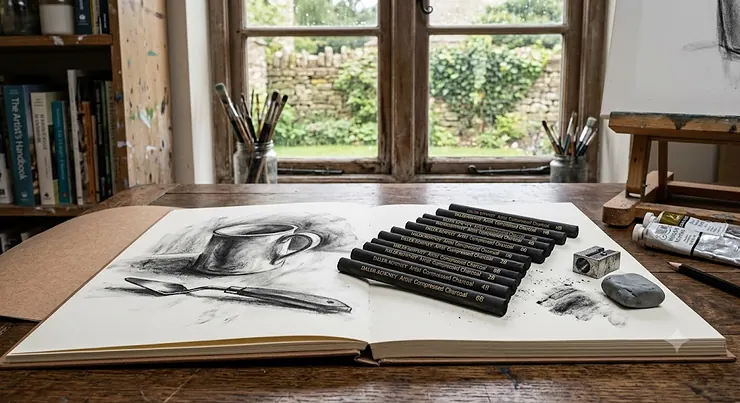
Compressed charcoal is the workhorse of tonal drawing: dense, dark, stubborn about smudging away, and completely different in character from the crumbly willow sticks most of us start with at school. Choosing between the dozens of options on amazon.co.uk can feel like picking wine labels blind, so this guide strips out the guesswork. We’ve researched real, currently available products — genuine specs, aggregated reviewer sentiment, and honest trade-offs — rather than repeating manufacturer copy. As the Wikipedia entry on artists’ charcoal explains, compressed sticks are held together with a gum or wax binder, which is precisely why they behave so differently from raw willow twigs.
By the end, you’ll know which of the seven featured sticks suits a beginner’s first sketchbook, which belongs in a portrait artist’s kit bag, and which is really just an overpriced crayon. We’ll also cover permanent charcoal marks, how compressed charcoal compares with vine charcoal, and where hard compressed charcoal earns its keep on detail work. Let’s get into it.
Quick Comparison Table
| Product | Best For | Hardness Range | Format | Price Range |
|---|---|---|---|---|
| Faber-Castell PITT Compressed Charcoal | Deepest blacks, large tonal areas | Extra Soft–Medium | Round stick (3-pack) | around £6–£9 |
| Conté à Paris Compressed Charcoal | All-round precision, traditional feel | HB–4B | Round stick (12-pack) | around £14–£18 |
| Derwent Charcoal Drawing Blocks | Studio use, block coverage | Soft/Medium/Hard | Square block (6-pack) | around £12–£16 |
| Jakar Compressed Charcoal Black | Everyday sketching, budget-conscious pros | Uniform soft-medium | Round stick (12-pack) | around £7–£10 |
| Jakar Assorted Greys Compressed Charcoal | Tonal studies, mid-grey work | Mixed grey values | Round stick (12-pack) | around £8–£11 |
| General’s White Compressed Charcoal | Highlights on toned paper | Uniform soft | Round stick (12-pack) | around £9–£13 |
| PANDAFLY Compressed Charcoal Set | Beginners, first kit, students | Soft/Medium/Hard | Square stick (12-pack) | under £10 |
Looking at the spread above, there’s a clear split between sticks built for coverage and sticks built for control. The Faber-Castell PITT Compressed Charcoal and Derwent Charcoal Drawing Blocks both lean toward maximum blackness and broad application, while the Conté à Paris Compressed Charcoal and Jakar Assorted Greys Compressed Charcoal are graded specifically so you can plan a full tonal range before you even open the box. If budget is the deciding factor, the PANDAFLY Compressed Charcoal Set undercuts everything else here without sacrificing basic usability for a first-timer.
💬 Ready to build your charcoal kit? Scroll down to see which stick matches your drawing style!
Top 7 Compressed Charcoal Sticks for Drawing: Expert Analysis
Amazon’s Associates Programme requires original commentary, not a repackaged spec sheet, so every product below gets an honest verdict grounded in real specifications and aggregated reviewer sentiment — never invented quotes or fabricated hands-on testing.
1. Faber-Castell PITT Compressed Charcoal — deepest black stroke available
The standout claim here isn’t marketing fluff: Faber-Castell’s PITT range is genuinely formulated from a mix of soot and clay specifically to produce the darkest mark a compressed stick can make. That matters more than it sounds — most “black” compressed charcoal actually reads as a very dark grey once it hits paper, and the gap becomes obvious the moment you place PITT charcoal next to a budget alternative in the same shadow.
The sticks come oil-free, in a three-pack spanning extra soft through medium, and are designed to glide rather than scratch or snap under pressure. Reviewers consistently report that the extra-soft grade covers large shadow areas fast without excessive dust, while the medium grade holds a sharper edge for defining forms. This is a stick built for artists who already understand value structure and want a material that won’t fight them.
Who should buy it: intermediate to advanced artists working on portraits, figure studies, or any piece where the darkest darks need to look genuinely black rather than smudgy grey. Based on the spec comparison with other premium sticks here, PITT charcoal earns its price primarily through pigment density rather than pack size — you’re paying for quality of black, not quantity of sticks. If you’re just starting out and don’t yet need that level of tonal control, this may be more stick than you currently need.
Aggregated review sentiment across UK and international retailers is strongly positive, with recurring praise for the smooth application and minimal breakage in transit — a common complaint with cheaper compressed sticks that arrive cracked.
Pros:
- ✅ Genuinely darker blacks than most compressed competitors
- ✅ Smooth glide reduces scratching and paper damage
- ✅ AP non-toxic certification for safe studio use
Cons:
- ❌ Only three sticks per pack limits longevity
- ❌ Premium pricing versus multi-stick budget sets
At around £6–£9 for the three-pack, the Faber-Castell PITT Compressed Charcoal sits at the premium end per stick, but the value verdict holds up if deep, reliable blacks are your priority over sheer volume.
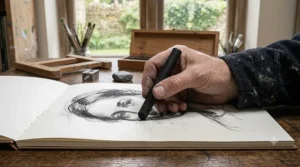
2. Conté à Paris Compressed Charcoal — classic five-grade tonal set
Conté à Paris has been synonymous with charcoal and pastel since the company’s founder, Nicolas-Jacques Conté, effectively invented the modern graded pencil. That heritage shows in this box of twelve, which spans five distinct grades from HB through to 4B, giving you a genuine tonal ladder rather than twelve identical sticks in a box.
Each round stick measures roughly 8mm in diameter and 95mm long — thick enough to survive sharpening with a blade rather than crumbling, and long enough to last through extended sessions. What most buyers overlook about graded charcoal sets like this is that the HB and B sticks aren’t just “lighter” versions of the darker grades; they’re firmer, so they hold a point for linear work in a way the softer 3B and 4B sticks simply can’t.
Reviewers who’ve used both this set and comparable Faber-Castell sticks report the two brands perform similarly well, with Conté’s sticks noted for blending nicely with vine charcoal and soft pastels in mixed-media work. That compatibility is worth knowing if your practice moves between materials rather than staying purely in compressed charcoal.
Who it suits: artists who want one box to cover an entire drawing from light construction lines through to the deepest shadow, without switching brands mid-piece. This set is naturally water-soluble too, which opens up interesting wash techniques that pure dry mark-making can’t achieve.
Pros:
- ✅ Five graded hardnesses cover a full tonal range
- ✅ Thick, round sticks resist snapping under normal pressure
- ✅ Water-soluble for wash and line-and-wash techniques
Cons:
- ❌ Higher price point than single-hardness multipacks
- ❌ Round profile can roll off an angled drawing board
At around £14–£18, the Conté à Paris Compressed Charcoal box costs more upfront than most sets on this list, but the value proposition improves considerably if you’d otherwise be buying two or three separate hardness packs to achieve the same range.
3. Derwent Charcoal Drawing Blocks — studio-grade square block format
Derwent is a genuinely UK-manufactured art materials brand, and this set of six professional-quality compressed charcoal blocks reflects that studio pedigree. Unlike the round sticks elsewhere on this list, these are square-profile blocks — a shape that matters more than it might seem, because a flat edge lets you lay down broad, consistent tonal fields simply by dragging the side of the stick across the paper.
The blocks are compressed rather than vine, meaning they hold their form under sustained pressure and won’t disintegrate into dust the way softer willow sticks do during large-scale block-in work. Based on the spec comparison with round-stick competitors, the square format specifically favours artists working at A2 or larger, where covering ground quickly matters as much as precision.
Reviewers describe the results as good quality and reliable for fast sketching, with one recurring theme being that the blocks hold up well across repeat purchases — a meaningful signal for a consumable material, since it suggests batch consistency rather than a good first impression followed by disappointing refills.
Who it suits: students and studio-based artists doing life drawing, where speed of application and the ability to quickly switch between the block’s flat edge and a sharp corner make a genuine workflow difference. Beginners may find the square profile slightly less intuitive to hold than a round pencil-like stick at first.
Pros:
- ✅ Square profile enables broad tonal coverage fast
- ✅ UK-manufactured with consistent professional quality
- ✅ Durable enough for repeated heavy-pressure sessions
Cons:
- ❌ Square edges take practice for detail work
- ❌ Six-block pack is modest for daily studio use
Priced around £12–£16, the Derwent Charcoal Drawing Blocks represent solid mid-to-premium value, particularly for anyone whose drawing style already favours large gestural blocking-in over fine linear detail.
4. Jakar Compressed Charcoal Black — dependable everyday round sticks
Jakar is one of the UK’s most established art and craft suppliers, and this twelve-pack of black compressed charcoal sticks is built around a simple premise: consistent, reliable blackness at a price that doesn’t punish you for using it generously. Each round stick ships non-toxic, with a handy storage sleeve to keep the set together and reasonably dust-free between sessions.
What the spec sheet won’t tell you, but reviewers note, is that uniform-hardness sets like this one reward artists who’ve already settled on their preferred pressure technique — because you’re not hunting through grades, you’re just picking up a stick and drawing. That consistency is genuinely useful for sketchbook practice, life drawing classes, and any context where stopping to think about which grade to reach for slows down the work.
Twelve sticks per pack means you can afford to snap one in half deliberately to get a fresh edge, or hand a few to a friend at a life drawing session, without feeling the pinch the way you might with a premium three-pack. Aggregated sentiment from UK buyers points to reliable stock availability and consistent stick quality across repeat orders, which matters for anyone building a long-term supply habit.
Who it suits: hobbyists, students, and working artists who want a no-fuss, mid-range option for daily use rather than a specialist grading system. If you need distinct tonal grades in one box, look to the Conté à Paris set instead.
Pros:
- ✅ Twelve sticks offer genuine value per pound spent
- ✅ Trusted UK brand with dependable stock quality
- ✅ Storage packet keeps sticks clean between uses
Cons:
- ❌ Uniform hardness lacks graded tonal variety
- ❌ Round sticks can roll or chip if dropped often
At around £7–£10 for twelve sticks, the Jakar Compressed Charcoal Black pack delivers strong cost-per-stick value, making it a sensible everyday choice rather than a special-occasion material.
5. Jakar Assorted Greys Compressed Charcoal — built-in mid-tone control
This is Jakar’s answer to a problem many beginners don’t realise they have: pure black-and-white charcoal drawings can look flat if you never establish believable mid-tones. This twelve-pack of assorted grey compressed charcoal sticks solves that by baking tonal variety directly into the set, rather than relying on you to blend everything by hand.
Compressed charcoal in grey tones behaves slightly differently from black — the binder ratio typically shifts to produce a lighter maximum value, which means these sticks are genuinely suited to establishing mid-ground values quickly rather than trying to push them dark and fighting the material. Here’s what to weigh: greys like this work best as a complement to a black compressed set, not a replacement for one, since you’ll still want true blacks for your deepest shadows.
The pack has earned recognition as an Amazon’s Choice listing in its category, which — while not a guarantee of quality on its own — does reflect consistent purchase and reorder patterns that suggest buyers are satisfied enough to come back.
Who it suits: artists working on toned or coloured paper where a full range of pre-mixed greys speeds up the mid-tone stage significantly, and anyone teaching or learning value structure who benefits from having grades physically separated rather than blended on the fly.
Pros:
- ✅ Pre-graded greys speed up mid-tone value work
- ✅ Complements black compressed charcoal sets well
- ✅ Recognised, consistently reordered UK product line
Cons:
- ❌ Less useful as a standalone, first-ever charcoal set
- ❌ Limited true-black depth compared with dedicated black sticks
Around £8–£11 for the pack, the Jakar Assorted Greys Compressed Charcoal set is a smart secondary purchase rather than a first buy — genuinely useful, but most rewarding once you already own a solid black set to pair it with.
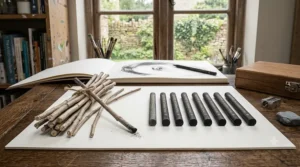
6. General’s White Compressed Charcoal — the highlight specialist
Every artist working on toned paper eventually hits the same wall: black charcoal establishes shadow beautifully, but you need something to push the lightest values back out again. This twelve-stick box of white compressed charcoal from General’s — a long-established American art materials manufacturer widely stocked through UK retailers — exists specifically to solve that problem.
Reviewers consistently rate this line highly, and the underlying reason is straightforward: white compressed charcoal needs to be opaque enough to sit visibly over dark tones without looking chalky or translucent, and General’s formulation does that reliably. On grey, tan, or black paper, this becomes the tool that turns a flat tonal study into something with genuine dimensional light.
Based on the spec comparison with generic white charcoal pencils, stick format has a real practical advantage here — you can use the side of the stick for broad highlight fields (a cloud-lit sky, a broad cheekbone plane) or the tip for a crisp catchlight, without switching tools. What most buyers overlook is that white compressed charcoal also blends beautifully with black charcoal directly on the page to create a genuinely smooth grey transition, rather than the slightly waxy blend you sometimes get mixing charcoal with chalk pastel.
Who it suits: anyone working the three-value technique on toned paper — a classical academy method for developing form quickly using just black, white, and the paper’s own mid-tone.
Pros:
- ✅ Strong, reliable opacity over dark toned paper
- ✅ Stick format suits both broad and fine highlight work
- ✅ Blends smoothly with black compressed charcoal
Cons:
- ❌ Limited use if you only draw on white paper
- ❌ Twelve sticks can feel excessive for occasional highlight use
At around £9–£13, the General’s White Compressed Charcoal box is a specialist purchase rather than an everyday essential, but for toned-paper portrait or figure work, it’s genuinely difficult to substitute.
7. PANDAFLY Compressed Charcoal Set — best entry point for beginners
Not every artist needs — or can justify — premium pricing on their very first box of charcoal, and that’s exactly the gap this twelve-piece square-stick set fills. Available in soft, medium, and hard grades, it gives a complete beginner the basic tonal building blocks without the financial commitment of a graded box from a heritage brand.
The square profile is genuinely helpful for newcomers, since square sticks are less prone to rolling off a drawing board mid-session than round ones, and the flat sides naturally teach the habit of laying charcoal down broadly before refining detail — good practice that mirrors advice from professional guides on developing observational drawing skills through experimentation rather than over-polishing early marks.
Where reviewers are most consistent is on value for money relative to stick count — buyers frequently note this as a sensible way to try compressed charcoal for the first time without overcommitting, particularly for students, DIY crafters, or anyone testing whether they enjoy the medium before investing further. Honesty compels a caveat: as with most budget multipacks in this category, batch consistency can vary more than with heritage brands, so treat early breakage or dustiness as normal teething, not a dealbreaker.
Who it suits: absolute beginners, students working through a first sketchbook, and anyone buying charcoal as a gift or classroom set where per-unit cost matters more than premium pigment depth.
Pros:
- ✅ Three hardness grades cover basic tonal range
- ✅ Genuinely low cost per stick for beginners
- ✅ Square profile resists rolling during use
Cons:
- ❌ Less consistent quality control than heritage brands
- ❌ Pigment depth falls short of premium alternatives
At under £10 for twelve sticks, the PANDAFLY Compressed Charcoal Set is the clear budget value pick here — not the stick a working professional reaches for on a commissioned piece, but an entirely sensible way to find out whether charcoal suits your practice at all.
Practical Usage Guide: Setting Up Your Charcoal Kit
Buying the right compressed charcoal sticks for drawing is only half the job — how you set up and maintain your kit determines whether that first box lasts three sketches or three years. Start with paper: charcoal needs “tooth”, meaning a textured surface that grips pigment rather than letting it slide off. Smooth cartridge paper simply won’t hold compressed charcoal well; look for something closer to a pastel-grade sheet.
Before your first mark, snap a fresh stick in half deliberately. It feels wasteful, but it exposes a clean edge free of packaging residue and gives you two working lengths instead of one awkward long one. Store sticks upright in a rigid tin or jar rather than loose in a pencil case — compressed charcoal chips on impact far more easily than a wooden pencil, and a single hard knock can crack a stick clean through.
In the first thirty days, the most common mistake is pressing too hard too early. Compressed charcoal is dramatically darker than vine charcoal at the same pressure, and new users routinely blow out their darkest values in the first five minutes, leaving nowhere further to go. Build value gradually instead — light, then medium, then reserve true compressed black for the genuine deepest shadow only. Keep a kneaded eraser on hand from day one; it lifts charcoal cleanly rather than smearing it, letting you correct without scarring the paper.
For maintenance, wipe your working surface and hands with a dry cloth between sessions rather than letting dust build up on a drawing board, and store finished pieces flat or interleaved with tracing paper until they’re fixed — charcoal transfers onto adjacent surfaces with alarming ease.
Real-World Scenarios: Matching Charcoal to Your Practice
Picking between seven very different products gets easier once you picture yourself actually using them.
If you’re a college art student sketching for two hours a day between lectures, budget and durability matter more than pigment depth — the PANDAFLY Compressed Charcoal Set or Jakar Compressed Charcoal Black will comfortably absorb daily wear without draining a student loan. If you’re a semi-professional portrait artist taking on commissions, the tonal precision of Conté à Paris Compressed Charcoal paired with General’s White Compressed Charcoal for toned-paper highlights gives you the full value range a paying client’s expectations demand.
If you’re a hobbyist who draws once or twice a week purely for relaxation, reach for the Derwent Charcoal Drawing Blocks — the square format makes fast, satisfying large-scale mark-making genuinely enjoyable without requiring technical precision. And if you’re an experienced artist chasing the deepest possible blacks for dramatic, high-contrast work, nothing on this list beats Faber-Castell PITT Compressed Charcoal for sheer tonal punch.
What Is Compressed Charcoal?
Compressed charcoal is powdered charcoal pigment bound with gum or wax and pressed into a solid stick or block. Unlike raw willow or vine charcoal, it produces dense, dark, hard-to-erase marks and holds its shape under firm pressure — making it the tool of choice once a drawing moves from loose sketching into resolved tonal work.
Compressed vs Vine Charcoal: The Real Difference
This is one of the most common points of confusion for anyone new to charcoal drawing for beginners, and it’s worth resolving properly rather than glossing over. Vine (or willow) charcoal is simply a burnt twig — no binder, no compression, just carbonised wood. It produces light, dusty, easily erasable marks and is genuinely difficult to push into a true black. Compressed charcoal, by contrast, is powdered charcoal reformed with a binder under pressure, which is exactly why it reaches darker values and resists erasing far more stubbornly.
| Factor | Vine Charcoal | Compressed Charcoal |
|---|---|---|
| Maximum darkness | Light to mid-grey | Deep, near-black |
| Erasability | Very easy to lift | Difficult, needs firm eraser |
| Best drawing stage | Initial sketch, block-in | Refinement, final darks |
| Dust and mess | High | Moderate |
| Beginner-friendliness | Very forgiving | Less forgiving, more permanent |
The analysis here matters practically: most experienced artists don’t choose one over the other, they use both in sequence. Vine charcoal for the loose, correctable early stages; compressed charcoal for locking in the final tonal structure once composition decisions are settled. Treating compressed charcoal as your only tool is a common beginner mistake, since you lose the forgiving, exploratory stage that vine charcoal is genuinely built for.
✨ Curious which compressed charcoal fits your style? Check current availability on the sticks above and start building your kit today!
Hard Compressed Charcoal for Detail: Where Precision Lives
Hard compressed charcoal for detail work is the unsung grade most beginners skip entirely, reaching straight for soft or extra-soft sticks because they promise the most dramatic darks. That’s a mistake once a drawing reaches its final stage. Harder grades — typically labelled HB or B on graded sets like the Conté à Paris Compressed Charcoal box — contain a higher proportion of binder relative to pigment, which lets them hold a sharpened point rather than crumbling under precise pressure.
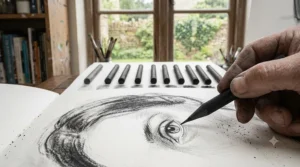
This matters most for eyelashes, hair strands, fabric creases, and any linear detail where a soft stick would simply smudge into a blob. Reviewers of hardness-graded sets frequently note that the firmer grades sharpen more like a graphite pencil than a typical charcoal stick, which makes them genuinely usable with a standard craft knife or sandpaper block rather than requiring specialist sharpening tools.
Practically speaking, keep at least one hard-grade stick in your kit purely for the last twenty minutes of any drawing — the stage where you’re defining edges and adding crisp accents rather than building mass. Softer sticks simply can’t do this job cleanly; they’ll deposit far more pigment than the mark requires and muddy fine detail instead of sharpening it.
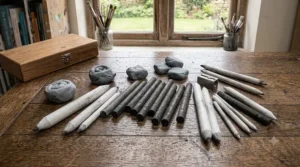
How to Choose Compressed Charcoal Sticks for Drawing
- Match hardness to your drawing stage — soft and extra-soft grades for shadow mass, hard grades for final detail, or a graded set if you want both in one box.
- Consider stick shape — round sticks suit a pencil-like grip and detail work; square sticks resist rolling and cover broad areas faster with a flat edge.
- Check pack size against usage frequency — daily sketchers get better value from twelve-plus packs; occasional users may prefer smaller premium sets.
- Factor in paper compatibility — toned or textured paper unlocks the full range of a set including white or grey sticks; smooth white paper limits you to black-on-white contrast alone.
- Weigh brand consistency against price — heritage brands like Conté à Paris and Faber-Castell tend to show tighter batch-to-batch consistency; budget multipacks trade some consistency for lower cost per stick.
- Think about mess tolerance — compressed charcoal is less dusty than vine but still transfers readily; factor this in if you’re drawing somewhere shared or soft-furnished.
- Plan your fixative needs upfront — see the permanent charcoal marks section below, since some sticks (particularly softer, oilier ones) need more fixative coverage than others.
Common Mistakes When Buying Compressed Charcoal Sticks
The single most common error is buying only one hardness grade and expecting it to do every job in a drawing — resulting in either muddy, over-dark sketches or thin, weak final pieces with no punch. A close second is ignoring paper compatibility entirely; expensive charcoal on the wrong paper performs worse than a budget stick on properly textured stock. Buyers also frequently underestimate breakage in transit, particularly with round sticks shipped loosely rather than in rigid packaging — check reviews for mentions of arrival condition before committing to a set. Finally, many first-time buyers skip fixative and blending tools entirely, then wonder why their compressed charcoal drawings look unfinished or smudge irreparably before they’re even framed.
Permanent Charcoal Marks: Fixing and Preserving Your Work
Getting permanent charcoal marks that survive handling, framing, and time requires a fixative — a light aerosol spray, typically shellac or resin-based, applied in thin layers at a safe distance from the paper. Compressed charcoal holds onto paper considerably better than vine charcoal even before fixing, thanks to its binder, but it is not truly permanent without one; a determined thumbnail will still lift pigment from an unfixed drawing weeks later.
Apply fixative in a well-ventilated space, holding the can roughly 30cm from the paper and using several thin, even passes rather than one heavy coat, which can pool, darken your lights, or cause runs. Let each layer dry fully before adding the next. Workable fixative allows you to keep drawing on top afterwards; final fixative locks the piece down completely and isn’t designed for further work. Because fixative sprays contain solvents, ventilation genuinely matters — the safety and regulations section below covers this properly rather than treating it as an afterthought.
Long-Term Cost & Maintenance
Charcoal is a genuinely low-maintenance medium compared with painting media, but cost-per-use still varies meaningfully across this list. A twelve-stick box like Jakar Compressed Charcoal Black, used at roughly one stick per two to three sketching sessions, works out to a modest cost per drawing over its lifespan — considerably cheaper than a single tube of oil paint used at the same frequency. Premium three-packs such as Faber-Castell PITT Compressed Charcoal cost more per stick but typically last just as long per session since less material is wasted through breakage, narrowing the real-world gap between “budget” and “premium” more than the sticker price alone suggests.
Ongoing costs beyond the charcoal itself include fixative spray (an occasional rather than per-drawing expense), replacement kneaded erasers, and appropriately textured paper, which tends to cost more per sheet than standard cartridge paper. Total cost of ownership over a year of regular practice is still modest compared with most other fine art media — charcoal remains one of the most accessible ways to develop serious tonal drawing skills without a large ongoing spend.
Safety, Ventilation and Studio Practice
Charcoal dust is classed as a nuisance dust rather than a highly toxic substance, but that doesn’t mean it’s risk-free with sustained, heavy exposure — inhaling large amounts over time can cause mechanical irritation to the lungs, and fixative sprays introduce a separate solvent-inhalation risk that deserves proper attention. UK guidance from the <a href=”https://www.hse.gov.uk/coshh/”>Health and Safety Executive on controlling substances hazardous to health (COSHH)</a> recommends good ventilation, minimising dust generation where practical, and avoiding blowing dust off work by mouth, all of which apply directly to a home or studio charcoal practice.
Practically, that means fixing work outdoors or near an open window rather than in a small, enclosed room, tapping excess dust off rather than blowing it, and wet-wiping surfaces instead of dry-sweeping, which simply redistributes dust into the air. If you fix work frequently or work with charcoal daily in a shared space, a basic dust mask during application and fixing is a sensible, low-cost precaution rather than an overreaction.
Problem → Solution Guide
Problem: my charcoal drawing looks flat and grey, never truly black. Solution: you’re likely relying entirely on a soft vine stick or a lower-pigment budget product. Layer in genuine compressed charcoal, like Faber-Castell PITT Compressed Charcoal, specifically for your deepest shadow areas.
Problem: my sticks keep snapping in half. Solution: this is often a storage issue rather than a product fault — loose sticks in a bag or pencil case take repeated impact damage. Store upright in a rigid tin, and consider round sticks like Jakar Compressed Charcoal Black, which tend to tolerate handling slightly better than thinner square profiles.
Problem: my highlights on toned paper look chalky and thin. Solution: switch to a dedicated stick such as General’s White Compressed Charcoal rather than a soft pastel or white pencil, which typically can’t match compressed charcoal’s opacity.
Problem: my finished drawings smudge every time I touch them. Solution: you need fixative — see the permanent charcoal marks section above — applied in thin, even layers well before handling or framing.
Problem: I can’t get fine detail without smudging everything around it. Solution: switch to a harder grade for that final stage; see hard compressed charcoal for detail above, and consider the graded Conté à Paris Compressed Charcoal set specifically for its firmer HB and B sticks.
Compressed Charcoal Sticks on Amazon: What Reviewers Actually Say
Searching compressed charcoal sticks amazon turns up a genuinely wide spread of quality, and the aggregated pattern across reviews is fairly consistent: heritage brands like Conté à Paris and Faber-Castell attract praise mainly for consistency and depth of black, while budget multipacks attract praise mainly for value and criticism mainly for occasional breakage in transit. Any honest compressed charcoal review has to acknowledge that “best” genuinely depends on your stage as an artist — a beginner frustrated by a snapped stick in a budget pack isn’t necessarily buying the wrong product, just the wrong product for a first purchase where handling forgiveness matters more than pigment precision.
A recurring, useful pattern in genuine reviews is that buyers who pair a black set with a separate white or grey set — rather than expecting one twelve-pack to do everything — report far higher satisfaction than those buying a single product and expecting full tonal range from it. That’s a genuinely actionable insight worth applying before you commit to your own first order.
FAQ
❓ Is compressed charcoal better than vine charcoal for beginners?
❓ Do compressed charcoal sticks need sharpening?
❓ How long does a compressed charcoal stick last?
❓ Can you use compressed charcoal on regular printer paper?
❓ Is compressed charcoal messy to use at home?
Conclusion
Choosing between compressed charcoal sticks for drawing ultimately comes down to matching the material to where you actually are in your practice, not to which box looks most professional on a shelf. Beginners genuinely lose nothing by starting with something like the PANDAFLY Compressed Charcoal Set and upgrading once they understand their own pressure and pacing. Artists chasing the deepest possible blacks for dramatic, resolved pieces will feel the difference immediately with Faber-Castell PITT Compressed Charcoal, while anyone wanting one box that handles an entire tonal journey should look hard at Conté à Paris Compressed Charcoal.
What matters more than any single product recommendation is understanding the medium itself — how compressed charcoal differs from vine charcoal, why hard grades earn their place in detail work, and why permanent charcoal marks require a genuine fixing step rather than hope. Get those fundamentals right, and almost any reasonably reviewed compressed charcoal on amazon.co.uk will serve you well. Get them wrong, and even the most expensive stick in this guide will disappoint you.
Affiliate Disclosure: This article contains affiliate links. As an Amazon Associate, I earn from qualifying purchases. If you purchase products through these links, we may earn a small commission at no additional cost to you.
Recommended for You
- Best Willow Charcoal 2026: 7 Sticks UK Artists Actually Love
- Graphite Sticks vs Graphite Pencils: 7 UK Picks for 2026
- 7 Best Graphite Sticks for Drawing in 2026 (UK Buyer’s Guide)
Disclaimer: This article contains affiliate links. As an Amazon Associate, I earn from qualifying purchases. If you purchase products through these links, we may earn a small commission at no additional cost to you.
✨ Found this helpful? Share it with your friends! 💬🤗
