
In This Article
A wobbly line is a small crime. A wobbly right angle is a felony, because everything you build on it inherits the mistake. That’s the quiet reason the humble set square for technical drawing has outlived CAD, tablets and every other glowing rectangle that was supposed to replace it. Pick the right one and your drawings sharpen up overnight. Pick the wrong one and you’ll spend an evening wondering why your “parallel” lines are arguing.
This guide is written for British drawers: A-level Design & Technology students, architecture undergraduates, model-makers, hobbyists, and anyone hunting for a dependable drafting set square UK stockists actually carry. I’ve compared seven real products across budget, mid-range and premium. The comparison draws on published specifications, UK retailer listings and the themes that recur in genuine customer reviews. I haven’t hand-tested any of them, so you won’t find invented anecdotes here, just honest analysis of what the numbers mean on a drawing board.
Expect a quick comparison, a full breakdown of each pick, buying criteria, usage tips, real-world scenarios and a short note on UK drawing standards. Whether you want a precision angle tool for drawing that locks onto any angle, or a plain 45° triangle that never lets you down, there’s a pick below. Prices are ranges drawn from UK retailer listings at the time of research. They may vary, so check current prices before buying, as Amazon listings may differ.
Quick Comparison: Set Square for Technical Drawing at a Glance
| Product | Angles | Size | Price band | Best For |
|---|---|---|---|---|
| Helix 20cm Geometry Set (Q88100) | 45° and 60°/30° pair, plus ruler and protractor | 20 cm set | Under £10 | Beginners and classroom kits |
| Artway Professional Acrylic Set Square | 45° or 60°/30° (sold separately) | 25–30 cm | Under £10 | Budget full-size A3 work |
| Staedtler Mars 567 Set Square | 45° or 30/60° | About 21–36 cm | Budget-to-mid (by size) | Ink and technical pens |
| Staedtler Mars 568 Set Square with Grip | 45° geometry style | 16 or 22 cm | Around £9–£15 | Steadier repositioning |
| rOtring Centro Professional Set Square | 45° with 180° scale | 32 cm hypotenuse | Premium (check current price) | Daily professional use |
| Artway Adjustable Set Square | Adjustable 0–90° | 20 or 30 cm | Under £20 | Odd angles on a budget |
| Aristo Adjustable Set Square | Adjustable via arc scale | 25 cm | Around £30 | Fine-angle layout work |
Looking at the table, the Artway Professional Acrylic Set Square and Helix 20cm Geometry Set (Q88100) are the cheapest ways in, but they solve different problems. One gives you a full-size triangle, the other a complete starter kit. If your work involves ink or odd angles, the Staedtler Mars 567 Set Square and the two adjustable models justify the extra spend. The rOtring Centro Professional Set Square is the one to buy once you’ve decided this is a long-term habit.
💬 Just one click — help others make better buying decisions too!😊
What Is a Set Square for Technical Drawing?
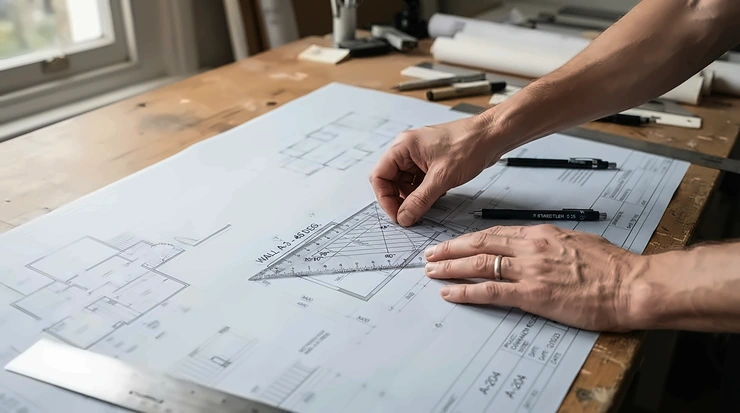
A set square for technical drawing is a flat, right-angled triangular guide, usually clear acrylic or plastic, that rests against a straight edge such as a T-square or parallel motion to draw precise 90°, 45°, 30° and 60° lines. It’s the simplest precision angle tool for drawing accurate verticals, diagonals and parallels.
Wikipedia’s entry on the set square describes the two usual forms: a 90-45-45 triangle and a 30-60-90 triangle. It also notes that they’re often sold in packs with protractors and compasses. Some variants add extra markings at 7° and 42° to ease dimetric axonometry. Traditionally, set squares were wooden, often with a void in the centre. Today the clear-plastic version is the norm for technical drawing.
The clever bit is combination. Stack a 45° triangle against a 30/60° one and you can reach 15° increments, such as 15° and 75°, without touching a protractor. That’s why most drafting supplies lists ask for a pair rather than a single triangle. It’s a small piece of geometry that does a surprising amount of work.
Top 7 Set Squares for Technical Drawing: Expert Analysis
Here are seven real products, spanning pocket-money to professional, each judged on what its specification means in practice and what genuine reviewers report.
1. Helix 20cm Geometry Set (Q88100) — best starter bundle on a budget
This is less a single triangle than a tidy kit, and that’s its charm: one purchase covers the basics of drafting supplies for a school pencil case.
The set pairs a 200 mm ruler with a 45° and a 60°/30° set square plus a 180° protractor, all in durable transparent blue plastic, per UK retailer listings. At 20 cm, the triangles suit A4 work and small details. On A3 you’ll shuffle the triangle along its guide more often, and every shuffle is a chance to drift. The blue tint helps you spot the tool on a white sheet, but it dims fine pencil lines slightly compared with clear acrylic.
On paper, this is a school-and-first-year kit, not a studio workhorse. Pick it if you’re learning the ropes or buying for a classroom, then graduate to larger triangles. I couldn’t find a meaningful body of independent reviews for this exact listing, so I won’t characterise customer sentiment. It’s sold for education use through UK suppliers including Staples.
Pros:
- ✅ Complete kit: triangles, ruler and protractor together
- ✅ Very low cost per tool
- ✅ Compact enough for any pencil case
Cons:
- ❌ 20 cm limits A3 and larger work
- ❌ Blue tint dulls fine pencil lines
Price: well under £10 at the time of research; a sensible, low-risk way to start.

2. Artway Professional Acrylic Set Square — full-size acrylic for pocket money
Its standout is simple honesty: proper acrylic, proper length, and a bevelled edge at a price that barely registers.
UK listings show a 45° triangle in 25 cm and 30 cm, and a 60°/30° triangle in 30 cm, all with a bevelled edge. Retailer descriptions also mention a protective carry case. That 30 cm hypotenuse comfortably spans an A3 vertical in one stroke, and fewer repositionings mean fewer opportunities for error. A bevelled edge helps you see the line you’re drawing and reduces graphite smearing under the tool. It isn’t a true inking edge, so keep technical pens for the Staedtler.
The catch: the 45° and 60° versions are sold separately, so you’ll need to buy both to match a standard pair. This is the pick for the budget-conscious student who needs real size without real expense. I couldn’t verify a robust review sample for this specific listing, so treat it as a spec-led recommendation.
Pros:
- ✅ Generous 25–30 cm lengths for A3 work
- ✅ Clear acrylic with a bevelled edge
- ✅ Carry case mentioned in retailer listings
Cons:
- ❌ 45° and 60° sold separately
- ❌ No inking edge for technical pens
Price: under £10, which makes it a strong value verdict for beginners.
3. Staedtler Mars 567 Set Square — inking edge with the scale starting at the corner
The standout here is the scale that begins directly at the edge, which is exactly where you want your measurement to start.
Listings describe transparent blue plastic, an inking edge for drawing pens, and a 45/45 form with a 90° corner. UK stockists such as Cult Pens carry 45° and 30/60° versions in lengths from roughly 21 cm to 36 cm. An inking edge is raised or recessed so ink doesn’t wick under the triangle and smudge. If you draw with technical pens or fineliners, this feature alone can save an evening of tidying up.
One reviewer of Staedtler’s Mars maths set mentioned using the triangles for graphs, mechanical parts, schematics and flow charts. That’s a different product, so I wouldn’t read it as a verdict on this one, but it suggests the Mars family handles mixed technical work. The Staedtler Mars 567 Set Square suits anyone who inks, or who dimensions directly from the edge.
Pros:
- ✅ Inking edge reduces smudging with pens
- ✅ Scale starts right at the edge
- ✅ Wide size range at UK stockists
Cons:
- ❌ Blue tint softens pale pencil lines
- ❌ Priced above the cheapest acrylic
Price: budget-to-mid-range depending on size; check current price for your length.
4. Staedtler Mars 568 Set Square with Grip — a finger-grip that steadies your line
Its standout is the grip, which gives your fingertip something solid to hold while the other hand does the drawing.
UK listings offer a 16 cm and a 22 cm version, with the 22 cm sold as product code 568 35. The retailer describes a practical grip feature designed to make line drawings comfortable and controlled. Drift usually happens when you lift and reposition, and a grip gives you a lever, so you can press firmly without your fingers wandering onto the drawing surface. It also keeps greasy fingertips off the working area.
The trade-off is length: 22 cm is on the compact side for A3, so it suits A4 and detailed work best. I’d see it as a tool for students who find ordinary triangles slippery. I couldn’t verify a meaningful review sample for this exact listing. A UK stockist showed the 22 cm version at around £9 on offer against an RRP of about £15.
Pros:
- ✅ Grip improves control when repositioning
- ✅ Familiar, trusted brand
- ✅ Compact for A4 and detail work
Cons:
- ❌ 22 cm is short for A3
- ❌ Pricier than plain acrylic triangles
Price: around £9–£15, which is fair for a comfort upgrade.
5. rOtring Centro Professional Set Square — the 180° protractor built into a triangle
The standout is a triangle that doubles as a protractor and ruler, so you reach for fewer tools.
Specifications list a 32 cm hypotenuse with a 30 cm/1 mm scale, a 180°/1° angle scale, and counter-directional numbering on a coloured background. The listing also mentions a removable handle and ink-friendly tracing edges. Counter-directional numbering lets you read angles from either end, and the coloured background separates the scales, which matters when you’re squinting at a table at 9 pm. The removable handle works like the Staedtler grip, but you can take it off when it’s in the way.
Reviewers on retail listings describe it as sturdy, accurate and well designed. A buyer of a shorter rOtring professional square called it all they wanted “except for the size”, so check dimensions. Availability looks patchy: one UK stockist lists the 30 cm version as no longer available, so confirm stock before buying.
Pros:
- ✅ Combines triangle, ruler and 180° protractor
- ✅ Removable handle and tracing edges
- ✅ Large 32 cm hypotenuse
Cons:
- ❌ Availability can be inconsistent
- ❌ Premium cost versus basic triangles
Price: premium bracket; check current price. A strong value verdict for daily users.
6. Artway Adjustable Set Square — adjustable angles without a premium bill
The standout is adjustment from 0° to 90°, so odd angles don’t require a protractor detour.
Listings show acrylic construction in 20 cm and 30 cm sizes, a bevelled edge, engraved markings, metric measurements and a protective carry case. Engraved markings don’t rub off like printed ones, which matters over years of use. An adjustable square earns its keep with angles like 22.5° or 15°, common in roof pitches, hinges and layout work.
The honest caveat: any pivot has some play. Reviewers of comparable acrylic adjustable squares note that professionals who rely on one daily may want something more substantial. For architectural sketching and layout it’s ideal; for repeatable production drawings, I’d verify angles against a fixed triangle. Retailer listings show consistently strong star ratings for this model, but the review pools are modest, so I’d treat that as encouraging rather than conclusive.
Pros:
- ✅ Any angle from 0° to 90°
- ✅ Engraved markings that won’t rub off
- ✅ Comes with a protective case
Cons:
- ❌ Pivot can loosen with heavy use
- ❌ Less rigid than thicker alternatives
Price: from under £10 for the smaller size, and under £20 overall; strong value.
7. Aristo Adjustable Set Square — 3.5 mm Plexiglass with half-degree graduations
The standout is thickness and resolution: 3.5 mm Plexiglass and an arc scale that reads to half a degree.
The 25 cm model has a hypotenuse that can be fixed at any position on an arc scale running 0–45° and 90–45°, in 1° and 0.5° increments. It also functions as a protractor. The extra thickness gives rigidity, so the hinge feels less likely to flex under pressure, and finer graduations let you set angles finer than most people can comfortably draw.
This is the pick for designers and architectural sketching who care about repeatable angle-setting. I couldn’t find an independent review sample I’d trust, so this rests on specification alone. A UK university shop listed it at around £30, so it’s a considered purchase. Availability can be patchy, so check stock.
Pros:
- ✅ Thick 3.5 mm Plexiglass feels rigid
- ✅ Half-degree graduations on the arc scale
- ✅ Doubles as a protractor
Cons:
- ❌ Costs noticeably more than fixed triangles
- ❌ Stock can be patchy
Price: around £30, which feels fair for a precision angle tool for drawing.
Top 7 Side by Side
| Product | Angles | Hypotenuse / Size | Material | Review evidence | Best For |
|---|---|---|---|---|---|
| Helix 20cm Geometry Set (Q88100) | 45° + 60°/30° | 20 cm | Blue plastic | Limited | Beginners |
| Artway Professional Acrylic Set Square | 45° or 60°/30° | 25–30 cm | Acrylic | Limited | Budget A3 work |
| Staedtler Mars 567 Set Square | 45° or 30/60° | About 21–36 cm | Blue plastic | Brand-level only | Pen users |
| Staedtler Mars 568 Set Square with Grip | 45° | 16 or 22 cm | Plastic | Limited | Steady control |
| rOtring Centro Professional Set Square | 45° + 180° scale | 32 cm | Clear plastic | Positive themes | Daily professionals |
| Artway Adjustable Set Square | 0–90° | 20 or 30 cm | Acrylic | Strong ratings, small pool | Odd angles |
| Aristo Adjustable Set Square | Arc scale, 0.5° steps | 25 cm | Plexiglass | None verified | Fine-angle layout |
Reading across, the fixed triangles win on predictability and price, while the adjustable pair wins on flexibility. The rOtring Centro Professional Set Square stands out for fitting a protractor into a fixed form, which is why it carries a premium. If budget is your main constraint, the Artway Professional Acrylic Set Square gives the most length for the least money.
How to Choose a Set Square for Technical Drawing
Choosing well comes down to six decisions, in this order.
- Match the size to your paper. For A4, a 16–20 cm hypotenuse is plenty. For A3, aim for 25–30 cm so you can draw a full vertical in one pass.
- Decide fixed or adjustable. Fixed triangles are rigid and repeatable; adjustable ones handle odd angles but have a pivot that can loosen.
- Check the edge. A bevelled edge helps with pencil; an inking edge is better with technical pens.
- Consider thickness and material. Thicker acrylic resists flexing and gives a firmer edge to work against.
- Look at the markings. Engraved scales outlast printed ones, and a scale starting at the edge is handier for dimensions.
- Set a realistic budget. Under £10 is fine for learning; spend more only when a specific feature solves a specific problem.
Most buyers skip step two, which is why they end up with a drawer full of triangles.
Features That Actually Matter (And Those That Don’t)
Marketing loves a long feature list, but only a handful change your lines. The ones that matter are edge quality, rigidity and legible markings. A nicked edge ruins accuracy regardless of price, and a flexible triangle bows under pressure, so thickness and material are worth paying for.
What matters a little: a grip or removable handle for repositioning, and a scale beginning at the edge for quick dimensioning. The Staedtler Mars 568 Set Square with Grip and the rOtring Centro Professional Set Square both address the first, while the Staedtler Mars 567 Set Square addresses the second.
What doesn’t matter much: colour, a fancy case, or a protractor you’ll never use. A blue tint is a matter of taste rather than accuracy, and a 180° scale only earns its place if you actually measure angles. Before paying extra for any feature, ask yourself whether you’d notice its absence after a week of drawing. If the answer is no, skip it and spend the money on drafting supplies you’ll use daily, like a decent pencil and drafting tape.
Common Mistakes When Buying a Drafting Set Square UK Shoppers Make
The first mistake is buying too small. A 16 cm triangle looks charming and then frustrates you on every A3 sheet. Match length to your largest paper size, not your smallest.
The second is buying one triangle when you need two. A single 45° or 30/60° triangle covers a fraction of common angles, so pairs or sets are usually better value. Note that Artway Professional Acrylic Set Square listings sell 45° and 60° separately.
The third is ignoring the edge. Chipped or rough edges are accuracy killers, and cheap triangles can arrive with imperfect edges. Inspect on arrival, and don’t use a damaged triangle for precision work.
Fourth: assuming adjustable means better. Adjustable models are brilliant for odd angles but add a pivot that can loosen. The Artway Adjustable Set Square and Aristo Adjustable Set Square suit sketching and layout best.
Finally, many buyers forget to verify availability. Some listings for premium models appear and vanish, so confirm stock before planning around a purchase.
Fixed vs Adjustable: Choosing a Precision Angle Tool for Drawing
Fixed triangles give you rigid, repeatable 90°, 45°, 30° and 60° with no setup. Adjustable squares trade that rigidity for any angle in between. Neither is universally better, and many drawers end up owning both.
One reviewer of a rOtring drawing-board set made the point neatly: the supplied square was perfect for 90° and 45° lines, but you’d need a separate adjustable square, protractor and compass to work effectively on engineering drawings. That’s real-world advice about the limits of fixed tools.
Here’s my analytical take. If your work is mostly orthogonal (plans, elevations, simple isometrics), fixed triangles cover almost everything. If you often meet awkward angles such as roof pitches or hinge swings, an adjustable model like the Artway Adjustable Set Square saves time. If you need those odd angles repeatably and precisely, the Aristo Adjustable Set Square with its half-degree scale is the stronger precision angle tool for drawing. For the cleanest setup, pair a fixed Staedtler Mars 567 Set Square with one adjustable square, so each tool does what it does best.
Set Square vs T-Square, Parallel Motion and CAD
A set square rarely works alone. It rides against a straight edge, usually a T-square or a drawing board’s parallel motion. Designing Buildings’ wiki entry on the set square lists related tools including T-squares, adjustable squares and combination squares, which is a useful map of the family.
| Tool | Strength | Weakness | Best For |
|---|---|---|---|
| Set square for technical drawing | Fast, precise standard angles | Limited angles unless paired | Artway Professional Acrylic Set Square users |
| T-square alone | Long, reliable horizontals | No angles on its own | Large boards |
| Ruler plus protractor | Any angle | Slow and error-prone | Occasional use |
| CAD software | Infinite precision and editing | Needs hardware and time | Final production drawings |
| Adjustable square | Any angle in one tool | Pivot play | Aristo Adjustable Set Square users |
Looking at the comparison, a set square beats the ruler-plus-protractor route for speed and the T-square alone for angles. CAD wins on editing, but it can’t match the immediacy of pencil on paper, which is why architectural sketching still leans on hand tools. For most people, the sweet spot is a T-square or parallel motion plus a pair of triangles, with CAD for the final version.
Practical Usage Guide: Getting Crisp Lines From Day One
A good tool still needs good habits. Here’s how to set up and keep it sharp.
Setup. Tape your sheet down with drafting tape, squared to the board edge. Rest your triangle against a straight edge, and always work from a datum edge you trust.
The flip test. Draw a line against your triangle’s 90° edge, flip the triangle over and draw again. If the two lines coincide, your right angle is true. If they diverge, the tool or the edge is off. It takes thirty seconds and settles arguments with yourself.
Pencil habits. Use a sharp pencil held at a consistent tilt, touching the edge lightly. Leaning in changes the line’s position, which is the commonest beginner error.
Maintenance. Wash acrylic with lukewarm water and a drop of washing-up liquid, then dry with a soft cloth. Avoid solvents, which can cloud or craze plastic. Store flat, away from radiators and sunny windowsills.
First-30-days mistakes. Drawing with a chipped edge, mixing metric and imperial scales, and pressing too hard on a grip handle. Each is easily avoided once you know about it.
Real-World Scenarios: Matching a Set Square for Technical Drawing to Your Life
The A-level student. Three hours a week at a school desk, A3 sheets, and a tight budget. A pair of Artway Professional Acrylic Set Square triangles (45° and 60°) gives full-size accuracy for pocket money. Add the Helix 20cm Geometry Set (Q88100) for small-scale work and protractor tasks.
The architecture undergraduate. Sketching on trace in the studio and on site, with a bag to carry. One Hobbycraft reviewer praised a set-squares pack as portable and handy for carrying between sites. The Aristo Adjustable Set Square covers awkward angles with fine resolution, while a Staedtler Mars 567 Set Square handles inked outlines. Budget: around £30–£50 combined.
The hobbyist and model-maker. Mixed work at a kitchen table, a few times a week, medium budget. The rOtring Centro Professional Set Square packs triangle, ruler and protractor into one tool, which suits cramped workspaces where fewer tools mean less clutter.
Notice the pattern: the best purchase isn’t the most expensive one, it’s the one matched to paper size, frequency and workspace.
✨ Don’t Miss These Exclusive Deals!
🔍 Take your technical drawing to the next level with these carefully selected products. Click on any highlighted item to check current pricing and availability. These tools will help you create crisp, confident drawings you’ll be proud to show off!
Problem → Solution Guide
Problem: ink smudges under the triangle. Ink creeps beneath flat edges by capillary action. Solution: choose an inking edge such as the Staedtler Mars 567 Set Square, and lift the triangle slightly when inking.
Problem: the triangle slides when you reposition. Solution: use a grip, as on the Staedtler Mars 568 Set Square with Grip, or the removable handle on the rOtring Centro Professional Set Square. Keep the underside clean, too.
Problem: you need an angle the fixed pair can’t give. Solution: combine triangles for 15° steps, or use an adjustable model like the Artway Adjustable Set Square for anything in between.
Problem: numbers are hard to read upside down. Solution: counter-directional numbering, as on the rOtring Centro Professional Set Square, lets you read angles from both ends.
Problem: cloudy or scratched acrylic. Solution: clean with mild soapy water, avoid solvents, and replace the tool if scratches obscure your lines.
Long-Term Cost & Maintenance
Cost per use is where cheap set squares quietly win. A triangle used twice a week for three years sees over 300 sessions, so even a modest purchase works out at pennies per session. A premium tool at around £30 over five years is still only a few pounds a year, which is easy to justify if you draw regularly.
The real long-term cost is damage. Heat warps plastic, so keep triangles off radiators and out of hot cars. Edges chip if dropped or used as a cutting guide, and a chipped edge is an accuracy problem rather than a cosmetic one. Using your set square as a straight edge for a craft knife is the fastest way to ruin it.
Maintenance is simple: wipe clean, store flat, and inspect edges every few months. If you’re buying drafting supplies for a family or class, a low-cost kit like the Helix 20cm Geometry Set (Q88100) is easier to replace than a precision instrument. Conversely, if you’ll draw daily for years, investing in the rOtring Centro Professional Set Square or Aristo Adjustable Set Square can make economic sense.
Standards and Compliance: What UK Drawing Conventions Expect
Set squares are measuring and drawing aids rather than regulated consumer machinery, and I found no set-square-specific UKCA or CE requirement in my research. If you’re buying for children, check the supplier’s safety information, particularly for maths sets that include compasses.
What does matter in the UK is drawing convention. BS 8888 is the British standard developed by BSI for technical product documentation, geometric product specification and engineering drawings. It replaced BS 308 in 2000, according to Wikipedia. BSI’s own catalogue shows the standard being revised repeatedly, so check which edition your course or employer requires via BSI Knowledge.
Why mention this in an article about triangles? Because accurate tools serve accurate conventions. Scales, tolerances and title blocks matter little if your lines are off by a degree. A reliable set square for technical drawing is the first link in a chain that ends with a drawing someone else can build from.
FAQ
❓ How much should I spend on a drafting set square UK students can rely on?
❓ Which size set square for technical drawing suits A3 paper?
❓ Is an adjustable set square accurate enough for technical drawing?
❓ Do I need both a 45° and a 30/60° set square?
❓ Is a set square useful for architectural sketching?
Conclusion
The best set square for technical drawing isn’t the priciest; it’s the one that fits your paper size, your drawing habits and your budget. If you’re starting out, the Artway Professional Acrylic Set Square and Helix 20cm Geometry Set (Q88100) give you accuracy for pocket money. If you work in ink, the Staedtler Mars 567 Set Square earns its place, and the Staedtler Mars 568 Set Square with Grip helps with control. For odd angles, the Artway Adjustable Set Square is the budget route, and the Aristo Adjustable Set Square is the precision route. And if you draw daily and want everything in one tool, the rOtring Centro Professional Set Square is the premium choice, subject to stock.
Remember the flip test, keep your edges clean and don’t use your triangle as a cutting guide. Good drafting supplies reward good habits, and a drafting set square UK drawers can trust will outlast most gadgets on your desk. Prices and availability change, so check current listings before you buy.
✨ Ready to sharpen up your drawings?
📐 Click on any highlighted product to check current pricing and availability, then pick the set square that fits your paper, your budget and your style. Your straightest lines are one click away!
Recommended for You
- Portable Drawing Board For Sketching Outdoors: 7 Best Picks (2026)
- Drawing Board For Artists: 7 Best UK Picks Worth Buying (2026)
- Light Pad For Animation: 7 Best Picks For UK Animators (2026)
Disclaimer: This article contains affiliate links. As an Amazon Associate, I earn from qualifying purchases. If you purchase products through these links, we may earn a small commission at no additional cost to you.
✨ Found this helpful? Share it with your friends! 💬🤗
