In This Article
Every drawing is a negotiation between what you meant and what the pencil did. The eraser is the mediator, and it rarely gets any credit. Good news for your wallet: the best erasers under £10 for artists cost less than a cup of coffee, and a couple of them will outperform gadgets priced at four times as much.

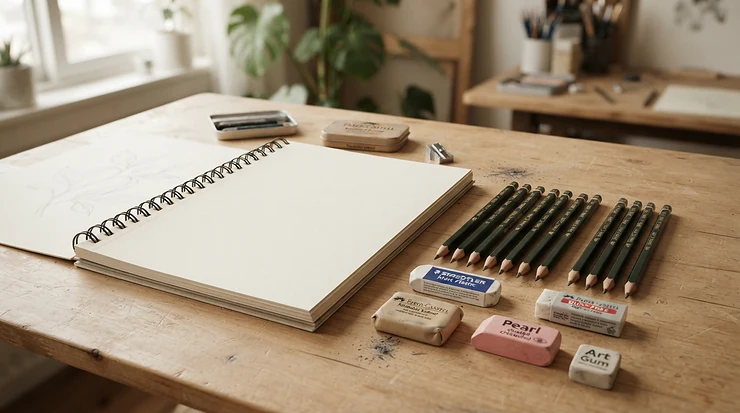
This guide covers seven real, widely stocked options across kneaded, vinyl and precision styles. It explains what each spec means at the drawing board, not just on the packaging. It’s built for students, hobbyists and sketchbook addicts who want cheap art erasers UK shoppers can order without second-guessing. If you’re assembling student drawing kit essentials on a tight budget, you’ll know exactly what to buy and what to skip.
One honest note first. The analysis below rests on published specifications, comparison tests and aggregated reviewer themes. I haven’t handled these products myself, so nothing here pretends otherwise. Where a review pool couldn’t be verified, I say so. Prices are shown as ranges only, so check current price on Amazon before buying.
Quick Comparison
| Eraser | Type | Best For | Price Range (check current price) |
|---|---|---|---|
| Faber-Castell Kneadable Eraser (Storage Case) | Kneaded | Charcoal, graphite, pastel lifting | Around £2-£4 |
| Tombow MONO Plastic Eraser | Vinyl/plastic | Clean, all-round pencil removal | Around £1-£2 |
| Staedtler Mars Plastic | Vinyl/plastic | Latex-free everyday erasing | Around £1-£3 |
| Tombow MONO Zero | Precision pen | Tiny highlights and detail fixes | Around £4-£7 |
| Faber-Castell Dust-Free Vinyl (7081 N) | Vinyl | Tidy desks, less crumb mess | Around £1-£3 |
| Pentel Clic Eraser | Retractable stick | Quick sketchbook corrections | Around £2-£4 |
| Koh-I-Noor Kneadable Eraser | Kneaded | Highlights and negative space | Around £1-£3 |
Notice the pattern: nothing here crosses £10, and most sit well under £5. A single Faber-Castell Kneadable Eraser plus a Tombow MONO Plastic Eraser covers roughly 90% of what a beginner will ever need to correct. The precision options, like the Tombow MONO Zero, are specialists. They earn their slot only if you draw fine detail.
💬 Just one click — help others make better buying decisions too!😊
Top 7 Erasers Under £10 for Artists: Expert Analysis
1. Faber-Castell Kneadable Eraser (Storage Case) — the all-round soft-lift standard
A kneaded eraser doesn’t rub marks away. It lifts them, which is why this grey putty block is the usual first purchase for anyone who works in soft graphite, charcoal or pastel.
The storage case matters more than it sounds. Putty erasers pick up fluff, and a loose one in a pencil case becomes a grey pebble fast. Because it’s pliable, you can pinch it into a point for lifting a tiny highlight in a portrait eye, or flatten it to dab back a tonal area.
Here’s what the spec sheet won’t tell you: a kneaded eraser can’t remove dense, heavily burnished marks. It lightens them. Reviewers in published roundups consistently praise its residue-free behaviour and note that it ranks among the most recommended soft erasers. I couldn’t verify a large pool of individual UK reviews, so treat that as the roundup consensus rather than a precise rating.
Pros:
- ✅ Lifts charcoal and pastel without smearing
- ✅ Moulds into points for fine highlights
- ✅ Case keeps it clean in a pencil case
Cons:
- ❌ Struggles with heavy, pressed graphite
- ❌ Eventually turns grey and needs replacing
At around £2-£4, it’s a clear value win. Check current price before buying.

2. Tombow MONO Plastic Eraser — the benchmark for clean pencil removal
In a comparison of four erasers on 80g/m² paper, the Tombow MONO Plastic Eraser came out ahead in the tiebreak round, with a foam rival nearly matching it. It’s a small test, but it fits the wider reputation this block has built over decades.
The firm, dense polymer removes graphite in clean, rolled-up crumbs rather than smeared dust. In practice, that means you can erase a construction line beside a finished shadow and leave the shadow intact. Because it’s firmer than a kneaded eraser, it handles harder grades (2H-HB) that putty simply flattens.
The trade-off is that it’s slightly harsher on soft or thin paper if you press hard. Use light, short strokes and let the material do the work. Fans on pencil forums describe it as the one eraser they’d keep if they could only have one, though that’s anecdotal enthusiasm, not a measured rating.
Pros:
- ✅ Removes graphite cleanly with minimal smudging
- ✅ Dense block lasts through months of use
- ✅ Corners give crisp, controllable edges
Cons:
- ❌ Too firm for charcoal or pastel work
- ❌ Can burnish delicate paper if pressed
Around £1-£2 range. Superb value at the cheap end of cheap art erasers UK shops stock.
3. Staedtler Mars Plastic — the latex-free workhorse
The Staedtler Mars Plastic is the classroom classic, and with good reason. The standard twin-pack is phthalate-free and latex-free, made in Germany, and comes with a sliding card sleeve that keeps the block clean.
Why does latex-free matter to an artist? Natural rubber latex contains proteins that some people react to, so a latex-free block is the safe pick if you share supplies with younger students or anyone sensitive. Its soft vinyl composition glides across paper, leaving minimal crumble and low wear.
The listing also states it removes graphite from tracing and drafting film. That’s a useful clue that it’s gentle enough for slick surfaces too. The slim 23 × 13 × 65 mm body fits a pencil case without bulging, though it can feel small in a larger hand.
Compared with the Tombow MONO Plastic Eraser, the Mars feels softer and more forgiving. It erases slightly less aggressively on dark marks but treats paper better. I couldn’t verify a reliable pool of individual UK reviews for this exact twin-pack, so judge it on construction and reputation.
Pros:
- ✅ Latex-free and phthalate-free for sensitive users
- ✅ Soft, paper-friendly erasing action
- ✅ Sleeve keeps the block clean
Cons:
- ❌ Slimmer block feels small for big drawings
- ❌ Less bite on dense dark marks
Typically in the £1-£3 range for a twin pack. Check current price.
4. Tombow MONO Zero — the pocket-sized precision tool
If the others are paintbrushes, the Tombow MONO Zero is a scalpel. It’s a refillable, pen-style eraser with a thin 2.3 mm cylindrical tip that advances when you click the cap. Reviewers note it works much like a mechanical pencil.
For artists, that means lifting a single whisker, a glint in an eye or one stray dot from a stipple drawing. One pencil-focused blogger found it worked well over several days of use, though they judged it unsuitable for erasing large areas. That fits what you’d expect from a 2.3 mm tip.
The annoying catch is refills. The eraser is replaceable, which is good for the environment, but it uses a proprietary refill, so factor in the extra cost. Round and rectangular tip versions exist, and the rectangular one is better for straight edges.
If you buy just one precision eraser, this is the one that suits fine detail best. If you rarely draw detail, skip it and spend the money on pencils.
Pros:
- ✅ Ultra-fine tip for tiny highlight corrections
- ✅ Refillable, so the barrel gets reused
- ✅ Click mechanism needs no sharpening
Cons:
- ❌ Proprietary refills add to running costs
- ❌ Useless for large-area erasing
Priced around £4-£7, so still comfortably under £10.
5. Faber-Castell Dust-Free Vinyl (7081 N) — the tidy-desk champion
Eraser crumbs are the glitter of the drawing world: they get everywhere. The Faber-Castell Dust-Free Vinyl (7081 N, made in Germany) was designed to bind its debris into larger, brushable rolls.
That sounds trivial until you’ve smeared dust across a finished tonal drawing with the heel of your hand. A cleaner eraser means fewer ghost marks, so it’s a smart choice for graphite work on smooth paper where every stray crumb shows.
In the four-eraser comparison mentioned earlier, the Faber-Castell vinyl was one of the contenders, and the reviewer’s test favoured the foam and MONO options on fine lines. That makes it a very good rather than best-in-class performer. Its virtue is consistency and low mess, not outright aggression.
It’s a sensible choice for a student drawing kit essentials list, particularly for classrooms where tidiness gets graded. Verified individual UK review data was thin, so rely on specs and test notes here.
Pros:
- ✅ Dust binds into larger, easier-to-sweep crumbs
- ✅ Gentle on most smooth drawing papers
- ✅ Reliable German manufacturing
Cons:
- ❌ Less crisp on fine lines than MONO
- ❌ Block can feel generic and unremarkable
Around £1-£3. Check current price before buying.
6. Pentel Clic Eraser — the grab-and-go sketchbook fix
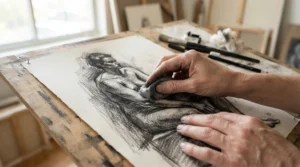
Click erasers are barrel-style tools shaped like a pencil, containing a retractable cylinder of eraser material, most commonly soft vinyl. The Pentel Clic Eraser is the best-known version, and its biggest advantage is simplicity.
You click it, correct a line, click it away. No block to lose, no crumbs on a dock of unwashed coffee mugs. It sits neatly in a sketchbook elastic or a shirt pocket, which suits urban sketchers and anyone drawing on trains or park benches.
The rectangular tip is wider than the Tombow MONO Zero‘s needle, so it’s better for tidying a hatched region or erasing a letter-sized correction. It won’t compete with a full-size block for coverage, though. Treat it as a second eraser, not your only one.
Refills are sold separately, so a spare pack costs a couple of pounds. Reviewer sentiment in published guides is generally positive for convenience, but I couldn’t verify a trustworthy UK-specific rating.
Pros:
- ✅ Pocket-friendly retractable design
- ✅ Wider tip than needle-style erasers
- ✅ Refillable body reduces waste
Cons:
- ❌ Small eraser wears down quickly
- ❌ Not suited to big shading areas
Around £2-£4 range at the time of research.
7. Koh-I-Noor Kneadable Eraser — the budget highlight lifter
If the Faber-Castell Kneadable Eraser is the dependable family saloon, the Koh-I-Noor Kneadable Eraser (the blue one) is the cheerful runabout. One buying guide singled it out for lifting highlights and working negative space, which is exactly where kneaded erasers shine.
Negative-space drawing means erasing light shapes out of a dark tonal base. Think tree branches glowing against a shaded sky, or a candle flame lifted from charcoal. A pliable block lets you squash it into a wedge, dab, and re-knead to refresh the surface.
Colour is a small but practical bonus: a bright blue block is much harder to lose among grey charcoal-stained clutter. It also contrasts neatly with the grey Faber-Castell Kneadable Eraser, so you can reserve one for graphite and one for charcoal without mixing residues.
I’d buy this as a second kneaded eraser rather than a first. Many online roundups include it as a value option, but confirm current stock and size, because pack formats vary.
Pros:
- ✅ Great for negative-space and highlights
- ✅ Bright colour is easy to spot
- ✅ Pairs well with a grey graphite block
Cons:
- ❌ Not suited to heavy graphite pressing
- ❌ Pack sizes vary between sellers
Often sits in the £1-£3 range. Check current price.
How the Seven Stack Up
| Eraser | Key Spec | Everyday Meaning | Best For |
|---|---|---|---|
| Faber-Castell Kneadable Eraser | Putty texture, storage case | Lifts, doesn’t rub | Charcoal and soft graphite |
| Tombow MONO Plastic Eraser | Dense polymer block | Crisp, clean lines | Technical and everyday pencil |
| Staedtler Mars Plastic | Latex-free, 23 mm wide | Safe, gentle erasing | Younger students |
| Tombow MONO Zero | 2.3 mm tip, refillable | Pinpoint highlights | Detail illustrators |
| Faber-Castell Dust-Free Vinyl | Binds crumbs | Tidier worktop | Smooth tonal drawings |
| Pentel Clic Eraser | Retractable stick | Instant sketchbook fix | Commuter sketchers |
| Koh-I-Noor Kneadable Eraser | Pliable putty | Highlights on demand | Negative-space artists |
Looking at the comparison above, the Tombow MONO Plastic Eraser and Faber-Castell Kneadable Eraser form the most useful pair, because one removes and the other lifts. If detail work matters more than coverage, the Tombow MONO Zero is worth its higher price within this budget. Buyers drawing mostly in coloured pencil should lean towards the firmer vinyl options, since putty can smear wax-based marks.
What Are Erasers Under £10 for Artists?
Erasers under £10 for artists are affordable drawing erasers, usually kneaded putty, vinyl blocks or refillable precision sticks, designed to remove or lift graphite, charcoal, pastel and coloured pencil without damaging paper. They typically cost between £1 and £7 each. Unlike a plain school rubber, they’re built for control rather than just correction.
The tricky bit is that “eraser” covers different tools doing different jobs. According to Wikipedia’s overview of erasers, vinyl and “plastic” erasers are softer, non-abrasive and erase more cleanly than standard rubber ones. And by Wikipedia’s entry on kneaded erasers, putty erasers absorb graphite and charcoal particles instead of rubbing them off.
So the real choice isn’t brand, it’s behaviour. Do you need to remove, lift or detail?
How to Choose Erasers Under £10 for Artists
- Match the eraser to your medium. Charcoal and pastel want kneaded putty. Hard graphite wants vinyl. Coloured pencil often needs a firmer block or a precision pen.
- Check the paper. Thin sketchbook paper tears under firm blocks. Use softer vinyl or putty and light pressure.
- Decide remove versus lift. Removing erases a mistake entirely. Lifting only lightens it, which is what you want for highlights.
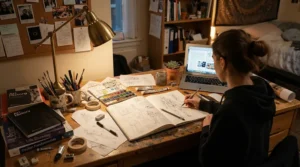
- Consider crumb control. If you draw on a desk with a tablet or laptop nearby, a dust-binding eraser saves cleaning time.
- Look for latex-free labelling. Shared classroom kits and younger users benefit from this, as natural rubber latex proteins can trigger allergies.
- Add one precision tool. A fine-tip pen eraser handles tiny corrections no block can reach.
- Budget for two or three, not one. A small collection under £10 total beats a single expensive tool.
Cheap Art Erasers UK: Where the Real Bargains Hide
Cheap art erasers UK buyers find online fall into three tiers. The ultra-cheap multipacks often use highly plasticised vinyl in novelty shapes, and Wikipedia notes that hard novelty vinyl erasers tend to smear heavy markings. That’s the first red flag: if the eraser is shaped like a cupcake, it’s probably not for serious drawing.
The second tier is the one this article focuses on: recognised stationery brands like Staedtler, Faber-Castell and Tombow. They cost pennies more but come with consistent formulation, so a block you buy next year feels like the one you bought today.
The third tier is “artist-grade” branding at £8-£10. Here the difference is often packaging rather than performance. A £2 Faber-Castell Kneadable Eraser and a more expensive boxed putty eraser do the same job.
The practical conclusion: buy known brands, avoid novelty shapes, and spend leftover budget on better paper. It’s a more effective upgrade than any eraser.
Student Drawing Kit Essentials: Where Erasers Fit
A decent student drawing kit essentials list is short. You need graded pencils (2H, HB, 2B, 6B), a sketchbook, a sharpener and erasers. Most students over-buy pencils and under-buy erasers, then wonder why their drawings look grubby.
Aim for three erasers. A firm vinyl block, like the Staedtler Mars Plastic, handles construction-line removal. A putty eraser, like the Faber-Castell Kneadable Eraser, handles tone adjustments. A fine tip, like the Tombow MONO Zero, handles last-minute details.
That trio typically lands around £7-£12 together, though the first two alone come in at roughly £3-£7. Anything beyond that is optional until your style demands it.
Teachers also tend to favour latex-free erasers in shared classrooms, so the Mars block is a safe choice for school use. Check your course’s materials list, since some art courses specify brands or types.
Building a Student Sketching Kit Under £25
Let’s turn theory into a worked example. Imagine a first-year illustration student who commutes 45 minutes each way and sketches on the train. Their budget is tight, their bag is full and their sketchbook takes a beating.
A sensible student sketching kit for this person might include:
- A mid-grade A5 sketchbook (£5-£8)
- Three pencils: 2H, HB, 4B (£3-£6)
- A Pentel Clic Eraser for quick fixes on the move (£2-£4)
- A Faber-Castell Kneadable Eraser in its case for tone control (£2-£4)
- A small sharpener (£1-£2)
That’s roughly £15-£25 depending on brands, with room to spare. The Pentel Clic Eraser wins here because it’s pocketable and doesn’t need a clean surface, while the putty case keeps crumbs contained in a bag.
Contrast that with a studio-based hobbyist drawing in charcoal on weekends. They’d skip the click eraser and invest in two kneaded blocks, like the Koh-I-Noor Kneadable Eraser alongside the Faber-Castell. Same budget, different priorities.
✨ Build Your Kit Today!
🎨 Ready to sketch smarter? Click any highlighted eraser above to check current prices and availability, then pair it with a decent pencil set. Your sketchbook will thank you!
Affordable Art Supplies: Long-Term Cost and Maintenance
Affordable art supplies only stay affordable if they last. Erasers wear down, but how quickly depends on type and care.
Vinyl blocks lose volume gradually. A Tombow MONO Plastic Eraser used moderately can last many months, and the cost per use is pennies. Putty erasers last differently. Wikipedia notes that a kneaded eraser typically lasts less time than a regular one before being discarded, because graphite and charcoal accumulate in its mass. You’ll replace putty more often, but at around £1-£4 each that’s still trivial.
Precision pens like the Tombow MONO Zero have the highest running costs, because the refills are proprietary. If you use one daily for detailed work, refills can add up. Occasional users won’t notice.
| Option | Typical Lifespan | Running Cost | Best For |
|---|---|---|---|
| Tombow MONO Plastic Eraser | Months | Very low | Daily graphite work |
| Faber-Castell Kneadable Eraser | Weeks to months | Low | Charcoal and tone lifting |
| Tombow MONO Zero | Depends on refills | Moderate | Fine detail |
| Pentel Clic Eraser | Weeks | Low-moderate | Quick fixes |
Reading the table, the Tombow MONO Plastic Eraser delivers the lowest cost per use, which makes it the sensible default for most students. The Faber-Castell Kneadable Eraser costs a little more over time but offers a different capability altogether. Think of it as a tool you replace, not a mistake you repeat.
Value Stationery vs Dedicated Art Erasers
Plenty of artists wonder whether value stationery, like the eraser stuck to the end of a pencil or a multipack from a high-street shop, is good enough. For basic writing it often is. For drawing, it’s more mixed.
Pencil-end erasers are usually harder rubber or vinyl, and they tend to leave streaks on soft graphite. They also wear unevenly, which makes clean edges hard. A dedicated block such as the Staedtler Mars Plastic performs better because it’s formulated to erase graphite from paper without smearing.
The honest counterpoint is that value stationery is perfectly adequate for rough sketching. If you’re just roughing out compositions, nobody needs a specialised tool.
| Option | Strength | Weakness | Best For |
|---|---|---|---|
| Pencil-end rubber | Convenient, cheap | Streaks, uneven wear | Rough notes |
| Multipack stationery erasers | Very cheap | Variable quality | Scrap sketching |
| Staedtler Mars Plastic | Clean, latex-free | Slim block | Finished drawings |
| Faber-Castell Kneadable Eraser | Lifts without rubbing | Wears out | Tonal artwork |
The table shows that dedicated erasers justify their small premium once the drawing matters. For finished artwork, a £2 block beats a free pencil-end rubber every time. If you’re sketching purely for fun, though, the cheap option does the job.

Practical Usage Guide: Getting More From Your Erasers
Buying the right eraser is half the job. Using it properly is the other half.
Knead before you use. Pull and fold a putty eraser until it’s warm and clean. A fresh surface lifts better. When it turns very grey or shiny, replace it.
Use corners deliberately. Cut a vinyl block with a craft knife to create a fresh edge. A clean corner gives crisp lines on a Tombow MONO Plastic Eraser and avoids smearing.
Lift, don’t rub. On soft paper, dab and lift with putty. Rubbing burnishes graphite into the paper, which makes it permanent.
Brush, don’t blow. Sweep crumbs off with a clean brush or the side of your hand held clear of the drawing. Blowing sends damp fragments onto the paper.
Protect the surface. Place a clean sheet under your drawing hand to avoid smudging while you work.
Store properly. Keep putty in its case, such as the Faber-Castell Kneadable Eraser‘s, away from dust and warm radiators, and keep vinyl blocks in their sleeves.
For further technique ideas, Art Side of Life’s eraser guide breaks down eraser types by medium, which is a handy companion to this list.
Problem to Solution: Fixing Common Eraser Frustrations
Problem: Smudged graphite. Use a dust-binding vinyl like the Faber-Castell Dust-Free Vinyl and brush crumbs away rather than wiping.
Problem: Torn or shiny paper. You’re pressing too hard or using a block that’s too firm. Switch to a softer Staedtler Mars Plastic or dab with putty.
Problem: Can’t erase a tiny detail. Use the 2.3 mm tip of the Tombow MONO Zero instead of a clunky block.
Problem: Putty keeps going grey. That’s normal, because it’s absorbing graphite. Knead it often, and replace it when it stops lifting.
Problem: Ghost lines remain. Dense, dark graphite stains the tooth of the paper. Use a firmer block like the Tombow MONO Plastic Eraser, and next time draw lightly.
Problem: Lost erasers. Buy a brightly coloured one like the Koh-I-Noor Kneadable Eraser. It’s much harder to lose.
Features That Matter (And Those That Don’t)
Marketing around erasers can get dramatic, so here’s a simple filter.
Features that matter: material type (putty or vinyl), latex-free labelling if relevant, size and grip, and whether the manufacturer is established. These determine how the eraser actually behaves on paper.
Features that don’t: novelty shapes, scented formulas, glittery packaging and “artist-grade” labels without any technical explanation. They add cost without improving erasing.
One underrated feature is the sleeve. The sliding card cover on a Staedtler Mars Plastic keeps the block clean, which stops it transferring grime to your paper. A small thing, but it affects results.
Another is refillability. The Tombow MONO Zero and Pentel Clic Eraser let you replace the eraser core, which reduces waste and long-term cost.
Safety Guide: Latex, Dust and Younger Artists
For most people, erasers are harmless. But there’s one safety point worth knowing: some erasers contain natural rubber latex, and certain people are allergic to it. The Health and Safety Executive explains that natural rubber latex contains proteins to which some individuals may develop an allergy.
If you’re buying for a school, a family or someone with a known sensitivity, choose a latex-free product. The Staedtler Mars Plastic is listed as latex-free and phthalate-free, which makes it a safer default. Check the packaging of any eraser you buy, since formulations vary.
Beyond allergies, keep small erasers away from very young children, as they can be a choking hazard. And clean crumbs from the table, because eraser dust in food areas is nobody’s idea of a snack.
Common Mistakes When Buying Erasers Under £10 for Artists
Buying novelty shapes. Hard decorative vinyl can smear heavy marks, as Wikipedia notes. Fun for a pencil case, poor for a portrait.
Using one eraser for everything. Putty can’t clean up hard lines, and vinyl can’t gently lift charcoal. Two types cover nearly everything.
Overspending. Beyond about £5, you’re often paying for packaging. A £2 block from a trusted brand is usually enough.
Ignoring paper type. A great eraser on cartridge paper may tear thin sketchbook pages. Test on a corner first.
Never replacing putty. A grey, shiny kneaded eraser doesn’t lift anymore. It just moves dirt around.
Forgetting refills. If you buy a Tombow MONO Zero or Pentel Clic Eraser, budget for spare cores.
Frequently Asked Questions
❓ Which erasers under £10 for artists are best for beginners?
❓ Are kneaded erasers good value for money?
❓ Where can I buy cheap art erasers in the UK?
❓ What's the best eraser for coloured pencil?
❓ Is an electric eraser worth it for students?
Conclusion
The best erasers under £10 for artists aren’t flashy. They’re small, inexpensive tools that solve specific problems. For most people, the winning combination is a Tombow MONO Plastic Eraser for clean removal and a Faber-Castell Kneadable Eraser for lifting and tonal control.
If you want extra precision, add the Tombow MONO Zero. If you sketch on the move, the Pentel Clic Eraser is a pocket-friendly choice. For a tidy desk, the Faber-Castell Dust-Free Vinyl is worth a look, and the Staedtler Mars Plastic is the safe latex-free pick for shared kits. The Koh-I-Noor Kneadable Eraser is a cheerful second putty for highlights.
Whatever you choose, think of erasers as drawing tools, not just correction tools. Used well, they create light as much as they remove mistakes. That’s real value from affordable art supplies.
Recommended for You
- Drawing Paper Pad Under £10: 7 Best Budget Buys (2026)
- Bleedproof Paper For Markers: 7 Best Picks For UK Artists (2026)
- Bristol Board For Ink Drawing: 7 Best Picks For UK Artists (2026)
Disclaimer: This article contains affiliate links. As an Amazon Associate, I earn from qualifying purchases. If you purchase products through these links, we may earn a small commission at no additional cost to you.
✨ Found this helpful? Share it with your friends! 💬🤗
