In This Article
Every drawing has a moment when it goes wrong. A highlight vanishes under a heavy hand, or a guideline you swore you’d keep faint turns into a permanent scar. You reach for the rubber, as we call it in Britain, and the paper pills, the graphite smears, and the whole thing looks like it’s been through the wash.
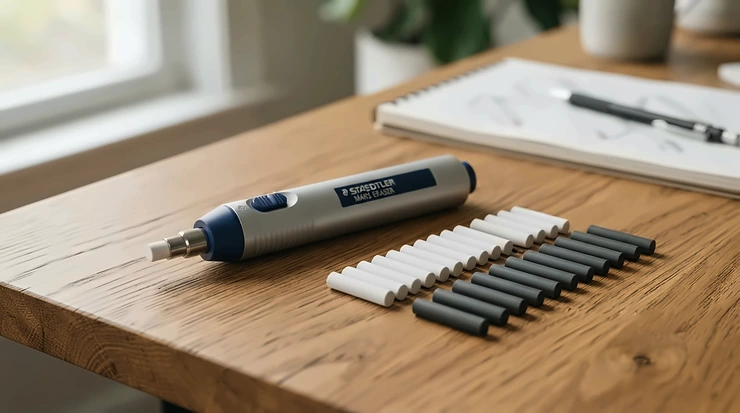
This is the problem an electric eraser for artists was built to solve. It’s a pen-sized motor that spins a slim refill in tiny circles, lifting pencil, charcoal and pastel with almost no pressure. You steer it with a fingertip, not a forearm. It also stays accurate when your hand tires or your detail is smaller than a rice grain.
The category is crowded, though, and much of it is near-identical plastic. So this guide sorts the signal from the noise. It compares seven real, widely available options, from pocket-money kits to professional-grade rechargeables. It explains what each spec means at the drawing board, and it covers the batteries, refills and UK disposal rules that nobody mentions until something goes wrong.
Based on the spec comparison, the best electric eraser for artists isn’t the most expensive one. It’s the one whose refill sizes, power source and weight suit how you actually draw. Read on and you’ll know which that is for you.
Quick Comparison: Best Electric Eraser for Artists at a Glance
| Product | Power | Refill Sizes | Best For |
|---|---|---|---|
| Derwent USB Rechargeable Eraser | Built-in 500mAh rechargeable battery | 5mm and 2.4mm | Professionals wanting ultra-fine control |
| AFMAT Rechargeable Electric Eraser | Built-in 600mAh rechargeable battery | 5mm and 2.3mm | Best all-round value with big refill stock |
| Sakura Cordless Electric Eraser | 2 AAA (included) | Extra-fine, single size | Delicate highlights and lightweight comfort |
| Derwent Battery Operated Eraser | 2 AAA (not included) | Approx. 4-5mm | Comfortable everyday sketching |
| Jakar Mini Electric Eraser Pen | Batteries (check listing) | Fine pen-style tip | Students and budget-conscious beginners |
| Ohuhu Electric Eraser Kit | 2 AAA | Two sizes | Starter kit with brush |
| Amazon Basics Electric Eraser | 2 AAA | Large and small holders | Maximum refills for minimum spend |
Looking at the table, the two rechargeables suit anyone who draws several times a week, because they remove the battery-buying habit entirely. The Sakura Cordless Electric Eraser and Derwent Battery Operated Eraser trade that convenience for a lighter, simpler build. Budget buyers should note that the Amazon Basics Electric Eraser and Jakar Mini Electric Eraser Pen are perfectly capable starters, but they sit at the less refined end of the range.
💬 Just one click — help others make better buying decisions too!😊
What Is an Electric Eraser for Artists?
An electric eraser for artists is a pen-sized, battery-powered tool that spins a slim vinyl or rubber refill in tiny circular motions to lift graphite, charcoal, pastel and coloured pencil from paper. It removes marks precisely, avoids smudging, and creates crisp highlights without the downward pressure that tears or burnishes the surface.
The idea isn’t new. Wikipedia’s history of the eraser notes that English engineer Edward Nairne reportedly sold the first widely marketed rubber eraser in 1770, and that the electric version dates back to 1932. Those early machines were chunky workshop tools. Today’s versions weigh about as much as a marker pen, and some charge from the same USB lead as your phone.
Why does this matter for you? A traditional eraser works by friction across a wide contact area. An electric eraser works through a tiny contact point moving very fast. So you lift a hairline highlight in a portrait, clear a stray construction line in a botanical study, or sharpen the edge of a shape without disturbing its neighbours. That is the whole appeal, and it’s why the electric eraser for artists has moved from niche gadget to regular drawer resident.
One honest caveat before we go on. These tools are strong, and strong tools can over-polish. Reviewers and art guides agree that an electric eraser is better for highlights and corrections than for gently lightening broad tonal areas. Keep that in mind when we reach the tips.
Top 7 Electric Erasers for Artists: Expert Analysis
1. Derwent USB Rechargeable Eraser — rechargeable, with an ultra-fine 2.4mm option
The standout here is the pairing of a built-in battery with two refill sizes. Derwent supplies a 500mAh lithium-ion cell, a USB charging lead, and 20 refills: ten 5mm and ten extra-fine 2.4mm.
In practice, that 2.4mm refill is the useful part. It is narrow enough for single hairs, eyelash highlights and fine architectural lines, while the 5mm refill covers larger clean-ups. The body measures roughly 16cm long and under 2.5cm wide, so it sits like a fat pencil. The push-on, push-off button means your finger isn’t clamped on a switch for the whole session, which is tiring over an hour.
On paper, this is the premium choice for professionals and serious hobbyists. Cultpens notes it ships only within the UK because of the lithium battery, which is a small but useful detail for UK buyers. Retailer reviewers I found praise the latching button and the rechargeable design, and one reviewer with limited hand dexterity called it a game changer for coloured pencil work. A published roundup flags the price as the main drawback.
Pros:
- ✅ Ultra-fine 2.4mm refill for hairline detail
- ✅ Built-in USB rechargeable battery, no spares needed
- ✅ Latching button for hands-free control
Cons:
- ❌ Pricier than battery-powered rivals
- ❌ Battery cannot be swapped out when it ages
Expect a price in the £20-£35 range, so check current price. It is excellent value if you draw weekly, and harder to justify if you erase twice a month.

2. AFMAT Rechargeable Electric Eraser — the most refills for the money
This kit’s party trick is generosity. Published specs list a 600mAh lithium-ion battery, one USB cable, 40 large refills, 100 small refills, a cleaning brush and three spare rubber holders. Most competitors give you a fraction of that.
What does it mean for you? Refills are consumables, and an electric eraser for artists eats them steadily, because the tip wears down as it works. Having 140 in the box could cover years of normal use. It takes both 2.3mm and 5mm tips, so you can switch between highlight work and bigger clean-ups, and the stated runtime is around 600 uses per charge.
I’d argue this is the smartest all-round buy for most people reading this. It suits students, hobbyists and working illustrators who want rechargeable convenience without the premium badge. The sensitive power button is a double-edged feature, as it responds quickly but may switch on in a pencil case if you’re careless, so tuck it away mindfully.
Honesty note: I found plenty of editorial praise, including a respected buyer’s guide naming it a favourite for value, but not a deep pool of verifiable UK customer reviews. Treat the sentiment as editorial consensus.
Pros:
- ✅ Huge refill stock, 140 pieces in one kit
- ✅ Rechargeable with 2.3mm and 5mm compatibility
- ✅ Extra holders and a brush included
Cons:
- ❌ Sensitive button can switch on accidentally
- ❌ Fixed battery, so no instant swap mid-session
Price range: roughly £10-£20, so check current price. For the contents alone, the value verdict is very strong.
3. Sakura Cordless Electric Eraser — featherweight, with batteries included
The hook is the weight. Published figures put it at about 2.4oz, around 68g, with the batteries installed, and unusually it ships with its two AAA cells.
Light matters more than it sounds. A heavy tool tires the hand and drifts in the final millimetre of a stroke, which is exactly when you want it steady. The smooth, elliptical body sits snugly in the hand, and the refills are extra fine, so tiny highlights are quick work.
The trade-off is flexibility. It accepts only one refill size, so you cannot swap to a broad tip for larger areas. For anyone doing pure detail erasing on portraits, wildlife fur or fine pencil work, that’s an acceptable limit. If you want one tool for everything, it isn’t.
A published guide notes that professional artists rate it highly, though it also flags that the price sits near the top of the cordless range. I couldn’t verify a large review set, so I’d read that praise as an editorial signal rather than a proven consensus.
Pros:
- ✅ Batteries included, ready to use out of the box
- ✅ Around 68g makes long sessions comfortable
- ✅ Extra-fine refills suit delicate highlights
Cons:
- ❌ Accepts one refill size only
- ❌ Dearer than most battery-powered rivals
Expect a price around £15-£25, so check current price. It’s a worthwhile spend if comfort is your priority, and a luxury if it isn’t.
4. Derwent Battery Operated Eraser — comfortable, with an accident-proof top button
The distinguishing feature is where the power button lives. Derwent places it on top of the body, which makes it hard to knock on or off while you’re working.
It weighs about 2.5oz (roughly 70g) and uses two AAA batteries, which are not included. Its sleek ergonomic shape suits left- and right-handed users alike, and the box holds eight long-lasting refills of around 4-5mm. That size is a general-purpose compromise. It’s a touch too broad for the finest hairs but very comfortable for clearing guidelines, tidying edges and lifting soft highlights.
Based on the spec comparison, this is the sensible pick for someone who wants brand reliability without paying for rechargeable tech. It pairs well with a Derwent USB Rechargeable Eraser if you want a fine-detail partner later, because the brand’s refills are widely stocked in UK art shops. A published buyer’s guide says it works well on pencil drawings and fits any artist’s kit.
I couldn’t verify a large body of customer reviews for this specific model, so I’m relying on that editorial summary.
Pros:
- ✅ Top-mounted button prevents accidental switching
- ✅ Light, ambidextrous, comfortable body
- ✅ Eight long-lasting refills included
Cons:
- ❌ Batteries are not included in the box
- ❌ No extra-fine tip for hairline detail
Price range: roughly £10-£20, so check current price. A tidy mid-range choice for general sketching.
5. Jakar Mini Electric Eraser Pen — pocket-money precision
Jakar built its reputation on affordable art kit, and this pen-style eraser is a clear example. It has a transparent body, comes in yellow, green, pink or blue, and ships with five spare refills.
The slim shape matters more than the colours. A narrower body lets you grip close to the tip, the way you’d hold a technical pen, which is what gives fine control. A published guide says its accuracy suits fine art and watercolour-style highlighting, and that spare refills sell cheaply in 30-packs, so buy extras at the same time.
For students, beginners and anyone buying a first electric eraser for artists, this is a low-risk entry. It runs on small replaceable batteries (listings vary between AA and AAA, so read yours), which keeps the body light but makes you a battery buyer for life.
What would you lose against the premium picks? Mostly refinement: fewer refills, no rechargeable convenience, and a simpler build.
Pros:
- ✅ Very low cost of entry
- ✅ Slim pen shape for close, precise grip
- ✅ Cheap refill packs available separately
Cons:
- ❌ Only five refills in the box
- ❌ Needs regular battery replacement
Expect a price under £10, so check current price. Excellent value for what it is.
6. Ohuhu Electric Eraser Kit — starter kit with a brush included
Ohuhu’s selling point is completeness. The kit runs on two AAA batteries and includes 20 refills plus a small brush for sweeping away eraser crumbs.
The brush is more useful than it looks. Eraser debris left on a drawing gets dragged across it by your hand and leaves faint grey streaks, which defeats the object. Sweeping as you go keeps the page clean.
It’s a compact, push-button tool that will handle touch-ups on drawings and architectural plans. The catch, flagged in a published guide, is refill hunting. Locating matching refills later can be awkward, and Derwent refills are reported to be not quite a perfect fit. So when you buy this kit, treat the 20 refills as your supply, and think carefully before relying on it for years of heavy use.
For occasional users, that’s a small worry. For daily illustrators, it’s a reason to look at the Derwent or AFMAT options, where replacement stock is easier to find.
I could not verify a broad set of independent customer reviews, so I’ve limited this entry to what the product’s published contents and an editorial guide say.
Pros:
- ✅ Brush included to keep drawings clean
- ✅ Twenty refills in the box
- ✅ Compact and light for travel
Cons:
- ❌ Matching replacement refills can be hard to find
- ❌ Batteries needed, with no rechargeable option
Price range: under £15, so check current price. Fine for casual use.
7. Amazon Basics Electric Eraser — 90 refills for rock-bottom cost
Nothing beats it on sheer quantity. The kit includes two holders, fitting smaller and larger refills, plus around 90 refills in total, powered by two AAA batteries.
That is a lot of erasing for very little money. If you’re experimenting to see whether an electric eraser for artists suits your style, risking a tenner instead of a day-rate is sensible. It’s also a handy second tool: keep it in the travel bag so your good one never leaves the studio.
A published guide is candid that Amazon Basics isn’t known for top-tier quality, and that the eraser itself is not the highest grade, though it should more than suffice for simple tasks and for novice artists. I’d read that as a build-quality warning. Expect less refined motor feel and perhaps less consistency than the premium picks.
I couldn’t verify a large sample of reviews myself, so that editorial view is my main source.
Pros:
- ✅ Roughly 90 refills in the kit
- ✅ Two holders cover small and large tips
- ✅ Very low cost to try the tool
Cons:
- ❌ Build quality is modest
- ❌ Less refined feel for delicate work
Expect a price under £10, so check current price. It’s the cheapest sensible way in.
Side-by-Side Spec Check
| Product | Battery | Refills Included | Weight | Price Range | Best For |
|---|---|---|---|---|---|
| Derwent USB Rechargeable Eraser | 500mAh Li-ion | 20 | Light | £20-£35 | Ultra-fine control |
| AFMAT Rechargeable Electric Eraser | 600mAh Li-ion | 140 | Not stated | £10-£20 | All-round value |
| Sakura Cordless Electric Eraser | 2 AAA included | Extra-fine refills | Approx. 68g | £15-£25 | Lightweight comfort |
| Derwent Battery Operated Eraser | 2 AAA, not included | 8 | Approx. 70g | £10-£20 | Everyday sketching |
| Jakar Mini Electric Eraser Pen | Batteries | 5 | Not stated | Under £10 | Beginners |
| Ohuhu Electric Eraser Kit | 2 AAA | 20 | Not stated | Under £15 | Starter with brush |
| Amazon Basics Electric Eraser | 2 AAA | Approx. 90 | Not stated | Under £10 | Budget trials |
These prices are indicative ranges drawn from typical UK retail listings, so confirm them before buying. The table shows a clear split. The rechargeables cost more up front but remove running costs, while the AAA models are cheaper on day one and dearer over years. If you only buy one, the AFMAT Rechargeable Electric Eraser covers the most ground, and the Derwent USB Rechargeable Eraser is the pick if hairline precision matters most.
How to Choose an Electric Eraser for Artists
Picking well comes down to six questions. Work through them in order.
- Decide how fine your detail is. If you draw fur, hair or botanical veins, you need a refill around 2.3-2.4mm. A 5mm tip is too broad for that work and will clip neighbouring lines.
- Choose your power source. Rechargeable models suit frequent use and save buying batteries. AAA models are lighter and swap instantly, which helps if you don’t want to wait on a charge. Norfolk County Council’s guidance reminds you to remove batteries before discarding devices, which is easier on removable-cell models.
- Check the weight and shape. Around 70g is typical for a pen-style eraser. Lighter is easier on the hand, while a little heft can steady you.
- Look at the switch. A latching button spares your finger. A top-mounted button prevents accidental activation.
- Count the refills and check availability. A big kit is only valuable if you can replace the tips later. Same-brand refills are safest.
- Match it to your medium. Graphite, charcoal and pastel respond well. Heavily burnished coloured pencil is stubborn on any eraser, so test on scrap paper first.
Stuck between two options? Choose the one with the finer refill. You can always draw broader marks with a fine tip, but you cannot draw fine marks with a broad one.
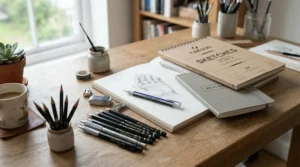
Cordless Eraser for Detailed Work: What Actually Matters
A cordless eraser for detailed work lives or dies on three things: tip size, weight and stability. Everything else is packaging.
Tip size is the obvious one. Hairline highlights and tiny clean-ups demand the narrowest refill your tool accepts. Both the Derwent USB Rechargeable Eraser and the AFMAT Rechargeable Electric Eraser list 2.3-2.4mm options, and the Sakura Cordless Electric Eraser is built around extra-fine tips. The Derwent Battery Operated Eraser, with its 4-5mm refills, is better suited to broader tasks.
Weight comes next. Think of it like writing with a feather versus a tent peg. Light bodies, around 68-70g, reduce fatigue, though a slightly heavier tool can calm tremor. Finally, stability: that means a button you don’t have to hold and a body that doesn’t rattle. A latching switch is a small feature with a big effect over a two-hour session.
Here’s the practical takeaway. If your work is mostly fine, spend on a narrow refill and a comfortable body. If it’s mostly general sketching, a cheaper kit is plenty. And always keep a spare set of refills in the drawer, because a worn tip loses its edge long before the box runs out.
Eraser Tips for Fine Lines: A Practical Usage Guide
Great gear helps, but technique does most of the work. These eraser tips for fine lines come from the way the tools behave, and they apply whichever model you buy.
Setting up. Fit a fresh refill, pushing it in until it seats firmly. Charge or fit batteries before you start, because a tool that fades mid-highlight gives uneven results.
First strokes. Practise on scrap paper that matches your drawing surface. Use almost no pressure. Let the spin do the work, and move in short, light passes. Pressing harder doesn’t lift more graphite; it burnishes the paper and leaves a shiny patch.
Fine-line technique. Hold the tool like a pencil, near the tip. Touch down, lift, and re-touch rather than dragging. For a crisp hair highlight, work along the line direction, not across it.
Masking. To protect nearby areas, slip a thin plastic erasing shield or a scrap of paper with a cut slit over the drawing. It gives you hard edges that freehand work can’t.
Cleaning up. Brush debris away between passes. Residue left on the page smudges.
Common first-month mistakes. Using a worn, rounded tip. Pressing too hard. Erasing the same spot repeatedly until the paper fibres lift. Skipping scrap-paper tests on heavily layered work.
Maintenance schedule. Replace refills when the tip goes round. Wipe the chuck clean monthly, and recharge rechargeables before storing them for long periods.
✨ Don’t Miss These Exclusive Deals!
🔍 Ready to take your detail work to the next level? Click any highlighted product above to check current pricing and availability. A good tool turns frustrating corrections into clean, confident highlights your sketchbook will thank you for!
Detail Erasing in Practice: Three Artist Case Studies
Specs mean little until they meet a real desk. Here are three profiles, each matched to a pick with reasoning.
The portrait student. She works in graphite on smooth Bristol board, three evenings a week, on a tight budget. Her main task is detail erasing for eyelash and hair highlights. The AFMAT Rechargeable Electric Eraser fits well. The 2.3mm tip handles hairs, the big refill stock keeps running costs near zero, and rechargeable power removes the battery habit. She’d spend a modest sum once and rarely think about it again.
The commissioned illustrator. He draws daily and bills by the hour, so lost time is lost money. A Derwent USB Rechargeable Eraser suits him. Its latching button reduces strain over long sessions, the 2.4mm refill handles fine corrections, and the premium price pays back through comfort and reliability.
The weekend sketcher. She draws on holiday and wants light kit. The Jakar Mini Electric Eraser Pen or Amazon Basics Electric Eraser is plenty. Both are cheap enough to lose without grief, and she can slip a spare into a coat pocket.
The pattern is clear. Frequency of use decides rechargeable versus battery. Fineness of detail decides tip size. Budget decides the rest. If you’re unsure which profile fits, start with the cheapest tool in the right tip size, then upgrade once your habits are clear.
Electric Eraser vs Traditional Alternatives
| Eraser Type | Precision | Smudge Risk | Paper Damage Risk | Best For |
|---|---|---|---|---|
| Electric eraser (e.g. AFMAT Rechargeable Electric Eraser) | Very high | Low | Moderate if pressed hard | Hairline highlights and tidy corrections |
| Kneaded eraser | Moderate | Low | Very low | Soft tonal lightening and charcoal |
| Vinyl or plastic eraser | Moderate | Moderate | Moderate | General pencil clean-up |
| Art gum eraser | Low | Higher residue | Low | Large areas on soft paper |
A kneaded rubber remains the gentlest option for lifting tone, because you press and lift rather than rub. A vinyl block remains the cheapest all-rounder. Electric erasers earn their place where those two struggle: tiny, exact marks.
Looking at the comparison, an electric eraser for artists doesn’t replace the rest of the drawer. It complements it. Use a kneaded eraser for broad softening, then bring in the Derwent USB Rechargeable Eraser for crisp edges and highlights. Beginners should note that the electric tool’s power is its risk as well as its strength, so practise light touch first.
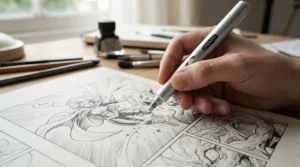
Fine Art Tools: Where an Electric Eraser Fits in Your Kit
Among fine art tools, an electric eraser sits in the finishing category, alongside blending stumps, fixative and a good sharpener. It doesn’t build a drawing. It refines one.
Consider a typical graphite workflow. You block shapes with a soft pencil, build tone with layering, blend with a stump, and then, near the end, you pull out highlights. That last step is where the tool matters. Instead of leaving reserved white paper for every sparkle, you can draw freely and lift highlights afterwards.
It also helps charcoal and pastel pencil users, because those media lift cleanly. Heavily burnished or wax-based pencil layers resist, so don’t expect miracles there.
If you’re assembling a kit on a budget, my ranking would be: quality pencils and paper first, a kneaded eraser second, then an electric eraser for artists third. If you already have the first two and draw detail, it’s the cheapest upgrade in fine art tools for the improvement it brings.
Think of it like a scalpel in a toolbox. You won’t use it every minute, but nothing else does that particular job.
Illustration Supplies: Long-Term Cost and Maintenance
Illustration supplies are a running cost, and an electric eraser is no exception. The sticker price tells only half the story.
Refills are the main ongoing expense. Derwent’s own UK listing describes a 30-pack with 15 large 5mm and 15 extra-fine 2.4mm refills at a low price, under £5 at the time of research, which shows how cheap replacements can be when the brand sells them directly. Batteries are the other cost. AAA models need replacing, while rechargeables avoid that entirely.
| Product | Upfront Cost | Running Cost | Best For |
|---|---|---|---|
| Derwent USB Rechargeable Eraser | Higher | Low (refills only) | Heavy, long-term use |
| AFMAT Rechargeable Electric Eraser | Low-mid | Very low | Best long-term value |
| Sakura Cordless Electric Eraser | Mid-high | Batteries and refills | Comfort-first users |
| Amazon Basics Electric Eraser | Very low | Batteries only | Occasional use |
Overall, the AFMAT Rechargeable Electric Eraser offers the lowest cost of ownership, because the large refill supply and rechargeable cell cancel out running costs. The Derwent USB Rechargeable Eraser costs more up front, but its refills are easy to restock. For occasional sketchers, the Amazon Basics Electric Eraser is cheaper over a short horizon, though per-use costs rise if you draw weekly.
Maintenance is simple: brush the chuck, replace worn tips, and store the tool somewhere dry.
Common Mistakes When Buying an Electric Eraser for Artists
Plenty of buyers go wrong in the same few ways. Here’s how to avoid them.
Buying on refill count alone. A hundred refills sound great, but only if they fit your tool and you can restock them. Check compatibility before you celebrate.
Ignoring tip size. A kit with only 5mm tips can’t do hair or tiny highlights. Look for a 2.3-2.4mm option if detail is your goal.
Forgetting batteries. Some models, like the Derwent Battery Operated Eraser, don’t include them. It’s a small nuisance, but avoidable.
Overpaying for features you won’t use. A professional rechargeable is wasted on someone erasing monthly.
Assuming it works on everything. Wax-heavy coloured pencil and ink are tough on any eraser. Test first.
Pressing too hard. More force doesn’t mean more erasing. It means torn paper.
Skipping spare refills. A worn tip loses its edge long before it breaks. Keep spares.
If you avoid these seven errors, you’ve dodged most of the regret that shows up in buyer comments. A little planning beats a drawer full of unused gadgets every time.
Safety, Batteries and UK Disposal Guide
Electric erasers are low-risk tools, but they contain batteries, and batteries deserve respect.
For rechargeable models such as the Derwent USB Rechargeable Eraser and the AFMAT Rechargeable Electric Eraser, charge them with the supplied lead, avoid leaving them plugged in unattended for long periods, and keep them away from heat. Cheap, unbranded chargers can fall short of UK safety standards, so stick to the supplied lead or a reputable adapter. When you buy, look for CE or UKCA marking and a seller you trust.
Disposal matters more than most people realise. A recent Cambridgeshire and Peterborough waste partnership notice reports that more than 1.6 billion batteries were thrown away in the UK in 2023, with over 1.1 billion hidden inside everyday items. It adds that batteries and battery-powered electricals can be recycled free of charge at household recycling centres, supermarkets and DIY stores.
So, when your eraser finally dies, don’t bin it. Remove removable batteries and recycle them separately. If the battery is built in, as on the rechargeable models, take the whole device to a recycling point. It’s a two-minute errand that prevents bin-lorry fires.
FAQ
❓ Can an electric eraser for artists work on coloured pencil?
❓ Will an electric eraser tear my paper?
❓ How long do electric eraser refills last?
❓ Is a rechargeable electric eraser worth the extra money?
❓ Where can I buy electric eraser refills in the UK?
Conclusion
The best electric eraser for artists is the one that matches your detail level, drawing frequency and budget, not the one with the biggest price tag. Once you’ve worked that out, the choice gets easy.
For most people, the AFMAT Rechargeable Electric Eraser is the smart all-rounder, offering rechargeable power, two tip sizes and a vast refill stock. If hairline precision is your priority and the budget allows, the Derwent USB Rechargeable Eraser is the refined choice. The Sakura Cordless Electric Eraser rewards comfort-seekers, the Derwent Battery Operated Eraser suits steady everyday sketching, and the Jakar Mini Electric Eraser Pen, Ohuhu Electric Eraser Kit and Amazon Basics Electric Eraser make friendly, low-risk starters.
Whichever you pick, remember the basics: a fine refill for fine work, a feather-light touch, a brush for crumbs, and a proper recycling bin for dead batteries. Add that to your fine art tools and illustration supplies, and you’ll fix mistakes in seconds that once cost you an evening.
Recommended for You
- Erasers Under £10 for Artists: 7 Best Picks, No Smudges (2026)
- Drawing Paper Pad Under £10: 7 Best Budget Buys (2026)
- Bleedproof Paper For Markers: 7 Best Picks For UK Artists (2026)
Disclaimer: This article contains affiliate links. As an Amazon Associate, I earn from qualifying purchases. If you purchase products through these links, we may earn a small commission at no additional cost to you.
✨ Found this helpful? Share it with your friends! 💬🤗
