In This Article
A blending brush for pastel art is a soft-bristled or soft-tipped tool that merges, softens and smooths soft pastel marks so separate strokes melt into seamless gradients. It nudges loose pigment around the paper rather than adding colour. That gives you far more control than a fingertip in tight areas.
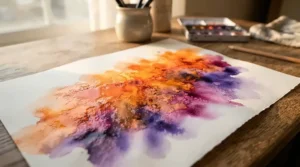
Here’s the thing about pastel: it’s pigment in its most naked form, a stick of powdered colour with just enough binder to hold its shape. That purity gives you glowing colour. It also means every stroke is one careless swipe away from mud. The right blending brush for pastel art is the difference between a sky that glows and one that looks like a smudged window.
The market is confusing. Some tools are proper pastel brushes, and some are watercolour mop brushes that happen to work. Others are sponge tips or rubber-tipped “shapers” that aren’t brushes at all but do the same job. I’ve sorted through current product descriptions, UK retailer listings and published reader feedback to build this guide. I haven’t tested any of these products myself, so what follows is analysis grounded in specs and review evidence, not lab results.
By the end you’ll know which soft bristle brush for pastels suits your paper, your palette and your budget. You’ll also get a plan for a dust-free blending tool setup and a repeatable soft pastel technique. And you’ll know which pastel art supplies are worth buying and which are marketing noise. Prices below are ranges only, so check current prices before you buy.
Quick Comparison: Best Blending Brush for Pastel Art at a Glance
| Product | Tool Type | Price Range | Best For |
|---|---|---|---|
| Jackson’s Pastel Brush Set of 3 | Pastel-specific brush set | Low £10s | Jackson’s Pastel Brush Set of 3 suits all-round beginners |
| Pro Arte Series 320 Round Mop | Goat hair mop brush | Budget-friendly, varies by size | Pro Arte Series 320 Round Mop suits big, feathery skies |
| Daler-Rowney Graduate Black Goat Round Mop | Goat hair mop brush | Under £10 | Daler-Rowney Graduate Black Goat Round Mop suits tight budgets |
| Colour Shaper Pastel Set | Rubber-tipped shapers | Around £20-£30 | Colour Shaper Pastel Set suits detail and hair-free blending |
| PanPastel Sofft Knife and Covers | Sponge applicator | Under £7 per knife | PanPastel Sofft Knife and Covers suits low-dust blending |
| Derwent Paper Stumps | Rolled paper stumps | Under £5 | Derwent Paper Stumps suit pinpoint softening |
| Derwent Burnisher & Blender Set | Colourless blender tools | Around £8-£12 | Derwent Burnisher & Blender Set suits pastel pencil work |
Notice how the table isn’t all brushes. That’s deliberate. For most artists the best result comes from one real soft bristle brush for pastels for broad passages and one precision tool for edges. If you’re buying only one thing, the Jackson’s Pastel Brush Set of 3 gives the broadest coverage. If you’re sensitive to dust or work with PanPastel, the PanPastel Sofft Knife and Covers changes the equation. Budget buyers can get a perfectly serviceable mop brush for pocket change, with a trade-off in shedding that we’ll cover below.
💬 Just one click — help others make better buying decisions too!😊
Top 7 Blending Brush for Pastel Art Options: Expert Analysis
Every pick below is real and currently listed with UK retailers. Where I couldn’t verify review text, I say so rather than fill the gap.
1. Jackson’s Pastel Brush Set of 3 — purpose-built trio for pastels
Jackson’s describes this set as tools for mixing and blending pastels and pencils, plus fine detail work. That’s a refreshingly specific brief in a category where many “blending brushes” are really watercolour brushes in disguise.
Three brushes in one pack means you can dedicate one to warm colours, one to cool and one to details. That habit keeps your blends clean, because a brush loaded with ultramarine will tint your next yellow green. The listing I found doesn’t state hair type or head sizes, so check the product page. It matters, because softer hair floats pigment across the surface while firmer hair pushes it into the paper’s tooth.
On paper, this is the safest first purchase for anyone building a blending brush for pastel art kit from scratch. The set gives you a large, a medium and a small tool for roughly the price of a sandwich meal deal. It’s also a good fit for colour blending in portraits, where you move between broad cheeks and small eyelids.
I couldn’t find verified customer review text for this set, so there’s no review consensus to report. Treat it as promising rather than proven.
Pros:
- ✅ Three shapes cover broad and detailed blending
- ✅ Described by the retailer specifically for pastels
- ✅ Dedicated brushes keep warm and cool colours clean
Cons:
- ❌ Listing doesn’t specify hair type or sizes
- ❌ No verified review evidence found
Price range: low £10s, check current price. Verdict: strong value if the head sizes suit your paper format.

2. Pro Arte Series 320 Round Mop — featherweight goat hair for big skies
The Series 320 is a fine goat hair mop, and the maker markets it for watercolour and ink washes. It also describes the bristles as soft enough for laying down pastels, which is the part we care about.
Goat hair is the classic “do no harm” hair for blending. It’s so soft it barely disturbs underlying layers, so it feathers an edge rather than carving into it. The mop shape holds a generous amount of hair in a rounded head. Used dry, that head sweeps across a wide area and smooths it in a single pass.
Based on the spec description, this is a specialist for large, quiet areas: skies, mist, out-of-focus backgrounds and soft shadows. It’s less suited to crisp detail, because a mop head naturally fans out and can’t land a precise tip. Pair it with a smaller tool for edges.
I couldn’t verify review text for this exact series. That’s worth knowing, because goat hair mops as a class draw mixed comments on shedding (see the next product), so inspect it when it arrives.
Pros:
- ✅ Super-soft goat hair barely disturbs layers
- ✅ Rounded mop head covers large areas quickly
- ✅ Doubles as a watercolour wash brush
Cons:
- ❌ Poor precision for small details
- ❌ No verified review data found
Price range: budget-friendly and varies by size, so check current price. Verdict: a sensible second brush for anyone painting landscapes.
3. Daler-Rowney Graduate Black Goat Round Mop — cheapest way into goat hair
Daler-Rowney’s Graduate range is aimed squarely at students and hobbyists, and this 1 inch black goat hair round mop is one of its simplest products. The brand recommends it for softening and blending because it leaves minimal brushstrokes.
That “minimal brushstroke” claim is exactly what you want for pastels. A mop with a short handle puts your hand close to the paper, which gives you a delicate touch for gentle feathering across a gradient. The 1 inch head is generous, so it suits A3 sky blends better than small studies.
Reviews on one UK craft retailer’s page for this brush are mixed. Some buyers praise its softness and say it helps with blending, but several complain about bristles coming loose. One reviewer says the shedding made the first outing painful. Most of these reviews describe use with acrylic and watercolour, not pastels, so apply them with caution. In practice, a shed hair on pastel is easy to flick away. A shed hair in wet paint is not.
Pros:
- ✅ Very soft goat hair blends with minimal marks
- ✅ Short handle gives close, delicate control
- ✅ Very affordable for students
Cons:
- ❌ Reviewers report bristles shedding early
- ❌ Large head is too big for fine details
Price range: under £10, check current price. Verdict: great value for experimenting, as long as you accept some shedding.
4. Colour Shaper Pastel Set — hair-free blending for detail work
Colour Shapers look like paintbrushes, but they have flat or tapered rubbery tips where the hair would be. The set on UK retailer artsupplies.co.uk is described as an assortment chosen by professional artists, and it comes in size 2 and size 6.
Rubber tips push pigment rather than sweeping it, so you get surgical control at the cost of a “painterly” feather. The tapered tip refines a lip line or an eyelid. The flat tip presses pastel into the paper’s tooth for denser coverage. And because there are no hairs, there’s nothing to shed or splay out of shape.
My read of the specs: this is the best tool in the group for realism, such as portraits, animal eyes and architecture. It’s the wrong tool for a whole sky, though. Size 6 helps there but still won’t match a mop.
The reviews I could verify are a small sample: eight on the retailer’s page. The one visible comment is from a newcomer to pastel who found it a really useful set of tools. That’s encouraging but thin.
Pros:
- ✅ Flat and tapered tips for varied blending
- ✅ No hairs to shed or splay
- ✅ Wipes clean between colours
Cons:
- ❌ Costs more than basic brushes
- ❌ Too small for broad skies
Price range: around £20-£30 depending on size, check current price. Verdict: a worthwhile premium for portrait artists.
5. PanPastel Sofft Knife and Covers — sponge applicator that keeps dust down
Sofft tools were developed specifically for PanPastel, but the maker says they also work with soft pastel sticks. The knife is a flexible plastic palette knife shape. Slip a micropore sponge cover over it and it becomes a cross between a brush and a knife.
The semi-absorbent sponge holds and releases pigment evenly with a non-abrasive surface. It leaves a smooth, brushstroke-free finish. Covers are reusable. You wipe them on a dry paper towel between colours or wash them in soap and water. The maker warns that over-stretching a cover will tear it.
This is the most dust-conscious entry here. One published PanPastel review notes that the format creates less dust than stick pastels because you use applicators rather than rubbing sticks. That makes the PanPastel Sofft Knife and Covers the closest thing to a dust-free blending tool in this list. It’s best for anyone who works indoors or has a sensitive chest.
That same reviewer also warns that sponge tips wear down quickly and replacements add up. Budget for covers as a consumable.
Pros:
- ✅ Smooth, brushstroke-free blending finish
- ✅ Reusable covers wash clean easily
- ✅ Associated with lower dust than sticks
Cons:
- ❌ Sponge covers wear out quickly
- ❌ Replacement covers add ongoing cost
Price range: under £7 per knife, with assorted packs costing more, so check current price. Verdict: excellent for low-dust work, but expect running costs.
6. Derwent Paper Stumps — pinpoint softening for under a fiver
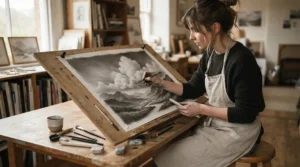
Paper stumps, also called tortillons, are tightly rolled paper with pointed ends. They are the oldest trick in the drawing kit. Derwent’s version is a staple of UK art shops, and it has 25 reviews on one retailer’s listing, the largest pool in this guide.
A stump doesn’t spread pigment like a brush. It burnishes it flat. That makes it brilliant for softening a tiny highlight or fading a hard pastel pencil edge, and poor for large areas. The pointed end is also a quiet bonus: you can sharpen it by rubbing it on fine sandpaper when it gets clogged.
My analysis: think of the Derwent Paper Stumps as the finishing tool, not the main tool. Use a goat hair mop or Jackson’s brush for the first pass, then a stump to tidy details. They’re cheap enough to treat as disposable, and keeping separate stumps for light and dark colours avoids dirty marks.
I haven’t verified the text of those 25 reviews, only the count, so I can’t summarise sentiment. The volume at least suggests it’s a trusted staple.
Pros:
- ✅ Brilliant for tiny highlights and fine edges
- ✅ Sharpens easily when clogged
- ✅ Extremely cheap to replace
Cons:
- ❌ Useless for blending large areas
- ❌ Clogs with pigment quickly
Price range: under £5, check current price. Verdict: a must-have supporting tool.
7. Derwent Burnisher & Blender Set — colourless blenders for pastel pencil detail
This set sits at the edge of our topic because its tools are designed with coloured pencils in mind. It has 18 reviews on one UK retailer, so it’s clearly popular. Check the product page for the exact contents.
The logic is useful, though. Colourless blenders add no pigment of their own, so they smooth what’s already there. For artists who use pastel pencils alongside soft sticks, such as for eyelashes, jewellery or fine lines, this is a clean way to finish edges without the mess of a dry brush.
I’d treat the Derwent Burnisher & Blender Set as a supporting actor. It doesn’t replace a blending brush for pastel art in broad passages, and I wouldn’t buy it for soft pastel sticks alone. For mixed-media artists, though, it bridges the gap between pencil detail and pastel colour.
As with the stumps, I verified the review count but not the review text, so I can’t offer a sentiment summary.
Pros:
- ✅ Adds no colour, so blends stay true
- ✅ Handy for pastel pencil detailing
- ✅ Small, tidy and easy to carry
Cons:
- ❌ Designed mainly for coloured pencils
- ❌ Not suited to broad pastel areas
Price range: around £8-£12, check current price. Verdict: worth it only for mixed-media artists.
Top 7 Comparison: Specs and Real-World Meaning
| Product | Key Feature | Review Evidence | Best For |
|---|---|---|---|
| Jackson’s Pastel Brush Set of 3 | Three shapes in one set | No review text found | Beginners wanting one purchase |
| Pro Arte Series 320 Round Mop | Fine goat hair mop | No review text found | Landscape skies |
| Daler-Rowney Graduate Black Goat Round Mop | 1 inch goat hair head | Mixed, with shedding complaints | Budget experiments |
| Colour Shaper Pastel Set | Size 2 and 6 rubber tips | 8 reviews on one UK retailer | Portrait artists |
| PanPastel Sofft Knife and Covers | Reusable sponge covers | Small pools, one detailed review | Low-dust working |
| Derwent Paper Stumps | Rolled paper points | 25 reviews on one UK retailer | Fine highlights |
| Derwent Burnisher & Blender Set | Colourless blenders | 18 reviews on one UK retailer | Mixed-media detail |
Looking at the comparison above, the Colour Shaper Pastel Set and the PanPastel Sofft Knife and Covers are the most specialised options, and they cost accordingly. The Jackson’s Pastel Brush Set of 3 is the best generalist if you can accept the missing hair-type detail. Anyone shopping on a tight budget can start with the Daler-Rowney Graduate Black Goat Round Mop and the Derwent Paper Stumps, and still cover broad and fine blending for under £15 combined.
How to Choose a Blending Brush for Pastel Art
Choose a blending brush for pastel art by matching hair softness and head shape to the area you’re blending, then checking that the brush sheds little. Soft goat hair suits large skies and gentle gradients, while rubber or sponge tips suit detail.
- Match the head shape to your subject. Round mops cover skies and mist, while tapered tips suit eyes, edges and small shapes. Landscape painters need bigger heads than portrait artists.
- Pick hair softness for the pastel hardness. Very soft pastels need a very gentle brush, otherwise the brush grinds pigment into the paper instead of floating it across.
- Consider your paper’s tooth. Rough paper holds pigment well and tolerates firmer tools. Smooth paper clogs fast, so go softer.
- Check shedding evidence. Read reviews for “loses hairs” comments. A shed hair on a pastel painting is irritating, even if you can flick it off.
- Plan for cleaning. Sponge covers wash easily, while natural hair holds pigment deep in the head. Decide how much cleaning effort you’ll tolerate.
- Think about dust. If you work indoors, a dust-free blending tool setup with sponge applicators is worth the premium.
- Budget for a second tool. One broad tool and one precision tool beats two broad tools. Plan your spending on both.
Soft Bristle Brush for Pastels: Goat, Hog or Synthetic?
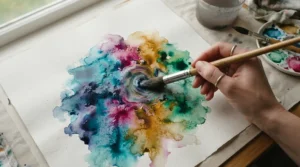
The classic debate about any soft bristle brush for pastels is what the head is made from. Based on the product descriptions in this guide, goat hair is the traditional answer for good reason. Retailers and makers describe goat hair mops as ultra-soft and ideal for softening colour transitions with minimal brushstrokes. They’re also used by conservators for gently dusting delicate items, which tells you how little force they apply to a surface.
Synthetic heads can imitate that softness and often cost less. They hold their shape better and shed less, but they can feel springier. That springiness pushes pigment rather than floating it. Hog bristle is firmer still, so it’s usually better for moving pigment into rough paper than for polishing a gradient.
What does this mean in practice? For skies, mist, water and skin, choose goat or a very soft synthetic. For crisp transitions on textured paper, choose something with a little more resistance. A pastel-specific soft bristle brush for pastels, like the Jackson’s Pastel Brush Set of 3, usually splits the difference, though it’s worth checking the hair type on the listing.
Whatever you choose, don’t use a brush that has previously held wet paint without cleaning it thoroughly. Dried paint stiffens hair and leaves scratch marks in soft pastel that you can’t blend out.
Dust-Free Blending Tool: How to Keep Pastel Dust Under Control
No blending method is truly dust-free. Soft pastel is made of fine pigment particles, and any tool that disturbs it releases some into the air. But a good dust-free blending tool strategy can cut exposure dramatically.
Why does it matter? According to Artists Network, pastel dust is made of extremely fine particles, and a significant portion of the pigment particles are small enough to reach deep into the lungs. The article also notes that some pigments are inorganic and may contain toxic metals. You can reduce dust in a studio, but you can’t completely control it in a home setting.
Here’s how tools compare. Sponge applicators like the PanPastel Sofft Knife and Covers are associated with lower dust, because you load pigment from a pan rather than rubbing a stick. Rubber-tipped tools like the Colour Shaper Pastel Set don’t flick pigment into the air, because they press rather than sweep. Large goat hair mops release the most airborne dust, because sweeping motions lift particles.
Practical steps help whatever you use:
- Work with the board vertical so loose pigment falls away.
- Tap, don’t blow, excess dust off the surface.
- Wet-wipe your workspace instead of dry sweeping.
- Ventilate the room, and consider a mask for heavy sessions.
Soft Pastel Technique: A Step-by-Step Blending Routine
A reliable soft pastel technique matters more than the brush you own. Here’s a repeatable routine using a typical kit.
Step 1: Lay down colour lightly. Use the side of the stick and keep pressure gentle. Heavy pressure fills the paper’s tooth and leaves nothing for later layers to grip.
Step 2: Start with the lightest tool. Sweep a goat hair mop, such as the Pro Arte Series 320 Round Mop, across the area in one direction. Use feather-light strokes and let the bristles do the work.
Step 3: Refine edges with a smaller tool. Switch to a small brush from the Jackson’s Pastel Brush Set of 3, or a Colour Shaper Pastel Set tip, to soften transitions where two colours meet.
Step 4: Add detail on top. Use the Derwent Paper Stumps to soften a highlight, then add sharp pastel pencil accents.
Step 5: Clean between colours. Wipe sponge tools on a dry paper towel and tap natural-hair brushes against the edge of a bin. Never mix a warm and cool blend with the same tool.
Common mistakes in the first 30 days: over-blending until colours turn grey, pressing too hard, and using the same brush for every colour. Blend less than you think you need. A little visible stroke gives pastel its life.
Colour Blending Problems and How to Fix Them
Even with a good blending brush for pastel art, colour blending goes wrong in predictable ways. Here are five common problems and fixes.
Problem 1: Colours turn muddy. This usually means you’ve blended complementary colours too far. Fix it by layering a fresh colour on top and blending far less, or by using separate brushes for warm and cool areas.
Problem 2: Hard lines won’t soften. The pigment has probably filled the paper’s tooth. Lightly scrape with a blade or switch to a firmer tool like the Colour Shaper Pastel Set, and rebuild the transition with lighter strokes.
Problem 3: Your brush leaves streaks. The brush is probably clogged. Tap it clean, or swap to a fresh sponge cover from the PanPastel Sofft Knife and Covers range.
Problem 4: Bristles shed into the painting. Flick them off with a clean dry brush. If a brush keeps shedding, as some reviewers report with the Daler-Rowney Graduate Black Goat Round Mop, retire it from your pastel kit.
Problem 5: Dust is making you cough. Never blow dust off your work. The University of Massachusetts Amherst advises tapping dust off so it falls to the floor or table, and wet-wiping surfaces afterwards. It also notes that pastels may contain toxic pigments such as chrome yellow or cadmium, and that blowing excess dust off a drawing is one major source of inhalation.
Real-World Scenarios: Which Kit Suits Which Artist?
Here are three realistic profiles and the kits that suit them.
The beginner on a £20 budget. Maria (a composite profile) has just bought her first set of soft pastels and wants to paint simple landscapes at the kitchen table, two evenings a week. The Jackson’s Pastel Brush Set of 3 gives her broad and fine tools in one pack. Add a pack of Derwent Paper Stumps and she still has change left over. Her priority is learning soft pastel technique, not owning kit.
The portrait artist working indoors. David (also a composite) paints portraits on small boards in a spare room and worries about dust. The Colour Shaper Pastel Set gives him precise control for eyes and lips, and the PanPastel Sofft Knife and Covers keeps dust low in broad skin passages. His budget is £40-£60, and he’ll accept ongoing costs for covers.
The landscape painter outdoors. Priya (composite) paints large skies on A2 paper in her garden, three or four times a week. Dust is less of a worry outdoors. A Pro Arte Series 320 Round Mop handles large cloud gradients, and a Daler-Rowney Graduate Black Goat Round Mop works as a cheap spare. She’ll replace brushes often, so cheap tools suit her.
The point is simple. Your subject, studio and frequency should drive the purchase, not the tool’s popularity.
Pastel Art Supplies Beyond the Brush: What Actually Matters
Buying a blending brush for pastel art is only one part of building a decent kit. Here’s how to filter marketing hype from real value among pastel art supplies.
Features that matter: paper with enough tooth to hold layers, a few good pastel sticks in your key colours, and a pair of tools for broad and fine blending. Paper is the most overlooked item. Even the best brush can’t rescue a smooth surface that won’t hold pigment.
Features that don’t: brand-name sets with 100 shades when you use ten, fancy brush cases, and anything promising “dust-free” results without qualification. Remember that no blending method is entirely dust-free.
Useful extras: a kneaded eraser for lifting highlights, a wet wipe for hands, and fixative used sparingly and with good ventilation. Spray fixatives contain solvents, according to the UMass guidance, so use them outdoors or with strong ventilation.
Think of pastel art supplies like a kitchen. A few good knives do more than a drawer full of gadgets. If you only have £30, spend it on decent paper, a handful of quality sticks and one soft bristle brush for pastels, not on an enormous tool set.
Blending Brush vs Fingers, Stumps and Sponges
Is a blending brush for pastel art actually better than your finger? It depends on the job. Art Is Fun notes that fingers are the obvious tool, but they struggle in areas smaller than a fingertip without smudging. It also lists cotton buds, chamois and kneaded rubbers as alternatives.
| Method | Strength | Weakness | Best For |
|---|---|---|---|
| Fingers | Warm, intuitive, free | Too large for small areas | Beginners and big areas |
| Jackson’s Pastel Brush Set of 3 | Control across sizes | Needs cleaning | Everyday blending |
| Derwent Paper Stumps | Pinpoint accuracy | Clog quickly | Small highlights |
| PanPastel Sofft Knife and Covers | Smooth, low-dust finish | Covers wear out | Indoor studios |
The table shows why no single method wins. Fingers are free and expressive but oily skin can transfer grease to the paper. Brushes give consistent, hygienic control. Stumps are unbeatable for tiny details but useless for big blends. The best approach is mixing methods: use a brush for the foundation, a stump or Colour Shaper Pastel Set tip for edges, and fingers only for quick experiments.
Price Range and Long-Term Cost of a Blending Brush for Pastel Art
How much should you spend on a blending brush for pastel art? Less than you’d expect, but the cheapest tool isn’t always the cheapest over time.
| Tier | Example | Price Range | Long-Term Value |
|---|---|---|---|
| Budget | Daler-Rowney Graduate Black Goat Round Mop | Under £10 | Cheap, but may shed |
| Budget | Derwent Paper Stumps | Under £5 | Cheap and replaceable |
| Mid-range | Jackson’s Pastel Brush Set of 3 | Low £10s | Strong all-round value |
| Mid-range | Derwent Burnisher & Blender Set | Around £8-£12 | Niche but useful |
| Premium | Colour Shaper Pastel Set | Around £20-£30 | Durable, no shedding |
| Running cost | PanPastel Sofft Knife and Covers | Under £7 per knife | Covers need replacing |
Looking at long-term value, the Colour Shaper Pastel Set may outlast cheap brushes because there are no hairs to shed, although I couldn’t verify its lifespan from reviews. The PanPastel Sofft Knife and Covers is cheap upfront but has running costs, as one reviewer notes about replacement tips. Brushes like the Pro Arte Series 320 Round Mop or Daler-Rowney Graduate Black Goat Round Mop are low-cost, but replace them when they start shedding or splaying.
Common Mistakes When Buying a Blending Brush for Pastel Art
A few avoidable errors trip up most first-time buyers.
Mistake 1: Buying a stiff brush. Firm hair scratches soft pastel and grinds pigment into the paper. Stick with soft goat hair or gentle sponge tips.
Mistake 2: Choosing one big brush for everything. A large mop is wonderful for skies but hopeless on an eyelid. Buy at least two sizes.
Mistake 3: Ignoring reviews about shedding. The Daler-Rowney reviews show how common this complaint is with budget goat hair. A shedding brush wastes time picking hairs out of the work.
Mistake 4: Forgetting running costs. Sponge covers wear out, as the PanPastel reviewer notes. Factor in replacements before you commit.
Mistake 5: Assuming “dust-free” means zero dust. No tool eliminates dust entirely. Treat the phrase as “lower dust” and still ventilate.
Mistake 6: Ignoring paper. The best blending brush for pastel art can’t compensate for a surface with no tooth. Fix the paper first, then upgrade the tool.
FAQ
❓ Which blending brush for pastel art is best for beginners?
The Jackson’s Pastel Brush Set of 3 is a sensible start, because it offers multiple head sizes designed for pastels in one pack. Check the listing for hair type, and add stumps for tiny details…
❓ Can I use a make-up brush as a soft bristle brush for pastels?
Soft eyeshadow or blusher brushes can work for light blending, because they’re designed to move loose powder gently. Avoid stiff or wet-used brushes, and test on scrap paper first. Cleaning properly matters, so never share them with cosmetics afterwards…
❓ How much should I spend on pastel art supplies for blending?
A workable blending kit can cost under £25: one goat hair mop, one detail tool and a few stumps. Spend more on paper and pastels before upgrading tools. Check current prices, as retailers vary…
❓ Is there a truly dust-free blending tool for soft pastels?
No tool is completely dust-free, but sponge applicators like the PanPastel Sofft Knife and Covers are associated with lower dust than stick pastels. Combine them with ventilation, tapping rather than blowing dust, and wet-wiping surfaces for the best protection…
❓ Where can I buy a blending brush for pastel art in the UK?
UK art retailers, craft shops and online marketplaces including amazon.co.uk stock many of these tools. Compare listings for hair type, size and reviews, and check current prices and availability, as stock changes…
Conclusion
The best blending brush for pastel art is the one that matches your subject, your paper and your studio. For most UK artists, that means two tools: a soft broad brush for skies and gradients, and a precision tool for edges and highlights.
If you want one purchase, the Jackson’s Pastel Brush Set of 3 gives the most flexibility, though you should verify hair type on the listing. Landscape painters will love a goat hair mop such as the Pro Arte Series 320 Round Mop. Budget buyers can start with the Daler-Rowney Graduate Black Goat Round Mop and Derwent Paper Stumps. Portrait artists and dust-conscious painters should look at the Colour Shaper Pastel Set and PanPastel Sofft Knife and Covers. And mixed-media artists may find the Derwent Burnisher & Blender Set a handy extra.
Whichever route you take, build your soft pastel technique with light layers and restrained colour blending, and treat dust seriously. Tap, don’t blow. Ventilate. Wet-wipe. The right blending brush for pastel art only makes your work easier. The hard part, as ever, is knowing when to stop blending.
✨ Ready to Blend Like a Pro?
🎨 Pick the tools that suit your style, click any highlighted product to check current pricing and availability, and start creating soft, glowing gradients you’ll be proud to frame!
Recommended for You
- Kneadable Eraser Vs Plastic Eraser: 7 Best Picks For Sketching (2026)
- Plastic Eraser For Graphite Sketching: 7 Flawless Picks (2026)
- Kneadable Eraser For Charcoal Drawing: 7 Ultimate Picks (2026)
Disclaimer: This article contains affiliate links. As an Amazon Associate, I earn from qualifying purchases. If you purchase products through these links, we may earn a small commission at no additional cost to you.
✨ Found this helpful? Share it with your friends! 💬🤗
