In This Article
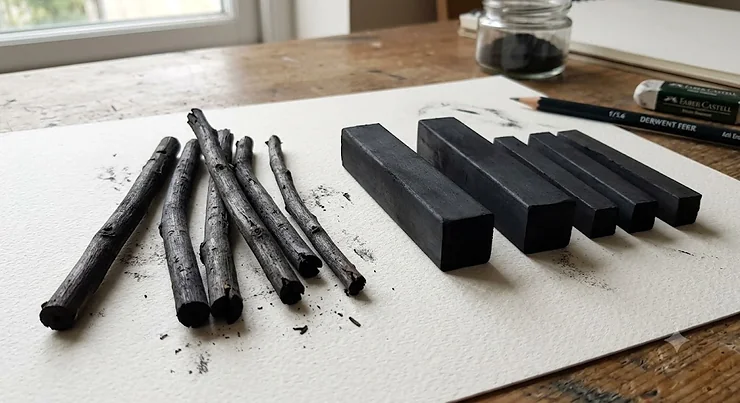
Willow charcoal vs compressed charcoal is the first fork in the road for anyone picking up a drawing stick for the first time, and honestly, it trips up more people than it should. Willow charcoal is a soft, crumbly stick of pure carbonised wood that erases almost completely, while compressed charcoal is powdered charcoal bound with gum or wax into a denser, darker, harder-wearing stick. That’s the whole distinction in one breath, but the practical fallout — how each one behaves on paper, how forgiving it is of mistakes, how it plays with an eraser — is where things get interesting.
If you’ve ever stood in an art shop aisle in Bristol or Leeds, staring at a rack of identical-looking black sticks with wildly different price tags, you’ll know the confusion is real. As Art UK’s own glossary of art terms explains, charcoal has been used for sketching since antiquity precisely because it’s so quick and forgiving to work with — a quality that still defines why artists reach for it today. Some sticks are willow, some are compressed, some are pencils wearing a charcoal disguise, and the labelling rarely explains why any of it matters. This guide sorts through seven genuine products available on amazon.co.uk, explains what separates willow from compressed in practice, and gives you a decision framework so you’re not just guessing at the till.
We’ll cover which charcoal suits beginners, what actually rubs off the page and what doesn’t, how tonal drawing works with each type, and when a fixative spray earns its place in your kit. Expect honest, spec-grounded commentary throughout — no invented reviews, just real products and real reasoning.
Quick Comparison Table
| Product | Charcoal Format | Best For |
|---|---|---|
| Daler-Rowney Simply Charcoal Sticks | Willow (assorted) | Absolute beginners on a budget |
| Winsor & Newton Artists’ Willow Charcoal | Willow (assorted) | Reliable mid-range all-rounder |
| Coates Willow Charcoal | Willow (extra thick) | Large-scale gestural work |
| Derwent Charcoal Drawing Pencils | Charcoal pencil | Detail work and tidy hands |
| Derwent Charcoal Drawing Blocks | Compressed | Bold, permanent tonal contrast |
| Daler-Rowney Charcoal Chunki | Willow (chunky stick) | Fast underdrawing and blocking-in |
| Winsor & Newton Artists Fixative Spray | Fixative (accessory) | Protecting any finished charcoal piece |
Looking at the spread above, the willow options cluster toward the softer, more forgiving end of the scale, while the Derwent Charcoal Drawing Blocks sit apart as the only true compressed stick in the line-up — the one to reach for when you need ink-black darks that won’t budge. Beginners are generally steered toward the Daler-Rowney Simply Charcoal Sticks or the Derwent Charcoal Drawing Pencils, since both keep mess and unpredictability to a minimum while you learn how charcoal actually behaves.
💬 Found a pick you like already? Tap through and compare current prices before they change!
Top 7 Willow Charcoal and Compressed Charcoal Picks: Expert Analysis
1. Daler-Rowney Simply Charcoal Sticks — budget-friendly willow set for first-timers
This twelve-piece cardboard box of assorted willow sticks is where a lot of UK art students genuinely start, and that standout feature is worth expanding on: nothing here is precious, so you can experiment without fear of “wasting” an expensive stick. Willow charcoal like this contains no binder at all, which means it’s soft, powdery, and lays down tone with almost no pressure — brilliant for loose gesture drawing but a nightmare if you press too hard and expect crisp lines. Based on the assortment of thicknesses included, this set is built for exactly one purpose: teaching your hand how much pressure charcoal actually needs, which is usually far less than a graphite pencil.
Reviewers consistently describe this as a genuinely soft, “sets a base layer” kind of charcoal — good for establishing shapes and values before finishing with something firmer. That aligns with how Daler-Rowney positions its Simply range, as an accessible entry point rather than a professional-grade product. What most buyers overlook is that a soft willow set like this isn’t meant to be your only charcoal; it’s the loose, forgiving first pass that a compressed stick or pencil later refines.
Pros:
- ✅ Very low cost of entry for total beginners
- ✅ Assorted thicknesses cover fine lines to broad tone
- ✅ Extremely forgiving — mistakes lift off with ease
Cons:
- ❌ Crumbles and breaks more than premium willow
- ❌ Too soft and dusty for detailed final work
Priced in the budget bracket — typically under £10 at the time of research — this is solid value for anyone testing the water before committing to pricier charcoal.
2. Winsor & Newton Artists’ Willow Charcoal — best mid-range all-rounder
Winsor & Newton’s assorted box of twelve willow sticks earns its standout tag through consistency: the sticks are hand-selected for uniform thickness and freedom from knots, which sounds minor until you’ve fought through a stick that suddenly turns scratchy mid-drawing. Willow naturally varies from twig to twig, so paying a little more for graded, evenly baked pieces genuinely reduces the frustration of unpredictable marks partway through a sketch.
On paper, this puts Winsor & Newton Artists’ Willow Charcoal a notch above supermarket-tier willow without tipping into premium heritage pricing — it’s the sensible middle option. Aggregated feedback on this range points to smooth, even coverage and a good range from pale grey through to a satisfying near-black, which is unusual for uncompressed willow. What most buyers overlook is that “uniform” willow charcoal isn’t a marketing fluff phrase — it directly reduces wasted attempts, because you’re not discovering a bad knot three hours into a portrait.
Pros:
- ✅ Carefully graded sticks with fewer knots or flaws
- ✅ Good tonal range from pale grey to deep black
- ✅ Trusted, widely stocked British brand
Cons:
- ❌ Costs noticeably more than basic willow sets
- ❌ Still fragile compared with compressed sticks
Expect a price somewhere in the low-to-mid £10-£20 range, which represents fair value given the consistency gains over unsorted willow.
3. Coates Willow Charcoal — best for large-scale, gestural drawing
Coates has cultivated willow on the Somerset Levels since 1819, and that heritage isn’t just marketing flavour text — the extra-thick 12-14mm sticks in this box of four are genuinely built for covering large sheets of paper fast. The standout feature here is sheer size: these are chunky enough to lay in broad tonal blocks with the side of the stick, which is exactly what life-drawing students and mural sketchers need when working on A2 paper or bigger.
Because the willow is processed the traditional way — boiled, graded by diameter, then kiln-fired in sealed tins — the resulting stick has a notably velvety, consistent texture rather than the gritty unpredictability of cheaper willow. Here’s what to weigh: this format rewards confident, sweeping strokes far more than fine detail, so it suits gesture drawing and underpainting layouts rather than tight illustration work. Aggregated reviewer sentiment across willow-charcoal comparisons singles out Coates specifically for producing a deep black hue that’s unusual for uncompressed willow, alongside a smoothness that holds up across different stick batches.
Pros:
- ✅ Large diameter ideal for big, fast tonal blocking
- ✅ Traditionally processed for consistent texture
- ✅ Deep black achievable despite being uncompressed
Cons:
- ❌ Overkill for small sketchbook work
- ❌ Premium price for only four sticks
At around £8-£12 for four extra-thick sticks, the value case rests entirely on scale — buy this if you draw big, skip it if you mostly work in an A5 sketchbook.
4. Derwent Charcoal Drawing Pencils — best for beginners who hate mess
This set of six wood-cased charcoal pencils with a sharpener swaps the “handful of soot” experience for something closer to drawing with a normal pencil, and that’s precisely the standout feature. Because the charcoal core is encased in wood, you get the tonal richness of charcoal with dramatically less transfer onto your hands, your paper edges, or your carpet — a genuinely underrated win for anyone drawing at a kitchen table.
The set includes light, medium, dark and a tinted white charcoal pencil, so on paper this gives you a surprisingly complete tonal toolkit in one tidy tin. Based on the format, these behave more like compressed charcoal than pure willow — they hold a point, sharpen predictably, and resist smudging better than a bare stick, though they still blend beautifully with a finger or blending stump when you want softer transitions. What most buyers overlook is that charcoal pencils are the natural stepping stone between graphite habits and full charcoal-stick confidence, since the familiar pencil grip removes one variable while you learn tonal control.
Pros:
- ✅ Wood casing keeps hands and paper cleaner
- ✅ Includes light, medium, dark and white pencils
- ✅ Sharpens to a fine point for detail work
Cons:
- ❌ Less expressive than a bare stick for broad strokes
- ❌ Sharpening wastes some charcoal as shavings
Set pricing generally sits in the £10-£15 range with the sharpener included, which is reasonable given you’re effectively buying four tonal values in one box.
5. Derwent Charcoal Drawing Blocks — best for permanent, ink-dark contrast
These are genuine compressed charcoal — solid square blocks of reformed wood charcoal held together with a binder — and the standout feature is how dramatically darker and more stubborn they are compared with every willow stick on this list. The set of six spans light, medium and dark grades, letting you dial in exactly how much binder-driven density you want per mark.
Because compressed charcoal is powdered charcoal pressed with gum or wax, it resists smudging far better than willow and holds a sharp edge on the block’s corner for finer lines, while the flat face still lays down broad, confident strokes. Here’s what to weigh: that same binder which gives you deep, water-soluble, resistant blacks also makes compressed charcoal considerably harder to lift with an eraser, so mistakes are more of a commitment than they are with willow. Reviewers of Derwent’s charcoal ranges regularly note the blocks hold their edge well and don’t crumble the way looser willow sticks do, which matters if you’re working on detailed tonal studies rather than loose gesture sketches.
Pros:
- ✅ Genuinely permanent, ink-black darks
- ✅ Resists smudging far better than willow
- ✅ Three grades cover a full tonal spread
Cons:
- ❌ Much harder to erase than willow charcoal
- ❌ Can look flat without careful blending technique
Typically priced in the £10-£18 range for six blocks, this earns its keep as the “finishing” charcoal that locks in the darks a willow underdrawing can’t hold.
6. Daler-Rowney Charcoal Chunki — best for fast underdrawing and blocking-in
This single, extra-large willow stick is built entirely around one job: laying down big shapes fast. The standout feature is right there in the name — it’s chunky, roughly the width of a thumb, and lets you rough in a whole composition’s tonal structure in the time it’d take a thin stick to shade one small patch.
Because it’s uncompressed willow, this format is deliberately unsuited to detail; you use the flat side to mass in your darkest shadow shapes during a charcoal underdrawing before committing to anything with a pencil or compressed stick. On paper, that makes it less a “drawing tool” and more a compositional planning tool — the block of your entire tonal map before you refine anything. Reviewer feedback on Daler-Rowney’s chunky willow format consistently flags it as ideal for exactly this blocking-in stage, with several noting it wears down quickly precisely because it’s meant to cover a lot of ground fast.
Pros:
- ✅ Covers large areas in a fraction of the time
- ✅ Ideal first step in a charcoal underdrawing
- ✅ Cheap enough to use up without hesitation
Cons:
- ❌ Single stick wears down quickly with heavy use
- ❌ Useless for any fine linework or detail
At under £5 for a single stick at the time of research, this is one of the cheapest genuinely useful tools on the list — buy two or three if you plan on blocking in regularly.
7. Winsor & Newton Artists Fixative Transparent Spray — best for protecting any finished charcoal piece
Every charcoal drawing, willow or compressed, eventually needs fixing, and this 400ml aerosol is the standout accessory for doing it without yellowing or dulling your darks. It’s a colourless spray formulated specifically for charcoal, pastel, pencil and chalk, designed to bind loose particles to the paper so a finished piece survives being handled, framed, or posted to a client.
Based on the spec sheet, this is a workable fixative, meaning light coats let you keep drawing over the top without fully sealing the surface, while several thin layers at the end lock everything down for good — a distinction that matters because over-spraying in one heavy coat can visibly darken or “wet” the tones underneath. Aggregated reviewer sentiment is broadly positive on effectiveness and drying speed, though opinions are genuinely split on smudge-resistance and the strength of the propellant smell, so it’s worth using this outdoors or by an open window regardless of which reviews you believe.
Pros:
- ✅ Purpose-built for charcoal, pastel and chalk
- ✅ Workable formula allows layering while drawing
- ✅ Dries quickly without visible yellowing
Cons:
- ❌ Mixed reviewer opinions on total smudge-proofing
- ❌ Strong aerosol smell needs good ventilation
Priced around £10-£16 depending on can size, this is a small spend that protects hours of drawing time — arguably the best value item on this entire list.
Comparing the Top 7 in Detail
| Product | Format | Typical Grade Range | Price Range | Best For |
|---|---|---|---|---|
| Daler-Rowney Simply Charcoal Sticks | Willow | Assorted thin-thick | Under £10 | First-time buyers |
| Winsor & Newton Artists’ Willow Charcoal | Willow | Assorted, graded | £10-£20 | Consistent all-round use |
| Coates Willow Charcoal | Willow | Extra thick 12-14mm | £8-£12 | Large-scale gesture work |
| Derwent Charcoal Drawing Pencils | Pencil | Light/medium/dark/white | £10-£15 | Clean, detailed drawing |
| Derwent Charcoal Drawing Blocks | Compressed | Light/medium/dark | £10-£18 | Permanent, dark contrast |
| Daler-Rowney Charcoal Chunki | Willow | Single extra-large stick | Under £5 | Fast underdrawing |
| Winsor & Newton Fixative Spray | Fixative | 150ml / 400ml | £10-£16 | Protecting finished work |
Reading across this table, a clear pattern emerges: the willow products dominate the early, exploratory stages of a drawing, while the Derwent Charcoal Drawing Blocks and the Winsor & Newton Artists Fixative Transparent Spray belong at the finishing end of the process. If your budget stretches to only two purchases, pairing the Daler-Rowney Charcoal Chunki for blocking-in with the Derwent Charcoal Drawing Blocks for final darks gives you the widest tonal range for the least outlay.
Practical Usage Guide: Setting Up Your First Charcoal Kit
Getting started with charcoal doesn’t require a studio’s worth of gear, but a handful of setup decisions save you weeks of frustration. First, buy paper with some texture — smooth printer paper simply won’t hold charcoal particles, so a cartridge or dedicated charcoal pad in the 150-220gsm range is worth the small extra cost. Second, get a kneaded eraser rather than a standard rubber one; kneaded erasers lift charcoal by absorbing it rather than smearing it, which matters enormously with willow.
In your first thirty days, the most common mistake is pressing too hard with willow charcoal, expecting graphite-pencil behaviour and getting a muddy, over-dark patch instead. Hold the stick loosely, further back than you would a pencil, and let the weight of your hand do the work rather than your grip. A second common early error is skipping fixative until the very end of a piece and then discovering the drawing has smudged into an unrecognisable grey fog during transport — spray light, workable coats as you go, not just at the finish line.
✨ Ready to build your kit? Grab the essentials above before starting your first sketch!
Charcoal Underdrawing Technique: A Step-by-Step Walkthrough
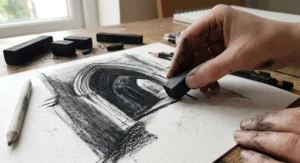
An underdrawing is the loose, tonal skeleton beneath a more finished piece, and charcoal happens to be the ideal medium for it because it’s fast, forgiving, and disappears easily beneath later layers of paint or refined mark-making. Start with a chunky willow stick, like the Daler-Rowney Charcoal Chunki, held on its side rather than its point, and rough in only the three or four biggest shapes and their darkest shadow masses — resist the urge to add any detail at this stage.
Once your major shapes sit correctly, knock back the excess dust with a soft cloth or your kneaded eraser until only a faint ghost of the composition remains; this stops later layers from picking up unwanted grey. From here, you can paint directly over willow underdrawing without much interference, since it contains no binder and lifts away easily, whereas a compressed-charcoal underdrawing would bleed and discolour water-based paint layers sitting on top. That single distinction — willow lifts, compressed stains — is the entire reason professional painters overwhelmingly choose willow for underdrawing and save compressed charcoal for standalone finished drawings.
 Real-World Scenarios: Which Charcoal Suits Your Practice
If you’re a college student sketching in lecture halls between classes, a set like the Derwent Charcoal Drawing Pencils makes far more sense than loose sticks — no dust in your bag, and the wood casing survives being dropped in with textbooks. If you’re an evening-class life-drawing regular working on A2 newsprint for twenty-minute poses, the Coates Willow Charcoal or the Daler-Rowney Charcoal Chunki will keep pace with fast, gestural mark-making far better than a precise pencil ever could.
If you’re further along and working toward finished portrait studies destined for a frame or a gift, you’ll likely want the full stack: willow for underdrawing, the Derwent Charcoal Drawing Blocks for locking in permanent darks, and the Winsor & Newton Artists Fixative Transparent Spray to protect the finished piece before it ever leaves your studio. Budget-conscious hobbyists drawing purely for relaxation can happily stop at the Daler-Rowney Simply Charcoal Sticks and a basic fixative — there’s no shame in a modest kit doing exactly the job you need.
Willow Charcoal vs Compressed Charcoal: The Core Differences
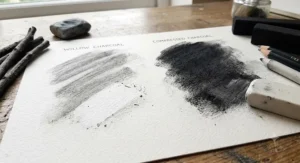
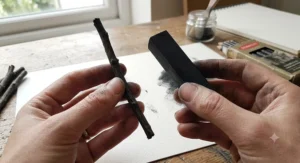
At the heart of willow charcoal vs compressed charcoal sits one manufacturing decision: willow is simply carbonised wood with no binder added, while compressed charcoal is powdered charcoal mixed with gum or wax and pressed into shape. That single difference cascades into everything else — willow is lighter in tone, softer, and erases almost completely, while compressed charcoal is darker, harder-wearing, and considerably more stubborn once it’s on the page.
Charcoal types for drawing generally break down into three practical categories: willow and vine (interchangeable in behaviour, made from willow twigs or grapevine respectively), compressed sticks and blocks, and charcoal pencils, which wrap a compressed charcoal core in wood for cleaner handling. What most buyers overlook is that these categories aren’t rivals so much as stages of one process — willow for loose exploration, compressed for committed darks, pencils for anywhere in between where control matters more than expressive breadth. According to the art history record on Wikipedia, artists have used carbonised wood as a drawing medium for tens of thousands of years, with compressed charcoal only emerging as a refined, twentieth-century development of that ancient willow tradition.
Which Charcoal Is Best for Beginners
For genuine beginners, softer willow charcoal in an assorted pack — the Daler-Rowney Simply Charcoal Sticks or the Winsor & Newton Artists’ Willow Charcoal — teaches pressure control faster than any other format, because heavy-handedness is instantly visible and instantly correctable with an eraser. Charcoal pencils, like the Derwent Charcoal Drawing Pencils, suit a different kind of beginner: someone coming from graphite pencil work who wants a familiar grip while they learn how charcoal tone differs from graphite line.
What compressed charcoal does not offer a beginner is forgiveness. Its binder means mistakes bed into the paper fibres and resist a kneaded eraser, so most tutors — and most retailers’ own beginner sets — steer new students toward willow or pencils first and introduce compressed sticks only once basic tonal control is established. Tate’s own glossary of art terminology backs this progression up, noting that charcoal’s characteristically loose, diffuse mark is what makes it suited to sketching and under-drawing rather than precise, controlled work — precisely the quality that makes willow so beginner-friendly.
Erasable vs Permanent Charcoal: What Actually Comes Off the Page
This is the practical crux of erasable vs permanent charcoal, and it’s worth being blunt about it: willow and vine charcoal, having no binder, erase close to completely with a kneaded eraser, which is why they’re the standard choice for sketching out a composition before committing to anything final. Compressed charcoal, precisely because of its gum or wax binder, adheres to the paper fibres in a way that resists erasing — you can lighten it, but rarely remove it entirely, and heavy-handed attempts tend to smear rather than lift.
Charcoal pencils sit in between, behaving more like compressed charcoal in permanence but offering finer control over exactly where that permanence lands. Here’s what to weigh: if your process depends on making changes as you go, build your early stages in willow and only bring in compressed charcoal once you’re confident about where your final darks belong. No amount of fixative reverses this dynamic either — fixative locks a drawing in place, but it doesn’t make a compressed-charcoal mistake any easier to remove than it already was.
Tonal Drawing with Charcoal: Building a Value Range
Tonal drawing with charcoal is fundamentally about establishing a value range — your lightest highlight, your darkest shadow, and everything graduating between them — before you worry about line or detail at all. Willow charcoal excels at the light-to-mid end of that range, since its powdery application lends itself to soft, blendable greys that are difficult to achieve with any binder-based medium. Compressed charcoal, by contrast, is what gets you a genuinely deep, velvety black at the shadow end, something willow alone often can’t quite reach no matter how many layers you stack.
A common, effective approach is to establish your full tonal map in willow first, then selectively deepen only the darkest shadow shapes using a compressed block like the Derwent Charcoal Drawing Blocks, keeping the softer mid-tones untouched. What most buyers overlook is that combining both formats in a single drawing isn’t a compromise — it’s standard academic practice, precisely because no single charcoal format covers the entire tonal spectrum equally well on its own.
Charcoal Fixative Spray: When, Why and How to Use It
A charcoal fixative spray works by depositing a fine resin mist over your drawing, binding loose charcoal particles to the paper fibres so the piece stops shedding dust every time it’s touched or moved. The Winsor & Newton Artists Fixative Transparent Spray is a workable formula, meaning you can spray light coats between drawing sessions without sealing the surface completely, then apply a final, slightly heavier coat once the piece is genuinely finished.
Technique matters more than most beginners expect: hold the can roughly 30cm from the paper, spray in slow, even side-to-side passes rather than one static burst, and always work in a well-ventilated space, since these aerosols contain flammable propellants. On paper, over-spraying in one heavy coat is the single most common mistake — it can visibly darken tones and create a slightly glossy sheen that flattens the matte texture charcoal is prized for in the first place.
Common Mistakes When Buying Charcoal
The single most frequent buying mistake is grabbing one box labelled simply “charcoal” without checking whether it’s willow, compressed, or pencils, then being confused when it behaves nothing like whatever was expected. A second common error is buying only compressed charcoal as a first purchase, since it looks more “serious” and professional, then struggling with a medium that doesn’t forgive mistakes the way willow does.
Buyers also routinely skip fixative entirely, assuming it’s an optional extra, only to discover weeks later that a finished piece has smudged into an unrecognisable grey fog in a folder or portfolio sleeve. Finally, plenty of shoppers overlook thickness and diameter entirely — a set of thin willow sticks is a poor match for anyone planning large-scale, gestural life drawing, where a thicker option like the Coates Willow Charcoal does a fundamentally different job.
Long-Term Cost & Maintenance
Charcoal is, refreshingly, one of the cheapest art mediums to maintain long-term: a modest kit combining budget willow, one compressed set, and a fixative spray typically costs less than a single tube of premium oil paint, and sticks last for dozens of drawings depending on your scale of working. The main ongoing cost is fixative, which gets used up steadily since every finished piece needs at least a couple of light coats, so budgeting for a replacement can every few months is realistic for a regular sketcher.
Storage matters more than most people expect for total cost of ownership: charcoal sticks kept loose in a bag will snap and crumble within weeks, while the same sticks kept in a simple tin or their original box last considerably longer. Charcoal pencils like the Derwent Charcoal Drawing Pencils carry a slightly higher per-use cost because sharpening wastes some material as shavings, but that’s offset by dramatically less breakage and mess compared with loose sticks.
Charcoal vs Traditional Alternatives
| Medium | Erasability | Tonal Depth | Learning Curve |
|---|---|---|---|
| Willow charcoal | Excellent | Moderate | Gentle |
| Compressed charcoal | Poor | Excellent | Moderate |
| Graphite pencil | Excellent | Limited | Gentle |
| Digital drawing tablet | Unlimited (undo) | Excellent | Steep (software) |
Set against graphite pencil and digital tools, charcoal’s real advantage is speed and expressiveness rather than precision — you can rough in a full tonal composition in minutes with willow, something graphite achieves far more slowly through layered hatching. Digital tablets offer unlimited undo and no fixative faff whatsoever, but plenty of artists find the physical resistance and unpredictability of real charcoal — willow’s crumble, compressed charcoal’s stubborn grip — teaches tonal judgement in a way a screen simply doesn’t replicate.
Frequently Asked Questions
❓ Is willow charcoal better than compressed charcoal for beginners?
❓ Can you mix willow and compressed charcoal in one drawing?
❓ Does charcoal need fixative spray to survive?
❓ Why does compressed charcoal not erase like willow?
❓ What thickness of charcoal is best for large drawings?
Conclusion
Willow charcoal vs compressed charcoal isn’t really a rivalry — it’s two tools built for two different stages of the same drawing. Willow gives you a soft, erasable, forgiving medium ideal for underdrawing and early tonal exploration, while compressed charcoal delivers the permanent, ink-dark contrast that finishes a piece properly. Beginners are almost always best served starting with willow or a charcoal pencil, building confidence with erasable mistakes before compressed sticks and fixative spray enter the kit.
Across the seven products covered here — from the budget-friendly Daler-Rowney Simply Charcoal Sticks through to the heritage Coates Willow Charcoal and the permanence of the Derwent Charcoal Drawing Blocks — there’s a sensible starting point whatever your budget or ambition. The Royal Academy of Arts, whose own drawing courses still teach charcoal as a foundational academic medium, treats it as the single best tool for learning to think in tonal masses before detail, and charcoal’s role in academic drawing training remains central to how the RA Schools structure their observational courses to this day.
Whichever combination you choose, remember the one rule that governs all of it: build loose and erasable first, commit to dark and permanent last, and always give a finished piece a couple of light coats of fixative before it goes anywhere near a folder.
✨ Don’t Miss These Exclusive Deals!
🔍 Take your charcoal drawing practice to the next level with the products covered above. Click through to check current pricing and availability on amazon.co.uk, and build a kit that will genuinely last you years of sketching.
Recommended for You
- Compressed Charcoal Sticks for Drawing: 7 Best Picks (2026)
- Best Willow Charcoal 2026: 7 Sticks UK Artists Actually Love
- Graphite Sticks vs Graphite Pencils: 7 UK Picks for 2026
Disclaimer: This article contains affiliate links. As an Amazon Associate, I earn from qualifying purchases. If you purchase products through these links, we may earn a small commission at no additional cost to you.
✨ Found this helpful? Share it with your friends! 💬🤗
