In This Article
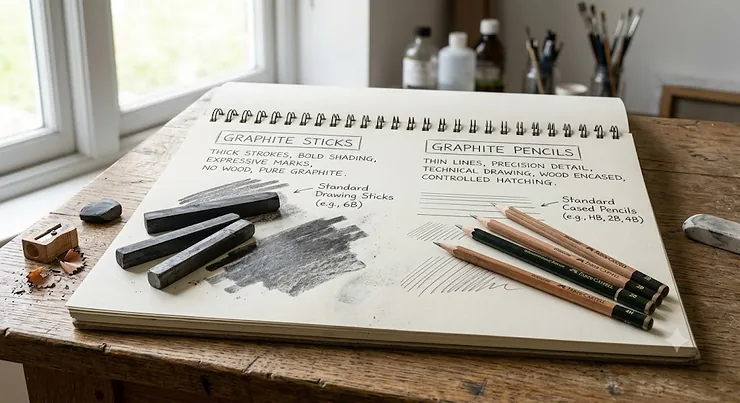
Stand in front of a half-finished drawing at two in the morning and you’ll eventually ask yourself the same question every graphite artist asks: should this next mark come from a sharpened point or a chunky, wrapper-free stick the size of your thumb? That’s the real tension behind graphite sticks vs graphite pencils, and it’s less about which tool is “better” and more about which one matches the mark you’re trying to make. A graphite pencil is a slim core of compressed graphite and clay bonded inside a wooden (or plastic) casing, built for control and fine line work. A graphite stick — sometimes sold “woodless,” sometimes as a solid block — is pure or near-pure graphite you can lay flat against the page to cover ground fast, then flip onto its edge for detail.
Both tools sit on the same graphite-to-clay spectrum, but the format changes everything about how they behave in your hand. Pencils reward patience and precision; sticks reward confidence and speed. According to Tate’s glossary on graphite, the material itself is a soft, crystalline form of carbon that’s been used for drawing since sticks of it were first encased for grip in the 1500s — which is a helpful reminder that “stick” actually came first, and the pencil was really just a way of making messy graphite more polite.
This guide walks through when to use graphite sticks, what woodless graphite genuinely offers over the traditional wood-cased format, and where graphite powder for blending fits into the picture. We’ll compare seven real products currently sold on amazon.co.uk, dig into how each renders tone in practice, and give you a decision framework so you’re not guessing at the till. Expect honest analysis grounded in real specs and aggregated review sentiment throughout — not manufactured hands-on claims.
Quick Comparison: Graphite Sticks vs Graphite Pencils
| Feature | Graphite Sticks (Woodless/Solid) | Graphite Pencils (Wood-Cased) | Best For |
|---|---|---|---|
| Coverage speed | Very fast — lay flat for broad tone | Slow — point only | Sticks: large works; Pencils: detail |
| Precision | Low to moderate (edge use) | High (sharpened point) | Pencils for portraits, sticks for landscapes |
| Blending | Naturally smudgy, blends easily | Needs a stump or finger to soften | Sticks for atmospheric tone |
| Portability/mess | Bulkier, dustier, hands get dirty | Clean, pocket-friendly | Pencils for travel sketching |
| Typical price range | Around £3-£20 per stick or small set | Around £2-£30 depending on set size | Both — budget flexible |
Sticks and pencils aren’t really competing products so much as different ends of a workflow. If you look at the table above, the pattern is obvious: sticks win on speed and tonal breadth, pencils win on control and cleanliness. Most serious graphite artists in the UK don’t pick one — they use a stick to block in value fast, then bring in a pencil for the final 10% of detail that makes a drawing read as “finished.” Where this gets interesting is woodless pencils, which sit awkwardly (and usefully) in between, offering pencil-shaped handling with stick-level graphite volume.
💬 Found this comparison useful? A quick click on a product below helps you (and other readers) find the right graphite fast.
Top 7 Graphite Sticks and Pencils: Expert Analysis
We’ve picked seven real, currently available products spanning budget, mid-range and premium price points, and covering sticks, wood-cased pencils, woodless hybrids and powder. Coverage and analysis are based on published specifications and aggregated UK/US customer review sentiment — always disclosed as such rather than presented as hands-on testing.
1. Derwent Natural Graphite Stick — best for expressive large-format work
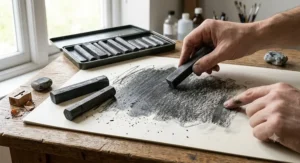
The Derwent Natural Graphite Stick is exactly what it sounds like: a solid block of graphite with no wood casing at all, sold individually in soft, medium and hard grades. Each stick measures around 8mm square and 75mm long, small enough to control but chunky enough that you can lay the whole flat side against the paper and cover a sheet of A2 in a fraction of the time a pencil would take. Because the graphite is naturally water-soluble, you can drag a wet brush across a section and pull it into a wash, which changes the entire character of a drawing from linear to painterly in seconds.
Based on the spec comparison with wood-cased alternatives, this format exists for one reason: mark-making freedom. Reviewers consistently note that the stick blends easily with a finger or paper stump, and that rotating it produces everything from a thin, controlled line to a broad tonal sweep in a single stroke. It’s aimed squarely at artists working loose, gestural studies, life drawing, or big atmospheric landscapes rather than tight technical illustration — what most buyers overlook is that the “hard” grade is still considerably softer and blacker than a hard wood-cased pencil, so don’t expect fine-line precision from it.
Pros:
- ✅ Genuinely fast for covering large areas of tone
- ✅ Water-soluble for wash and mixed-media effects
- ✅ Sold in soft, medium and hard so you can match your intensity
Cons:
- ❌ No wood casing means it marks hands and breaks if dropped
- ❌ Limited precision compared with a sharpened pencil point
Prices for a single Derwent Natural Graphite Stick typically sit under £10, with sets of three grades landing in the mid-teens — check current price, as packaging and grade counts vary. For the sheer square-inch-per-minute coverage it offers, it’s excellent value if large-format work is genuinely your focus.
2. Faber-Castell Castell 9000 Graphite Pencils — precision benchmark for fine detail
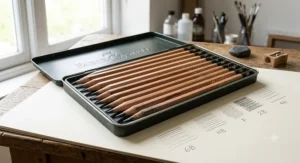
Launched in 1905 and still the reference point many art tutors reach for, the Faber-Castell Castell 9000 Graphite Pencils use a “Secural” bonding process that fuses the lead to the surrounding wood shaft, and it’s available across 16 degrees of hardness from a crisp 6H down to a velvety 8B. That range matters more than it might sound: it means you can buy exactly the hardness a technique calls for rather than fighting a mid-range pencil into doing two jobs.
What the spec sheet won’t tell you, but reviewers consistently note, is how resistant these leads are to snapping under a sharpener — several long-term UK reviewers report using the same set for a decade of professional illustration work without complaint about breakage, which is a genuinely uncommon claim in this price bracket. Practically, that break-resistance means fewer wasted pencils and less frustration mid-sketch, which matters if you’re working to a deadline or teaching a class where every broken tip is a distraction. This is the pencil to reach for when a drawing needs controlled, graduated tone rather than expressive looseness — portraiture, botanical illustration, technical rendering.
Pros:
- ✅ 16 hardness grades for precise tonal control
- ✅ Break-resistant bonded lead, praised in long-term reviews
- ✅ Smooth, non-scratchy laydown even at hard grades
Cons:
- ❌ Premium pricing compared with student-grade sets
- ❌ Slower for filling large areas than a stick or woodless format
Individual pencils are typically under £3, while a boxed set of 12 usually falls in the £15-£25 range depending on retailer. Given the longevity reviewers describe, the cost-per-drawing works out low over time.
3. Staedtler Mars Lumograph Graphite Pencils — best all-rounder value pick
The Staedtler Mars Lumograph Graphite Pencils range covers an enormous 24 degrees of hardness (12B through to 10H in the full range, with 12-pencil sets typically spanning 6H-8B), built around a “super-bonded” lead formula designed to resist breakage during both sharpening and drawing. The hexagonal barrel and lacquered finish are small details, but they add up to a pencil that sits comfortably in the hand for long sketching sessions without rolling off the desk.
Reviewers consistently note that the Lumograph blends beautifully and erases cleanly, with several UK buyers specifically calling out the value-for-money relative to premium competitors — one recurring theme in aggregated reviews is that people who’ve used both this and pricier German pencils struggle to justify the extra cost for casual or student use. Here’s what to weigh: if you want one set that competently handles everything from light construction lines to deep shadow blocking without buying multiple brands, this is probably the safest single purchase on this list, even if it doesn’t quite match the Castell 9000 for professional break-resistance under heavy use.
Pros:
- ✅ 24-degree hardness range covers nearly every technique
- ✅ Strong value-for-money sentiment in UK reviews
- ✅ Break-resistant lead suited to classroom and studio use
Cons:
- ❌ Slightly less refined laydown than premium artist-grade lines
- ❌ Metal tin quality reported as flimsy by some reviewers
A 12-pencil metal tin generally sits in the £10-£18 range, making this one of the more accessible full-range sets on the market — prices may vary, so check current pricing before buying.
4. General’s Woodless Graphite Pencils — best budget woodless hybrid
General’s Woodless Graphite Pencils are pure graphite cores in a pencil-shaped, lacquer-coated format — no wood, but still shaped and sized to hold like a normal pencil rather than a chunky stick. Sets typically run HB through 8B, and because the entire pencil is usable material rather than a thin core surrounded by wood, you get considerably more actual graphite per pencil for a similar footprint.
Based on the spec comparison with wood-cased options, the appeal here is dual-purpose handling: you can sharpen the tip for a reasonably fine line, or turn the pencil on its side for broad shading strokes, all from one tool. That versatility is what most buyers overlook when they first encounter woodless pencils — they assume it’s simply “a fatter pencil,” but the real benefit is not having to switch tools between line work and tonal blocking. Reviewers describe them as smooth-laying and economical over time, since there’s no wasted wood to sharpen away. This is a strong entry point if you’re curious about woodless graphite but don’t want to commit to premium pricing yet.
Pros:
- ✅ Dual-use: sharpen for line, use flat side for tone
- ✅ More usable graphite per pencil than wood-cased equivalents
- ✅ Genuinely budget-friendly for the format
Cons:
- ❌ Lacquer coating can chip with rough handling
- ❌ Fewer hardness grades than premium woodless competitors
A set of four to five pencils with a sharpener typically sits under £15, which is competitive for a woodless starter set.
5. Koh-I-Noor Progresso Woodless Graphite Pencils — best premium woodless option
Koh-I-Noor Progresso Woodless Graphite Pencils use Hardtmuth graphite — the same lineage behind one of the oldest pencil manufacturers in Europe — encased in a protective lacquer coating rather than wood. The range spans HB through 9B, with an additional water-soluble “aquarelle” variant in some sets, meaning you can move between dry shading and washed effects without switching brands.
What the spec sheet doesn’t capture is how solid these feel in the hand compared with cheaper woodless alternatives; reviewers describe a “weighty” feel and clean sharpening with a standard sharpener, which isn’t guaranteed with woodless formats since some brands’ lacquer coatings gum up blades. Honest analytical take: if you’ve already tried a budget woodless pencil and liked the format but found the lead inconsistent, this is the natural upgrade — the Hardtmuth graphite lineage has a long-standing reputation among illustrators for smooth, predictable laydown across the full tonal range.
Pros:
- ✅ Full HB-9B range plus a water-soluble aquarelle option
- ✅ Reputed for smooth, consistent laydown across grades
- ✅ Sharpens cleanly with a standard sharpener, unlike some woodless rivals
Cons:
- ❌ Pricier than General’s or other entry-level woodless pencils
- ❌ Still fragile if dropped, like most woodless formats
Individual pencils typically run a few pounds each, with a 12-pack (single grade) in the mid-teens to low-£20s range — always check current price, as Koh-I-Noor’s UK availability fluctuates by retailer.
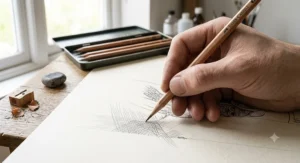
6. Cretacolor Monolith Woodless Graphite Pencil — thickest lead for bold expressive marks
The Cretacolor Monolith Woodless Graphite Pencil takes the woodless concept further with an unusually thick, solid graphite core wrapped in only a thin lacquer layer, available across five degrees of hardness from HB to 9B. Because so little of the diameter is given over to casing, you get an outsized graphite reserve compared with a standard pencil — closer in generosity to a stick, but still shaped for pencil-grip control.
Reviewers consistently highlight the high pigment density and light-fastness of the Monolith range, and note it’s particularly suited to expressive shading across extended areas — exactly the kind of large-area tonal work where a thin wood-cased pencil would wear down in minutes. On paper, this means the Monolith sits closest to a genuine middle ground between a stick and a pencil: you can rotate it to use a wide edge for sweeping tone, then work down to a point for tighter passages, all without changing tools. What most buyers overlook is that the thick lead also makes it more prone to chipping if sharpened aggressively, so a gentle, rotating sharpening motion gets better results than forcing it through a standard sharpener.
Pros:
- ✅ Unusually thick lead for a woodless format, closer to a stick’s coverage
- ✅ High pigment density and good light-fastness
- ✅ Smooth transition between broad tone and finer line
Cons:
- ❌ Only five hardness grades, narrower than some rivals
- ❌ Needs a careful, gentle sharpening technique
Single pencils generally sit around £3-£6, with prices varying by hardness and retailer — a genuinely accessible way to try a premium woodless format without a big outlay.
7. Cretacolor Graphite Powder (150g) — best for blending and tonal washes
Cretacolor Graphite Powder is pure graphite in loose powder form, sold in a resealable 150g plastic tub, designed to be applied dry with a brush, cloth or finger, or mixed with water and painted on like a wash. It’s the odd one out on this list — not a stick, not a pencil — but it belongs here because graphite powder for blending is the tool most artists reach for once sticks and pencils alone can’t achieve the smooth, gradient-heavy tone a piece demands.
Reviewers consistently mention the versatility of this specific product, citing uses ranging from soft background shading in fine art pieces to metallic-effect priming on 3D printed props, and multiple UK buyers specifically call out its effectiveness for covering large areas smoothly compared with sanding down a pencil to make homemade powder. Here’s what to weigh: powder gives you total control over tonal gradation because you’re applying it with a brush rather than a fixed-width tool, but it’s genuinely messy — expect graphite dust on your hands, desk and possibly your trousers if you’re not careful with application distance from your artwork.
Pros:
- ✅ Unmatched for smooth, large-area tonal gradients
- ✅ Versatile — usable wet or dry, on paper or mixed media
- ✅ Strong, consistently positive UK review sentiment on quality
Cons:
- ❌ Messy application; dust spreads if handled carelessly
- ❌ No linear detail capability on its own — needs a pencil for line work
A 150g tub typically sits in the £15-£20 range, which is reasonable given how far a small amount of powder stretches across a large drawing surface.
Practical Usage Guide: Setting Up Your Graphite Kit
Getting good results from either format starts before you make a single mark. If you’re new to graphite sticks, unwrap the protective film gradually rather than stripping it all at once — most sticks come with a peel-away wrap specifically so you can expose only as much bare graphite as the current stage of your drawing needs, keeping the rest clean for later. For pencils, a proper craft knife or a two-hole sharpener designed for artist pencils will give you a longer exposed lead than a standard stationery sharpener, which matters because a longer point lets you vary pressure and angle for different line weights without constant resharpening.
A common mistake in the first 30 days of working with graphite sticks is pressing too hard immediately, which burnishes the tooth of the paper and makes later layers slide rather than grip. Build tone in light layers instead, and keep a kneaded eraser nearby — it lifts graphite without smearing, unlike a standard rubber. For maintenance, store woodless pencils and sticks in a rigid case or tin; because they lack wood protection, a loose stick rattling around in a bag is genuinely likely to snap. Finally, keep a dedicated blending stump or tissue for graphite only — using the same stump for charcoal will muddy your greys with unwanted black.
Real-World Scenarios: Matching the Tool to the Job
The architecture student sketching on-site. Working outdoors with limited desk space, in 20-minute bursts between lectures, a pocketable wood-cased pencil set like the Staedtler Mars Lumograph makes more sense than a stick — no dust, no mess, easy to sharpen with a small travel sharpener, and the range of hardness covers both fine linework and quick shadow blocking.
The fine artist working A1 and larger. Anyone tackling large-format, expressive figure studies or landscapes needs a graphite stick for large drawings simply because a pencil point can’t cover that much surface area before your wrist gives out. The Derwent Natural Graphite Stick or the thicker Cretacolor Monolith let you block in a full sheet of tone in the time a pencil would take to shade a single square inch, which is the whole point of expressive drawing with graphite sticks — speed that keeps pace with instinct rather than fighting it.
The portrait illustrator refining detail. Precision work — eyelashes, hair strands, subtle tonal transitions on skin — calls for a hard, break-resistant lead like the Faber-Castell Castell 9000, paired with Cretacolor Graphite Powder for the soft background gradients that would otherwise take dozens of overlapping pencil strokes to achieve smoothly.
When to Use Graphite Sticks
Deciding when to use graphite sticks really comes down to scale and intent rather than skill level — beginners and professionals both benefit from sticks in the right context. Reach for a stick when you’re blocking in an entire composition’s value structure before adding detail, when you’re working larger than A3, or when the piece calls for a loose, gestural quality rather than tight linework. Life drawing sessions, where poses last only a few minutes, are a classic case: a stick laid flat captures the weight and shadow of a pose in seconds, in a way a pencil simply can’t match for speed.
Conversely, avoid reaching for a stick when a piece demands crisp edges or fine detail from the outset — a wide, flat tool fights against precision by design. The honest analytical middle ground, and one that most experienced graphite artists eventually land on, is starting a large piece with a stick for the underlying tonal map, then finishing with a pencil once the composition is locked in. This two-stage workflow gets you the speed of a stick without sacrificing the control a pencil offers for the details that carry a drawing’s final impact.
Woodless Graphite Benefits
Woodless graphite benefits are easy to underestimate if you’ve only ever used wood-cased pencils, because the format solves a problem you might not have noticed you had: waste. In a standard pencil, a thin core is bonded inside a much larger cylinder of wood, meaning a large proportion of what you’re sharpening away and discarding is wood, not graphite. A woodless pencil is close to 100% usable material, which genuinely changes the cost-per-drawing over the life of the tool, particularly for artists who shade extensively rather than working in fine line.
The second, less obvious benefit is dual functionality. Because a woodless pencil is essentially a thin stick shaped to pencil dimensions, you get stick-like coverage from the flat side and pencil-like control from a sharpened tip, without switching tools mid-drawing. What most buyers overlook is the environmental angle too — less wood consumed per gram of usable graphite is a genuine, if modest, sustainability upside, and it’s worth noting given that both major pencil manufacturers now publish sustainable-forestry sourcing commitments for their wood-cased ranges as standard. The trade-off, as covered in the product reviews above, is fragility: woodless formats snap more readily under pressure or a drop than a wood-protected pencil, so a rigid case isn’t optional, it’s essential.
✨ Ready to build your graphite kit? Check current prices and availability on the products above before they change! 🖤
Graphite Tone Rendering: What to Expect in Real-World Performance
Specs on a packet — HB, 4B, 9B — only tell part of the story of how graphite actually behaves on paper, and graphite tone rendering is where the real differences between sticks, woodless pencils and wood-cased pencils become obvious. A hard grade like 2H produces a light, silvery line with almost no texture, ideal for underdrawing that won’t show through a final layer. Move down to a mid-range HB or 2B and you get a genuinely versatile grey that holds detail while still allowing some depth of shadow. Push into 6B-9B territory and graphite starts to take on an almost metallic sheen under raking light — a quality the Metropolitan Museum’s materials guide notes is one of the features that distinguishes graphite drawings from works made in black chalk or charcoal, since graphite’s flat, disk-shaped particles reflect light differently.
In practice, this means your choice of grade changes not just how dark a mark is, but how it physically looks depending on the angle you view the finished piece from — something photographs of graphite artwork often fail to capture. Softer grades and graphite powder render the deepest, most velvety blacks but smudge easily and can develop that telltale sheen if over-layered; harder grades stay matte and crisp but simply cannot achieve true black no matter how many layers you stack. The practical takeaway: build your darkest values last, using your softest tool, and protect the piece with a fixative once you’re happy with the final tone, since graphite — unlike ink — never fully locks itself to the paper.
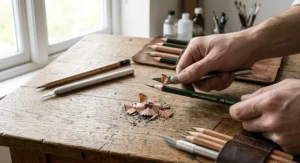
How to Choose Between Graphite Sticks and Graphite Pencils
- Assess your typical working size first. If most of your drawings are A4 or smaller, a pencil-first kit will serve you better than a stick-heavy one; anything A3 and up benefits significantly from stick coverage.
- Consider your subject matter. Portraiture and botanical illustration lean toward pencils for control; landscapes, life drawing and abstract tonal studies lean toward sticks.
- Think about your workspace. Sticks and powder are dusty and benefit from a dedicated desk or mat; pencils travel cleanly in a pencil case.
- Budget across the full toolkit, not a single item. A cheaper stick plus a mid-range pencil set often outperforms a single expensive item that can’t do both jobs.
- Factor in blending needs. If your style leans toward soft, atmospheric tone, prioritise a stick or graphite powder for blending over a large pencil set.
- Test hardness ranges deliberately. Buy a small multi-grade set before committing to a full 24-pencil tin — many buyers over-purchase hardness grades they never actually use.
- Match fragility tolerance to your habits. If you sketch on the move or travel a lot, favour wood-cased pencils over woodless sticks, which snap more easily in transit.
| Table 3: Feature Breakdown | Graphite Stick | Woodless Pencil | Wood-Cased Pencil |
|---|---|---|---|
| Best for | Large tonal blocking | Hybrid line + tone | Fine detail and control |
| Portability | Low | Medium | High |
| Blending ease | Excellent | Very good | Moderate (needs a stump) |
| Typical grade range | 2-3 grades | 5-9 grades | Up to 24 grades |
The pattern across this table reinforces what the earlier sections have argued: wood-cased pencils win decisively on control and travel-friendliness, while sticks win on speed and coverage, with woodless pencils genuinely earning their place as a practical middle tier rather than a novelty format.
Common Mistakes When Buying Graphite Sticks and Pencils
The most frequent mistake is buying a single “one grade fits all” pencil, usually an HB, and trying to force it to do the job of an entire tonal range — you end up over-pressing to get dark values and losing the light end of the scale entirely. A closely related error is buying a huge 24-degree set as a first purchase, then only ever using four or five grades because the extremes (10H, 12B) are rarely needed outside technical or highly expressive specialist work. On the stick side, a common misstep is buying a single hard grade expecting stick-level coverage speed with pencil-level control — the format doesn’t really deliver both at once, and you’ll be happier owning at least one soft stick for blocking and one pencil for detail. Finally, many first-time woodless pencil buyers skip a proper storage tin, then are surprised when half their set arrives at the next sketching session in pieces.
Long-Term Cost & Maintenance: Graphite Sticks vs Pencils
Cost-per-use is where woodless formats and sticks genuinely pull ahead over time, since so little material is wasted compared with sharpening away wood. A wood-cased pencil loses a meaningful chunk of its total graphite to sharpening shavings over its life, while a woodless pencil or stick converts almost all of its mass into usable drawing material. That said, the total cost of ownership depends heavily on your working style: an artist who shades large areas will get more value from a stick’s coverage-per-pound, while an artist who works small and detailed will barely dent a pencil’s core over months of use, making the wood-cased format’s slightly higher per-gram price largely irrelevant in practice.
Maintenance is straightforward either way — a soft cloth to wipe dust off sticks, a sharp craft blade rather than a cheap plastic sharpener for pencils, and dry storage away from humidity, which can occasionally cause wood-cased pencils to swell slightly and crack their casing. Replace sharpeners regularly, since a dull blade crumbles graphite cores rather than cutting them cleanly, and that’s a frequently overlooked cause of “this pencil keeps breaking” complaints that actually have nothing to do with the pencil itself.
Safety and Sourcing: What UK Artists Should Know
Graphite itself is not classified as a hazardous material for general drawing use, but it’s worth understanding what you’re actually handling, particularly with powders and dusty sticks. Natural graphite can contain trace crystalline silica, and prolonged, heavy inhalation of any fine dust — graphite included — is best avoided through simple good practice: work in a ventilated space, avoid blowing loose dust off a drawing (tap it off instead), and wash hands before eating. For most hobbyist and studio use with pencils, sticks and small amounts of powder, this is a low-risk material, but if you’re using graphite powder extensively or in a classroom setting, treat it the same way you would any fine art dust — with basic ventilation and hygiene rather than alarm.
On sourcing and heritage: the UK’s connection to graphite runs deeper than most casual buyers realise. Borrowdale graphite, mined in Cumbria from the 16th century onward, was so pure it could be cut directly into sticks without any binding agent — the deposit that effectively started the entire pencil industry in Keswick, and the reason Derwent (a brand on this list) takes its name from the Cumbrian river running through that same valley. The historic mine workings are now a scheduled monument protected by Historic England, a small but genuinely interesting bit of context next time you pick up a graphite stick.
Graphite Sticks and Pencils for Different Artists
Beginners are usually best served by a mid-range wood-cased set like the Staedtler Mars Lumograph, since the format is forgiving, familiar and doesn’t demand the careful handling a woodless pencil or stick requires. Students and illustrators working to deadlines benefit most from break-resistant premium pencils like the Faber-Castell Castell 9000, where fewer snapped leads means fewer interruptions during a timed project. Working professionals and fine artists producing large-scale pieces get the most value from combining a stick like the Derwent Natural Graphite Stick with Cretacolor Graphite Powder, since both formats prioritise speed and tonal range over portability — not a concern in a studio setting. Hobbyists exploring mixed media should look toward woodless pencils like the Koh-I-Noor Progresso, which bridge dry graphite work with water-soluble aquarelle effects in one purchase.
Features That Actually Matter (And Those That Don’t)
Hardness range genuinely matters — a set spanning at least HB to 6B covers the vast majority of real drawing needs without unnecessary extremes. Break-resistance matters if you sharpen frequently or work under time pressure, but matters far less if you’re a slow, deliberate sketcher who rarely snaps a lead regardless of brand. Water-solubility is a genuinely useful bonus feature if you enjoy mixed-media effects, but it’s not something to pay a premium for if you never intend to use it. On the “doesn’t matter much” side: fancy tin packaging looks appealing on a shelf but has zero bearing on drawing performance, and an extremely wide 24-degree range is marketing appeal for most casual buyers who’ll realistically use six to eight of those grades regularly.
FAQ
❓ What's the main difference between graphite sticks and graphite pencils?
❓ Are woodless graphite pencils better than normal pencils?
❓ How do you blend graphite for smooth shading?
❓ What grade of graphite pencil is best for beginners?
❓ Can you use graphite sticks for detailed drawing?
Conclusion
There’s no single winner in graphite sticks vs graphite pencils, and honestly, that’s good news — it means you get to build a kit around how you actually draw rather than settling for a compromise tool. Sticks like the Derwent Natural Graphite Stick earn their place when speed and scale matter most; woodless options like the Koh-I-Noor Progresso and Cretacolor Monolith offer a genuinely useful middle ground for artists who want stick-like graphite volume in pencil-like control; and precision pencils like the Faber-Castell Castell 9000 and Staedtler Mars Lumograph remain unbeaten for detail work that has to hold up under close inspection. Add Cretacolor Graphite Powder to the mix once you’re chasing smooth, large-area tonal gradients that no single stick or pencil can quite achieve alone.
The most productive way to think about this comparison isn’t “which do I buy” but “which do I reach for first” on any given piece — and increasingly, the honest answer among working graphite artists is: both, at different stages of the same drawing.
Recommended for You
- 7 Best Graphite Sticks for Drawing in 2026 (UK Buyer’s Guide)
- Clutch Pencil vs Mechanical Pencil: 7 Best Artist Picks 2026
- Best Clutch Pencil UK: 7 Top Lead Holders Tested for 2026
Disclaimer: This article contains affiliate links. As an Amazon Associate, I earn from qualifying purchases. If you purchase products through these links, we may earn a small commission at no additional cost to you.
✨ Found this helpful? Share it with your friends! 💬🤗
