In This Article
Somewhere between “I fancy trying colouring again” and actually clicking “buy,” most people freeze. There are tins with 24 pencils and tins with 150. There are pencils that cost less than a coffee and pencils that cost more than a week’s food shop. A coloured pencil set sounds like the simplest art purchase you could make — until you’re twelve browser tabs deep, comparing lightfastness ratings you didn’t know existed an hour ago.
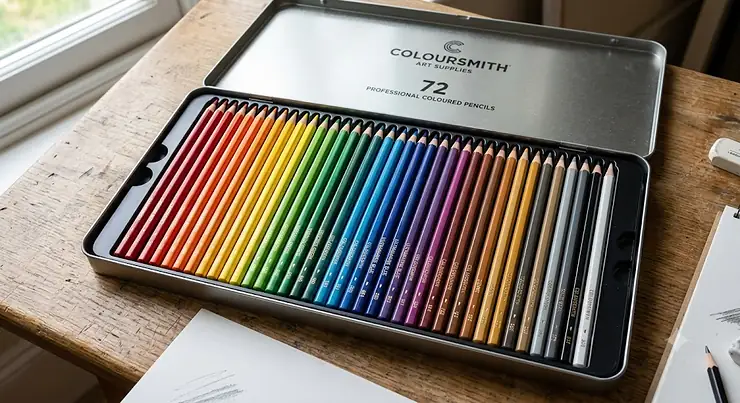
Here’s the short version: a coloured pencil set is a boxed or tinned collection of pigment-cored pencils, usually ranging from 12 to 150+ shades, built around either a wax-based or oil-based core, and pitched at anything from casual colouring-book fun to serious studio work. The right one for you depends far less on the number on the box and far more on core softness, pigment strength, and how the set fits the way you’ll actually use it.
This guide breaks down seven real, currently available sets — spanning budget tins under £15 through to premium studio ranges nudging £150 — with honest analysis drawn from real specifications and aggregated reviewer sentiment, not marketing copy. We’ll cover which set suits a nervous beginner, which one earns its keep for a working illustrator, and which one is quietly the best value pick most buyers walk straight past. As the Wikipedia entry on coloured pencils explains, the mix of pigment concentration, binding agents and core softness is what actually separates a scholastic-grade pencil from an artist-grade one — so understanding what’s inside the pencil matters more than the flashy tin it comes in.
Quick Comparison Table
| Pencil Set | Core Type | Pack Size | Price Range | Best For |
|---|---|---|---|---|
| Ohuhu 72 Colouring Pencils | Soft oil-based | 72 | Under £25 | Beginners wanting punchy colour |
| Faber-Castell Polychromos | Firm oil-based, artist-grade | 60 | £60-£90 range | Detail-focused illustrators |
| Derwent Chromaflow | Soft wax-oil hybrid | 72 | £70-£100 range | Blending and layering fans |
| Derwent Lightfast | Oil-based, museum-grade | 36 | £90-£130 range | Archival, exhibition-quality work |
| Prismacolor Premier | Soft wax-based | 72 | £45-£70 range | Adult colouring book enthusiasts |
| Castle Arts 72-Set | Soft round-barrel | 72 | Under £20 | Budget blending on a shoestring |
| Black Widow Pencils | Soft velvety wax | 96 | £25-£40 range | Value-conscious hobbyists |
A quick glance tells its own story here: pack size and price don’t move in lockstep the way you’d expect. The Castle Arts 72-Set and the Ohuhu 72 Colouring Pencils both pack 72 shades into a case for under £25, while the Derwent Lightfast asks three to four times that for half the colours — because you’re paying for archival permanence, not sheer quantity. If you’re weighing colour count against your actual budget, that gap is the single most important number on this table.
💬 Found a set that’s calling your name already? Have a browse through the current listings before prices shift — art supplies rarely stay put for long!
Top 7 Coloured Pencil Sets: Expert Analysis
1. Ohuhu 72 Colouring Pencils — vivid pigment at a beginner-friendly price
The standout here is simple: colour payoff that punches well above its price bracket. Ohuhu’s 72-piece set uses a soft, oil-based 4mm core housed in a basswood barrel, which means the pigment lays down thick and opaque on the first stroke rather than needing five passes to look convincing. Each pencil is pre-sharpened and the set ships in a fold-out canvas case with slots for every colour, so nothing rolls off the desk mid-project.
Based on the spec comparison with pricier ranges, the wider 4mm core is the quiet hero here — it resists snapping under pressure and holds a workable point longer than the thinner 3mm cores found on many budget rivals, which matters enormously if you’re layering heavily on textured paper. This is squarely a beginner-to-intermediate set: someone picking up colouring again after years away, or a student building a first proper kit, will get more mileage from Ohuhu than from a scholastic-grade set that resists blending entirely.
Reviewers consistently report strong initial pigment saturation and easy blending with a colourless blender pencil, though a recurring theme in aggregated feedback is that a handful of paler tones (yellows and light pinks especially) need a firmer hand to show up clearly on white paper. That’s a known trait of soft oil-based cores generally, not a defect unique to this set.
Pros:
- ✅ Strong pigment laydown straight from the pencil
- ✅ Wide 4mm core resists snapping under pressure
- ✅ Canvas case keeps colours organised and portable
Cons:
- ❌ Pale shades need heavier pressure to show up
- ❌ Colour range skews warm, fewer true cool greys
Prices generally sit under £25, which makes this one of the strongest entry points into oil-based blending pencils on the market — check current price before buying, as art supply pricing shifts with stock levels.
2. Faber-Castell Polychromos — the industry benchmark for precision work
What immediately sets this set apart is its firmness: a break-resistant oil-based core built for controlled, detailed mark-making rather than loose, buttery blending. Faber-Castell has produced artist-grade coloured pencils since the early 20th century, with the Polychromos line originally launched in 1908 as a 60-colour range — a heritage that shows in the consistency of pigment across the current 60-pencil tin.
The specs matter in practice: each pencil is fully pigmented (no wood-filler binders diluting the colour), waterproof once applied, and rated highly lightfast, meaning finished work resists fading under UV exposure for years rather than months. What most buyers overlook about Polychromos is that its firmness is a feature, not a limitation — it’s precisely why botanical illustrators, technical artists, and anyone working on fine detail reach for this brand over softer alternatives that smudge under a steady hand.
Aggregated reviewer sentiment across UK retailers is remarkably consistent: praise centres on colour accuracy and the pencils’ resistance to breaking when sharpened, while the recurring criticism is that true beginners sometimes find the firm core less forgiving for broad, quick colouring-book style work compared with a softer wax pencil.
Pros:
- ✅ Exceptional lightfastness for archival-quality artwork
- ✅ Break-resistant core survives frequent sharpening
- ✅ Colour-matched across the entire Faber-Castell range
Cons:
- ❌ Firm core is less forgiving for fast, loose blending
- ❌ Premium price for only 60 colours versus rivals’ 72+
At around £60-£90 depending on retailer, this sits at the top of the mid-tier, and for anyone planning to sell or exhibit finished pieces, the lightfastness alone justifies the jump from a budget set.
3. Derwent Chromaflow — smooth layering built for blend-heavy styles
The headline feature is texture: a soft wax-oil hybrid core engineered specifically for effortless layering, positioned by Derwent as a direct, UK-manufactured rival to the famously buttery American soft-core brands. The 3.5mm core is round rather than the wide flat-sided cores found elsewhere, giving a slightly different grip and line quality that suits sweeping colour fields over fine crosshatching.
In practical terms, that soft core lays colour down fast with minimal pressure, which is exactly what you want when covering large areas or building up several translucent layers to create depth — something a firmer pencil like Polychromos resists doing quickly. Here’s what to weigh: this softness comes at the cost of point retention, so if your style leans toward fine linework rather than broad colour fields, you’ll be reaching for the sharpener more often than with a harder-core alternative.
Reviewers frequently note that Chromaflow blends almost as smoothly as much pricier premium ranges, with a common thread in feedback being surprise at how creamy the application feels for the price point — though several also mention the tin’s slots are snug enough that pencils can be fiddly to remove without catching a neighbouring colour.
Pros:
- ✅ Buttery soft core ideal for smooth colour blending
- ✅ Strong pigment coverage over large areas
- ✅ British-manufactured with consistent quality control
Cons:
- ❌ Softer core wears down and needs frequent sharpening
- ❌ Snug tin slots make single-pencil removal fiddly
Expect this 72-piece tin to sit in the £70-£100 range — a genuine mid-premium option for anyone whose style is built around blending rather than fine detail.
4. Derwent Lightfast — the archival choice for work that has to last
The standout claim is right there in the name: this range is formulated to be 100% lightfast, meaning finished artwork is designed to resist fading for up to 100 years under museum display conditions. That’s not marketing fluff either — every colour in the range is tested against the internationally recognised ASTM D6901 standard and the Blue Wool Scale ISO 105, which is the same benchmark galleries and conservators use to assess archival permanence.
What that means practically: the wide, 4mm oil-based core is formulated to resist the colour-shift and fading that eventually dulls cheaper pigments, so if you’re producing pieces intended for sale, framing, or long-term display, this is the only set on this list built specifically for that job. On paper this means a smaller palette — just 36 core colours in this tin — but Derwent designed the range to be individually replenishable, so serious buyers often build toward the full range colour by colour rather than needing every shade upfront.
Because this is a specialist, lower-volume product, verified independent customer review data is thinner than for the mass-market sets on this list; what’s consistently reported by artists who’ve tested it is a creamy, dense application and genuinely fade-resistant colour over time, which aligns with the manufacturer’s published lightfast testing. Given that gap in independently verifiable review volume, we’d weight the manufacturer’s third-party-standard testing data fairly heavily here rather than relying on anecdote alone.
Pros:
- ✅ Certified 100% lightfast to recognised ASTM/ISO standards
- ✅ Thick, dense oil-based core for rich pigment
- ✅ Individually replenishable pencils extend set longevity
Cons:
- ❌ Only 36 colours in this tin versus 72+ rivals
- ❌ Highest price bracket on this list by some margin
Pricing typically lands in the £90-£130 range for the 36-tin — a premium ask, but one aimed squarely at buyers for whom permanence is non-negotiable rather than a nice-to-have.
5. Prismacolor Premier — the adult colouring book favourite
The defining feature is a famously soft, thick wax-based core that lays down colour like a mini oil pastel — which is precisely why this range became the go-to recommendation during the adult colouring book boom. The 72-piece set covers a broad spectrum with genuinely distinct shades rather than repetitive near-duplicates, useful when you’re trying to convey subtle gradation across, say, a floral illustration.
Based on the spec comparison with firmer artist pencils, the trade-off here is durability versus application ease: the wax-heavy core smudges and blends beautifully under a blending stump or even a finger, but it’s also softer and snaps more readily under heavy-handed sharpening than an oil-based rival like Polychromos. For anyone whose primary use case is filling in intricate colouring book patterns rather than technical illustration, that trade-off tips firmly in Prismacolor’s favour.
A recurring pattern in aggregated review feedback is enthusiastic praise for blendability and pigment richness, paired with a genuinely common complaint about core breakage on arrival or during use — worth factoring in if you’re buying for a child or a heavy-handed colourer, since Prismacolor’s own softness is both its best feature and its main vulnerability.
Pros:
- ✅ Exceptionally soft core blends like a dream
- ✅ Wide, distinct colour range avoids near-duplicate shades
- ✅ Long-standing reputation among adult colouring enthusiasts
Cons:
- ❌ Soft core prone to breaking, especially in transit
- ❌ Wears down faster than firmer oil-based alternatives
Typical pricing sits in the £45-£70 range for the 72-set, positioning it as accessible mid-tier rather than budget or premium.
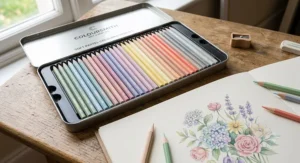
6. Castle Arts 72-Set — round-barrel comfort that punches above its price
The immediate standout is the round, soft-touch barrel — a genuinely different feel in the hand compared with the hexagonal barrels used almost everywhere else on this list, and one that testers consistently flag as more comfortable across long colouring sessions. Independent testing by Creative Bloq, covering pack sizes up to 120 colours, rated the shading and layering performance as first-rate for the price bracket, praising the smooth, creamy hues the soft-touch finish produces.
Here’s what most buyers overlook: a genuinely soft, creamy core at this price point is unusual — most budget sets compensate for low cost with harder, chalkier cores that fight you on blending. Castle Arts instead seems to have prioritised application feel over barrel branding, which is exactly the right trade-off for a hobbyist who wants the blending experience of a pricier set without the price tag. The same independent testing found the pencils hold a sharpened point longer than most competing budget ranges, with colours clearly labelled on the barrel — which matters more than it sounds once you’ve misplaced a lid-printed colour key.
The main honest caveat, also flagged by that testing, is the round barrel itself: it lacks the hexagonal grip finish some users prefer for control during detailed work, and it can roll off an angled desk if you’re not careful.
Pros:
- ✅ Comfortable round barrel for long colouring sessions
- ✅ Holds a sharpened point longer than most budget rivals
- ✅ Clearly labelled, easy-to-read colour names
Cons:
- ❌ Round barrel can roll off an angled desk or table
- ❌ Lacks the grip control of a hexagonal barrel
At under £20 for 72 colours, this is arguably the sharpest value pick on the entire list — genuinely soft-core performance without the premium price.
7. Black Widow Pencils — velvety application on a hobbyist’s budget
The standout here is texture-for-money: a smooth, almost creamy core that punches well above its budget price bracket, built around a soft wax formulation designed specifically to make blending forgiving for newer colourists. The 96-piece set (Black Widow also sells smaller tins) gives genuine breadth across the spectrum, including a run of skin-tone and earth shades that budget competitors often skimp on.
In practical use, that softness translates to rich, even coverage without the heavy hand-pressure a harder student-grade pencil demands — a meaningful difference for anyone whose hands tire quickly during long colouring sessions, including younger users or anyone with grip fatigue concerns. What the spec sheet won’t tell you, but reviewer patterns suggest, is that Black Widow performs closer to mid-tier oil-based sets than its price would imply, which is precisely why it shows up repeatedly on budget “best of” round-ups rather than being dismissed as a cheap filler set.
The genuinely common thread in feedback is enthusiasm for the blending and colour richness relative to cost, with the honest downside being a comparatively smaller base of verified long-term durability reviews than the longer-established brands on this list — a natural consequence of Black Widow being a newer entrant rather than a specific quality concern.
Pros:
- ✅ Smooth, creamy application unusual at this price
- ✅ Generous 96-colour range including varied earth tones
- ✅ Low hand-pressure needed, reducing grip fatigue
Cons:
- ❌ Shorter track record than long-established brands
- ❌ Barrel finish feels less premium than pricier rivals
Set pricing generally falls in the £25-£40 range for the 96-tin, making it a strong middle ground between the ultra-budget and mid-premium tiers covered above.
Top 7 Products: Full Specs Comparison
| Pencil Set | Core Hardness | Water-Soluble | Lightfast Rated | Barrel Shape | Best For |
|---|---|---|---|---|---|
| Ohuhu 72 Colouring Pencils | Soft | No | Not specified | Hexagonal | First-time buyers |
| Faber-Castell Polychromos | Firm | No | Yes, high | Hexagonal | Detail and technical work |
| Derwent Chromaflow | Soft-medium | No | Not specified | Round | Blend-heavy styles |
| Derwent Lightfast | Medium-soft | No | Yes, 100% certified | Hexagonal | Archival, exhibition pieces |
| Prismacolor Premier | Soft | No | Partial range | Round | Colouring book fans |
| Castle Arts 72-Set | Soft | No | Not specified | Round | Best all-round value |
| Black Widow Pencils | Soft | No | Not specified | Hexagonal | Budget blending |
Read across this table and a clear pattern emerges: softness and lightfastness rarely travel together. The two sets with formally certified lightfast ratings — Faber-Castell Polychromos and Derwent Lightfast — both lean firmer, while the softest, most blendable cores (Prismacolor Premier, Black Widow Pencils) either lack full-range lightfast certification or simply haven’t published it. If longevity of the finished piece matters as much as how the pencil feels going down, that’s the trade-off to weigh first.
Benefits vs Traditional Alternatives
| Format | Colour Consistency | Portability | Learning Curve | Best For |
|---|---|---|---|---|
| Coloured pencil set | High, fixed palette | Excellent | Gentle | Detail work, blending, portability |
| Felt-tip / marker set | Variable, can bleed | Good | Gentle | Bold flat colour, younger children |
| Watercolour paint set | High, but mixable | Moderate | Steep | Washes, texture, expressive work |
| Crayon set | Low, waxy build-up | Excellent | Very gentle | Very young children, thick application |
The core advantage a coloured pencil set holds over markers and crayons is control: you can layer, blend, and correct pencil work in a way that’s simply not possible once a felt-tip has bled into paper fibres. Watercolour offers more expressive range but demands water, drying time, and a genuinely steeper learning curve before results look intentional rather than accidental. For anyone wanting a portable, mess-free medium that still allows real technical depth as skills grow, coloured pencils occupy a sweet spot the other three formats don’t quite reach.
Practical Usage Guide: Getting the Most From Your First Set
Opening a new tin is the easy part — getting consistent results in the first month is where most beginners either fall in love with the hobby or quietly abandon it in a drawer. Start by sharpening every pencil to a moderate point before your first session; over-sharpening to a needle-fine tip on a soft core (like Prismacolor Premier or Black Widow Pencils) is the single most common cause of snapped leads in the first week of ownership.
Layer light to dark, not the other way round. Building colour gradually with light pressure, then deepening with firmer strokes, gives far more control than pressing hard from the first stroke — a mistake almost every beginner makes at least once. For blending, a colourless blender pencil or a small piece of tissue works on soft-core sets like Ohuhu 72 Colouring Pencils and Castle Arts 72-Set; firmer cores like Faber-Castell Polychromos respond better to layering technique than to physical blending tools.
Store pencils flat or upright rather than loose in a bag — cores inside the wood can fracture invisibly from repeated drops, which then causes the pencil to snap mid-sharpen weeks later with no obvious cause. A basic sharpener with a wide, sharp blade matters more than most buyers expect; a blunt or narrow sharpener is a common hidden culprit behind “my pencils keep breaking” complaints that actually have nothing to do with the pencil brand itself.
Real-World Scenarios: Which Set Fits Your Life
The returning hobbyist, evenings only, budget around £20: Someone picking colouring back up after a stressful few years, colouring for twenty minutes before bed a few times a week, doesn’t need certified lightfastness or a 150-colour range. The Castle Arts 72-Set or Black Widow Pencils deliver genuinely soft, satisfying application without demanding a big spend, and 72-96 colours is plenty of variety for adult colouring books without overwhelming choice paralysis.
The design student building a portfolio, moderate budget, frequent use most days: Daily use for coursework needs durability and consistency more than sheer colour count. Derwent Chromaflow or Prismacolor Premier both blend well enough for illustration coursework while staying below the true professional price ceiling, and their broad ranges cover most brief requirements without needing supplementary singles.
The semi-professional illustrator selling or exhibiting finished pieces, higher budget, quality-first: Once artwork is being sold, framed, or submitted for exhibition, lightfastness stops being optional. Faber-Castell Polychromos for detail-heavy technical illustration, or Derwent Lightfast for pieces intended for long-term display, both justify their higher price through certified permanence that budget ranges simply don’t offer.
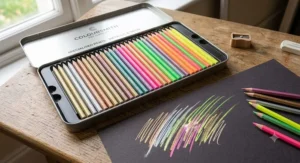
How to Choose a Coloured Pencil Set
- Decide your core preference first. Soft wax-based cores (Prismacolor, Black Widow) blend easily but wear down and snap more readily; firmer oil-based cores (Polychromos) hold a point longer but resist quick blending.
- Match colour count to actual use, not aspiration. A 36-colour lightfast set replenished over time often serves a working artist better than a 150-colour set of duplicated near-shades.
- Check lightfast ratings if the work will be displayed. Pigment lightfastness is one of the main factors separating budget and premium brands in both quality and price — pay for it only if you actually need it.
- Consider barrel shape for comfort. Round barrels (Castle Arts, Chromaflow) suit long sessions; hexagonal barrels give more grip control for fine detail.
- Factor in sharpening frequency. Softer cores need a sharp, wide-blade sharpener and more frequent touch-ups — budget for a decent sharpener alongside the pencils themselves.
- Read aggregated review sentiment, not star averages alone. A 4.5-star average hides a lot; look for recurring specific complaints (breakage, colour mislabelling) rather than the headline score.
- Buy a tester or a small tin before committing to the full range. Several brands sell 12 or 24-piece versions of their larger sets — a low-cost way to check whether a core suits your hand before spending £80+.
Common Mistakes When Buying a Coloured Pencil Set
The most frequent misstep is chasing colour count above all else — a 150-colour budget set with a chalky, hard core will frustrate a beginner far more than a well-chosen 36-colour set that actually blends. Pencil count is a marketing number; core quality is the thing you’ll feel every single stroke.
A second common error is ignoring barrel shape and hand comfort entirely, then being surprised when long sessions cause fatigue. If you or the intended user has any grip sensitivity, a softer, lower-pressure core like Black Widow Pencils or Castle Arts 72-Set will feel noticeably kinder than a firm, high-pressure set like Faber-Castell Polychromos.
The third mistake, and arguably the costliest, is buying premium lightfast pencils for work that will never be displayed or sold. Certified lightfastness genuinely does cost more to manufacture, and paying that premium for a set destined purely for a personal colouring book is money better spent on paper quality or a wider colour range instead.
What to Expect: Real-World Performance
Specs on a box rarely translate directly into lived experience, so here’s the practical translation. A “soft, oil-based 4mm core” (Ohuhu, Chromaflow) feels, in the hand, like colouring with a slightly waxy crayon that glides rather than scratches — satisfying immediately, but it wears down visibly faster over a single session than a firmer pencil. A “firm, oil-based core” (Polychromos) feels more like a fine drawing tool: more resistance, more control, and noticeably less mess on your fingers, but it takes longer pressure and more layers to build the same depth of colour a soft core achieves in one pass.
“100% lightfast” (Derwent Lightfast) doesn’t change how the pencil feels day-to-day at all — the difference only shows up years later, when a piece coloured with a lower-lightfast pencil has visibly faded in sunlight and the certified set hasn’t. And a “soft wax-based core” (Prismacolor, Black Widow) translates to genuinely effortless blending with almost no tool required, at the cost of leaving more pigment dust on the page that needs a light brush-off before you handle finished work.
Coloured Pencil Sets for Adults
Adult buyers overwhelmingly split into two camps: relaxation-focused colourists working through intricate pattern books, and hobbyist-to-semi-professional illustrators building actual technique. For the first group, a soft, forgiving core matters more than technical specs — Prismacolor Premier and Castle Arts 72-Set both prioritise ease of blending over precision, which suits the meditative, low-pressure nature of adult colouring book work. This isn’t just anecdotal, either: the Mental Health Foundation lists mindful colouring or drawing as a genuine, evidence-informed mindfulness technique, worth knowing if stress relief is as much the goal here as the finished picture.
For the second group, moving toward Faber-Castell Polychromos or Derwent Chromaflow makes sense once basic technique is established, since both offer the layering depth and colour consistency needed for original illustration work rather than pre-printed pattern filling. A frequent pattern in aggregated adult-colourist feedback is starting with a soft budget set, then investing in a firmer, more technical range once specific frustrations (colour muddiness, poor layering) push them to upgrade — which is a genuinely sensible, cost-effective progression rather than a sign the first set was a poor choice.
Long-Term Cost & Maintenance
The upfront price tag tells only part of the cost story. A soft-core budget set wears down faster, meaning more frequent sharpening and, eventually, replacement of individual heavily-used colours (usually skin tones, black, and mid-greens) well before the rest of the tin is exhausted. Brands like Derwent and Faber-Castell sell individual replacement pencils, which is genuinely better long-term value than repurchasing an entire set once your favourite three shades run out.
Cost-per-use also shifts dramatically with frequency. A £90 Derwent Lightfast set used weekly for years works out cheaper per session than a £15 set replaced three times over the same period because of snapped cores and worn-out favourites. Conversely, an occasional colourist who picks pencils up twice a month gets little practical return from paying premium prices — a mid-range set like Derwent Chromaflow or Prismacolor Premier represents the more sensible total cost of ownership for that usage pattern.
Maintenance itself is minimal but not zero: a wide, sharp-bladed sharpener (replaced roughly every 6-12 months of regular use), occasional storage in a dry space to prevent wood swelling, and periodic wiping down of soft-core pencils to remove pigment dust from the barrel all extend usable life meaningfully beyond what casual buyers expect.
Safety, Regulations and Compliance
Coloured pencils sold in the UK, particularly sets marketed for children, fall under formal toy safety law. The Toys (Safety) Regulations 2011, published via GOV.UK, set out the essential safety requirements a product must meet before it can be placed on the market, covering obligations for manufacturers, importers and distributors alike. Products classed as toys must carry the correct UKCA or CE marking, and CE-marked toys currently remain accepted for sale in Great Britain under a transitional provision within those regulations.
The specific standard most relevant to pencils and other art materials is EN 71-3, which governs chemical safety. In broad terms, it sets strict limits on how much of a range of elements — including lead, cadmium, chromium and mercury — can migrate out of toy materials, with the aim of minimising a child’s exposure to potentially toxic substances through normal handling and mouthing. When buying for children specifically, checking for a clear EN71-3 or CE/UKCA reference on the packaging is a simple, worthwhile step — reputable brands across this list, including budget options, publish this compliance information.
For adult-only purchases intended for personal or professional use, these specific child-safety migration limits are less directly relevant, though general product safety obligations under UK consumer law still apply to any set sold on the UK market.
Problem → Solution: Fixing Common Coloured Pencil Frustrations
Problem: Pencils keep snapping when sharpened. This is almost always down to internal core fracture from drops or impact, or an old, blunt sharpener blade rather than a faulty pencil. Switch to a sharp, wide-blade sharpener and store pencils flat rather than loose in a bag.
Problem: Colours look patchy or streaky rather than solid. Usually a pressure and layering issue rather than a pigment fault — build colour in several light layers rather than one heavy pass, particularly with firmer cores like Faber-Castell Polychromos, which is designed for layering technique over brute pressure.
Problem: Pale colours barely show up on white paper. A known limitation of light pigments generally, most noticeable on sets like Ohuhu 72 Colouring Pencils. Using slightly toned or cream-coloured paper, or applying a darker base layer first, both help pale shades read more clearly.
Problem: Set arrived with visibly broken cores. A genuinely common transit issue with soft wax-based cores like Prismacolor Premier, caused by rough handling rather than manufacturing fault in most cases — most retailers will replace affected pencils individually if reported promptly.
Problem: Can’t tell colours apart once out of the original tin order. Investing in a simple pencil roll or labelled tray, and periodically checking barrel-printed colour names before they wear off from handling, prevents the frustration of hunting for “that one specific green” mid-project.
Buyer’s Decision Framework
If your priority is the lowest possible entry cost with genuinely soft, blendable colour, choose Castle Arts 72-Set or Black Widow Pencils, because both deliver a soft-core feel disproportionate to their price. If your priority is fine detail and technical accuracy for illustration or design work, choose Faber-Castell Polychromos, because its firm core and colour consistency are built specifically for controlled mark-making. If your priority is finished artwork that must survive years of light exposure without fading, choose Derwent Lightfast, because it’s the only set here with full ASTM/ISO lightfast certification across its range. If your priority is relaxed, effortless blending for colouring books, choose Prismacolor Premier, because its soft wax core is purpose-built for exactly that use case.
Features That Actually Matter (And Those That Don’t)
Core softness and pigment concentration matter enormously — they determine how a pencil actually feels and performs stroke by stroke, and no amount of marketing can compensate for a chalky, under-pigmented core. Lightfast certification matters, but only if your work will be displayed, sold, or stored somewhere sunlit for years; for a personal colouring book kept in a drawer, it’s an expense without a practical payoff.
What matters much less than packaging suggests: total colour count above roughly 72-96 shades. Beyond that point, sets increasingly include near-duplicate tones that a skilled colourist could mix or layer from a smaller, well-chosen palette anyway. Fancy tin materials (metal versus plastic versus canvas roll) affect durability and portability marginally, but have zero bearing on how the pencil performs on paper — don’t pay a premium for presentation alone.
Coloured Pencil Set FAQ
❓ How many colours do I need in a coloured pencil set?
❓ What's the difference between a 72 coloured pencil set and a 120 coloured pencil set review-wise?
❓ Are expensive coloured pencil tin sets actually worth it over budget options?
❓ Can I expand a coloured pencil set later with individual pencils?
❓ Is a coloured pencil set for adults different from a children's set?
Conclusion
Choosing between these seven sets really comes down to one honest question: what will you actually do with the pencils, and how often? A returning hobbyist colouring a few evenings a week gains little from certified lightfastness and everything from a soft, forgiving core like Castle Arts 72-Set or Black Widow Pencils. A student or working illustrator building technique benefits from the layering depth of Derwent Chromaflow or the precision of Faber-Castell Polychromos. And anyone producing work destined for a wall or a gallery has, frankly, only one sensible choice on this list in Derwent Lightfast.
None of these seven is objectively “the best” — that framing misses how differently core hardness, colour count, and lightfastness suit different hands and different goals. What matters is matching the set to your actual habits rather than the biggest number on the box. Whichever you choose, the research above should mean you’re buying based on how the pencil will genuinely perform, not just what the packaging promises.
Recommended for You
- Dip Pen Sets Under £25: 7 Best Budget Picks for UK Beginners (2026)
- Waterproof Drawing Ink: 7 Best UK Picks That Won’t Bleed (2026)
- Drawing Ink for Dip Pens: 7 Best Picks for UK Illustrators (2026)
Disclaimer: This article contains affiliate links. As an Amazon Associate, I earn from qualifying purchases. If you purchase products through these links, we may earn a small commission at no additional cost to you.
✨ Found this helpful? Share it with your friends! 💬🤗
