In This Article
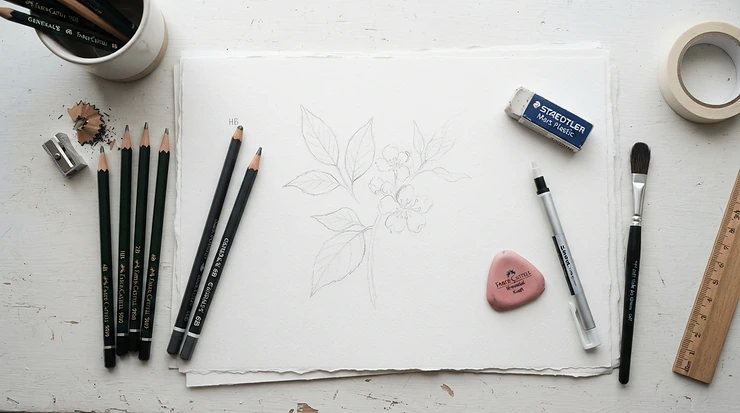
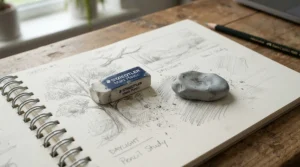
A kneadable eraser (a putty rubber, in British English) is a soft, pliable lump that lifts graphite and charcoal by absorbing it, without rubbing. A plastic eraser is a firmer vinyl block that scrubs marks away and sheds crumbs as it goes. The kneadable eraser vs plastic eraser choice is really lightening a mark versus banishing it.
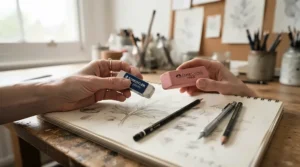
Here’s what most beginners get wrong. They agonise over pencil grades, then grab whatever rubber is rattling around the bottom of the pencil case. Twenty minutes later the shading has turned to grey sludge, or a ghost of the original line refuses to leave. An eraser isn’t the clean-up crew. It’s a drawing tool in its own right.
Kneaded erasers are typically made of unvulcanised rubber and work by trapping particles rather than scrubbing them off, which is why artists use them to pull highlights out of a dark passage. Plastic erasers do the opposite job. They’re the heavy lifters for crisp, total removal.
This is your complete eraser comparison for 2026. You’ll find eraser types explained for beginners, a straight answer on which eraser for sketching suits your style, and seven real products analysed against their specs and aggregated review themes. You’ll also get practical workflows that product listings never mention. Whether you’re pulling together your first beginner art supplies or topping up your sketching essentials, you’ll know what to buy and why. Prices throughout are approximate ranges, so check the current price before you buy.
Quick Comparison: Kneadable Eraser vs Plastic Eraser at a Glance
Before the deep dive, here’s the short version. Think of it as the cheat sheet you can screenshot and take to the art shop.
| Feature | Kneadable eraser | Plastic eraser |
|---|---|---|
| How it works | Absorbs graphite and charcoal when pressed or dabbed | Rubs marks off; graphite leaves with the crumbs |
| Strongest at | Lightening tone, highlights, soft charcoal | Clean, complete removal of graphite |
| Paper impact | Very gentle; barely abrades the surface | Gentle if used lightly; scrubbing can scuff |
| Lifespan | Long if kneaded clean; saturates eventually | Wears down steadily and leaves crumbs |
| Best For | Faber-Castell Kneadable Art Eraser: shading and highlights | Staedtler Mars Plastic: crisp corrections |
Looking at the table, neither side wins outright, because the two solve different problems. A kneadable eraser is a subtractive drawing tool, perfect for softening an area without destroying it. A plastic eraser is a correction tool, for when a line has to vanish completely.
If you can only afford one today, let your medium decide. Soft pencils and charcoal favour the kneadable option, while harder pencils and tidy line work favour plastic. Most sketchers end up owning both, and the pair usually costs less than a coffee and a pastry.
💬 Just one click — help others make better buying decisions too!😊
Top 7 Erasers for Sketching: Expert Analysis
The picks below are split across both camps and across budgets, from pocket-money blocks to a refillable precision pen. Each entry reflects real specs and the themes that recur in genuine user reviews. None of it is claimed hands-on testing.
1. Winsor & Newton Large Putty Rubber — softest, most forgiving lift
Soft is the whole personality here. Retail listings describe a putty block at roughly 1.3 × 6.8 × 4.1 cm, pitched at pencil, chalk and charcoal, that moulds to a fine point. That chunky slab gives you plenty of clean surface to knead through before it greys out. On a big A3 charcoal study, smaller blocks tend to saturate halfway across the sky, so the extra bulk is a practical advantage rather than a gimmick.
Based on the spec comparison, this is the friendliest starting point for anyone nervous about damaging paper. You can pinch off a sliver for a highlight without wrestling the whole block. The trade-off is control. A softer body has less bite when you need to lift dense, heavily pressed graphite, so keep a plastic eraser within reach for those stubborn passages.
The review pool for this listing is small, but the themes are consistent. Buyers say it feels noticeably softer than stiff grey kneadable erasers, that small pieces break off cleanly, and that they expect it to last. Treat that as early sentiment rather than a long-term durability verdict.
Pros:
- ✅ Very soft, easy to pinch and shape
- ✅ Large block saturates slowly on big drawings
- ✅ Works on pencil, chalk and charcoal
Cons:
- ❌ Less bite on dense, heavy graphite
- ❌ Small review pool limits long-term certainty
Price: around £5-£7 at the time of research. That’s fair value if you draw large and often, so check the current price.
2. Faber-Castell Kneadable Art Eraser — the all-rounder with its own case
The standout feature is the plastic storage case, and it matters more than it sounds. Kneadable erasers are lint magnets, and a case keeps studio fluff off the surface between sessions. The block measures about 4.9 × 4.9 × 1.5 cm and weighs around 31 g (model 127220), so it slips into a pencil case without adding bulk.
The honest take is that this is the safest first kneadable eraser for most people. It handles graphite, charcoal, pastel and coloured pencil, and the compact square is easy to flatten for broad lifting or roll between your fingers for fine control. Beginners and intermediates who want a single eraser for several media will get the most from it.
Reviewers consistently praise its versatility across media and the way dabbing lifts excess graphite while leaving a faint guideline behind. Recurring complaints are that it can feel too soft for firm work, that it may dry out if left uncovered for long stretches, and that kneadable erasers take a little getting used to if you’ve only ever scrubbed.
Pros:
- ✅ Case keeps dust and fluff away
- ✅ Handles graphite, charcoal, pastel and coloured pencil
- ✅ Compact square suits small kits
Cons:
- ❌ Some find it too soft for firm lifting
- ❌ Can dry out if left uncovered
Price: roughly £3-£6 depending on pack size, so check the current price. The case alone makes it solid value.
3. Koh-I-Noor Kneadable Eraser — firmer bite for dense graphite
Firmness is the hook. Retail guides list it under code FA6423KE and trace the brand’s heritage back to 1790. A firmer kneadable eraser behaves quite differently from a squishy one. It resists smearing when you press into heavily layered graphite, but it offers less of that pull-apart, pinch-to-a-point tenderness.
On paper, this suits the sketcher who works in the 2B to 6B range and wants controlled tonal reduction rather than a gentle mist of lifting. One reviewer comparing the two brands described the Koh-I-Noor Kneadable Eraser as the stiffer option for graphite and charcoal. They preferred the Faber-Castell Kneadable Art Eraser for coloured pencil, noting it gave roughly twice the eraser volume for roughly twice the price.
That’s a single reviewer’s view, and I couldn’t verify a large UK review pool, so weigh it accordingly. The analytical takeaway is straightforward. Firmness trades capacity for control, so expect a smaller working block that saturates sooner. If you like tight, deliberate tonal edits, that’s a fair swap.
Pros:
- ✅ Firm feel resists smearing in dense graphite
- ✅ Good for graphite and charcoal lifting
- ✅ Often priced below larger blocks
Cons:
- ❌ Smaller volume saturates sooner
- ❌ Less pliable for fine pinching
Price: roughly £2-£5, so check the current price. It’s good value for graphite-heavy work.
4. Derwent Kneadable Eraser — very soft, but reviews are mixed
This one earns its place as the honest cautionary tale. Derwent carries real weight in pencils, so plenty of beginners assume its putty rubber is the safe choice. Its defining feature is extreme softness, which feels lovely for tiny touch-ups on soft pencil and makes it easy to knead into shape.
The reviews on a major UK craft retailer’s page are genuinely split. One buyer rated it two out of five, reporting a sticky residue on fingers and a faint film on paper that interfered with the next layer of pencil. Another found it too soft, so it blackened quickly and was binned after a few hours of drawing. Others praised it for lifting graphite cleanly, working well with charcoal and being kind to watercolour paper.
Based on those patterns, it suits small, light corrections better than long drawing sessions. Beginners buying their first kneadable eraser are probably better served by the options above. If you do buy it, store it somewhere cool and clean, and avoid holding it in warm hands for long stretches, since heat is what turns very soft putty tacky.
Pros:
- ✅ Very soft and easy to knead
- ✅ Lifts graphite well in small areas
- ✅ Reported as kind to watercolour paper
Cons:
- ❌ Some report sticky residue on hands and paper
- ❌ Can darken fast and need early replacement
Price: roughly £2-£5, so check the current price. Value is decent for light use, but it isn’t the first pick.
5. Staedtler Mars Plastic — German-made benchmark for clean removal
The headline here is consistency. The block measures 65 × 23 × 13 mm and sits in a sliding sleeve that keeps it clean inside a pencil case. The manufacturer’s data sheet lists a polyvinyl chloride elastomer with natural chalk filler, a phthalate-free softening agent and no latex. In everyday terms, that means a reliably non-smudging block that doesn’t discolour paper.
Here’s the part spec sheets don’t spell out. The rectangular shape gives you three usable straight edges, perfect for cutting a crisp border or removing a stray construction line. That makes it the natural partner for sketching with harder pencils. The latex-free formulation also makes it a sensible, school-safe pick for families managing latex sensitivities.
I couldn’t verify a deep, trustworthy review pool for this exact listing, so I won’t invent sentiment. What I can say is that the Staedtler Mars Plastic appears regularly in artist round-ups of recommended vinyl erasers, which is a reasonable signal of reputation, if not a substitute for buyer data.
Pros:
- ✅ Clean, non-smudging removal of graphite
- ✅ Latex-free and phthalate-free formulation
- ✅ Sliding sleeve keeps it tidy
Cons:
- ❌ Too blunt for tiny details
- ❌ Crumbs need brushing away
Price: around £1-£3, so check the current price. This is outstanding value and the cheapest way to start.
6. Pentel Hi-Polymer Block — low-crumb workhorse for big areas
The big idea is a latex-free polymer block, available in medium (ZEH-05) and large (ZEH-10) sizes. A distributor lists a non-phthalate plasticiser, and the maker says it resists cracking and hardening with age. That matters if you’ve ever opened an old pencil case to find a rock-hard eraser fossilised in the corner.
It excels at clearing big patches of graphite quickly, so it suits sketchers who rough in loosely and tidy generously. The pack sizes also make it a classroom favourite, since a multipack is easy to share around a table. The block shape is the compromise, because corners only get you so far on small details.
Reviewers describe clean lifts with little smearing, and one noted noticeably fewer crumbs than a traditional pink rubber. Another remarked that older red versions dried out and left marks, which the white polymer blocks avoided. Treat that as a reminder to buy the white Pentel Hi-Polymer Block specifically, and check the listing before you click.
Pros:
- ✅ Lifts graphite quickly with light pressure
- ✅ Latex-free with a protective sleeve
- ✅ Stays soft rather than hardening
Cons:
- ❌ Block shape is awkward for fine details
- ❌ Still produces some crumbs
Price: around £1-£3 per block, with multipacks common. Check the current price. Cost-per-use is excellent.
7. Tombow Mono Zero — pen-style precision for tiny details
The headline is the 2.3 mm round tip (a 2.5 × 5 mm rectangular version also exists), housed in a push-button body with a metal guide. Think of it as a mechanical pencil for removing graphite. In practice, that lets you erase a single eyelash highlight or a stray cross-hatch without disturbing the neighbouring lines. The eraser is refillable, and a retailer notes the design won Red Dot recognition in 2010.
The analytical take is that the Tombow Mono Zero isn’t an all-round eraser. It’s a scalpel. Pair it with a bigger block for broad work. It suits detailed sketchers, illustrators and architecturally minded doodlers who care about clean edges more than speed.
User reports praise its precision and note that it doesn’t damage paper in normal use. A common caveat is that the tiny eraser wears down quickly, so refills become a running cost. Heavy detailers should factor that in before treating it as a bargain.
Pros:
- ✅ Pinpoint accuracy for fine detail
- ✅ Refillable body reduces waste
- ✅ Clip and slim body fit a pocket
Cons:
- ❌ Tiny tip wears down quickly
- ❌ Refills add ongoing cost
Price: around £3-£6, with refills extra, so check the current price. It’s good value for detail work but poor value as an only-eraser purchase.
Top 7 Eraser Comparison Table
Prices below are indicative ranges, so check the current price before buying.
| Product | Type | Key detail | Price range | Review pattern | Best For |
|---|---|---|---|---|---|
| Winsor & Newton Large Putty Rubber | Kneadable | Large, soft, moulds to a point | Around £5-£7 | Small pool, positive | Winsor & Newton Large Putty Rubber: beginners, charcoal |
| Faber-Castell Kneadable Art Eraser | Kneadable | Includes storage case | Roughly £3-£6 | Broadly positive | Faber-Castell Kneadable Art Eraser: all-round sketching |
| Koh-I-Noor Kneadable Eraser | Kneadable | Firmer feel | Roughly £2-£5 | Firmness praised | Koh-I-Noor Kneadable Eraser: dense graphite |
| Derwent Kneadable Eraser | Kneadable | Very soft | Roughly £2-£5 | Mixed | Derwent Kneadable Eraser: small touch-ups |
| Staedtler Mars Plastic | Plastic | 65 × 23 × 13 mm, sleeve | Around £1-£3 | Few verifiable reviews | Staedtler Mars Plastic: crisp corrections |
| Pentel Hi-Polymer Block | Plastic | Latex-free, two sizes | Around £1-£3 | Clean, low-crumb | Pentel Hi-Polymer Block: large areas, school |
| Tombow Mono Zero | Plastic (precision) | 2.3 mm refillable tip | Around £3-£6 | Precise, wears fast | Tombow Mono Zero: fine details |
Reading across the table, the Staedtler Mars Plastic and Pentel Hi-Polymer Block deliver the best cost-per-use, while the Faber-Castell Kneadable Art Eraser is the safest kneadable purchase. If budget is tight, the sensible pairing is one kneadable eraser plus one plastic block. Skip the Derwent Kneadable Eraser until you know you want something extra soft.
✨ Don’t Miss These Eraser Deals!
🔍 Take your sketching to the next level with these carefully selected erasers.Click on any highlighted product to check current pricing and availability. A good pair of erasers will help you create the crisp, glowing drawings you’ve been picturing!
Practical Guide: Using a Kneadable Eraser and a Plastic Eraser Together
The pros rarely pick a side in the kneadable eraser vs plastic eraser debate. They run both in sequence, and the workflow costs nothing extra.
Your first minute: Pull the block apart and knead it between your fingers until it warms and the surface looks even. A fresh, cold kneadable eraser is stiff and can leave faint marks until it has been properly worked.
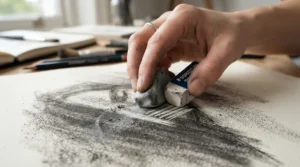
Lifting tone: Flatten the eraser, press onto the area, then lift. Never drag it like a block. Pressing absorbs graphite, whereas rubbing smears it.
Detail work: Pinch it to a point for highlights, or roll it along a line to thin the mark out.
Final clean-up: Switch to a plastic eraser such as the Staedtler Mars Plastic. Use a corner for crisp edges, hold the paper flat with your other hand, and sweep crumbs away with a soft brush rather than your palm, which drags graphite across the page.
Maintenance schedule:
- Every session: fold and stretch the kneadable block until dark patches disappear.
- Weekly: wipe plastic erasers on scrap paper to remove embedded graphite.
- Always: store the Faber-Castell Kneadable Art Eraser in its case, and keep the Pentel Hi-Polymer Block in its sleeve.
Common mistakes in your first 30 days: rubbing a kneadable eraser like a block, leaving it uncovered on a dusty desk, and scrubbing hard with a plastic eraser until the paper shines. Each one has the same fix. Use lighter pressure and cleaner storage, and the kit will behave itself.
Real-World Scenarios: Which Eraser Fits Which Sketcher
Specs only matter when matched to a real life. Here are three profiles, each with a budget, an environment and a frequency of use.
The sixth-former on A3 charcoal studies (budget about £10, drawing three or four times weekly): Large sheets eat small erasers, so the Winsor & Newton Large Putty Rubber earns its place for tone lifting. Add a Staedtler Mars Plastic for sharpening edges. The combined spend stays comfortably inside budget, with room left for a sheet or two of better paper.
The commuter with a pocket sketchbook (budget about £8, sketching on the train, daily): Space is the constraint. A Faber-Castell Kneadable Art Eraser in its case protects against bag fluff, and a Tombow Mono Zero slips into a shirt pocket for tiny corrections. You’ll replace refills fairly often, but you won’t be carrying a whole pencil case’s worth of kit.
The parent buying for a child’s school art (budget about £5, weekly use): Durability and safety matter more than finesse. The Pentel Hi-Polymer Block is sold as latex-free, and the Staedtler Mars Plastic is listed as latex-free and phthalate-free. Pick whichever pack size suits, and label the sleeve with a name so it survives the school bag.
The pattern across all three is the same. Match the eraser to the space you draw in, not just the drawing you imagine making.
Problem → Solution Guide for Common Eraser Frustrations
Problem 1: My kneadable eraser is leaving grey smears.
It’s almost certainly saturated. Stretch, fold and re-knead until a clean interior surface appears. If it has darkened all the way through, replace it.
Problem 2: The eraser feels sticky.
Warm hands soften putty. Rest it somewhere cool, and be cautious with very soft options like the Derwent Kneadable Eraser, where some buyers report residue.
Problem 3: My plastic eraser tears or shines the paper.
You’re pressing too hard. Dab lightly, use a clean corner, and let the eraser do the work. If the paper is thin, switch to kneadable for the tonal part of the job.
Problem 4: A faint ghost line remains.
That’s graphite pressed into the grain of the paper. Lift what you can with kneaded putty, then finish with a plastic eraser. Next time, sketch lighter in the construction stage.
Problem 5: I can’t erase tiny details cleanly.
A block is too clumsy for a single hair-width mark. Use the Tombow Mono Zero to isolate it, and keep a scrap of paper handy to test the tip first.
How to Choose Between a Kneadable Eraser and a Plastic Eraser
Choosing doesn’t need to be complicated. Work through these steps in order.
- Identify your main medium. Charcoal and soft graphite lean kneadable, whereas harder pencils lean plastic. Soft media smear easily, so absorbing beats scrubbing.
- Check your paper. Delicate or textured papers favour kneadable because it barely abrades. Smooth cartridge handles both.
- Decide whether you want to lighten or remove. If you want tonal control, choose kneadable. If you need a line gone, choose plastic.
- Think about size. Large drawings favour big blocks like the Winsor & Newton Large Putty Rubber. Tiny work favours the Tombow Mono Zero.
- Consider storage. A case, such as the one the Faber-Castell Kneadable Art Eraser includes, keeps putty clean.
- Check materials if allergies matter. Look for latex-free labelling on the exact product you’re buying, not just the brand.
- Set a budget. Start with one of each. The pair costs less than a single fancy pencil.
Eraser Types Explained for Beginners
Walk into an art shop and the eraser wall can feel like a pharmacy. Here are eraser types explained for beginners, in plain English.
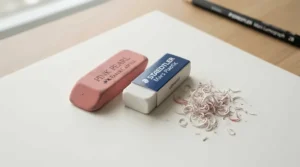
Standard rubber: The pink block or pencil-top eraser. Cheap and fine for homework, but it can smear and leave tinted crumbs.
Plastic (vinyl): According to Wikipedia’s overview of erasers, good plasticised vinyl erasers are softer, non-abrasive and erase cleaner than standard rubber because the graphite is carried away in the scraps. This is your general-purpose clean-up tool.
Kneaded (putty rubber): Pliable, reusable and absorbent. It lifts rather than scrubs.
Art gum: Soft and crumbly, suited to delicate surfaces.
Sand erasers: Gritty and aggressive, meant for stubborn marks. Not for beginners.
Mechanical or stick erasers: Pen-style tools like the Tombow Mono Zero for detail.
For most people, two types cover everything: one kneadable, one plastic. Everything else is optional, and you can add it later once you’ve discovered what your drawing style actually demands.
Which Eraser for Sketching? A Medium-by-Medium Guide
The honest answer to which eraser for sketching depends on what’s in your hand.
Soft graphite (4B-8B): Use kneadable first. Soft graphite smears under a block, so the Faber-Castell Kneadable Art Eraser lifts it more cleanly.
Harder graphite (HB-2B): Plastic wins. The Staedtler Mars Plastic removes light lines with little effort.
Charcoal and pastel: Kneadable, every time. Blocks smear dry media across the page.
Coloured pencil: Gently dab with a kneadable eraser to lift surface colour, then use plastic for stubborn marks.
Fine detail: Reach for the Tombow Mono Zero.
Quick thumbnails and rough sketches: The Pentel Hi-Polymer Block clears big messes fast.
A useful rule is to use kneadable during shading and plastic for the final clean-up. Which eraser for sketching also depends on paper. Lightweight sketchbook paper tears easily, so lean softer, and keep the Koh-I-Noor Kneadable Eraser in mind if you want firmness without scrubbing.

Kneadable Eraser vs Plastic Eraser: Head-to-Head Analysis
Here’s how both camps compare against the traditional pink rubber most people already own.
| Factor | Kneadable eraser | Plastic eraser | Standard pink rubber |
|---|---|---|---|
| Smearing | Very low | Low | Higher |
| Crumbs | Almost none | Yes, easy to brush | Yes, often tinted |
| Paper kindness | Excellent | Good with light pressure | Variable |
| Precision | High (hand-shaped) | Medium to high | Low |
| Best For | Faber-Castell Kneadable Art Eraser: tone work | Staedtler Mars Plastic: full removal | Homework only |
The kneadable option wins on gentleness and control, while the plastic option wins on finality. A standard pink rubber matches neither for art use, which is why upgrading is the single easiest improvement a beginner can make.
Here’s the practical consequence. If you try to do everything with plastic, you’ll scuff paper and flatten soft tones. If you try to do everything with kneadable, stubborn lines will linger. The kneadable eraser vs plastic eraser decision is therefore less “either/or” and more “which first?” Start with whichever matches the medium you use most, then add the other within a month.
Beginner Art Supplies and Sketching Essentials Beyond Erasers
Erasers don’t live alone. Sensible beginner art supplies lists pair them with a short, practical kit.
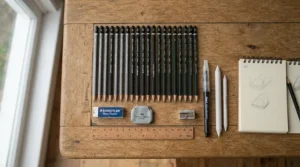
Two beginner drawing kit lists from the University of Strathclyde’s Centre for Lifelong Learning both ask for a plastic eraser and a putty rubber, alongside 2B and 4B graphite pencils, a sharpener and a cartridge pad. That’s a useful reality check on sketching essentials. The pairing isn’t a marketing gimmick, it’s standard teaching practice.
A sensible starter kit:
- A 2B and a 4B pencil (or similar)
- One kneadable eraser and one plastic eraser
- A cartridge paper pad around 120 gsm
- A sharpener or craft knife
- Blending stumps for soft transitions
If you’re building beginner art supplies on a tight budget, spend on paper and erasers before fancy pencil sets. Good sketching essentials can cost under £20 in total, and a quality eraser pair makes every cheap pencil look better.
Long-Term Cost and Maintenance: What Each Eraser Really Costs You
Erasers look cheap until you do the sums. A plastic block wears away with every correction, so heavy users may get through one every month or two. A kneadable eraser, by contrast, absorbs rather than disappears. As Dick Blick’s guide to erasers explains, pressing and lifting without rubbing lightens a passage without smudging or abrading the paper.
That behaviour has its own cost model. A kneadable eraser costs more upfront, but it can last far longer if you keep kneading it clean, and it only fails once saturated. The Tombow Mono Zero flips the equation. The body is a one-off purchase, but the refills wear quickly, so heavy detailers will pay a steady drip.
Cost-per-use reasoning:
- Plastic block: lowest upfront cost, steady replacement.
- Kneadable block: moderate upfront cost, long life with care.
- Refillable pen: highest running cost, highest precision.
For most sketchers, the best-value combination is a Faber-Castell Kneadable Art Eraser plus a Staedtler Mars Plastic, with a Tombow Mono Zero added only when detail work demands it.
Common Mistakes When Buying Erasers
Buying only one type. The kneadable eraser vs plastic eraser choice is often framed as a duel, but each covers the other’s weakness.
Choosing the softest putty by default. Very soft options can darken fast and feel sticky, as some buyers of the Derwent Kneadable Eraser report.
Ignoring size. A tiny block on a large drawing saturates quickly.
Skipping storage. Putty collects fluff, so buy or keep a case.
Assuming “rubber” means the same thing everywhere. In Britain, “rubber” means an eraser, and a putty rubber means a kneadable one. Check you’re not accidentally buying something else online.
Overpaying for features you won’t use. A precision pen is a luxury until your work demands it.
FAQ
❓ How long does a kneadable eraser last?
❓ Can a kneadable eraser remove pen or ink marks?
❓ What is the best plastic eraser size for a sketching kit?
❓ Are plastic erasers latex free?
❓ Is a refillable eraser worth the money?
Conclusion
So, kneadable eraser vs plastic eraser: who wins? Neither, and both. A kneadable eraser is your tool for tone, highlights and gentle correction. A plastic eraser is your tool for decisive removal and crisp edges.
If you’re starting from scratch, the smartest move is the pairing. Choose the Faber-Castell Kneadable Art Eraser or the Winsor & Newton Large Putty Rubber for the soft work, then add a Staedtler Mars Plastic or Pentel Hi-Polymer Block for clean-up. Consider the Koh-I-Noor Kneadable Eraser if you prefer a firmer feel, and save the Tombow Mono Zero for when detail demands it. Think twice before buying the Derwent Kneadable Eraser as your first putty rubber.
Remember the three takeaways from this eraser comparison: match the eraser to your medium, press and lift rather than scrub, and keep your kit clean. Get those right and your beginner art supplies punch well above their price, and your sketching essentials start to feel like a genuine toolkit.
Recommended for You
- Plastic Eraser For Graphite Sketching: 7 Flawless Picks (2026)
- Kneadable Eraser For Charcoal Drawing: 7 Ultimate Picks (2026)
- Electric Eraser For Artists: 7 Best Picks For Flawless Lines (2026)
Disclaimer: This article contains affiliate links. As an Amazon Associate, I earn from qualifying purchases. If you purchase products through these links, we may earn a small commission at no additional cost to you.
✨ Found this helpful? Share it with your friends! 💬🤗
