In This Article
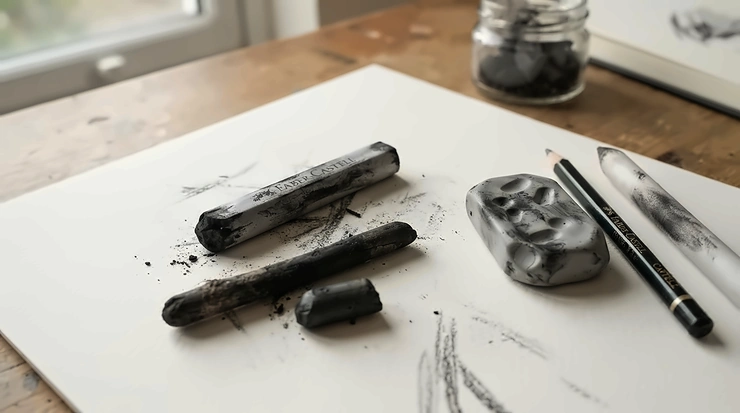
A kneadable eraser for charcoal drawing is a soft, putty-like piece of rubber that lifts charcoal by absorbing it rather than scrubbing it away. You press, pinch or roll it to draw pigment into the putty. You mould it into a point or wedge to cut light back into a dark passage. Then you knead it clean and go again. Reference definitions describe it as unvulcanised rubber, also called a putty rubber, that traps graphite and charcoal particles instead of wearing down.

Charcoal doesn’t so much sit on the paper as hover there. It’s a loose cloud of black dust held on by little more than paper tooth and optimism. Reach for a standard plastic rubber and you’ll smear that cloud into a grey bruise. A kneadable eraser for charcoal drawing works the opposite way. It’s less a correction tool than a second drawing tool, one that draws in light.
That’s why serious charcoal artists keep one within arm’s reach at all times. With the right piece you can lift a glint into an eye, carve a rim of light along a jawline, or rescue a sky that went too dark. With the wrong one you get greasy smears, stray crumbs, or a lump that hardens in your pencil case like a forgotten gobstopper.
This guide covers seven real, widely sold options, from budget to premium. They’re assessed from published specifications, retailer details and aggregated reviewer sentiment. I haven’t tested any of them, and I won’t pretend otherwise. You’ll also find a step-by-step technique guide, a decision framework and honest notes on where each eraser falls short. Start with the quick comparison, then dig into the detail.
Quick Comparison: Kneadable Eraser for Charcoal Drawing at a Glance
| Product | Feel | Format | Price range | Best For |
|---|---|---|---|---|
| Faber-Castell Kneadable Eraser | Very soft, pliable | Single block in storage case | around £2-£4 | All-round charcoal and pastel work |
| Staedtler Kneadable Art Eraser | Soft, absorbent | Single block | under £3 | Students on a tight budget |
| Koh-I-Noor Kneadable Eraser | Soft, slightly tacky | Single boxed block | around £2-£4 | Pulling light from dark grounds |
| Winsor & Newton Kneaded Putty Rubber | Firmer, holds its shape | Medium (4cm × 3cm) or large (7cm × 4cm) | £3-£6 range | Fine points and detail |
| Derwent Kneadable Eraser | Very soft, putty-like | Single block | under £4 | Quick, loose sketching |
| Prismacolor Premier Kneaded Eraser | Firm at first, softens with use | Three sizes; medium about 42 × 30 × 7 mm | £3-£5 range | Heavy daily users |
| Phinus Kneaded Erasers (8 Pack) | Soft, absorbent | Eight-piece multipack | roughly £8-£12 range | Classes, studios, travel kits |
Prices are indicative at the time of research. Check current price on the product page, as they change constantly.
Looking at the table, the Faber-Castell Kneadable Eraser is the safest all-round starting point, and the Staedtler Kneadable Art Eraser is the cheapest way in. If you want precision rather than pure softness, the firmer Winsor & Newton Kneaded Putty Rubber earns its slightly higher price. Anyone buying for a group should look at the Phinus Kneaded Erasers (8 Pack), though its track record is the least proven here.
💬 Just one click — help others make better buying decisions too!😊
Top 7 Kneadable Erasers for Charcoal Drawing: Expert Analysis
Each pick below follows the same logic. First comes what the specification means in practice, then who it suits. After that comes what real reviewers say, with the thin spots flagged honestly.
1. Faber-Castell Kneadable Eraser — softest all-rounder, case included
The standout is a very soft putty paired with a storage case, which is smarter than it sounds. Supplied as a single grey block, the Faber-Castell Kneadable Eraser is pitched for correcting and lightening charcoal, graphite and pastel. The case matters because loose putty collects pencil-case grit, and grit in an eraser becomes scratches on your drawing. The softness means it warms and pinches into a point within seconds, which is just what you need for lifting a glint from a dark tone.
Based on the spec comparison and published roundups, this suits anyone working in soft vine or compressed charcoal who wants one eraser to do everything. Softness cuts both ways, though. Heavy charcoal saturates a soft piece faster, so expect to knead more often. Reviewers consistently praise the pliability, the clean pick-up and the case, while a minority report it stiffens if left out of its box for a while.
Pros:
- ✅ Very soft and quick to shape
- ✅ Storage case keeps grit out
- ✅ Lifts charcoal and pastel cleanly
Cons:
- ❌ Saturates faster on heavy charcoal
- ❌ Can stiffen when left uncased
Expect around £2-£4 at the time of research. For the case alone, that’s strong value.
2. Staedtler Kneadable Art Eraser — cheapest dependable way in
The standout is price. The Staedtler Kneadable Art Eraser costs less than a sandwich and still does the core job. The manufacturer positions it as pliable, absorbent and suited to lightening charcoal and pastel. It also stresses that you can shape the block to vary the width of the erasing area. That’s genuinely useful, because flattening it into a wedge lets you lift a broad tonal band in one pass, while a pinched tip handles the fine work.
On paper, this is a sensible first eraser for students, sketchbook doodlers and anyone unsure charcoal will stick. The honest caveat is evidence. I couldn’t find a sizeable pool of verifiable UK customer reviews at the time of research. This verdict therefore rests on the stated specification and the broad, well-understood behaviour of the product type, not on proven reviewer consensus. Check recent reviews on the product page before buying.
Pros:
- ✅ Very low cost of entry
- ✅ Shapeable for wide or fine lifting
- ✅ Suited to charcoal and pastel work
Cons:
- ❌ Limited verifiable review data
- ❌ No storage case included
Expect under £3. It’s a low-risk purchase, but it’s unproven beyond the spec sheet.
3. Koh-I-Noor Kneadable Eraser — heritage brand, built for negative space
The standout is its reputation for pulling light out of dark grounds. A 2026 roundup singles out the Koh-I-Noor Kneadable Eraser (listed under code FA6423KE in blue) for reductive work. That means laying a deep charcoal tone first, then drawing the lights back in with the eraser. The same roundup says compressed and soft vine charcoal users will enjoy it most. It’s made by a company that has been producing art materials since 1790.
What does that mean for you? If your style is tonal and atmospheric, with moonlit trees, smoky portraits and glowing windows, you’ll lean on lifting more than on drawing. Under those conditions an eraser that releases cleanly and doesn’t smear matters more than raw softness. The colour is cosmetic, though a paler putty can make saturation easier to spot. As with the Staedtler, I couldn’t verify a deep UK review pool, so the praise here comes from one roundup’s assessment.
Pros:
- ✅ Strong fit for reductive charcoal work
- ✅ Established European art-supply heritage
- ✅ Handles compressed and vine charcoal
Cons:
- ❌ Few verifiable UK reviews found
- ❌ Single piece only
Expect around £2-£4. It’s good value if your work is mostly tonal.
4. Winsor & Newton Kneaded Putty Rubber — holds its shape for fine points
The standout is firmness. The Winsor & Newton Kneaded Putty Rubber comes in medium (4cm × 3cm) and large (7cm × 4cm). The maker says it can be moulded to a fine point and works on pencil, chalk and charcoal without smearing. Firmer putty keeps a sharp tip longer, which is why it suits tiny highlights, such as a catchlight in an eye or a sparkle on water.
Choose the large size if you’re working on A3 or bigger, and the medium for sketchbook scale. Reviewers on retailer pages describe it lifting pencil from watercolour paper without roughing the surface. A handful of five-star comments on the maker’s site say it holds its shape better than other putty rubbers and that small pieces can be pinched off without crumbling. That pool is small, so weigh it accordingly. The trade-off of firm putty is that it takes a moment longer to warm up in cold hands.
Pros:
- ✅ Holds a fine point well
- ✅ Two sizes for different scales
- ✅ Gentle on delicate paper surfaces
Cons:
- ❌ Slower to soften in cold hands
- ❌ Small verified review pool
Expect a £3-£6 range depending on size. It’s a solid premium-leaning choice for detail work.
5. Derwent Kneadable Eraser — pale putty, quick to soften, mixed reviews
The standout is how quickly it softens. The Derwent Kneadable Eraser is described by retailers as suited to highlighting, stippling and ghosting. You mould it until soft, pull it to a point and remove layers of pigment gradually. That gradual lifting is what makes it good for ghosting, where you want a faint pale trace rather than a hard white mark.
Reviewer sentiment here is the most divided of the seven. Some call it indispensable for charcoal and praise the clean, precise lifting. Others report a sticky film on fingers and, in one case, a slight residue on the paper that interfered with the next pencil layer. One buyer found it blackened quickly and binned it after a few hours of drawing. The practical reading is that it suits light, loose sketching better than marathon sessions. If you’re prone to sticky-finger complaints, give it a trial on scrap paper first.
Pros:
- ✅ Softens fast and shapes easily
- ✅ Good for gentle ghosting effects
- ✅ Easy to find at UK art shops
Cons:
- ❌ Some reviewers report sticky residue
- ❌ Blackens quickly under heavy use
Expect under £4. It’s decent value for light work, but not the long-haul choice.
6. Prismacolor Premier Kneaded Eraser — built to last for heavy users
The standout is longevity. The Prismacolor Premier Kneaded Eraser (model SA70530, medium) is sold in three sizes. One retailer lists the medium at roughly 42 × 30 × 7 mm and 18 g. Its maker says it highlights and erases chalks, charcoal, pastels and coloured pencils. It starts firm and softens as you knead it, which is a feature rather than a flaw if you dislike overly squishy putty.
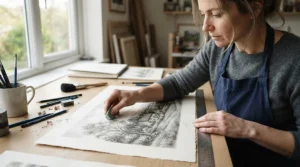
Because it softens gradually, it tends to suit artists who draw daily and resent replacing consumables. One reviewer on the maker’s page reports a single piece lasting months, though that’s a single data point. Availability can be patchy, as the maker’s own site showed it out of stock at the time of research, so check current UK stock before planning around it. If you want the dense, controlled feel of firmer putty with room to grow, this is a credible pick.
Pros:
- ✅ Softens gradually with kneading
- ✅ Three sizes available
- ✅ Reported to last for months
Cons:
- ❌ Stiff and slightly awkward at first
- ❌ Stock can be inconsistent
Expect a £3-£5 range. It’s good long-term value for regular users.
7. Phinus Kneaded Erasers (8 Pack) — eight pieces for studios and classes
The standout is quantity. The Phinus Kneaded Erasers (8 Pack) is marketed for blending, highlighting, shading, smoothing and correction. A product Q&A states it lightens charcoal, pastel, chalk, coloured pencil and graphite. The practical value of eight pieces is segregation. Roundups advise dedicating one eraser to charcoal so dark pigment doesn’t transfer onto lighter pencil work, and a multipack makes that discipline cheap.
It also suits classrooms, workshops and travel kits, where erasers walk off. The caveat is unproven quality. The UK listing I found showed no ratings yet, so there’s no reviewer consensus to summarise. Treat the claims as the seller’s, not as verified outcomes. If you’re buying for a group, consider testing one piece first before committing the class budget.
Pros:
- ✅ Enough erasers to dedicate per medium
- ✅ Low cost per individual piece
- ✅ Good for classes and travel kits
Cons:
- ❌ No verifiable ratings found
- ❌ Lesser-known brand
Expect roughly £8-£12 for the pack (check current price). The value is real only if the quality holds up.
Charcoal Drawing Technique: A Step-by-Step Lifting Guide
Amazon listings won’t teach you this, but how you use the eraser matters as much as which one you buy. This sequence works with any of the seven. It reflects the reductive approach described in The Met’s overview of charcoal materials and techniques, which lists erasing among the core charcoal methods.
- Warm and knead first. Pull the putty apart, fold it and squeeze for 20 to 30 seconds. Cold putty drags and can leave streaks.
- Tone the paper before you lift. Lay a soft charcoal layer, then blend it with a fingertip or stump. You can’t lift light from paper you haven’t darkened.
- Dab, don’t drag. Press the eraser down and lift straight up. Dragging pushes charcoal sideways and muddies edges.
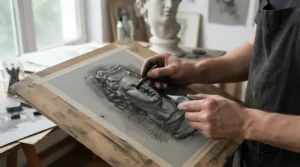
- Shape for the job. Use a point for glints, a wedge for edges and a flattened pad for broad tonal lifting. Traditional charcoal tutorials show light being etched into dark areas with a sharp-edged eraser, and putty pinched to an edge does a similar job.
- Refresh constantly. Fold the dirty surface inward every few dabs. A saturated eraser re-deposits charcoal.
- Step back. Squint from a metre away. Lifted highlights always look stronger up close, so judge from a distance.
- Fix last. Apply fixative only once you’re happy. Lifting after fixing is far harder.
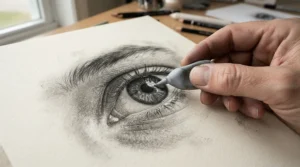
Highlight Lifting: Problems and Solutions
Even with a good eraser, highlight lifting can go wrong. Here are the five most common problems and their fixes.
Problem: the eraser leaves grey smears. The eraser is saturated. Fold it inward and knead until the surface looks clean, then dab again.
Problem: highlights look patchy and uneven. You’ve probably pressed too hard in some spots. Use consistent, light pressure, and build the highlight in two or three passes instead of one heavy one.
Problem: the paper looks shiny or burnished. Repeated rubbing flattens the paper’s tooth. Switch to lifting straight up, and avoid going over the same spot more than a handful of times.
Problem: the eraser feels sticky or leaves residue. This is a reported complaint with some softer putties, such as the Derwent Kneadable Eraser. Wash your hands, work on a scrap first, and consider a firmer option like the Winsor & Newton Kneaded Putty Rubber.
Problem: you can’t get back to white on dense black. Per general references on the tool, kneaded erasers are better at lightening than at fully removing heavy dark areas. Build darks more gradually in future, and accept a pale grey as the practical limit.
Real-World Scenarios: Which Eraser for Which Artist?
Scenario one: the A-level student. Working on A3 cartridge paper for coursework, with a budget of a few pounds. The Staedtler Kneadable Art Eraser or the Faber-Castell Kneadable Eraser covers the need. The Faber-Castell Kneadable Eraser‘s case suits a rucksack that gets bounced around on the bus.
Scenario two: the weekend portrait hobbyist. Drawing two evenings a week, with heavy tonal work on toned paper. The Koh-I-Noor Kneadable Eraser suits reductive work, and the Prismacolor Premier Kneaded Eraser wears well over many sessions.
Scenario three: the life-drawing class tutor. Needs a stash for twelve people, with erasers that go missing. The Phinus Kneaded Erasers (8 Pack) makes sense, provided you test one piece before buying more.
Scenario four: the detail-obsessed illustrator. Wants tiny highlights on hair and metal. The firmer Winsor & Newton Kneaded Putty Rubber holds a sharp point best.
How to Choose a Kneadable Eraser for Charcoal Drawing
Choosing well comes down to six decisions.
- Match softness to your charcoal. Soft vine charcoal and loose sketching suit a very soft putty. Dense compressed charcoal and detail suit something firmer.
- Consider your paper. Lighter sketch paper wants a gentle putty, and heavy cartridge paper tolerates more pressure.
- Pick a size to match your scale. Large pieces cover tonal areas on A3. Small ones suit sketchbooks and travel.
- Think about storage. A case protects against grit, which is the main way putty becomes damaging.
- Check for allergies. If latex matters to you, read labels carefully. For example, the US maker of General’s Kneaded Erasers states its product is latex and PVC free.
- Plan for multiples. Roundups advise one dedicated eraser for charcoal. For a ready-made set, Mont Marte Kneaded Erasers is highlighted in one roundup as a multipack option.
Mouldable Eraser for Highlights: Shaping Light Into the Dark
A mouldable eraser for highlights is really a set of tools disguised as one lump. A pinched tip draws fine lines, like the sparkle of an eye or a strand of hair. A rolled cylinder makes soft, rounded lifts, good for cloud tops and skin sheen. A flattened pad removes a broad band of tone, which is how you build a glowing gradient along a cheekbone. A sharp edge, pulled across the paper, creates crisp rim lights.
This is why putty firmness matters. Softer erasers like the Faber-Castell Kneadable Eraser reshape quickly but also lose their tip quickly. Firmer ones like the Winsor & Newton Kneaded Putty Rubber hold a point for longer. What most buyers overlook is that you don’t need to choose one forever. Many artists keep a soft piece for broad work and a firm piece for detail.
Soft Eraser for Charcoal Blending: Softening Edges by Subtraction
Blending is usually about adding, with fingers, stumps and tissue. But a soft eraser for charcoal blending works from the other direction. Tap a flattened piece along a hard edge and the charcoal fades into the paper gently. This is especially useful where a stump would drag too much pigment into the light.
Try this on a shadow edge. Lay the dark, blend it, then dab the border lightly with a pale putty. The edge softens and picks up a hint of transparency that blending alone can’t achieve. Softer putties suit this best, so the Faber-Castell Kneadable Eraser or the Derwent Kneadable Eraser are natural fits. Keep a clean surface exposed, or you’ll push grey back in.
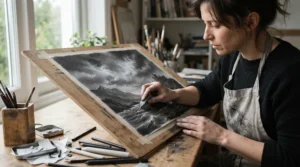
Soft Pastel Correction: What Works and What Doesn’t
Soft pastel correction is trickier than charcoal because pastel pigment is denser and often coloured. The maker of the Staedtler Kneadable Art Eraser states it’s suited to correcting and lightening pastel, and other makers say the same of their putties. That’s reliable for light layers.
The limit is density. Heavy, layered pastel fills the paper’s tooth, and no putty will fully remove it. Based on general references on the tool, expect to lighten rather than erase. Practise the sequence: lift gently with a dab, then rework the area with fresh pastel. Dedicate a separate eraser for pastel, because coloured pigment saturates putty fast. Test on a corner first, and avoid rubbing, which grinds pigment deeper into the surface.
Kneadable Eraser vs Plastic Rubber and Other Alternatives
| Eraser type | Charcoal lifting | Paper-friendliness | Precision | Best For |
|---|---|---|---|---|
| Kneadable eraser | Excellent, absorbs | Very gentle | Moulds to any shape | Highlights, tonal lifting |
| Plastic (vinyl) eraser | Good, but can smear | Needs sturdier paper | Edge only | Hard corrections on heavy paper |
| Gum eraser | Moderate | Gentle | Low | Light surface cleaning |
| Pen-style precision eraser | Limited | Moderate | Very high | Tiny pencil details |
| Electric eraser | Strong | Can damage paper | High | Stubborn marks on tough paper |
Looking at this comparison, the kneadable eraser is the only type that behaves like a drawing tool, thanks to its moulding ability. A roundup of artist erasers notes that plastic types suit heavy paper where pressure is acceptable, while lighter sketch paper wants a kneaded or gum variant. For charcoal, the absorbing action is what keeps dark dust from spreading, which is exactly why the putty type earns its place.
Long-Term Cost and Maintenance
| Tier | Products | What you pay | What you trade | Best For |
|---|---|---|---|---|
| Budget | Staedtler Kneadable Art Eraser, Derwent Kneadable Eraser | Under £4 | Fewer verified reviews or mixed durability | Students, casual sketching |
| Mid-range | Faber-Castell Kneadable Eraser, Koh-I-Noor Kneadable Eraser, Prismacolor Premier Kneaded Eraser | £2-£5 range | Softness or stock consistency varies | Regular artists |
| Premium / bulk | Winsor & Newton Kneaded Putty Rubber, Phinus Kneaded Erasers (8 Pack) | £3-£12 range | Firmness or unproven quality | Detail work, classes |
Cost per use hardly matters at these prices, so maintenance is what counts. Knead the putty clean after each session, and store it covered and away from heat, since warm putty turns sticky. Retire it when kneading no longer returns it to a clean state, because a saturated eraser deposits pigment instead of lifting it.
For archival work, note that conservation records describe kneaded rubber as leaving tiny, nearly invisible crumbs, so it’s worth brushing the surface lightly before fixing or framing.
Common Mistakes When Buying a Kneadable Eraser
Buying on price alone. The cheapest piece isn’t always the best fit. If it’s too soft or too firm for your charcoal, you’ll fight it every session.
Sharing one eraser across media. A putty used on charcoal will deposit grey onto lighter pencil work. Keep a dedicated one for charcoal.
Ignoring size. Tiny pieces are awkward for large tonal lifts, and oversized ones are clumsy for detail.
Expecting it to erase dense black. It lightens beautifully but doesn’t vanish heavy darks.
Ignoring storage. Leaving putty loose invites grit and warmth, both of which ruin it. A case, or at least a clean pot, makes a real difference.
Frequently Asked Questions
❓ Which kneadable eraser for charcoal drawing is best for beginners?
❓ Is a multipack of kneadable erasers worth buying?
❓ Why does my kneadable eraser leave grey smears?
❓ Can a kneadable eraser lift soft pastel without staining the paper?
❓ How do I soften a hard, new kneadable eraser?
Conclusion
The best kneadable eraser for charcoal drawing is the one that matches your charcoal, your paper and your habits. For most people, the Faber-Castell Kneadable Eraser is the safest all-rounder, thanks to its softness and protective case. The Staedtler Kneadable Art Eraser is the budget route, though its review evidence is thin. The Koh-I-Noor Kneadable Eraser suits reductive, tonal work, and the Winsor & Newton Kneaded Putty Rubber is the pick for fine points. The Derwent Kneadable Eraser suits light sketching, with the caveat of mixed reviews. The Prismacolor Premier Kneaded Eraser rewards daily users, and the Phinus Kneaded Erasers (8 Pack) makes sense for groups, once you’ve tested a piece.
Whichever you choose, the technique matters just as much as the tool. Dab rather than drag, knead often, and keep a dedicated eraser for charcoal. Do that, and even a modest piece of putty will pay you back in luminous highlights.
✨ Ready to start lifting light?
Check the current price of your favourite pick and give your next drawing the glow it deserves!🎨
Recommended for You
- Electric Eraser For Artists: 7 Best Picks For Flawless Lines (2026)
- Erasers Under £10 for Artists: 7 Best Picks, No Smudges (2026)
- Drawing Paper Pad Under £10: 7 Best Budget Buys (2026)
Disclaimer: This article contains affiliate links. As an Amazon Associate, I earn from qualifying purchases. If you purchase products through these links, we may earn a small commission at no additional cost to you.
✨ Found this helpful? Share it with your friends! 💬🤗
