In This Article
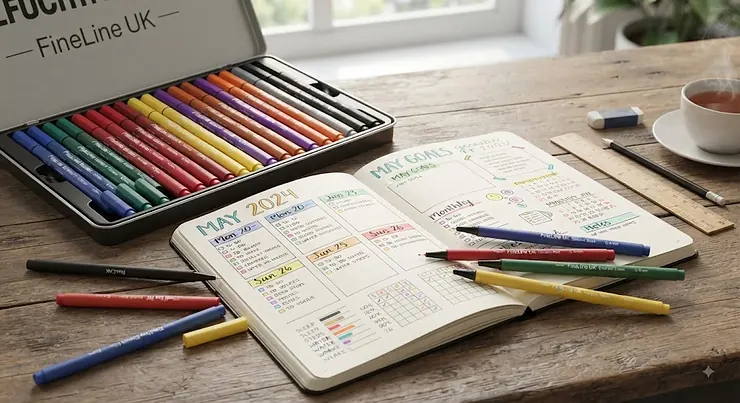
There’s a particular kind of heartbreak reserved for bullet journalers: you’ve spent twenty minutes ruling out a perfect weekly spread, and the pen you’re using decides, halfway through Thursday, to bleed clean through to the page beneath. Choosing fineliner pens for bullet journaling isn’t really about which packet looks prettiest on a stationery haul video — it’s about ink chemistry, nib durability and paper compatibility, three things that rarely get mentioned until something goes wrong.
This guide exists because most “best pens” round-ups are dressed-up product listings with a coat of enthusiasm painted over the top. We’re doing something different: real specs, honestly summarised review sentiment, and analysis that tells you why one pen suits a heavy-handed doodler and another suits someone who just wants tidy Monday-to-Sunday headers. Whether you’re weighing fineliner pens vs gel pens for drawing, hunting for reliable fineliner pens under £20, or trying to work out why your dot grid paper keeps letting ink through, you’ll find grounded, UK-specific answers here.
Fineliners have quietly become one of the defining tools of the bullet journal method, prized for the fine, consistent line that keeps handwriting and hand-drawn grids looking deliberate rather than scrappy. Seven real, currently available products sit at the centre of this article, spanning roughly £1 singles up to premium technical sets, so you can match a pen to your budget, your handwriting pressure and the kind of spreads you actually draw — not the aspirational ones from your Pinterest board. Every recommendation below is a genuine, purchasable product; none of it is invented.
Quick Comparison Table
| Pen | Line Width | Ink Type | Price Range | Best For |
|---|---|---|---|---|
| Staedtler Triplus Fineliner | 0.3mm | Water-based, dry-safe | Under £20 (set) | Colourful budget layouts |
| Stabilo Point 88 | 0.4mm | Water-based | Under £20 (set) | Left-handed writers |
| Sakura Pigma Micron | 0.20–0.45mm | Archival pigment | £10-£16 (6-pack) | Waterproof key lines and headers |
| Uni Pin Fine Line | 0.1–0.8mm | Pigment | £10-£15 (6-pack) | Consistent technical drawing |
| Faber-Castell PITT Artist Pen | 0.1–0.7mm | India ink | £10-£20 (set) | Mixed-media, watercolour spreads |
| rOtring Tikky Graphic | 0.1–1.0mm | Pigmented, water-resistant | £5-£8 (single) | Ruler work and precise layouts |
| Tombow Mono Drawing Pen | 0.1–0.8mm | Pigment | £12-£20 (set) | Long drafting sessions |
Looking at the spread above, the cheapest route into fineliner-based bullet journaling is a Staedtler Triplus Fineliner or Stabilo Point 88 set, both of which sit comfortably under £20 for a colourful multi-pen pack. If archival waterproofing matters more than colour range, the Sakura Pigma Micron and Uni Pin Fine Line occupy the sensible middle ground, while the Faber-Castell PITT Artist Pen, rOtring Tikky Graphic and Tombow Mono Drawing Pen reward anyone doing detailed technical layouts or mixed-media spreads with sturdier tips and more consistent long-term line quality.
💬 Found a pen that changed your journaling game? Share this guide with a fellow bujo obsessive!😊
Top 7 Fineliner Pens for Bullet Journaling: Expert Analysis
Below is a genuinely researched line-up of seven fineliners, chosen to cover budget, mid-range and premium price bands along with the variants and lesser-known alternatives worth knowing about. Every product is real and currently sold; pricing is shown in ranges only, since exact figures shift constantly.
1. Staedtler Triplus Fineliner — best all-round budget colour set
The Staedtler Triplus Fineliner is the pen most bullet journalers meet first, and there’s a reason it keeps turning up in every stationery drawer from student flats to design studios. Its triangular barrel is the standout feature here — it sounds like a gimmick until you’ve hand-lettered a header for twenty minutes and realised your fingers aren’t cramping.
The 0.3mm metal-clad tip holds its shape through heavy use, and the water-based, dry-safe ink formula means a pen left uncapped overnight on your desk won’t have died by morning — a genuinely useful trait for anyone who journals in short, interrupted bursts. It’s sold in packs from six colours right up to sets of 36, 42 and 60, so colour-coding an entire habit tracker is realistic without buying five separate brands.
Who should reach for this one: beginners building their first colour-coding system, and anyone who wants variety without committing to a premium price tag. Reviewers consistently describe the line quality as smooth and consistent across the full colour range, though several independent pen-testing sites note that, like most fineliners in this price bracket, it will show through thinner journal paper — a paper-thickness issue rather than a pen fault, and one we cover in detail further down.
Pros:
- ✅ Ergonomic triangular barrel reduces hand fatigue
- ✅ Dry-safe ink survives being left uncapped
- ✅ Huge colour range up to 60 shades
Cons:
- ❌ Can show through paper under 100gsm
- ❌ Not waterproof, so unsuitable under watercolour washes
Typically priced under £20 for a set of six to ten pens, with larger colour sets moving into the £25-£45 range, the Staedtler Triplus Fineliner represents excellent value for anyone building a colour-coded system from scratch.
2. Stabilo Point 88 — Europe’s best-selling fineliner
If the Staedtler Triplus Fineliner is the pen most people meet first, the Stabilo Point 88 is the one they meet standing right next to it on the shelf. Its distinctive hexagonal, orange-striped barrel is the standout feature — instantly recognisable, and genuinely practical, since the flat sides stop it rolling off a sloped desk mid-spread.
The 0.4mm steel-sleeved plastic tip lays down a slightly bolder, more consistent line than the Triplus, and the ink is specifically formulated to resist smudging, which independent reviewers highlight as a real benefit for left-handed writers dragging a hand across fresh ink. Available in ranges from around 30 up to 65 colours, it’s built for the same colour-coded habit-tracker use case as the Staedtler, just with a firmer, slightly less rounded line character.
Genuinely useful detail: this pen is widely reported as the best-selling fineliner in Europe, which matters practically — it’s the pen most likely to still be in stock at your local high street stationer when you need a replacement in a hurry, rather than something you’re waiting a week to arrive.
Pros:
- ✅ Smudge-resistant ink, good for left-handed users
- ✅ Widely stocked in UK shops for easy restocking
- ✅ Consistent 0.4mm line across the colour range
Cons:
- ❌ Mismatched cap colours annoy some long-term users
- ❌ Less even coverage than Staedtler when filling large areas
Single pens typically sit around £1-£1.50, with full sets of 30 to 65 colours falling in the £18-£40 range — comfortably inside the fineliner pens under £20 bracket if you’re buying a smaller starter set.
3. Sakura Pigma Micron — archival ink industry standard
Ask any bullet journal community which pen they’d grab in a house fire, and the Sakura Pigma Micron comes up more than any other single product. What most buyers overlook about this pen is that it isn’t really competing with the Staedtler or Stabilo at all — it’s a different category of tool, built around pigment-based, archival ink rather than the water-based dye ink typical of budget fineliners.
That pigment formulation is the practical distinction that matters: pigment particles are physically larger than dye molecules, so they sit on the surface of the paper rather than soaking into it, which is why the Micron resists bleed-through and ghosting far better than dye-based alternatives even on thinner journal pages. It’s also genuinely waterproof once dry, meaning you can lay a watercolour wash or run a highlighter directly over Micron linework without smearing the ink underneath — a specific, testable claim rather than marketing fluff.
Sizes run from an ultra-fine 0.20mm up to a bolder 0.45mm, letting you use one brand for both micro-writing in dense grid boxes and bolder section headers. Reviewers consistently praise the archival, fade-resistant quality, which matters if you intend to keep old journals as a long-term record rather than a disposable planner.
Pros:
- ✅ Genuinely waterproof, archival pigment ink
- ✅ Resists bleed-through better than dye-based fineliners
- ✅ Multiple nib sizes from ultra-fine to bold
Cons:
- ❌ Smaller nibs need gentle pressure or they can bend
- ❌ Pricier per pen than budget colour sets
A six-pack typically runs £10-£16, which places most Micron purchases just inside or just over the fineliner pens under £20 threshold depending on the set size and tip variety you choose.
4. Uni Pin Fine Line — most consistent technical fineliner
The Uni Pin Fine Line doesn’t get the same social-media attention as the Sakura Micron, but it’s a genuine favourite among journalers who’ve tested a wide spread of pens against different paper weights side by side. Its standout feature is consistency — testers who’ve run direct comparisons across 80gsm through 180gsm paper repeatedly rank it alongside the Micron for reliable, even ink flow regardless of paper quality.
Built with pigment ink in a technical-drawing pen format, the Uni Pin is designed for ruler and stencil work as much as freehand writing, which is genuinely useful if your bullet journal habit involves drafting straight-edged habit trackers or architectural-style layout grids. The tip is available across a wide range of widths, so a single six-pack can cover everything from micro annotations to bold divider lines.
Honest analytical take: this is the pen for someone who values reliability over brand recognition — it won’t show up in as many “aesthetic journaling” hauls, but it performs like a workhorse precisely because it isn’t trying to be decorative.
Pros:
- ✅ Excellent consistency across different paper weights
- ✅ Designed for ruler and stencil precision work
- ✅ Wide range of tip sizes in one set
Cons:
- ❌ Less colour variety than Staedtler or Stabilo
- ❌ Barrel design is plain compared to competitors
A six-pack of assorted tip sizes generally costs £10-£15, keeping the Uni Pin Fine Line firmly inside the fineliner pens under £20 category for most buyers.
5. Faber-Castell PITT Artist Pen — best India-ink premium set
The Faber-Castell PITT Artist Pen moves the conversation from “writing tool” to something closer to a proper drawing instrument. Its standout feature is the ink itself: genuine India ink, pigmented and waterproof, the same formulation family used in professional illustration and technical drafting rather than a journaling-specific dye blend.
Based on the spec comparison with the rest of this list, the PITT range is the most obviously multi-purpose — available in four nib sizes from an ultra-fine 0.1mm up to a 0.7mm medium, plus dedicated brush-tip variants for hand lettering. Faber-Castell explicitly markets a set built for bullet journaling that bundles a handful of tip sizes with a highlighter, which tells you plainly that the brand sees this as core journaling kit rather than a fine-art crossover product. Independent art-supply retailers highlight that, once dry, the ink doesn’t lift or bleed even when watercolour is layered directly over it — genuinely useful if your spreads mix line work with painted washes.
Here’s what to weigh: the trade-off for that fine-art-grade ink is a narrower everyday colour range than Staedtler or Stabilo, so most journalers pair a PITT set for structural linework with a separate coloured fineliner set for decoration.
Pros:
- ✅ Genuine waterproof India ink, bleedproof when dry
- ✅ Four nib widths plus brush-tip variants
- ✅ Holds up under watercolour washes
Cons:
- ❌ Fewer colours than dedicated colour-coding sets
- ❌ Premium per-pen pricing versus budget fineliners
Single pens typically fall in the £2-£3.50 range, with a small journaling-focused set landing around £10-£20 — still reasonable, though a full multi-colour collection will push past the £20 mark.
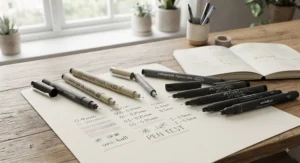
6. rOtring Tikky Graphic Fineliner — best for ruler-precise technical layouts
The rOtring Tikky Graphic carries decades of technical-drawing pedigree, and it shows the moment you run it along a ruler edge. Its standout feature is the metallic fibre tip, engineered specifically for use with templates and straight edges without the nib snagging, fraying or losing its shape the way cheaper plastic tips can.
rOtring’s “Free Ink” system is the mechanism worth understanding here: it’s designed to maintain constant, consistent ink flow across the pen’s usable life, which in practice means the line at pen number one hundred of a habit tracker looks the same as line number one — no fading, no scratchiness. The pigmented, water-resistant, lightfast ink is built for technical longevity rather than journaling flair, and it’s available across seven line widths, from hairline detail work up to bold section dividers.
Honest analytical take: this is overkill for someone who just wants a cheerful colour palette for weekly headers, but it’s precisely right for anyone building geometric, ruler-drawn spreads, habit-tracker grids, or anything resembling architectural layout work inside their journal.
Pros:
- ✅ Metallic tip built for ruler and template use
- ✅ Consistent ink flow across the pen’s lifespan
- ✅ Seven line widths for varied technical work
Cons:
- ❌ Not refillable, so it’s replaced rather than topped up
- ❌ Limited colour options compared with journaling-specific sets
A single rOtring Tikky Graphic typically costs £5-£8, which means building a small multi-width technical set for grid-based layouts generally stays within the fineliner pens under £20 range if you buy two or three widths.
7. Tombow Mono Drawing Pen — best lesser-known drafting-grade alternative
The Tombow Mono Drawing Pen is the pick most bullet journal beginners have never heard of, and that’s precisely why it earns its place here — Tombow’s name recognition in the UK sits mostly with its Dual Brush range, while this pigment-ink drafting pen quietly does excellent, unglamorous work in the background. Its standout feature is drafting-grade nib durability, built to withstand the repeated, heavy-pressure strokes of technical drawing rather than the lighter touch of casual note-taking.
The pigment ink formulation puts it in the same waterproof, archival category as the Sakura Micron and Uni Pin, meaning it resists bleed-through and stands up to highlighter and watercolour layering. Nib sizes span from an ultra-fine 0.1mm through to a bold 0.8mm, giving enough range to handle both micro-annotation and confident section dividers from a single set.
What most buyers overlook about this pen is that its main competitive edge isn’t the ink chemistry, which is broadly comparable to its rivals, but nib longevity under sustained pressure — testers who journal daily and press firmly report the tip holding its shape noticeably longer than some budget alternatives before it starts to fray or splay.
Pros:
- ✅ Drafting-grade nib built for sustained heavy use
- ✅ Waterproof, archival pigment ink
- ✅ Wide nib-size range in a single set
Cons:
- ❌ Less brand recognition means fewer UK reviews to cross-reference
- ❌ Colour range narrower than budget dye-based sets
Sets typically cost £12-£20, placing the Tombow Mono Drawing Pen at the upper end of the fineliner pens under £20 bracket depending on how many nib sizes the set includes.
Setting Up Your Fineliner Collection: A Practical Usage Guide
Buying the right pen is only half the job — how you set it up and maintain it from day one determines whether it lasts three months or three years. Before your first proper spread, run a swatch test on the inside back cover of your journal: lay down a line from every pen you own, in both light and firm pressure, then leave the page overnight and check the reverse side the next morning. This single five-minute habit catches bleed-through problems before they ruin a page you’ve actually planned.
Store fineliners horizontally rather than upright wherever possible — resting a pen nib-down for weeks can cause ink to pool unevenly at the tip, leading to blotchy first strokes when you next pick it up. Always recap immediately after use; even “dry-safe” formulations like the Staedtler Triplus Fineliner are more forgiving than most, not immune, and a pen left open overnight is the single most common cause of a prematurely dead nib.
In the first thirty days, the most common mistake is pressing too hard while your hand adjusts to a finer tip than a standard biro. Fineliners are designed to glide with minimal pressure — bearing down splays the fibre tip and permanently widens the line it produces. If you’re colour-coding a habit tracker, test your full palette together on a spare page first; some combinations that look harmonious in the pack read very differently once inked side by side on cream or white paper.
💬 Ready to build your own pen collection? Bookmark this guide and come back before your next stationery haul!😊
Real-World Bullet Journal Scenarios: Which Fineliners Fit Your Life
Abstract advice rarely beats seeing your own situation reflected back at you, so here are three realistic profiles matched to specific pens with the reasoning behind each pairing.
If you’re a university student journaling between lectures with a tight £15 monthly stationery budget, the Staedtler Triplus Fineliner six-pack or the Stabilo Point 88 thirty-colour set covers colour-coded lecture notes, deadline trackers and the occasional doodled margin without denting your budget. Both survive being tossed loose into a bag between classes far better than fussier premium pens.
If you’re a working professional who journals daily before bed and wants pages that will still look sharp in five years, pairing the Sakura Pigma Micron for structural writing with the Faber-Castell PITT Artist Pen for the occasional watercolour or washi-tape accent gives you archival permanence plus mixed-media flexibility, at a total cost still well under £40 for a well-rounded kit.
If you’re a technical planner who draws precise habit-tracker grids, financial trackers or architecturally inspired weekly spreads with a ruler, the rOtring Tikky Graphic or Uni Pin Fine Line will outperform decorative fineliners every time — their tips are engineered specifically to survive repeated contact with a straight edge without fraying.
Fineliner Pens vs Gel Pens for Drawing
This is one of the most common forks in the road for anyone setting up a bullet journal, and it’s worth settling with more than a one-line opinion. Fineliner pens and gel pens solve genuinely different problems, and understanding the difference in practice — not just on the spec sheet — will save you buying the wrong tool twice.
| Feature | Fineliner Pens | Gel Pens |
|---|---|---|
| Dry time | Near-instant | Slower, more smudge risk |
| Line consistency | Very consistent, ruler-friendly | Varies with pressure |
| Best use | Layouts, grids, fine detail | Bold writing, highlights |
| Bleed risk on thin paper | Low to moderate | Low, but ghosting common |
| Best For | Sakura Pigma Micron, rOtring Tikky Graphic | Everyday journaling text |
Fineliners belong to the same fibre-tip pen family that grew out of the mid-twentieth-century felt-tip marker, refined down to a much finer, more controlled point. They dry almost the instant they touch the page, which is precisely why they’ve become the bullet journal community’s default for layout work — you can rule a grid, add a header, and immediately rest your hand on the page without smearing a single line. Their pigment or India-ink formulations, as seen in the Sakura Pigma Micron and Faber-Castell PITT Artist Pen, also give artists genuinely reliable line weight control for detailed doodles, which is harder to achieve with a gel pen’s rounder, more variable ink flow.
Gel pens, by contrast, earn their keep in bold everyday writing and colour-blocking rather than precision drawing — the ink lays down thicker and glossier, which reads beautifully for a big monthly header but muddies fine linework fast. Reviewers who test both side by side consistently land on the same verdict: fineliners for structure and detail, gel pens for expressive, high-saturation writing, and most well-stocked bullet journal kits genuinely benefit from having both rather than picking one camp permanently.
Dot Grid Paper and Bleed-Through: What Actually Matters
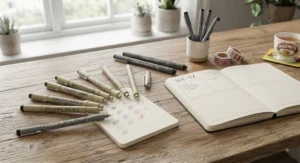
Dot grid paper is the de facto standard for bullet journaling for a specific structural reason: the small, evenly spaced dots guide straight lines and consistent spacing without the visual clutter of full ruled lines, which is why habit trackers, calendar grids and freeform sketches all sit comfortably on the same page format. Once ink is applied, the dots themselves recede almost invisibly, leaving your handwriting and drawn lines to do the visual work.
Bleed-through is a different issue entirely, and it’s worth being precise about the terminology because journalers often conflate two separate problems. Bleed-through means ink has fully penetrated the page and become visible on the reverse side; ghosting, by contrast, is a fainter shadow of ink showing through without actually soaking all the way across. Both stem from the same underlying cause — a mismatch between how much ink a pen deposits and how much the paper can absorb before it saturates.
Paper weight, measured in GSM (grams per square metre), is the single biggest lever you control. Standard budget notebooks often sit around 80gsm, which is genuinely workable with most fineliners but starts to struggle under heavier gel pens or brush markers. Many dedicated bullet journal users find 120 to 160gsm the sweet spot for mixed-media pages that combine fineliners with the occasional highlighter or watercolour wash. This is also why pigment-ink pens like the Sakura Pigma Micron and Tombow Mono Drawing Pen consistently outperform cheaper dye-based fineliners on thinner paper — their ink sits on the surface rather than saturating the fibres beneath, so the same page thickness shows noticeably less show-through. Pressing lightly rather than pressing hard also measurably reduces bleed-through, since a heavier hand forces more ink into the paper regardless of which pen you’re holding.
Fineliner Pens Under £20: Long-Term Cost & Maintenance
Sticking to a fineliner pens under £20 budget is entirely realistic, but the real cost conversation is longer-term than the sticker price on any single set. A £15 pack of six Staedtler Triplus Fineliners and a £15 set of thirty Stabilo Point 88 colours look similar on paper, but their cost-per-use diverges depending on how you actually journal.
If you’re colour-coding daily and cycling through your full palette every week, a large set — even at the upper end of the under-£20 bracket — amortises down to pennies per session over a year of regular use. If you mostly rely on one or two black or navy pens for structural writing, investing that same £20 in a smaller, higher-durability set like the Uni Pin Fine Line or a couple of rOtring Tikky Graphic widths often works out cheaper over eighteen months, because their nibs are built to withstand more total strokes before splaying.
Maintenance costs matter too, and they’re easy to overlook. None of the pens in this guide are refillable — once the ink runs dry, the whole pen is replaced — so total cost of ownership is really a function of how long each nib survives heavy use rather than ink volume alone. Reviewers who track pen longevity report that technical-drawing-grade tips, like those on the rOtring Tikky Graphic and Tombow Mono Drawing Pen, tend to outlast decorative budget fineliners under identical daily use, which can offset their slightly higher upfront price over the course of a year.
Planner Decoration With Fineliners: Features That Actually Matter
Planner decoration is where fineliners genuinely earn their keep beyond plain note-taking, but not every marketed feature translates into a real improvement on the page. Line width variety matters enormously — a single 0.3mm pen can’t do everything, and most experienced journalers keep at least three widths in rotation: something fine (0.1-0.2mm) for micro-detail and small lettering, a mid-range 0.3-0.5mm for everyday writing and borders, and a bolder 0.7mm-plus for headers and dividers that need to anchor a page visually.
Colour lightfastness is a feature that sounds like marketing hype until you flip back through an old journal a year later and find your pastel washi-inspired header has faded to almost nothing. Pigment-based sets, including the Sakura Pigma Micron and Faber-Castell PITT Artist Pen, are explicitly formulated to resist fading, which is worth prioritising if you plan to keep completed journals as a long-term archive rather than a disposable, single-year planner.
By contrast, features that get marketed heavily but matter less in practice include barrel colour-matching cosmetics and scent-infused ink variants — pleasant, but irrelevant to how well a spread actually looks or lasts. What genuinely elevates planner decoration is consistency: using the same two or three brands throughout a spread, rather than mixing five different ink formulations, keeps line weight and colour saturation visually coherent across a page.
✨ Don’t Miss These Exclusive Deals!
🔍 Take your bullet journal spreads to the next level with a well-matched fineliner set. Check current pricing and availability on the pens above to build a decoration kit your future self will thank you for!
How to Choose Fineliner Pens for Bullet Journaling
Fineliner pens for bullet journaling are fine-tipped, felt or fibre-tip pens, typically 0.1mm to 1.0mm wide, designed to produce a consistent, quick-drying line for writing, ruling grids and detailed drawing without smudging…
Choosing the right set comes down to a handful of practical criteria rather than brand loyalty:
- Decide your primary use first. Structural writing needs archival, waterproof ink like the Sakura Pigma Micron; decorative colour work is better served by a large budget set like the Staedtler Triplus.
- Match tip width to your handwriting size. Small, dense handwriting benefits from 0.1-0.3mm nibs; looser handwriting or bold headers suit 0.5mm and above.
- Check paper compatibility before committing to a set. A pen that performs beautifully on 160gsm paper may bleed on a budget 80gsm notebook — always test first.
- Consider ink permanence if you use watercolour or highlighters. Only genuinely waterproof, pigment-based pens survive layering without smearing.
- Factor in nib durability for your pressure style. Heavy-handed writers should prioritise metal-clad or steel-sleeved tips over softer plastic ones.
- Weigh colour range against per-pen cost. Larger sets reduce cost-per-colour but may include shades you rarely use.
- Buy a small set before a large one. Testing two or three brands on your actual notebook paper avoids an expensive mismatch later.
Common Mistakes When Buying Fineliner Pens
The most frequent mistake is buying purely on colour-set size without checking ink type — a 60-colour set is tempting, but if it’s dye-based rather than pigment-based, it may bleed on your particular paper regardless of how good the colour range looks in photos. Reading a set’s ink description before purchase, not just its colour count, avoids this entirely.
A second common error is assuming all fineliners in a given price band perform identically. Based on the spec comparison across this guide, a £15 pigment-based set like the Sakura Pigma Micron behaves very differently on the page to a £15 dye-based set like the Staedtler Triplus Fineliner, even though both fall inside the same fineliner pens under £20 category. Price alone tells you almost nothing about bleed resistance or archival quality.
Buyers also frequently overlook nib width labelling differences between brands — a “fine” tip from one manufacturer isn’t always the same millimetre width as a “fine” tip from another, so cross-referencing the actual mm figure, not just the marketing label, avoids an unwelcome surprise when your new pen writes thicker or thinner than expected.
Safety, Regulations and Compliance Guide
For anyone buying fineliners for children, or simply wanting reassurance about ink safety, it’s worth understanding the regulatory landscape briefly. Stationery products with play value sold in Great Britain generally fall under the Toys (Safety) Regulations 2011, which set requirements for materials, labelling and traceability. Since Brexit, compliant products in Great Britain carry either the UKCA marking or, under current transitional arrangements, the recognised CE marking; you can check the official government guidance on using the UKCA marking if you want the full legal detail behind what these marks confirm.
In practice, this means reputable fineliner brands sold through mainstream UK retailers — including every product featured in this guide — are manufactured to meet non-toxicity and material safety standards suitable for general use, including by children old enough to journal independently. If you’re buying for a younger child, it’s still worth checking individual packaging for specific age guidance, since nib size and small-parts risk can vary between product lines even within the same brand.
Frequently Asked Questions
❓ Do fineliner pens bleed through bullet journals?
❓ What is the best fineliner pen for beginners?
❓ Are fineliner pens better than gel pens for drawing?
❓ What GSM paper is best to avoid bleed-through?
❓ How much should I spend on fineliner pens under £20?
Conclusion
Choosing fineliner pens for bullet journaling really comes down to matching ink chemistry and nib type to what you actually draw, rather than chasing the biggest colour count or the most-photographed brand. Budget sets like the Staedtler Triplus Fineliner and Stabilo Point 88 genuinely earn their popularity for colourful, everyday layouts, while pigment-based options like the Sakura Pigma Micron, Uni Pin Fine Line and Tombow Mono Drawing Pen justify their slightly higher price with real bleed resistance and archival permanence. For anyone doing precise, ruler-guided layouts, the rOtring Tikky Graphic and the mixed-media flexibility of the Faber-Castell PITT Artist Pen round out a genuinely capable kit.
None of these seven pens is objectively “the best” in isolation — the right choice depends on your paper weight, your handwriting pressure, and whether you’re prioritising colour variety or archival permanence. What matters is buying with those specific criteria in mind rather than picking whichever set has the prettiest packaging, because the pen that photographs well and the pen that survives eighteen months of daily use aren’t always the same product.
Recommended for You
- Fineliner Pen Set for Artists: 7 Best Picks; Buying Guide 2026
- Fineliner Pens for Technical Drawing: 7 Best Picks for 2026
- Waterproof Fineliner Pens: 7 Best Picks UK 2026
Disclaimer: This article contains affiliate links. As an Amazon Associate, I earn from qualifying purchases. If you purchase products through these links, we may earn a small commission at no additional cost to you.
✨ Found this helpful? Share it with your friends! 💬🤗
