In This Article
Somewhere between the CAD file and the finished set of drawings, there’s still a moment where a human hand has to pick up a pen. Maybe it’s a quick section sketch pinned to the studio wall, a hand-annotated site survey, or a student portfolio that needs to look like it was made by a person rather than a plotter. Whatever the reason, fineliner pens for technical drawing are the tool that gets reached for again and again, because nothing else gives you a line that stays exactly the width you asked for, from the first stroke to the last.
Fineliner pens for technical drawing are fibre or plastic-nibbed pens, usually with a metal-clad tip, that lay down a consistent, pigment-based line for architectural, engineering and technical drawing work more broadly. Unlike ballpoints or standard felt-tips, the ink is formulated to be waterproof, fade-resistant and safe to run a straightedge along — which matters enormously the moment you’re inking over a pencil layout with a T-square in hand.
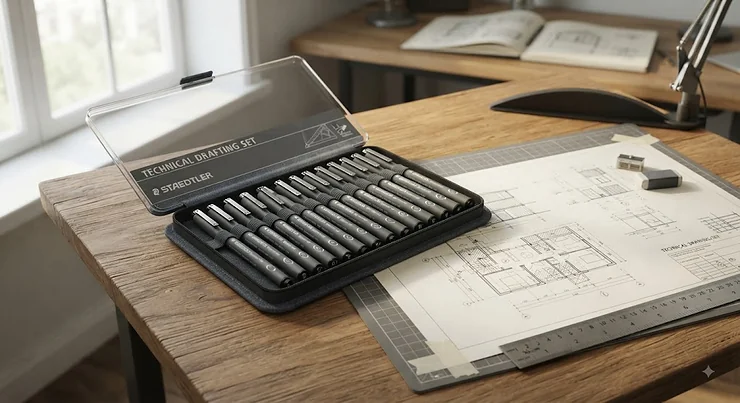
This guide walks through seven genuinely well-regarded pens on amazon.co.uk, from pocket-money multi-packs to the sort of set an architecture graduate buys themselves as a small treat. We’ll cover which nib sizes actually matter, how nib durability plays out over months of real use, what a ruler-safe tip is protecting you from, and where dedicated drafting pens earn their keep over a bargain bin set. Everything here is grounded in real product specs and genuine aggregated review sentiment — no invented five-star raves, just honest analysis of what these pens do well and where they fall short.
Quick Comparison Table
| Category | Pen | Nib Range | Best For |
|---|---|---|---|
| Best Overall | Staedtler 308 Pigment Liner | 0.05–0.8mm | All-round technical work |
| Best Budget | uni-ball PIN Fineliner | 0.1–0.8mm | Students and beginners |
| Best Premium | Faber-Castell PITT Artist Pen | 0.1–0.7mm + brush | Presentation drawings |
| Best for Nib Longevity | Sakura Pigma Micron | 0.15–1.2mm | Archival, detailed line work |
| Best Drafting Pen | rOtring Tikky Graphic | 0.1–0.7mm | Straightedge and template use |
| Best UK Brand | Derwent Graphik Line Maker | 0.05–0.8mm | Sketching and illustration crossover |
| Best Starter Multi-Pack | TWOHANDS 12-Piece Fineliner Set | 0.2–3.0mm | Trying different line widths cheaply |
Looking at that spread, the pattern that jumps out is nib size range versus nib toughness — the wider a set’s range, the more likely it leans towards sketching rather than precision drafting. If you’re drawing straight lines against a ruler for hours at a stretch, the Staedtler 308 Pigment Liner and rOtring Tikky Graphic are built with that specific abuse in mind, while the TWOHANDS 12-Piece Fineliner Set is better suited to exploratory sketching where the odd soft nib doesn’t matter as much.
💬 Found the right category already? Scroll down to the full product breakdown — or jump straight to how to choose below.🤗
Top 7 Fineliner Pens for Technical Drawing: Expert Analysis
1. Staedtler 308 Pigment Liner — the ruler-safe workhorse
Made in Germany and sold as singles or in mixed-width wallets, the Staedtler 308 Pigment Liner has quietly become the default recommendation wherever “fineliner pens for technical drawing” gets typed into a search bar, and the spec sheet explains why. It’s built around a long, metal-encased tip rated for use against rulers, stencils and templates, with nib widths from 0.05mm up to 0.8mm depending on which pack you buy. The pigmented black ink is indelible, waterproof and won’t smear when you run a highlighter over it later — a detail that matters more than it sounds once you’re colour-coding a marked-up drawing. Staedtler also rates the pen to survive 18 hours uncapped without drying out, tested to ISO 554, which is a genuinely useful buffer against the classic “left the lid off overnight” disaster. Based on the spec comparison with rival brands, this is one of the few sub-£15 pens making a formal durability claim rather than a marketing one. Reviewers consistently note that the nylon nib holds its shape far longer than cheaper alternatives; one long-term Amazon reviewer specifically compared it favourably to Sakura Pigma Micron, saying the Staedtler nib “held up” where the competitor’s nylon tip eventually pushed back into the barrel. Star ratings across the various pack sizes sit around 4.4 to 4.6 out of 5.
Pros:
- ✅ Long metal-clad tip genuinely rated for ruler and stencil work
- ✅ 18-hour cap-off tolerance reduces dried-out pens
- ✅ Reviewers report better nib longevity than several rivals
Cons:
- ❌ Ink runs slightly less jet-black than some Japanese brands
- ❌ Single pens cost more per-unit than bulk multi-packs
Expect to pay around £5-£7 for a single pen or roughly £12-£17 for a mixed-width set of six, depending on the retailer. At that price, and given the ruler-safe tip, this earns its place as a genuine daily-carry technical pen rather than a novelty.
2. uni-ball PIN Fineliner — the smart budget black fineliner pen set
If you want a black fineliner pen set that won’t sting if you lose one down the back of a drawing board, the uni-ball PIN Fineliner range is the sensible starting point. It uses uni-ball’s Super Ink, formulated to resist water and fading once dry, and the range spans 0.1mm through to 0.8mm nibs, which covers everything from hatching detail to bold outlines. What most buyers overlook about this range is that it was explicitly developed with architects and technical drafters in mind, not repurposed from a general stationery line — Ryman UK lists it specifically under its technical drawing category alongside pigment liners from Staedtler and Faber-Castell. Aggregated customer sentiment is strong and consistent: reviewers repeatedly describe the ink as fast-drying and the line as crisp even at the smallest widths, with one detailed review praising the 0.1mm to 0.8mm range for balancing “ultra-fine” detail work against broader everyday marks. A handful of reviews mention needing a couple of seconds’ drying time before touching the page, which is worth knowing if you’re a fast, heavy-handed drawer.
Pros:
- ✅ Genuine architect-oriented ink formulation, not a generic fineliner
- ✅ Wide nib range from 0.1mm to 0.8mm in one family
- ✅ Consistently praised for smooth, skip-free lines in reviews
Cons:
- ❌ Needs a few seconds to dry fully before smudge-proof
- ❌ Barrel feels lighter than premium metal-bodied alternatives
Packs of three typically sit around £5-£9, with larger assorted sets nudging toward the mid-£teens. As a black fineliner pen set for anyone starting a technical drawing course or portfolio, it’s genuinely hard to beat on value.
3. Faber-Castell PITT Artist Pen — the premium presentation pen
When a drawing needs to survive scanning, framing or twenty years in a portfolio, the Faber-Castell PITT Artist Pen is where a lot of professionals land. It’s built around pigmented India ink rather than the water-based pigment liners common elsewhere, and Faber-Castell’s own nib chart lists extra-superfine (0.1mm, black only), superfine (0.3mm), fine (0.5mm) and medium (0.7mm), with a brush nib available in the wider sets for filling large areas or adding expressive weight to a line. Here’s what the spec sheet won’t tell you outright: India ink’s reputation for being “unsurpassed” in lightfastness isn’t hyperbole so much as chemistry — the pigment particles are genuinely more stable under UV exposure than dye-based inks, which is why archivists and conservators lean on India ink formulations for anything meant to last. Based on the spec comparison with the rest of this list, the PITT is the only pen here explicitly marketed on acid-free, pH-neutral archival permanence rather than simply “waterproof.” Reviewers on Amazon UK rate the range around 4.3 to 4.7 stars depending on the specific set, with recurring praise for how dark and even the line stays across a full page.
Pros:
- ✅ True India ink formulation, not a water-based substitute
- ✅ Nib range covers 0.1mm precision through to brush lettering
- ✅ Archival, acid-free ink suited to long-term storage
Cons:
- ❌ Noticeably pricier per pen than pigment liner alternatives
- ❌ Brush nib takes practice to control on technical layouts
Individual pens sit around £3-£4, while a curated set of four to eight nibs typically runs from the low £teens up to the mid-£20s during full-price periods. For final presentation boards rather than working drawings, this is the pen most likely to justify the premium.
4. Sakura Pigma Micron — the nib durability benchmark to compare against
No conversation about nib durability in this category is complete without the Sakura Pigma Micron, partly because it’s the pen everyone else gets measured against, and partly because its own review history is refreshingly candid about where soft nylon nibs can let you down. Sakura’s Pigma ink was invented back in 1982 and uses pigment particles the company describes as roughly a hundred times larger than dye molecules, which is genuinely why it resists bleed-through on porous paper — the pigment sits in the top layer rather than soaking through. Nib sizes run from an ultra-fine 003 up through the 08 and Graphic 1.0mm widths, plus a flexible brush pen in some sets. On nib durability specifically, the aggregated picture is mixed but informative: several long-term reviewers note the plastic nib can compress or “push back” into the barrel under sustained heavy pressure, which is exactly the failure mode a firmer metal-clad tip is designed to avoid. Reviewers consistently note this doesn’t happen with light-to-moderate pressure, and the trade-off is a nib with a touch more give, which some drafters actually prefer for freehand sketching over ruled lines.
Pros:
- ✅ Pioneering archival pigment ink with excellent bleed resistance
- ✅ Slight nib flex suits freehand sketching and shading
- ✅ Enormous range of nib widths across the wider Micron family
Cons:
- ❌ Nib can compress under heavy, sustained pressure over time
- ❌ Less ideal than metal-clad tips for constant straightedge use
A set of eight typically costs between £10-£20, and single pens are usually £3-£5. If nib durability under a ruler is your priority, pair this with a metal-clad option below rather than relying on it alone for drafting.
5. rOtring Tikky Graphic — the dedicated drafting pen
For anyone who wants their pens to feel like proper drafting pens rather than repurposed stationery, the rOtring Tikky Graphic carries genuine pedigree — rOtring was founded in Germany in 1928, during the Bauhaus era, and the brand has been standard equipment in architecture studios ever since. The Tikky Graphic uses what rOtring calls Free Ink technology through a precise metallic fibre tip, specifically engineered, in the company’s own words, to be suitable for straightedges and templates. Nib widths run 0.1mm to 0.7mm, and a handy ink-level window on the barrel lets you see how much is left before you’re caught out mid-drawing. On paper this means fewer surprises during a long inking session, which matters when you’re three hours into a set of construction details. Reviewers do flag one honest quirk worth knowing: because the ink lays down generously, a 0.3mm Tikky Graphic can read closer to a 0.5mm line from some other brands, so it’s worth testing a single pen before committing to a full set if exact line weight matching is critical to your drawing standard.
Pros:
- ✅ Metallic fibre tip explicitly engineered for straightedge use
- ✅ Ink-level window removes the guesswork on refill timing
- ✅ Strong, substantial barrel feel favoured by heavy pen users
Cons:
- ❌ Line width can run heavier than the printed mm size suggests
- ❌ Can smudge if touched immediately after drawing a line
Single pens run around £4-£6, with three-piece sets typically £15-£20. As dedicated drafting pens with a straightedge-rated tip, this is the closest thing on this list to genuine studio-grade equipment.
6. Derwent Graphik Line Maker — the British-heritage alternative
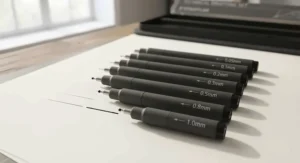
Made by Derwent, a name synonymous with graphite and colour pencils from England’s Lake District since the material was first discovered there, the Derwent Graphik Line Maker brings a slightly different engineering approach to the category. It uses a Japanese-sourced nib — Derwent’s own material sourcing sits alongside its PEFC Chain of Custody certification for sustainable production — filled with a lightfast, water-based pigment ink available in black, graphite and sepia. Nib sizes span from a superfine 0.05mm up to a bold 0.8mm in the black range, which gives it a genuinely versatile spread for combining fine detail with heavier outline work in the same drawing. What reviewers overlook until they’ve used a pack for months is how consistently the nibs resist fraying compared to some rival brands; one detailed long-term review specifically praised the Graphik Line Maker for never having “one fray or split” across repeated purchases, while noting only a slight bend at true end-of-life, which is a fair way to age out. Aggregated sentiment on the smaller nib sizes is slightly more mixed, with some reviewers noting the 0.05mm can run dry faster than the mid-range widths under frequent use.
Pros:
- ✅ Durable Japanese nib construction reviewers rarely report fraying
- ✅ Colour range (black, graphite, sepia) suits mixed technical sketching
- ✅ Strong sustainability credentials from an established UK manufacturer
Cons:
- ❌ Finest 0.05mm nib reportedly runs out faster than wider sizes
- ❌ Smaller UK stockist range than the bigger German and Japanese brands
Expect around £8-£12 for a pack of three and £15-£20 for a pack of six. If buying British matters to you as much as buying well, this is the pick that ticks both boxes credibly.
7. TWOHANDS 12-Piece Fineliner Set — the budget multi-width starter set
Rounding out the list is a genuinely different proposition: the TWOHANDS 12-Piece Fineliner Set, a budget-friendly box covering an enormous nib range from roughly 0.2mm through to 3.0mm, including a brush tip for filling and lettering. This is squarely aimed at students, hobbyists and anyone who wants to experiment with line weight before investing in a premium single-brand set. The set uses archival-grade, waterproof pigment ink, and each pen ships with a clearly labelled cap so you’re not squinting at faint printing to find the right width mid-drawing. Here’s what most buyers overlook when comparing multi-packs like this: a wide nib range at a low price point almost always trades off some manufacturing consistency between individual pens, and that’s exactly what aggregated reviews suggest — feedback is broadly positive on value and range, with reviewers commonly describing the pens as “great and very useful” for the price point, but nib durability across twelve pens at this cost point simply won’t match a single premium Staedtler or rOtring pen under sustained ruler use. For sketching, thumbnailing and building confidence with different line widths before a technical drawing course, though, it’s an excellent low-risk entry point.
Pros:
- ✅ Exceptional nib-width range for the price, 0.2mm to 3.0mm
- ✅ Labelled caps and a storage pouch aid quick organisation
- ✅ Archival waterproof ink despite the low cost per pen
Cons:
- ❌ Nib consistency between individual pens can vary
- ❌ Not intended for heavy, sustained straightedge drafting work
Sets like this typically sell for under £15 for all twelve pens, making it one of the cheapest ways to trial a full range of line widths before committing to premium drafting pens.
Getting the Most from Your Fineliner Pens: Setup and Maintenance
Straight out of the packet, most fineliner pens for technical drawing benefit from a few uncapped test strokes on scrap paper before they touch a real drawing — this settles the ink flow and reveals any dry-tip issues while you can still return a faulty pen. Store them horizontally where possible, since some pigment inks separate slightly if left nib-down for long stretches, and always recap immediately after use; the difference between an 18-hour cap-off tolerance and a genuinely open nib is the difference between a pen that survives a busy studio day and one that dies by lunchtime. Rotate through your set regularly rather than leaving finer nibs unused for weeks, since infrequent use is a common, avoidable cause of a fineliner drying out prematurely. A common first-30-days mistake is pressing too hard on ultra-fine 0.1mm or 0.05mm nibs out of habit from ballpoint use — these tips are engineered for a light touch, and heavy pressure is precisely what shortens nib life on softer, nylon-tipped pens. If you’re inking over pencil, let graphite dust settle or brush it away first, since graphite can clog a fine nib faster than paper fibres alone.
Real-World Scenarios: Matching Pens to Your Project
If you’re an architecture student inking a portfolio on a tight budget, a mixed pack like the uni-ball PIN Fineliner or the TWOHANDS 12-Piece Fineliner Set covers coursework needs without the outlay of a full premium collection, and the wider nib range in the TWOHANDS set is genuinely useful for exploring line weight before you commit to a signature style. If you’re a working draughtsperson producing detailed line drawings against a straightedge for hours at a stretch, the rOtring Tikky Graphic or Staedtler 308 Pigment Liner earn their higher per-pen cost through nib durability and ruler-safe tips that simply won’t degrade as fast under that specific stress. And if you’re preparing final presentation boards, competition entries or a portfolio piece meant to be scanned, framed or archived, the Faber-Castell PITT Artist Pen justifies its premium through genuinely archival India ink rather than a marketing claim — worth the extra cost when the drawing itself is the deliverable, less so for a working sketch that gets binned after the meeting.
How to Choose Fineliner Pens for Technical Drawing
- Match nib size to your smallest required detail. A 0.1-0.3mm nib suits hatching and fine annotation, while 0.5-0.8mm handles bold outlines and titles.
- Check for a metal-clad, ruler-safe tip if you draw against straightedges. Plastic-only tips wear faster under repeated contact with a ruler’s edge.
- Confirm the ink is genuinely waterproof, not just “smudge-resistant.” Technical drawings often get highlighted, washed with watercolour or handled repeatedly.
- Weigh archival claims against your actual storage needs. If a drawing needs to survive decades, pigment-based India ink outperforms standard dye inks.
- Buy a small mixed-width set before committing to a full premium range. Line weight preference is personal, and a £10-£15 starter pack reveals it cheaply.
- Consider cap-off tolerance if you tend to leave pens uncapped. An 18-hour rating like Staedtler’s genuinely reduces dried-out pens in daily use.
- Factor in nib durability against your typical pressure and pace. Heavy-handed drawers should lean toward metal-clad tips over softer nylon nibs.
Fineliner Pens vs Technical Drawing Pens
It’s worth being clear-eyed about a genuine distinction buried inside the phrase “technical drawing pens”: disposable fineliners and traditional refillable technical pens (the classic Rotring Isograph-style instrument, descended from the ruling pen) are related but not identical tools. Fineliners use a fixed fibre or plastic nib and a sealed ink reservoir — you use the pen until it’s empty, then replace it. Refillable technical pens use a fine metal tube nib and a bottle or cartridge ink system, and they’re the direct descendants of the drafting instruments described in Wikipedia’s overview of the technical pen, originally developed to replace the caliper-style ruling pen used since the 1600s. For most modern technical drawing work — student projects, site sketches, portfolio pieces, annotated surveys — a good fineliner is simpler, more portable and far less fussy than a refillable technical pen, which needs regular cleaning to stop the tube nib clogging. Refillable technical pens still earn their keep in specialist drafting environments where absolutely uniform line width across thousands of metres of ink is non-negotiable, but for the vast majority of buyers reading this, a quality fineliner like the rOtring Tikky Graphic or Staedtler 308 Pigment Liner delivers 95% of the precision with none of the maintenance burden.
| Feature | Fineliner Pens | Refillable Technical Pens |
|---|---|---|
| Setup and cleaning | None required | Regular cleaning to prevent clogging |
| Cost of entry | Low, £5-£25 for a set | Higher, £50+ for a quality set |
| Portability | Excellent, cap and go | Fragile, prone to leaking if jostled |
| Best For | Portfolio work, sketching, annotation | Sustained, high-volume drafting environments |
The table makes the trade-off obvious: refillable technical pens win on long-run cost-per-line for studios producing huge volumes of drawings, but fineliners win comprehensively on convenience and low upfront cost for everyone else. Unless you’re specifically running a drafting department that inks by the kilometre, a good fineliner set remains the more sensible starting point.
Nib Durability: Features That Actually Matter (And Those That Don’t)
Marketing copy for fineliner pens for technical drawing loves to talk about “precision,” but the feature that actually determines whether a pen survives six months of real use is nib construction, not the printed millimetre size. A metal-clad tip, like the ones on the Staedtler 308 Pigment Liner and rOtring Tikky Graphic, encases the fibre nib in a rigid metal sleeve, which is precisely what makes it safe to run against a ruler’s edge without the tip flattening or fraying. A plain nylon or plastic nib, as used in the Sakura Pigma Micron and most budget multi-packs, is softer and gives slightly under pressure — fine for freehand work, riskier for constant straightedge contact. What most buyers overlook is that ink volume and flow rate matter just as much as tip hardness: a pen that lays down ink generously, like the Tikky Graphic, can feel like it’s writing a wider line than its stated size, which affects how consistent a set looks across a finished drawing. Features that genuinely don’t matter much for technical work include novelty barrel shapes, scented ink and colour-coordinated packaging — none of these affect line quality, and they’re often where budget sets divert manufacturing cost away from the part of the pen that actually touches the paper.
Common Mistakes When Buying Fineliner Pens for Technical Drawing
The most frequent mistake is buying a single ultra-fine 0.1mm pen for an entire drawing, then wondering why hatching takes three times longer than it should — a mixed-width set solves this for a similar overall cost. A close second is assuming all “waterproof” claims are equal: some budget pens resist light contact with water but bleed under a watercolour wash, so if you’re combining ink with wet media, check for pigment-based archival ink specifically rather than a generic waterproof label. Buyers also frequently underestimate how much nib durability is influenced by their own drawing habits — pressing hard out of ballpoint muscle memory wears out a fine fibre tip far faster than a light, consistent touch. Finally, it’s easy to overlook cap-off tolerance until a pen dries out mid-drawing; if you tend to work in short bursts and forget to recap, a pen rated for a longer cap-off window, like Staedtler’s 18-hour claim, will save you money in replaced pens over a year of use.
Safety, Regulations and Ruler-Safe Tips: What UK Buyers Should Know
A ruler-safe tip refers specifically to a nib built to withstand repeated, direct contact with a straightedge without deforming — a metal-clad casing around the fibre point, rather than a bare plastic or felt tip that a ruler’s edge can gradually flatten or fray. This matters enormously for technical drawing specifically, where inked lines are frequently drawn against a set square or ruler rather than freehand, unlike most illustration or journaling use. Formal engineering and architectural drawings produced in the UK are typically expected to follow the conventions set out in BS 8888, the British Standard for technical product documentation and specification, which governs how drawings communicate dimensions and geometry — a good reminder that the pen is only one part of producing a drawing that reads correctly to another professional. On the safety side, reputable fineliner ink is formulated to meet standard non-toxicity certifications, and several ranges reviewed here, including the Staedtler pigment liners, specifically note pressure-balancing designs that prevent the pen dripping if used at altitude, which is a nice detail for anyone sketching on a flight. If you’re a student or new professional, it’s worth spending time with the wider discipline itself, including how architectural conventions get discussed in publications like the RIBA Journal, since understanding the discipline will do more for your line quality than any single pen purchase.
Long-Term Cost and Maintenance
Cost-per-use is the honest way to compare fineliner pens for technical drawing rather than sticker price alone. A £15 budget multi-pack of twelve pens works out to roughly £1.25 per pen, but if half of them dry out or fray within a few months of moderate use, the effective cost climbs fast. A £6 premium single pen from Staedtler or rOtring costs more upfront but, based on reviewer reports of nib longevity and the documented 18-hour cap-off tolerance on the Staedtler range, is likely to deliver considerably more total drawing time before replacement. The sensible middle path for most buyers is a mixed strategy: buy premium, metal-clad pens in the one or two widths you use constantly for ruled lines, and fill in the rest of your range with a budget multi-pack for less demanding, freehand work. This keeps total spend reasonable while protecting the pens doing the heaviest, most durability-testing job in your kit.
Frequently Asked Questions
❓ What is the best fineliner pen for technical drawing?
❓ Are fineliner pens waterproof enough for technical drawings?
❓ What nib size should I use for technical drawing?
❓ Can you use a ruler with a fineliner pen without damaging the nib?
❓ How long do fineliner pen nibs last?
Conclusion
Choosing the right fineliner pens for technical drawing really comes down to matching nib construction to how you actually work, not chasing the smallest millimetre size on the packaging. If you’re drawing against a ruler for hours, prioritise a genuine ruler-safe tip like the ones on the Staedtler 308 Pigment Liner or rOtring Tikky Graphic. If you’re building a first set on a student budget, a black fineliner pen set from uni-ball PIN or a wide-ranging multi-pack from TWOHANDS will cover coursework comfortably. And if the drawing itself is the final deliverable — framed, scanned or archived — the archival India ink in the Faber-Castell PITT Artist Pen is worth the extra cost. Whichever you choose, the honest answer from the research here is that no single pen wins every category; the best kit is usually a small, deliberate mix of two or three of the picks above, chosen for the specific jobs you do most often.
Recommended for You
- Waterproof Fineliner Pens: 7 Best Picks UK 2026
- Best Fineliner Pens 2026: 7 Top Picks You’ll Actually Love
- Cheap vs Expensive Coloured Pencils: 7 Picks Tested for 2026
Disclaimer: This article contains affiliate links. As an Amazon Associate, I earn from qualifying purchases. If you purchase products through these links, we may earn a small commission at no additional cost to you.
✨ Found this helpful? Share it with your friends! 💬🤗
