In This Article
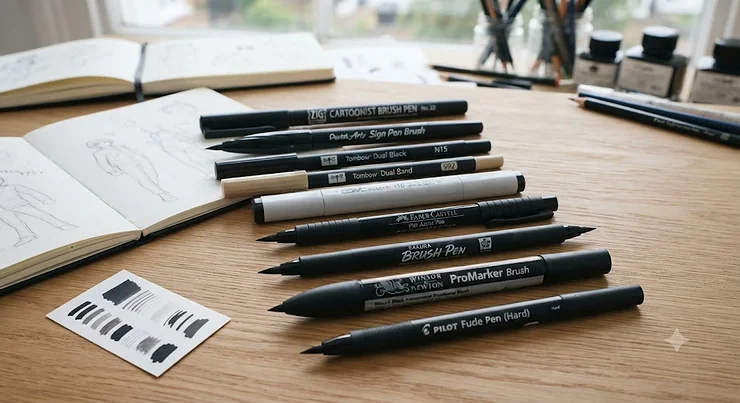
Somewhere between “just start drawing” and “buy every art supply on the internet” sits the actual, useful question: which brush pens for manga art are worth your money? It’s a fair thing to lose sleep over. A brush pen is the single tool most responsible for that unmistakable manga look — the whip-thin hairline that suddenly balloons into a confident, tapering stroke, the kind of line that makes a panel feel alive rather than traced. Get the wrong one and you’ll spend weeks fighting a tip that either refuses to bend or bends so much it feels like drawing with a wet noodle.
This guide focuses specifically on inking tools — the pens that put permanent, expressive linework on the page — rather than digital brush packs for Procreate or Clip Studio Paint, which solve a related but different problem. If you’re comparing traditional tools, it’s worth knowing that a fair few professional mangaka still reach for real ink and paper for at least part of their process, even in an increasingly digital industry. We researched real, currently available products, dug into genuine aggregated customer sentiment, and cross-referenced technical specs so you’re not left guessing. Whether you’re chasing that classic manga look for the first time or upgrading from a basic fineliner, here’s what actually matters — and which seven pens are worth your shortlist.
Quick Comparison Table
| Brush Pen | Tip Type | Best For | Price Range |
|---|---|---|---|
| Tombow Fudenosuke | Synthetic elastomer | Beginners on a budget | Under £10 |
| Faber-Castell PITT Artist Pen Brush | Synthetic nylon | Sketching and light inking | Under £8 |
| Sakura Pigma Brush | Synthetic, archival ink | Panel borders and solid blacks | £6-£10 |
| Pentel Pocket Brush Pen | Synthetic bristle, refillable | All-round manga inking | £12-£18 |
| Kuretake ZIG Cartoonist Mangaka Brush Pen | Synthetic, manga-tuned | Dedicated comic inking | £10-£20 |
| Tombow ABT Dual Brush Pen (Grey Set) | Synthetic dual-tip | Toning and screentone-style shading | £20-£32 |
| Kuretake No. 8 Fountain Hair Brush Pen | Real hair, refillable | Expressive, pro-level linework | £30-£45 range |
Looking at the table, there’s a clear budget-to-premium ladder here, and it roughly tracks with how much control the tip gives you versus how much character it brings to the page. The synthetic, felt-style tips at the cheaper end (Fudenosuke, Faber-Castell, Pigma) are forgiving and predictable, which is exactly what you want while you’re still learning how much pressure turns a hairline into a bold downstroke. The real-hair option at the top, by contrast, rewards a practised hand with line quality nothing synthetic quite replicates — but it will punish a heavy hand just as readily.
💬 Found a pen that suits your style already? Bookmark this page and come back before you commit to a purchase — one click could save you a mismatched buy.
Top 7 Brush Pens for Manga Art: Expert Analysis
1. Tombow Fudenosuke Brush Pen — best budget starter for beginners
The Tombow Fudenosuke comes in hard and soft tip versions, and that single distinction is genuinely useful rather than a marketing gimmick. The tip is made from a firm elastomer rather than loose bristles, so it holds its shape far longer than a typical felt-tip and resists splaying under a heavy hand. In practice, this means the hard tip behaves almost like a slightly springy fineliner for consistent line weight, while the soft tip introduces more visible thick-to-thin variation with the same amount of pressure. Reviewers consistently note that the ink is a genuinely deep, non-streaky black that scans and digitises cleanly — a detail that matters more than people expect once you’re prepping pages for print or webtoon upload. It’s aimed squarely at artists who are brush-curious but don’t want to gamble on a tool they might hate; the trade-off is a fairly small ink reservoir, so don’t expect it to survive an entire chapter.
Pros:
- ✅ Firm tip holds its shape, ideal for learning pressure control
- ✅ Deep, consistent black that scans well for digital cleanup
- ✅ Genuinely affordable way to try brush inking
Cons:
- ❌ Small ink capacity compared with refillable options
- ❌ Disposable — no cartridge or converter once it runs dry
Sitting comfortably under £10, this is one of the cheapest legitimate entry points into brush inking, and the value verdict is straightforward: buy two (hard and soft) before you commit to anything pricier.
2. Faber-Castell PITT Artist Pen Brush — best for sketching and light linework
The Faber-Castell PITT Artist Pen Brush uses a flexible synthetic nylon tip paired with India-ink-based pigment, which gives it a genuinely lightweight, springy feel that’s closer to a soft calligraphy brush than a stiff marker. What that means practically is quick, loose gestural marks come easily, but nailing a perfectly straight, controlled line takes more hand control than with the firmer Tombow above. The archival pigment ink is lightfast and waterproof once dry, so it plays nicely with watercolour or alcohol-based greytones layered on top without smearing the underlying linework — a common headache with cheaper dye-based pens. Aggregated reviewer sentiment tends to flag the tip as prone to fraying faster than pricier alternatives if you push down hard, which lines up with what you’d expect from a soft synthetic bristle at this price point. It suits artists who sketch loosely before committing to final inks, or anyone layering colour media over their linework.
Pros:
- ✅ Lightweight, flexible tip great for gestural sketching
- ✅ Waterproof, lightfast pigment ink survives colour layers
- ✅ Widely available individually or in sets
Cons:
- ❌ Tip frays faster under heavy pressure than firmer pens
- ❌ Less precise for tight, controlled comic linework
At well under £8 for a single pen, it’s a low-risk way to add brush texture to a sketchbook practice without touching your main inking budget.
3. Sakura Pigma Brush — best for solid blacks and panel borders
The Sakura Pigma Brush shares its archival pigment ink formula with the famous Micron fineliner range, which is a meaningful detail: it’s genuinely waterproof, acid-free and fade-resistant, meaning your finished pages won’t yellow or bleed years down the line. The felt-style tip is on the firmer side of “brush pen,” so it excels at filling large solid black areas — hair shadows, night skies, panel gutters — without the streaking or patchiness you sometimes get from thinner ink formulas. Where it doesn’t shine quite as brightly is fine, whip-thin taper; reviewers frequently mention it’s better suited to bold, confident strokes than delicate hairline detail work. That makes it a strong complementary pen rather than a sole inking tool for most manga artists — pair it with something like the Fudenosuke for detail work and reach for the Pigma when you need to lay down flat, saturated black fast.
Pros:
- ✅ Archival, waterproof pigment ink resists fading long-term
- ✅ Lays down dense, even solid blacks efficiently
- ✅ Consistent ink flow with minimal streaking
Cons:
- ❌ Less expressive taper than softer synthetic tips
- ❌ Not ideal as your only brush pen for detail work
Priced roughly in the £6-£10 range, it earns its keep as the “fill it in fast” pen in a rotation rather than your primary linework tool.
4. Pentel Pocket Brush Pen — best all-round pen for serious manga inking
The Pentel Pocket Brush Pen is arguably the single most recommended traditional inking tool among working comic artists, and the reasoning holds up under scrutiny. Its synthetic bristle tip is genuinely long compared with rivals, which gives it an unusually wide dynamic range between hairline flicks and broad, confident strokes — the kind of line variation that’s difficult to fake digitally. That length is also the trade-off: it demands more hand control than a shorter, stiffer tip, so it’s not necessarily the gentlest starting point for absolute beginners. It refills via disposable ink cartridges (two are typically included), and the supplied ink is genuinely waterproof, which matters if you plan to add watercolour or alcohol-marker greytones afterward. Aggregated review sentiment is remarkably consistent on one point: it’s the pen most artists reach for once they’ve outgrown disposable felt-tips and want a brush that rewards practice rather than plateauing quickly.
Pros:
- ✅ Exceptional line variation from hairline to bold strokes
- ✅ Genuinely waterproof ink, safe under other media
- ✅ Refillable cartridge system extends its working life
Cons:
- ❌ Steeper learning curve than shorter, firmer tips
- ❌ No official ink converter, limiting third-party ink options
At around £12-£18, it sits comfortably mid-range, and honestly, for artists ready to commit to brush inking as a real skill rather than a novelty, it’s difficult to argue against as the anchor pen of a kit.
5. Kuretake ZIG Cartoonist Mangaka Brush Pen — best pen built specifically for manga
Where most brush pens are general-purpose tools that happen to suit manga, the Kuretake ZIG Cartoonist Mangaka Brush Pen is designed from the ground up with comic and manga inking as the brief, and Kuretake’s decades of calligraphy and art-pen manufacturing experience shows in the tip engineering. The synthetic brush tip is tuned to sit between the extremes of the softer Fudenosuke and the longer Pentel Pocket Brush, aiming for a middle ground that’s controllable for panel borders yet still capable of dramatic taper for speed lines and hair. It typically comes as part of a broader Mangaka-branded toolkit that pairs the brush with fineliners in multiple widths, which is a genuinely practical bundling decision — most professional inkers use a brush for expressive lines and a fineliner for consistent detail work in the same page. Reviewers who work specifically in comic and manga formats tend to praise the balance it strikes, though it’s worth noting it’s less common on general stationery shelves than Tombow or Pentel, so availability can be patchier.
Pros:
- ✅ Tip specifically tuned for comic and manga linework
- ✅ Often bundled with complementary fineliners for full inking
- ✅ Balanced control-to-expression ratio for panel work
Cons:
- ❌ Less widely stocked than mainstream Tombow/Pentel pens
- ❌ Bundle sets cost more upfront than single pens
Expect to pay in the £10-£20 range depending on whether you buy the single pen or the fuller set, and for artists who know they’re committing to comic pages specifically, that upfront bundle cost tends to pay for itself by removing the guesswork of assembling a kit piece by piece.
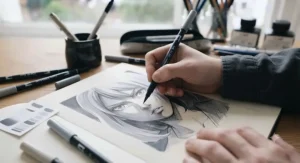
6. Tombow ABT Dual Brush Pen (Grey Set) — best for toning and screentone-style shading
The Tombow ABT Dual Brush Pen isn’t primarily an inking pen — it’s included here because manga art rarely stops at line art, and this is the pen most artists reach for once panels need tonal depth without switching to digital screentones. Each pen has a genuine flexible brush nib on one end and a fine bullet tip on the other, and the water-based ink blends smoothly when layered, which is exactly what you want for building soft gradients around characters’ hair, clothing folds or background shadow. A dedicated grey set (spanning cool and warm greys plus black) is the practical choice for manga specifically, since colour work generally happens digitally in this genre while physical greys still see heavy use in traditional inking workflows. Reviewers do flag one real limitation worth knowing before you buy: the felt tips are noticeably wider and more porous than a true brush pen, so they can’t hold a fine point for extended detail work the way the Pentel or Kuretake can.
Pros:
- ✅ Blends smoothly for soft, screentone-style gradients
- ✅ Dual nib gives both broad tone and fine detail
- ✅ Grey sets suit manga’s traditionally monochrome shading
Cons:
- ❌ Tips wear down and lose fine point faster
- ❌ Not a substitute for a true brush pen’s line variation
A grey set typically runs £20-£32 depending on how many shades are included, and the value case is strongest for artists who genuinely tone by hand rather than finishing everything in Photoshop or Clip Studio Paint.
7. Kuretake No. 8 Fountain Hair Brush Pen — best premium pen with real natural bristles
This is the pen for artists who’ve outgrown synthetic tips and want to feel what a genuine natural-hair brush does differently. The Kuretake No. 8 Fountain Hair Brush Pen uses real hair bristles (commonly a fine natural hair blend) rather than moulded plastic or nylon fibre, and the difference is immediately obvious under the hand: it responds to the smallest shift in pressure and angle with far more nuance, producing line variation that synthetic tips simply can’t fully replicate. That sensitivity cuts both ways, though — reviewers who’ve used both natural and synthetic pens consistently describe it as more responsive but also less forgiving, since it translates every small tremor in your hand onto the page rather than smoothing it out. It uses a standard international converter system, meaning you’re not locked into a single manufacturer’s cartridges the way you are with the Pentel, and can be filled with genuinely waterproof pigment inks for reliable results. This is a pen for artists who’ve already logged real hours with a synthetic brush and are ready to trade some forgiveness for expressive range.
Pros:
- ✅ Real hair bristles deliver unmatched line sensitivity
- ✅ Converter-compatible, so ink choice isn’t locked in
- ✅ Rewards practised control with genuinely expressive strokes
Cons:
- ❌ Unforgiving of an unsteady or untrained hand
- ❌ Premium price for what is, functionally, a learning investment
Sitting in the £30-£45 range, it’s the priciest pen on this list by a clear margin, and it’s honestly not the right first purchase — but for artists ready to commit to brush inking as a long-term skill, the value case is less about the pen and more about what it teaches your hand over time.
Real Brush Pens vs Synthetic Brush Pens
This is probably the single most common point of confusion for anyone shopping for brush pens for manga art, so it’s worth untangling properly rather than glossing over it. “Real” brush pens use genuine natural hair — often weasel, sable, or a blended natural fibre — bundled into a tip, the same basic construction as a traditional ink brush used in East Asian calligraphy for centuries. “Synthetic” brush pens instead use moulded nylon, felt, or a flexible elastomer shaped to mimic a brush tip’s taper without individual bristles.
| Factor | Real Hair Brush Pens | Synthetic Brush Pens |
|---|---|---|
| Line sensitivity | Extremely high, responds to tiny pressure shifts | Moderate, more forgiving of inconsistency |
| Learning curve | Steep — punishes an unsteady hand | Gentle — smooths out minor tremors |
| Longevity | Bristles can fray with heavy-handed use | Tips wear more predictably, often replaceable |
| Typical price | £25+ (e.g. Kuretake No. 8) | £5-£20 (e.g. Tombow Fudenosuke, Pentel Pocket Brush) |
| Best For | Artists confident in pressure control | Beginners and intermediate artists |
The practical takeaway from that comparison is this: synthetic pens like the Tombow Fudenosuke or Faber-Castell PITT Artist Pen Brush are individually shaped fibres bundled into a cone, which naturally allows for a more natural brush-like feel than felt, while still being far more predictable than genuine bristles. Real hair pens like the Kuretake No. 8, by contrast, have individual strands that separate and reconverge based on exactly how you’re pressing and angling the pen, which is precisely why they feel more alive under a skilled hand but genuinely harder to tame under a beginner’s. Neither category is objectively “better” — it’s a direct trade-off between forgiveness and expressive ceiling, and most working manga artists actually own at least one of each for different stages of a page.
Pressure Sensitivity: Why It’s the Whole Point of a Brush Pen
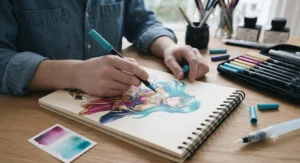
If you’ve only ever inked with a fineliner or ballpoint, pressure sensitivity is the concept that takes the longest to click — and once it does, it changes how you draw entirely. A fineliner produces the same line width regardless of how hard you press; a brush pen does the opposite by design, translating pressure directly into visible line weight. Light pressure with the tip barely touching the page produces a hairline stroke; pressing down harder splays the tip and lays down a bold, tapering line, and lifting off mid-stroke naturally thins the line back out again.
What most buyers overlook about pressure sensitivity is that it isn’t purely about the pen — the tip material fundamentally determines how much control you have over that range. Firm tips, like the hard-nib Tombow Fudenosuke, compress a smaller amount of pressure into a smaller range of line width, which is genuinely easier to control consistently but limits how dramatic your taper can get. Softer tips, like the Pentel Pocket Brush Pen or Kuretake No. 8, spread that same pressure range across a much wider spectrum of possible line widths, meaning small hand movements translate into bigger visual changes on the page. For manga specifically, pressure sensitivity is what produces the genre’s signature “speed lines,” dynamic action linework, and expressive hair strands that a rigid fineliner simply cannot fake convincingly.
✨ Want to build muscle memory fast?
Try inking the same simple shape twenty times, deliberately varying pressure from feather-light to firm — this drill alone will teach your hand more than any tutorial.
Ink Saturation Explained: Getting Consistent Blacks Panel After Panel
Ink saturation is the quality most beginners don’t think about until it bites them — usually halfway through a page, when a stroke that should be solid black suddenly turns grey and patchy. It refers to how completely and evenly a pen deposits pigment onto the paper, and it’s governed by three overlapping factors: ink formulation (dye-based versus pigment-based), tip material, and how much ink the reservoir is actually delivering to the tip at any given moment.
Pigment-based inks, used in pens like the Sakura Pigma Brush and Faber-Castell PITT Artist Pen Brush, tend to sit on top of the paper fibre rather than soaking fully in, which generally produces denser, more consistent black coverage that resists fading. Dye-based inks can look richer straight off the pen but are more prone to becoming patchy as the pen runs low, and they’re far less resistant to smudging if watercolour or alcohol markers are layered on top later. Reviewers consistently note that ink saturation degrades noticeably in the final quarter of a pen’s life — the Tombow Fudenosuke‘s smaller reservoir means this happens sooner than in refillable pens like the Pentel Pocket Brush Pen or Kuretake No. 8, where a converter or cartridge swap resets ink delivery instantly rather than gradually fading out.
For comic pages specifically, inconsistent saturation is genuinely disruptive — it reads as an error rather than a stylistic choice, particularly in solid black areas like hair, shadows or night backgrounds. The practical fix most working artists use is simple: keep a dedicated “fill pen” like the Pigma Brush on hand purely for solid black areas, and reserve your primary brush pen for line variation where minor saturation shifts matter far less.
Brush Pens for Comic Inking: From Thumbnail to Finished Page
Comic inking is a genuinely different discipline from general sketching, and brush pens behave differently depending on which stage of the process you’re using them for. Understanding that distinction is arguably more useful than any single product recommendation, because it changes which pen actually suits your workflow. This process — refining loose pencils into confident, print-ready linework — has deep roots; the Young V&A’s Japan: Myths to Manga exhibition traced exactly this lineage, connecting centuries of Japanese brush and ink traditions through to the manga and anime aesthetics readers recognise today.
At the thumbnail and rough-pencil stage, pressure control matters less than speed, so a forgiving synthetic tip like the Tombow Fudenosuke or Faber-Castell PITT Artist Pen Brush lets you work quickly without worrying excessively about line consistency. Moving into final linework, where panel borders, character outlines and speed lines all need to read cleanly at print size, a pen with a genuinely wide pressure-sensitivity range — the Pentel Pocket Brush Pen or Kuretake ZIG Cartoonist Mangaka Brush Pen — earns its place as the primary tool, since it’s expressive enough for hair and clothing folds but controllable enough for straight architectural lines with practice. Finally, at the finishing stage, dedicated fill pens like the Sakura Pigma Brush handle flat blacks, while a grey set like the Tombow ABT Dual Brush Pen adds tonal depth without needing to switch to digital tools at all.
A common mistake beginners make is trying to do all three jobs with a single pen. Professional inkers almost universally use a small rotation — one expressive brush for linework, one firm pen for fills, sometimes a fineliner for tight detail — rather than expecting one tool to excel at everything simultaneously.
Getting Started: Your First 30 Days With a Brush Pen
The single biggest reason beginners abandon brush pens within the first week is expecting fineliner-level control immediately. That’s simply not how brush inking works, and knowing that upfront saves a lot of frustration. Here’s a realistic first-month approach based on how most working artists describe learning the tool.
In the first week, resist the urge to ink finished artwork at all. Instead, spend fifteen minutes a day on pure pressure drills: straight lines from thin to thick and back, simple curves, and basic shapes, using a forgiving pen like the Tombow Fudenosuke hard tip. By week two, introduce actual linework — trace over old pencil sketches rather than committing to new final art, focusing purely on where thick and thin strokes should logically fall (thick on the “shadow” side of a form, thin on highlighted edges). Weeks three and four are where most people notice a genuine shift: line confidence improves, hesitation marks reduce, and it starts to feel less like fighting the pen and more like directing it.
A few maintenance habits matter from day one, regardless of which pen you choose. Always cap the pen fully when not in use — brush tips dry out and fray far faster than fineliner nibs if left exposed. Store brush pens horizontally or nib-up rather than nib-down to prevent ink pooling and flooding the tip. And if you’re using a refillable pen like the Pentel Pocket Brush Pen or Kuretake No. 8, flush the tip gently with water when switching ink types to avoid clogging from dried residue.
Real-World Scenarios: Matching the Pen to the Artist
Rather than a generic “it depends,” here’s how three common artist profiles typically map onto the products covered above, based on the priorities each situation demands.
The absolute beginner testing the waters: if you’re not yet sure brush inking is for you and don’t want to commit serious money to finding out, the Tombow Fudenosuke (hard tip) is the lowest-risk entry point. It’s cheap enough that “I didn’t get on with it” costs you under a tenner, and its firm tip won’t punish early mistakes the way a softer pen would.
The student building a portfolio for art school or webtoon submission: consistency across many pages matters more than raw expressiveness at this stage, since submission panels need to read cleanly. The Pentel Pocket Brush Pen strikes the right balance — refillable so cost per page drops over a portfolio’s worth of work, waterproof so scanning and digital cleanup stay simple, and expressive enough to demonstrate genuine linework skill to admissions tutors.
The hobbyist upgrading after a year of regular practice: if you’re inking weekly, know your pressure control is solid, and want a tool that grows with your skill rather than plateaus, the Kuretake No. 8 is worth the investment. The learning curve that would frustrate a beginner becomes an advantage once your hand is already trained — you’ll notice the extra sensitivity almost immediately in expressive linework like hair, fabric folds and dynamic action poses.
Common Mistakes When Buying Brush Pens for Manga Art
The most frequent mistake is buying based on price alone rather than tip type, then blaming the pen when a cheap felt-tip frays within days under heavy-handed use — that’s a mismatch between pressure habits and tip firmness, not necessarily a bad product. A close second is buying a single “do everything” pen and expecting it to handle fine detail, bold fills, and expressive linework equally well; as covered above, professional inkers typically rotate two or three pens for a reason.
Another common trap is ignoring ink type entirely. Dye-based inks look fine in isolation but bleed or smear the moment watercolour, alcohol markers or even a damp thumb touches them — genuinely frustrating if you discover this after finishing a page. Always check whether a pen’s ink is described as pigment-based or explicitly waterproof before layering other media on top. Finally, beginners frequently buy a natural-hair pen like the Kuretake No. 8 first, assuming “premium” automatically means “easier” — it’s actually the opposite, and starting there before building fundamental pressure control tends to be genuinely discouraging rather than helpful.
How to Choose the Right Brush Pen for Manga Art
Cutting through the marketing noise, here’s a practical decision process based on the factors that actually affect your results.
- Assess your current skill level honestly. If you’ve never used a brush pen before, prioritise a firm synthetic tip over an expressive natural-hair pen — control comes before range.
- Decide between disposable and refillable. Disposable pens like the Tombow Fudenosuke are cheaper to trial but costlier long-term if you ink regularly; refillable pens like the Pentel Pocket Brush Pen cost more upfront but drop in cost-per-page over time.
- Check the ink type before you buy. If you plan to layer watercolour, greytones or alcohol markers over your linework, confirm the ink is explicitly pigment-based or waterproof.
- Match the tip to your primary task. A firm tip suits panel borders and consistent linework; a soft or natural-hair tip suits expressive hair, fabric and dynamic action lines.
- Consider your typical page volume. Heavy, regular inkers benefit from refillable systems and dedicated fill pens; occasional sketchers may never need more than one disposable brush pen.
- Budget for a small rotation, not a single pen. Even a modest kit — one firm liner, one expressive brush, one fill pen — outperforms a single “perfect” pen for most manga workflows.
- Buy one pen before committing to a full set. Tip feel is genuinely personal; what a reviewer loves, your hand might fight, so trial before you invest in a premium option.
Brush Pens vs Dip Pens and Fineliners for Manga
Brush pens aren’t the only traditional inking option, and it’s worth understanding where they sit relative to the alternatives most manga artists eventually try.
| Tool | Line Variation | Learning Curve | Best For |
|---|---|---|---|
| Brush Pens (e.g. Pentel Pocket Brush Pen) | High, pressure-based | Moderate | Expressive linework, hair, action lines |
| Dip Pens (G-pen, Maru nib) | Very high, most nuanced | Steep, needs practice | Traditional manga-style tapered lines |
| Fineliners (e.g. Pigma Micron) | None, fixed width | Minimal | Consistent detail, panel borders, backgrounds |
Dip pens — the G-pen and Maru nib style tools used throughout the traditional manga industry in Japan — technically offer the finest control and most dramatic taper of any inking tool, but they require constant re-dipping, are messier, and have a genuinely steep learning curve involving nib pressure, ink flow and paper angle simultaneously. Brush pens like the Pentel Pocket Brush Pen or Kuretake ZIG Cartoonist Mangaka Brush Pen trade a small amount of that maximum expressiveness for enormous convenience — no ink bottle, no re-dipping, portable enough for sketching on a train. Fineliners sit at the opposite end entirely, sacrificing all line variation for absolute consistency, which is precisely why most working artists keep one in their kit alongside a brush pen rather than choosing definitively between categories.
Long-Term Cost & Maintenance
Sticker price tells an incomplete story with brush pens, since disposable and refillable systems age very differently in terms of total cost of ownership. A Tombow Fudenosuke costs under £10 but typically lasts weeks of regular use before the ink runs dry and the whole pen is discarded — genuinely fine for occasional sketching, but the cost-per-page climbs quickly under daily inking. A Pentel Pocket Brush Pen, by contrast, costs more initially but uses replaceable cartridges, meaning the core pen body — and its trained-in tip feel — lasts years, with only ink cartridges as an ongoing cost.
The Kuretake No. 8 takes this further with converter compatibility, letting you buy ink in bottles rather than proprietary cartridges, which is genuinely the cheapest ink-per-millilitre option of anything on this list once you factor in bottle pricing versus disposable cartridges. Maintenance costs matter too: synthetic tips on pens like the Tombow ABT Dual Brush Pen wear down gradually and aren’t replaceable, effectively capping the pen’s useful life regardless of ink remaining, while natural hair tips can occasionally be reshaped with gentle rinsing if they become misshapen, extending usable life further. For a regular manga artist inking multiple pages weekly, the maths generally favours investing in one or two refillable pens over cycling through disposable options indefinitely.
✨ Ready to Build Your Inking Kit?
🔍 Compare current pricing and availability on the pens above before you commit — stock and pricing shift often, so check the latest listing before checkout. The right combination genuinely transforms how confident your linework feels on the page.
Safety, Ink Types & UK Buying Considerations
For UK-based artists, a few practical points are worth knowing before buying brush pens for manga art. Most reputable brands sold through mainstream UK retailers — Tombow, Pentel, Faber-Castell, Sakura and Kuretake among them — comply with relevant toy and art material safety standards for the EU and UK markets, but always check individual product packaging or listings for current certification, particularly if buying for younger artists.
Ink composition matters beyond just performance. Genuinely waterproof, pigment-based inks (as opposed to water-soluble dye inks) rely on pigment particles that sit on the paper surface rather than dissolving fully — a formulation broadly related to traditional India ink, which has been used for permanent linework for centuries precisely because of this water resistance. If you’re scanning finished pages for digital colouring or publication, waterproof pigment ink also resists smudging from handling far better than dye-based alternatives, which is worth prioritising if your pages will be handled repeatedly during the inking and toning process. Finally, when buying online, cross-check current stock and pricing directly on the retailer’s listing rather than relying on older reviews, since manufacturers do periodically discontinue or reformulate specific brush pen lines.
FAQ
❓ What is the best brush pen for manga art?
❓ Are brush pens good for manga inking?
❓ Real hair or synthetic brush pens for manga — which is better?
❓ How long does a brush pen last for manga art?
❓ Can I use a brush pen instead of a dip pen for manga?
Conclusion
Picking the right brush pens for manga art really comes down to being honest about where you are right now, not where you’d like to be in six months. A forgiving synthetic tip like the Tombow Fudenosuke or Faber-Castell PITT Artist Pen Brush will teach your hand the fundamentals of pressure control without the frustration a natural-hair pen would cause at this stage. The Pentel Pocket Brush Pen remains the standout all-rounder for artists ready to commit to brush inking as a genuine skill, offering the widest useful pressure range without demanding perfection. And once your linework is confident and consistent, the Kuretake No. 8‘s real hair bristles offer an expressive ceiling that synthetic tips simply can’t match. Manga’s booming popularity on this side of the world — UK graphic novel sales data shows the category has genuinely exploded in recent years — means there’s never been a better moment to sharpen your own inking skills, whichever pen you start with. Whatever you choose, remember that pressure control and ink saturation both improve with hours logged, not with a bigger budget alone — the pen is only half the equation.
Recommended for You
- Dual Tip Brush Pens Set: 7 Best UK Picks for 2026
- 7 Best Watercolour Brush Pens UK Artists Love in 2026
- 7 Best Brush Pens for Calligraphy in 2026 (UK Buyer’s Guide)
Disclaimer: This article contains affiliate links. As an Amazon Associate, I earn from qualifying purchases. If you purchase products through these links, we may earn a small commission at no additional cost to you.
✨ Found this helpful? Share it with your friends! 💬🤗
