In This Article
There’s a particular kind of magic in watching a single stroke of colour bloom into a soft wash the moment water touches it. That’s the whole appeal of watercolour brush pens, and it’s why they’ve quietly taken over sketchbooks, bullet journals and kitchen tables across the UK. Unlike a full watercolour set, with its palette, water pots and inevitable puddle on the carpet, a good brush pen lets you paint on the sofa, on a train, or during a lunch break without a second thought about mess.

But “good” is doing a lot of heavy lifting in that sentence. Spend five minutes browsing watercolour brush pens on amazon.co.uk and you’ll hit a wall of near-identical sets, all promising vibrant colour and effortless blending. Some genuinely deliver. Others feel like felt-tips with delusions of grandeur. The difference usually comes down to the ink formula, the nib construction and how the pigment behaves once water hits the page — details you won’t find explained on a typical listing.
This guide cuts through that. We’ve researched seven real, currently available watercolour brush pens spanning budget, mid-range and premium options, weighed up how their water-soluble ink actually performs, and worked out which pens suit which kind of painter. You’ll also find a proper breakdown of brush pens vs watercolour paint, a walkthrough of blending technique that actually works, and advice on building a portable painting kit you’ll reach for daily rather than leave in a drawer. Prices fluctuate constantly on Amazon, so treat every figure here as a guide — always check the current price before buying.
What Are Watercolour Brush Pens?
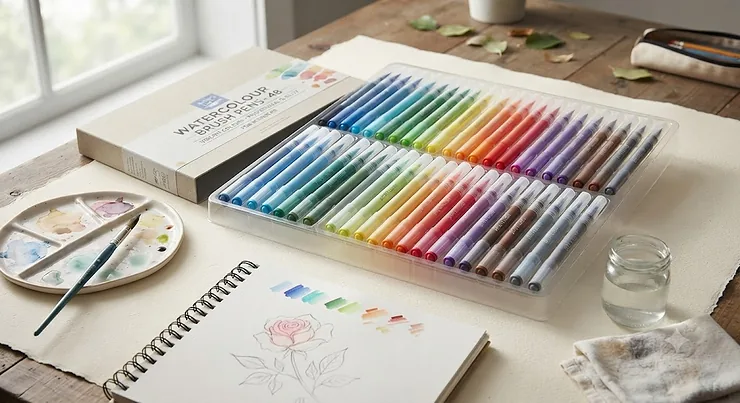
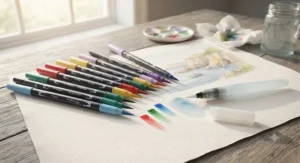
Watercolour brush pens are pens with a flexible, brush-shaped nib filled with water-soluble ink, designed to mimic the look of traditional watercolour painting without loose paint or a water pot. You apply colour directly to paper, then blend, lighten or dissolve it using a wet brush or water brush pen, creating washes, gradients and fine detail from a single, portable tool…
That portability is the entire pitch. As the Victoria and Albert Museum explains, traditional watercolour as a medium involves dry pigment mixed with a binder, usually gum arabic, then applied with water to a support such as paper. Brush pens simply package that same water-reactive pigment into a self-contained barrel, swapping a palette for a pen body and a paintbrush for a moulded nylon or polyester tip — a modern take on a technique with centuries of history behind it.
Quick Comparison Table
| Product | Best For | Price Range | Ink Type |
|---|---|---|---|
| Tombow ABT Dual Brush Pen | All-round blending & bullet journaling | £25-£65 range (set size dependent) | Water-based dye |
| Sakura Koi Coloring Brush Pen | Beginners wanting forgiving nibs | £20-£48 range | Water-based dye |
| Karin Brushmarker PRO | Maximum pigment saturation | £18-£95 range | Liquid dye ink |
| Winsor & Newton Promarker Watercolour | Closest feel to artist-grade pigment | £20-£75 range | Water-based pigment |
| Faber-Castell Pitt Artist Pen Brush | Mixed-media line and wash work | £2-£85 range | Waterproof India ink |
| Pentel Aquash Waterbrush | Portable water reservoir tool | £4-£14 range | N/A (water carrier) |
| Ohuhu Watercolour Brush Pens | Biggest colour range on a budget | £13-£42 range | Water-based dye |
Looking at the spread above, there’s no single “best” watercolour brush pen — the right choice depends entirely on whether you value blendability, pigment richness or portability most. Beginners on a budget will get more mileage from a large, forgiving set like Ohuhu Watercolour Brush Pens, while anyone chasing genuinely lightfast, artist-grade colour should be looking at Winsor & Newton Promarker Watercolour despite the higher outlay. Note too that not every “brush pen” on this list uses water-soluble ink in the traditional sense; Faber-Castell Pitt Artist Pen Brush deliberately uses waterproof India ink, which changes how you’d use it in a mixed-media piece.
💬 Found a pen here that’s caught your eye? Have a browse and see which one fits your style best!😊
Top 7 Watercolour Brush Pens: Expert Analysis
We’ve dug into real specifications, aggregated review sentiment from UK and international retailers, and honest side-by-side comparisons to bring you seven genuinely worthwhile options — not just a reshuffled Amazon listing.
1. Tombow ABT Dual Brush Pen — best all-rounder for blending
The dual-tip design is the standout feature here: a flexible brush nib at one end for washes and broad colour, and a 0.8mm fineliner at the other for detail work, both fed from the same water-based ink reservoir.
Each pen holds water-based dye ink that stays workable long after it’s dry on the page, meaning you can go back in with a wet brush hours — or days — later and still soften an edge. The brush tip itself is a firm-but-flexible nylon that springs back reliably, which in practice means less “fluffing” of the tip than you get with softer competitors. Sets range from small 10-12 colour starter packs up to the 108-colour ABT-108C collection with its own sorting case.
Based on the spec comparison with other pens on this list, the Tombow sits in an unusual sweet spot: professional-grade blending performance at a price that doesn’t require a second mortgage. What most buyers overlook is that the fine nib is genuinely useful for lettering and outlining, not just an afterthought bolted onto a brush pen — it’s part of why illustrators and bullet journalers alike reach for this pen first.
Aggregated UK retailer reviews consistently rate the range around 4.5 out of 5 stars, with reviewers repeatedly praising the smooth blending and dual-tip versatility; a smaller but recurring theme is that certain fluorescent shades dry out faster than the rest of the set with heavy daily use.
Pros:
- ✅ Dual brush and fine tip in one water-based pen
- ✅ Blends smoothly even after the ink has dried
- ✅ Huge colour range across multiple set sizes
Cons:
- ❌ A few fluorescent shades dry out faster than others
- ❌ Full 108-colour set is a serious investment
Individual pens sit around £2.50-£3.60, with 10-12 colour sets typically in the £25-£30 range and the full 108-piece collection landing around £45-£65 depending on promotions — solid value for a pen that genuinely earns its “gold standard” reputation among brush pen users.
2. Sakura Koi Coloring Brush Pen — best spring-back nib for beginners
What sets this pen apart straight away is the nylon nib’s ability to snap back into a fine point after even heavy pressure, which is unusually forgiving for anyone still learning brush control.
The odourless, water-based solvent ink is formulated specifically for layering, meaning you can build up two or three passes of colour without the paper pilling or the ink turning muddy. Sets come in 6, 12, 24 and 48-colour configurations, each including access to Sakura’s separate colourless blender pen, which lets you push pigment around the page without adding more colour.
Here’s what to weigh if you’re new to brush pens specifically: the Koi range is widely recommended as a first purchase precisely because the nib forgives inconsistent pressure, something that trips up beginners on stiffer competitor tips. Reviewers consistently note that it performs “similar to an artist brush” rather than a marker, which is a meaningful distinction when you’re trying to learn genuine watercolour techniques rather than colouring-book shading.
Aggregated customer sentiment across UK and US retailers sits comfortably above 4.5 stars, with buyers frequently mentioning the tip’s durability under repeated use; the main recurring criticism is that the 12-colour set feels limiting once you’re past the beginner stage and want more tonal variety.
Pros:
- ✅ Nib springs back reliably after heavy pressure
- ✅ Odourless ink layers without muddying colours
- ✅ Comes with a dedicated colourless blender pen
Cons:
- ❌ 12-colour set feels limited for intermediate work
- ❌ Larger sets carry a noticeable price jump
A 12-colour set typically runs around £20-£25, while the larger 24-colour collection sits closer to £40-£48 at full price — good value if you buy in at the set size you’ll actually grow into.
3. Karin Brushmarker PRO — most pigmented ink on the list
The standout here is sheer ink saturation: each barrel holds 2.4ml of concentrated dye-based “liquid ink,” noticeably richer than most competitors straight out of the pen.
That concentration means colours read as bold and glossy on the page even before you add water, and the nylon-polyester brush tip holds its shape well through detailed work. Sets scale from a 12-piece basic colour pack up to the 60-colour “Mega Box” with three colourless blenders, arranged by colour theory for easier mixing.
On paper this means Karin punches above its price bracket for vibrancy, but what the spec sheet won’t tell you is that this richness comes with a learning curve. Reviewers who are used to easier-blending pens like Tombow sometimes find the Karin ink trickier to soften smoothly, especially on less absorbent paper — it rewards practice rather than being instantly beginner-friendly.
Genuine buyer feedback is split but broadly positive: many reviewers rave about the depth of colour and describe rival pens as looking “watered down” by comparison, while a consistent minority report struggling to blend the ink cleanly regardless of paper choice, suggesting a steeper technique curve than some competitors.
Pros:
- ✅ Exceptionally saturated, glossy pigment straight from the pen
- ✅ 72-colour range arranged by colour theory
- ✅ Nylon-polyester tip holds detail well
Cons:
- ❌ Steeper learning curve for smooth blending
- ❌ Mega Box sets carry a genuinely premium price
Basic 12-colour sets sit around £18-£22, with the mid-size boxes in the £30-£40 range and the full Mega Box climbing toward £75-£95 — this is squarely a set for painters who already know they want intensity over ease.
✨ Don’t Miss These Exclusive Deals!
🔍 Take your watercolour brush pens collection to the next level with these carefully selected picks. Click on any highlighted item to check current pricing and availability. These tools will help you create authentic, gallery-worthy artwork your family will love!
4. Winsor & Newton Promarker Watercolour — closest feel to true artist pigment
The headline feature is provenance: this is Winsor & Newton’s own artists’ pigment technology squeezed into a twin-tipped marker body, rather than a craft-brand approximation of watercolour.
Each marker carries a fine point on one end and a flexible brush nib on the other, and — crucially — the ink is genuinely intermixable with Winsor & Newton’s traditional pan and tube watercolours. The 36-shade range is built from the same lightfast pigments used in the company’s professional ranges, which matters if you plan to sell or exhibit finished pieces rather than keep them in a personal sketchbook.
Based on the spec comparison, this is the pen for anyone who’s found dye-based competitors a little too “candy bright” and wants colour that behaves like proper artists’ watercolour once water touches it. What most buyers overlook is the reactivation feature: because the pigment stays water-soluble even after drying, you can return to a piece days later and keep blending, something dye-heavy pens don’t always allow without staining.
Independent reviews and Winsor & Newton’s own product documentation consistently highlight the pigment’s lightfastness and blending precision as the standout traits, and this reputation is well established given the brand’s long history in the UK art materials trade.
Pros:
- ✅ True artists’ pigment, intermixable with W&N watercolour paint
- ✅ Ink reactivates with water even after fully drying
- ✅ Twin fine and brush nib for detail and washes
Cons:
- ❌ Noticeably pricier per pen than dye-based competitors
- ❌ Colour range (36 shades) is narrower than budget sets
Sets of 6 typically start around £20-£25, climbing to roughly £45-£60 for a 12-piece set and up toward £75 for the fuller 24-shade collection — a genuine investment, but one aimed at buyers who want gallery-standard results rather than craft-shelf colour.
5. Faber-Castell Pitt Artist Pen Brush — waterproof line work for mixed media
Unlike everything else on this list, the standout feature of the Faber-Castell Pitt Artist Pen Brush is that its India ink is waterproof and permanent once dry — the opposite of water-soluble ink, and a deliberate design choice.
The pigmented, acid-free ink is lightfast and pH-neutral, applied through a genuinely flexible brush nib capable of producing a line anywhere from 1mm to 5mm depending on pressure. Sets run from single pens up to a 60-piece “Studio Box,” with popular curated sets in basic, earth and portrait tones.
Here’s what to weigh: because the ink is permanent once dry, this isn’t a pen for blending washes the way the others on this list are. Instead, its real value is as a companion tool — laying down waterproof outlines or fine details that survive a subsequent watercolour wash without bleeding, a technique long favoured in urban sketching and botanical illustration. Reviewers consistently praise the archival quality and precision of the nib for exactly this purpose.
Aggregated feedback across retailers highlights the pen’s reliability for fine detail and its refusal to smear once dry as its biggest strengths, with the recurring criticism being that colours can look flat compared with the water-soluble pigments elsewhere on this list.
Pros:
- ✅ Waterproof, lightfast India ink that won’t bleed under washes
- ✅ Flexible nib produces both fine lines and broad strokes
- ✅ Acid-free, archival quality for finished pieces
Cons:
- ❌ Not water-soluble, so it can’t be blended like the others
- ❌ Colours read flatter than pigment-based alternatives
Single pens run around £2-£3, a 12-colour tone set typically sits in the £18-£22 range, and the full 60-piece Studio Box climbs toward £70-£85 — worth adding to a kit alongside a genuine water-soluble set rather than as a standalone purchase.
6. Pentel Aquash Waterbrush — best portable water reservoir tool
The defining feature isn’t ink at all — it’s the squeezable barrel reservoir that holds water and feeds it steadily to a nylon brush tip, replacing a water pot entirely.
At roughly 125mm long with a durable Pa-fibre tip, the Aquash is designed to travel: cap it, drop it in a pencil case, and you’ve got a functioning wet brush wherever you land. It comes in fine, medium and broad tip sizes, and squeezing the barrel controls water flow precisely enough for both detail work and broad washes.
What most buyers overlook is that a waterbrush isn’t optional if you’re serious about a portable painting kit built around brush pens — without one, you’re still carrying a water pot, which defeats half the point. Reviewers who’ve compared several waterbrush brands note that the Pentel runs slightly drier than some rivals, which some painters prefer for finer control and others find limiting for large washes.
Genuine comparative reviews rate the Pentel Aquash highly for reliability and tip retention over repeated use, while noting its drier flow compared with premium alternatives as a minor trade-off rather than a flaw.
Pros:
- ✅ Self-contained water reservoir replaces a water pot
- ✅ Genuinely pocket-sized and travel-friendly
- ✅ Available in multiple tip sizes for control
Cons:
- ❌ Runs drier than some rival waterbrush brands
- ❌ Not an ink pen — needs pairing with colour
A single Aquash typically costs around £4-£6, while a set of three (fine, medium and broad) sits in the £10-£14 range — genuinely one of the cheapest ways to make any watercolour brush pen collection meaningfully more portable.
7. Ohuhu Watercolour Brush Pens — biggest colour range on a budget
The stand-out feature is sheer value: sets stretching to 72 colours and beyond for a fraction of the per-pen cost of premium brands, without feeling like a toy.
The soft, flexible nylon tips are designed to hold their shape without spraying or fraying, and the water-based ink is formulated to be odourless and non-toxic, making it a sensible pick for family use as well as solo practice. Larger sets come bundled with a water brush and a case, giving you most of a portable painting kit in one box.
Based on the spec comparison with pricier competitors, Ohuhu’s ink doesn’t quite match the saturation of Karin or Winsor & Newton, but for the price it’s a genuinely capable set for building brush control and colour theory before committing to premium pens. What most buyers overlook is that a 72-colour set effectively removes the need to mix greys and mid-tones by hand, which is exactly what a beginner needs while they’re still learning to blend confidently.
Aggregated Amazon UK review sentiment sits around 4.5-4.7 stars across most set sizes, with buyers frequently highlighting value for money and colour range; a genuine, recurring complaint involves occasional leaking or seeping ink from a small proportion of pens in a set, which is worth checking for on arrival.
Pros:
- ✅ Huge colour range for the price point
- ✅ Odourless, non-toxic ink suitable for family use
- ✅ Larger sets bundle a water brush and case
Cons:
- ❌ Ink saturation trails premium brands
- ❌ Occasional reports of leaking pens on arrival
Smaller 20-colour sets start around £13-£16, with the mid-range 36-48 colour sets in the £25-£35 bracket and the largest sets approaching £40-£42 — genuinely hard to beat as an entry point into watercolour brush pens.
Building Your Portable Painting Kit
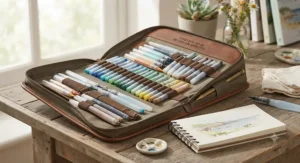
A portable painting kit built around brush pens should fit in a jacket pocket, not a rucksack, and the difference comes down to choosing a handful of pens deliberately rather than carrying an entire set everywhere. Start with 8-12 colours that cover a full tonal range — a warm and cool of each primary, plus black and a neutral brown — rather than every shade you own.
Pair those pens with a compact waterbrush like the Pentel Aquash Waterbrush instead of a water pot; it’s the single upgrade that makes brush pen painting genuinely mobile. A small, glued-bound watercolour sketchbook with at least 200gsm paper will resist buckling far better than standard cartridge paper, which matters enormously once you’re painting on your knee rather than a flat desk. Finally, a folded paper towel or a small cloth for blotting excess water rounds out a kit that fits in a coat pocket and survives a commute without a single drop spilled.
Real-Life Scenarios: Matching Pens to Painters
Consider a university student sketching between lectures on a tight budget: Ohuhu Watercolour Brush Pens paired with a single Pentel Aquash Waterbrush delivers a genuinely capable 30-minute daily practice kit for well under £50 total, with enough colour range to avoid constant hand-mixing.
A parent looking to encourage a child’s creativity without worrying about mess or safety is better served by Sakura Koi Coloring Brush Pen sets — the odourless, water-based ink and forgiving nib make early mistakes easy to fix, and the smaller set sizes keep costs sensible while a child’s interest is still developing.
For a working illustrator building a professional portfolio, Tombow ABT Dual Brush Pen paired with Faber-Castell Pitt Artist Pen Brush for waterproof outlines gives reliable, repeatable results that survive scanning and reproduction — a combination genuinely used across the hand-lettering and illustration community for exactly this reason.
Watercolour Brush Pens vs Watercolour Paint: Which Should You Choose?
This is the question most buyers land on eventually, and the honest answer is that it depends on what you’re prioritising: convenience or control.
| Factor | Watercolour Brush Pens | Traditional Watercolour Paint |
|---|---|---|
| Best For | Travel, journaling, quick studies | Large washes, fine art, exhibition work |
| Set-up Time | Under a minute | 5-10 minutes with palette and water |
| Colour Mixing | Limited to pre-set shades and tip blending | Unlimited custom mixing |
| Portability | Excellent — fits a pocket | Moderate — needs a palette and water |
| Learning Curve | Gentler for beginners | Steeper, but more expressive long-term |
Brush pens win decisively on convenience and consistency — you’ll never mix a “wrong” colour by accident, and there’s no water pot to knock over on the train. Traditional pan or tube watercolour paint wins on expressive range, because you can create genuinely unlimited custom shades and control paint-to-water ratio precisely, something no pre-mixed pen ink can fully replicate. Members of institutions such as the Royal Watercolour Society, Britain’s oldest body dedicated to painters working in the medium, overwhelmingly favour traditional paint for exhibition work — but plenty of working illustrators use both: brush pens for location sketching and quick colour notes, then traditional watercolour paint for considered studio pieces.
💬 Which side of the debate are you on? Give this a share if it helped you decide!😊
Water-Soluble Ink Explained: Why It Behaves the Way It Does
Water-soluble ink is the mechanism behind almost every pen on this list, and understanding it changes how you use these tools. The dye or pigment sits suspended in a water-based carrier rather than a permanent solvent, meaning it never fully “locks” to the paper the way waterproof ink does — a wet brush can always reactivate it, even days later.
This is precisely why Tombow ABT Dual Brush Pen and Winsor & Newton Promarker Watercolour allow you to soften edges long after the initial stroke, while Faber-Castell Pitt Artist Pen Brush deliberately avoids this behaviour by using waterproof India ink instead. The trade-off is that water-soluble ink smudges under an accidental splash or a sweaty hand, which is worth knowing before you leave a finished piece in a damp bag. Reviewers across multiple brands note that heavier, more absorbent watercolour paper handles reactivated ink far better than standard printer or notebook paper, which tends to pill or tear under repeated wetting.
Blending Technique for Watercolour Brush Pens: A Step-by-Step Guide
Good blending technique is what actually separates a flat colouring-book look from something that reads as genuine watercolour, and it comes down to three repeatable methods rather than natural talent.
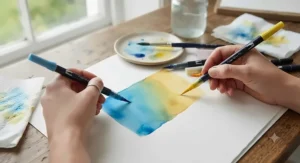
Tip-to-tip blending involves pressing a darker pen’s nib briefly against a lighter pen’s tip, transferring a small amount of ink before drawing on the page — the colour gradually fades back to the original shade after a few strokes, so nothing is wasted or ruined. On-paper blending is simpler still: lay one colour, then touch a wet water brush to the edge and drag it outward before the ink dries, creating a soft gradient exactly like traditional watercolour paper technique. Palette blending, meanwhile, involves scribbling colour onto a spare sheet or dedicated palette, adding a few drops of water, then picking the mixed colour up with a clean brush — this gives you the most control over the final ratio of pigment to water.
The single most common beginner mistake is working too slowly between layers, letting the first colour dry fully before attempting to soften it — water-soluble ink blends far more easily while it’s still slightly damp, so speed matters more than most tutorials admit.
How to Choose Watercolour Brush Pens: 7 Expert Criteria
- Nib firmness — a firmer nylon tip like the one on Sakura Koi Coloring Brush Pen suits beginners because it forgives inconsistent pressure, while softer tips reward more experienced control.
- Ink type — decide upfront whether you want water-soluble ink for blending or waterproof ink like Faber-Castell Pitt Artist Pen Brush for permanent line work.
- Colour range vs cost — a 72-colour budget set often serves beginners better than a 12-colour premium set, since it reduces the need to hand-mix tones early on.
- Paper compatibility — heavier, more absorbent paper dramatically improves blending results regardless of which pen you buy.
- Portability needs — if you’ll paint away from home, factor in a waterbrush like the Pentel Aquash Waterbrush as part of the total kit cost, not an afterthought.
- Lightfastness — if artwork will be framed or sold, prioritise pigment-based inks such as Winsor & Newton Promarker Watercolour over dye-based alternatives, which fade faster under sunlight.
- Set structure — look for sets organised by colour theory, like Karin Brushmarker PRO‘s Mega Box, which genuinely speeds up learning to mix confidently.
Common Mistakes When Buying Watercolour Brush Pens
The most frequent mistake is buying the largest colour set available on the assumption that more shades automatically means better results — in practice, 12 well-chosen colours and confident blending technique produce far more attractive work than 72 unused ones. A close second is ignoring paper entirely; even the best pen ink will look patchy and prone to bleed-through on standard printer paper, undermining an otherwise good purchase.
Buyers also frequently overlook the ink-type distinction covered above, purchasing a permanent pen like Faber-Castell Pitt Artist Pen Brush expecting blendable washes, or a water-soluble set expecting the smudge-proof reliability of permanent ink. Finally, skipping a waterbrush or wet brush entirely is a common false economy — without one, even the best water-soluble ink pen can only achieve dry, marker-like colouring rather than genuine watercolour effects.
Long-Term Cost & Maintenance
Watercolour brush pens are a genuinely low-maintenance medium, but they’re not free to run long-term, and it’s worth thinking in terms of total cost of ownership rather than the upfront set price. A well-used pen lasts anywhere from several months to a couple of years depending on frequency of use and nib pressure, with the ink typically outlasting the nib’s original sharpness on heavily used colours like black and skin tones.
Individual replacement pens are available for every brand on this list, which is a real advantage over paint tubes running dry all at once — you top up only the colours you’ve genuinely worn through. Over a two-year period, a regularly used Ohuhu Watercolour Brush Pens set will likely cost less in total than a single premium Karin Brushmarker PRO Mega Box, though the Karin set’s slower drying rate on frequently used colours can partly offset that gap for daily users. Storing pens horizontally, as several manufacturers recommend, also meaningfully extends nib life by keeping ink evenly distributed rather than pooling at one end.
Safety, Non-Toxic Standards & Regulations Guide
If you’re buying watercolour brush pens for a child, or simply want reassurance about what’s in the ink, UK toy and craft safety regulation is worth understanding. Products intended for children under 14 sold in Great Britain must comply with the Toys (Safety) Regulations 2011, which sets requirements around non-toxic materials, chemical migration limits and clear labelling — and manufacturers demonstrate compliance through the UKCA marking, the UK’s own conformity mark confirming a product meets the relevant safety requirements before it can be placed on the market.
Sets like Sakura Koi Coloring Brush Pen and Ohuhu Watercolour Brush Pens are both marketed as odourless and non-toxic, which is a genuinely relevant selling point for family use, though it’s always worth checking individual product packaging for the specific marking rather than assuming every “art supply” automatically qualifies as a toy under the regulations. For adult-only professional ranges like Winsor & Newton Promarker Watercolour, compliance still matters for general product safety, but the labelling conventions differ slightly since these aren’t marketed as children’s products.
Buyer’s Decision Framework
If you’re painting mainly for relaxation and journaling on a tight budget, choose a large dye-based set like Ohuhu Watercolour Brush Pens, because the colour range removes the pressure to master mixing straight away. If you’re building professional illustration or lettering work, choose Tombow ABT Dual Brush Pen because its dual-tip design and reliable blending translate directly into repeatable, scannable results. If lightfastness and true pigment behaviour matter because you plan to sell or frame finished pieces, choose Winsor & Newton Promarker Watercolour, accepting the higher price as the cost of archival quality. And if portability is your single biggest constraint, build around Pentel Aquash Waterbrush plus a compact 12-colour set rather than any large collection you won’t actually carry.
Frequently Asked Questions
❓ Do watercolour brush pens work the same as watercolour paint?
❓ Can you blend watercolour brush pens together?
❓ What paper is best for watercolour brush pens?
❓ Are watercolour brush pens safe for children?
❓ How long do watercolour brush pens last?
Conclusion
Watercolour brush pens sit in a genuinely useful middle ground between a felt-tip marker and a full watercolour set, and the right choice really does depend on what you’re trying to do with them. For blendable, dependable everyday use, Tombow ABT Dual Brush Pen remains the most consistently well-regarded all-rounder, while Sakura Koi Coloring Brush Pen offers the gentlest introduction for anyone brand new to brush control.
If pigment quality and lightfastness genuinely matter to your work, Winsor & Newton Promarker Watercolour justifies its higher price with true artists’-grade colour, and pairing any of these with a compact tool like the Pentel Aquash Waterbrush turns a simple pen collection into a proper portable painting kit. Whichever you choose, remember that blending technique and paper quality will affect your results just as much as the pen itself — a modest set used skilfully will consistently outperform an expensive one used carelessly. Always check current prices before buying, as they shift regularly on Amazon.
Recommended for You
- 7 Best Brush Pens for Calligraphy in 2026 (UK Buyer’s Guide)
- 7 Best Fineliner Pens for Bullet Journaling in 2026 (UK Guide)
- Fineliner Pen Set for Artists: 7 Best Picks; Buying Guide 2026
Disclaimer: This article contains affiliate links. As an Amazon Associate, I earn from qualifying purchases. If you purchase products through these links, we may earn a small commission at no additional cost to you.
✨ Found this helpful? Share it with your friends! 💬🤗
