In This Article
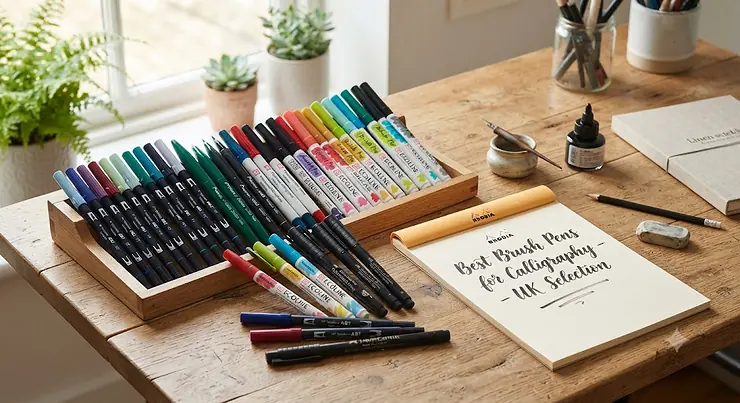
Brush pens for calligraphy are felt- or nylon-tipped pens with a flexible tip that mimics a traditional ink brush, letting you create thick downstrokes and hair-thin upstrokes without ever touching a bottle of ink. That’s the whole trick, really — one flexible nib doing the job a calligrapher used to need a pointed pen, an inkwell and a very steady hand to pull off.
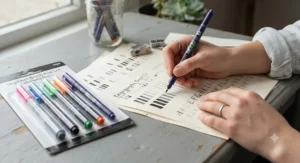
If you’ve ever watched someone’s Instagram lettering and thought “I could never do that,” I’d gently push back. Brush pens for calligraphy are, without much exaggeration, the single easiest entry point into hand lettering that’s ever existed, and the UK market is absolutely stacked with options in 2026 — from £3 disposables you’ll find in any decent stationery aisle to refillable Japanese fountain-style brush pens that serious calligraphers keep for a decade.
This guide isn’t a rewritten spec sheet. Every pen below has been cross-referenced against real UK retailer listings, aggregated customer review sentiment, and independent testing write-ups, so you’re getting honest analysis rather than marketing copy dressed up as advice. We’ll walk through seven genuinely good pens across budget, mid-range and premium tiers, then get into the technique, terminology and buying pitfalls that actually determine whether you’ll stick with this hobby or shove the pens in a drawer by March. Historically, calligraphy has always evolved around its tools — Western calligraphy in particular has been reshaped by every new writing instrument from the quill onward — and the brush pen is simply the latest chapter in that story.
Quick Comparison Table
| Pen | Tip Type | Best For | Price Range |
|---|---|---|---|
| Tombow Fudenosuke | Firm/soft dual felt | Absolute beginners | Around £5-£7 |
| Pentel Fude Touch Sign Pen | Small firm plastic | Portable daily practice | Under £3 (singles) |
| Sakura Koi Coloring Brush Pen | Soft springy felt | Brush pens for beginners calligraphy set | £15-£25 range |
| Tombow Dual Brush Pen | Large soft felt + fineliner | Blending and modern lettering | £25-£30 range (10-pack) |
| Faber-Castell Pitt Artist Pen Brush | Medium flexible nib | Archival, lightfast work | £2-£4 (singles) |
| Karin Brushmarker PRO | Nylon cone tip | Vibrant, juicy ink flow | £20-£30 range (12-pack) |
| Kuretake No. 8 Fountain Brush Pen | Refillable synthetic hair | Long-term, serious practice | £15-£25 range |
Looking at the table above, there’s a clear tier structure at play: the Tombow Fudenosuke and Pentel Fude Touch Sign Pen dominate the sub-£10 bracket for anyone testing the waters, the Sakura Koi Coloring Brush Pen and Tombow Dual Brush Pen sit comfortably in the mid-range for hobbyists who want colour variety, and the Karin Brushmarker PRO and Kuretake No. 8 Fountain Brush Pen justify their higher price with either richer ink or genuine refillability. Budget shouldn’t be the only factor, though — the Kuretake No. 8 costs more upfront but pays for itself over months of refills, while a disposable set like the Tombow Fudenosuke needs replacing entirely once the ink runs dry.
💬 Ready to find your perfect match? Scroll down to see exactly which pen fits your skill level and budget.
Top 7 Brush Pens for Calligraphy: Expert Analysis
We shortlisted these seven pens after digging through UK retailer listings, brand specifications and genuine aggregated review sentiment from stationery bloggers, JetPens community reviews and Amazon UK customer feedback. Each one earns its spot for a specific reason — there’s no filler here.
1. Tombow Fudenosuke — best budget entry point for total beginners
The standout feature here is the twin-tip design: one pen with a hard nib, one with a soft nib, so you can feel the difference between control and expressiveness before spending a penny more. The hard tip resists a lot of pressure before it flexes, which in practice means your first wobbly attempts at thick-and-thin strokes come out more controlled than they would on a floppier nib. The soft tip, by contrast, bends more readily under light pressure, giving you the dramatic stroke contrast that makes brush calligraphy look, well, like calligraphy.
Based on the spec comparison with other entry-level pens, the water-based pigment ink here is the sensible choice for beginners: it’s water-resistant once dry, so a stray coffee splash or light water wash for a watercolour background won’t wreck a finished piece. Reviewers consistently report that the black ink stays rich and doesn’t skip, even after weeks of daily practice, and multiple independent reviewers single it out as one of the most forgiving nibs for absolute newcomers.
The trade-off reviewers raise most often is durability against the ink supply: several long-term users note the tip typically outlasts the ink by only a couple of weeks of regular use, and because it’s non-refillable, that’s the end of the pen. On rough or fibrous paper, the fraying accelerates further.
Pros:
- ✅ Two tip firmnesses in one twin-pack — genuinely useful for comparison
- ✅ Ink resists smudging and stays vibrant through daily use
- ✅ Small enough to carry in any pencil case or bag
Cons:
- ❌ Non-refillable, so it’s genuinely disposable once dry
- ❌ Tip frays faster on rough or heavily textured paper
At around £5-£7 for the twin pack, this is about as low-risk as calligraphy tools get, and it earns every penny as a first purchase.
2. Pentel Fude Touch Sign Pen — best for portable daily practice
The short standout here is nib size: this pen has a noticeably smaller, firmer tip than most brush pens on this list, which sounds like a limitation until you realise it’s actually the reason people love it for small-format lettering. What most buyers overlook about this model is that tip size directly affects control — a smaller nib means less surface area flexing under your hand, so beginners often find it easier to keep letterforms consistent in a compact A6 or B6 notebook.
The water-based dye ink is fully blendable with water and other Sign Pen Brush colours, which opens the door to soft watercolour-style shading alongside straightforward lettering. Reviewers consistently note that colour saturation stays even from the first stroke to the last, without the fading-out effect some cheaper brush pens show as the nib runs low on ink.
Based on the spec comparison with the Tombow Fudenosuke, the Pentel’s firmer, smaller nib suits people who write small and want precision, while the Tombow suits people who want bigger, bolder strokes. If you’re the sort who scribbles quick lettering on the bus or during a lunch break, the compact barrel and durable tip make this a genuinely sensible daily-carry pen rather than a desk-only tool.
Pros:
- ✅ Compact, firm tip ideal for small-format lettering
- ✅ Colour stays saturated right through to the last drop
- ✅ Sold as affordable singles, so you can build a set gradually
Cons:
- ❌ Small tip limits the size of bold, sweeping strokes
- ❌ Full 12-colour sets cost noticeably more than buying loose singles justifies for casual use
Individual pens sit under £3, with a 12-colour set landing in the £20-£28 range depending on retailer stock.
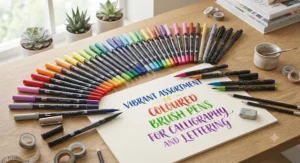
3. Sakura Koi Coloring Brush Pen Set of 12 — best brush pens for beginners calligraphy set
The standout advantage on the heading says it all: this is the set to buy if “beginner set” is genuinely what you’re searching for, because Sakura built the tip specifically to survive clumsy first attempts. The brush tip is described by Sakura as springing back to its original shape even after intense use, and aggregated reviewer sentiment backs that claim up — people who’ve hammered these pens through weeks of practice report the tip holding its point far longer than cheaper alternatives.
Here’s what to weigh before buying: the ink is dye-based rather than pigment-based, which means colours are vivid and blend beautifully with water for a genuine watercolour effect, but they are not lightfast. Reviewers who’ve compared the set against pigment inks are candid that Koi pens will fade over months if a finished piece is left in direct sunlight, so this genuinely isn’t the set for archival artwork — it is, however, an excellent set for practice sheets, journalling and anything you’re not framing.
For anyone specifically hunting for a brush pens for beginners calligraphy set that won’t punish early mistakes, this ticks the boxes: forgiving nib, blendable colour, and a low enough price that ruining a few sheets of paper doesn’t sting.
Pros:
- ✅ Tip springs back into shape even after heavy daily use
- ✅ Blends with water for genuine watercolour-style effects
- ✅ AP-certified non-toxic, sensible for shared or family use
Cons:
- ❌ Dye-based ink is not lightfast and will fade over time
- ❌ Colour swatches on caps can be hard to distinguish at a glance
Expect to pay in the £15-£25 range for the 12-colour set, depending on current stock and seller.
4. Tombow Dual Brush Pen — best mid-range pick for blending and modern lettering
The short standout feature is the dual-nib design: a large, soft brush tip on one end and a 0.5mm fineliner on the other, so you get bold calligraphy and fine detail work from a single barrel. The brush tip here is noticeably larger and more flexible than the Fudenosuke or Pentel, which the spec sheet won’t tell you, but reviewers note it means bigger, more dramatic swings between thick downstrokes and hairline upstrokes — ideal once you’ve moved past the absolute beginner stage.
What most buyers overlook about this model is how well it layers: the water-based ink is designed to be blended by touching two tips together or working wet-on-wet, so hobbyists doing modern brush lettering alongside light watercolour illustration get genuine crossover value. Amazon UK listings for the smaller sets carry ratings around 4.5 out of 5 stars from several hundred reviewers, with buyers repeatedly describing the investment as worthwhile despite the price, and praising the blendability specifically.
The honest downside, based on aggregated reviewer sentiment, is nib longevity — several long-term users report the soft tip frays faster under heavy daily use than firmer pens like the Fudenosuke or Pentel, particularly on textured paper.
Pros:
- ✅ Two tips in one barrel — brush and fineliner
- ✅ Excellent for blending and layering colour
- ✅ Wide colour range across the full collection
Cons:
- ❌ Softer tip frays faster than firmer alternatives with heavy use
- ❌ Full colour collections (96-108 pens) run well over £150
A 10-pen set typically sits in the £25-£30 range, while single pens cost roughly £3 each — check current price before buying the larger collections, since full sets are a significant investment.
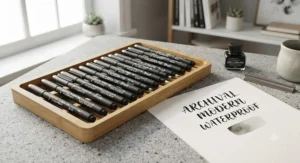
5. Faber-Castell Pitt Artist Pen Brush — best for archival, lightfast work
The standout feature is the ink itself: unlike the dye-based pens above, this uses pigmented India ink that’s acid-free, pH neutral and waterproof once dry — the pen you reach for when a piece actually needs to last. On paper this means your finished lettering resists fading and smudging in a way the Sakura Koi or Karin pens simply can’t match, which matters if you’re producing anything for framing, gifting or long-term storage.
Reviewers consistently describe the medium-sized flexible nib as sitting neatly between the small Pentel/Tombow Fudenosuke tips and the larger Tombow Dual Brush tip, making it a genuinely versatile middle ground once you’ve outgrown beginner pens. One quirk that reviewers highlight as a genuine practical advantage: the nib can be rotated within the barrel once one side starts to wear, effectively doubling its usable life — a trick not available on any other pen in this line-up.
Based on aggregated review sentiment, opinions on nib durability are mixed: some long-term users find the tip frays faster than the Tombow Fudenosuke under similar use, while others report it outlasting their Tombow Dual Brush pens. That inconsistency is worth flagging honestly rather than glossing over.
Pros:
- ✅ Pigmented India ink is genuinely waterproof and lightfast
- ✅ Nib can be rotated to extend usable life
- ✅ Medium tip size suits a wide range of lettering styles
Cons:
- ❌ Reviewer experiences on nib durability are inconsistent
- ❌ Pricier per-pen than disposable dye-ink alternatives
Single pens run roughly £2-£4, while larger studio gift-box sets of 24-60 pens land anywhere from £40 to over £100 depending on the collection.
6. Karin Brushmarker PRO — best for rich, juicy ink flow
The short standout feature is right there in the brand’s own description: “liquid ink technology” designed to keep ink flow consistently smooth right down to the last drop, which is a genuinely different engineering approach from the felt-tip pens above. The nylon tip — rather than felt — is medium-large and cone-shaped, and reviewers who’ve used both describe it as offering slightly better control through the thick-to-thin transition than a Tombow Dual Brush pen, thanks to a marginally less tapered shape.
Here’s what to weigh before buying: the dye-based ink is described by long-term users as noticeably more saturated and vibrant than Tombow’s equivalent colours, almost to the point of making Tombow inks look washed out by comparison. That vibrancy comes with a caveat reviewers raise honestly — the ink doesn’t blend as predictably on cheaper watercolour paper, and a few bullet journal users report ghosting or bleed-through on thinner pages that the Tombow Dual Brush doesn’t cause to the same extent.
Based on the spec comparison with Tombow, this is arguably a pen for people who already know they enjoy brush lettering and want richer colour, rather than a first purchase — several reviewers explicitly recommend it more to intermediate and advanced users than total beginners, given the price and the slightly less forgiving ink behaviour.
Pros:
- ✅ Consistently smooth ink flow engineered to last the whole pen
- ✅ Noticeably richer, more saturated colour than many rivals
- ✅ Nylon tip offers fine control through thick-to-thin transitions
Cons:
- ❌ Can bleed or ghost through on thinner journal paper
- ❌ Less forgiving for total beginners than felt-tip alternatives
A 12-colour basic set typically costs in the £20-£30 range, with the full 72-colour collection climbing well past £150 — check current price before committing to the larger sets.
7. Kuretake No. 8 Fountain Brush Pen — best premium refillable pick for serious practice
The standout feature is refillability, full stop: this pen works on the same converter system as a fountain pen, meaning you’re not throwing away a whole pen every time the ink runs dry. Once you understand that structure, the value proposition of a slightly higher upfront price makes a lot more sense — key specs like the synthetic hair brush tip and the fountain-pen-style cartridge system translate directly into a pen that’s built to be used for years rather than weeks.
Reviewers consistently describe the line variation as superior to disposable alternatives — thin lines with genuine control, and bold feathered strokes when full pressure is applied, closer to a traditional ink brush than any felt-tip pen on this list. Long-time calligraphers frequently name it as their go-to daily pen specifically because of that refillability combined with the responsive, springy brush feel.
Based on aggregated reviewer sentiment, the honest trade-off is a steeper learning curve: several reviewers note that getting thin, even lines takes noticeably more control than a firmer felt-tip pen, and the stock ink that ships with the pen is not waterproof, so serious users often switch to bottled ink via a converter fairly quickly. That’s an extra step and an extra cost beginners should budget for.
Pros:
- ✅ Genuinely refillable — built for years, not weeks
- ✅ Superior line variation compared with disposable felt tips
- ✅ Compatible with fountain pen ink converters for custom ink
Cons:
- ❌ Steeper learning curve than firmer beginner-friendly pens
- ❌ Stock ink isn’t waterproof, so many buyers upgrade separately
Prices sit in the £15-£25 range for the pen itself, with refill ink cartridges typically costing an additional £5-£10 for a pack of five.
Practical Usage Guide: Mastering the Upstroke/Downstroke Technique
Every brush pen on this list lives or dies by one core skill: the upstroke/downstroke technique. It sounds technical, but it’s genuinely simple once it clicks — apply light pressure moving your pen upward (a thin line), and firm pressure moving downward (a thick line). That single rule is the entire foundation of brush calligraphy, and almost every letterform you’ll ever write is built from combinations of these two strokes.
Here’s the part most tutorials skip: pressure control matters more than speed. Rushing the upstroke/downstroke technique is the single most common reason beginners produce shaky, inconsistent letters in their first fortnight. Slow down, and let the pen do the work rather than gripping it tightly.
A sensible first-30-days routine looks like this: spend the first week doing nothing but straight upstroke and downstroke drills on lined paper, not letters. Week two, move to basic shapes — ovals, loops, and the classic “bounce” that modern brush lettering is known for. Only in week three should you start combining strokes into actual letterforms, working lowercase before capitals. Maintenance-wise, store felt-tip pens horizontally or nib-down (check your specific pen — the Karin Brushmarker PRO and similar nylon-tip pens generally prefer nib-up storage to avoid drying out), and always recap immediately after use.
One optimisation trick that rarely makes it into beginner guides: angle the paper, not the pen. Rotating your paper roughly 30-40 degrees means your wrist stays in a natural position through the downstroke, which reduces fatigue and improves consistency far more than forcing an awkward pen grip.
Real-World Scenarios: Which Brush Pen Suits Your Practice
Rather than a generic recommendation, here are three realistic profiles matched to the pens above, with the reasoning laid bare.
The commuting hobbyist. If you’re squeezing in ten minutes of practice on the train or during a lunch break, a bulky pen with a huge nib is impractical. The Pentel Fude Touch Sign Pen or Tombow Fudenosuke fit a coat pocket, don’t leak, and their firmer tips forgive the jostling of a moving train far better than a soft, floppy nib would.
The budget-conscious student. Calligraphy supplies can spiral in cost fast, especially once you start eyeing 72-colour sets. For a student working with a tight weekly budget, the Sakura Koi Coloring Brush Pen Set of 12 delivers genuine colour variety and blendability for a single, contained purchase — no ongoing refill costs, no impulse-buying single pens one at a time.
The dedicated hobbyist upgrading their kit. Someone who’s been practising for six months and knows they’re sticking with calligraphy is the ideal buyer for the Kuretake No. 8 Fountain Brush Pen. The refillable system stops making financial sense for casual dabblers, but for someone writing daily, it pays for itself within a year compared with repeatedly buying disposable pens.
Problem → Solution: Fixing Common Brush Pen Frustrations
Even good pens go wrong in predictable ways. Here are the five issues that come up most often in aggregated review sentiment, with fixes.
Problem: Strokes look inconsistent and shaky. This is almost always a pressure control issue rather than a pen fault. Solution: go back to isolated upstroke/downstroke technique drills before attempting full words, and slow your writing speed by half.
Problem: The nib frays within days. Rough, fibrous paper — including standard printer paper — destroys felt tips fast. Solution: switch to smooth marker paper or a higher-quality cartridge paper, which multiple reviewers of the Tombow Fudenosuke specifically credit with extending nib life significantly.
Problem: Ink bleeds through the page. This is a paper weight issue more often than a pen fault, and it’s especially common with juicier inks like the Karin Brushmarker PRO. Solution: use paper rated at least 120gsm for brush pen work, and test a sheet before committing to a full page.
Problem: A dye-based pen’s colours have faded. This isn’t a fault — dye inks like those in the Sakura Koi Coloring Brush Pen genuinely aren’t lightfast. Solution: for anything you plan to display or gift, switch to a pigment-ink pen like the Faber-Castell Pitt Artist Pen Brush instead.
Problem: A refillable pen’s ink flow feels weak. Solution: with the Kuretake No. 8 Fountain Brush Pen, this is usually trapped air in a fresh converter — gently squeeze and release a few times with the nib submerged in ink to prime the flow properly.
How to Choose Brush Pens for Calligraphy
Picking between dozens of near-identical-looking pens is genuinely confusing, so here’s the reasoning experienced buyers actually use, broken into seven steps.
- Decide your skill level honestly. Firm, small nibs like the Pentel Fude Touch Sign Pen forgive beginner mistakes; large soft nibs reward existing control.
- Check whether the ink is pigment or dye-based. Pigment inks (like Faber-Castell Pitt Artist Pen Brush) last for archival work; dye inks fade but blend beautifully.
- Work out if refillability matters to you. Daily practisers save money long-term with a refillable option like the Kuretake No. 8 Fountain Brush Pen.
- Match nib size to your typical writing scale. Small-format journalling suits compact tips; large statement lettering suits bigger brush tips.
- Consider paper compatibility before buying ink-heavy pens. Juicy inks like the Karin Brushmarker PRO need thicker paper to avoid bleed-through.
- Set a realistic budget band and stick to it. Full 72-108 colour collections are a serious investment — start with a 10-12 pen set instead.
- Buy one pen before committing to a full set. Nib feel is genuinely personal; what a reviewer loves, your hand might not.
Brush Pens for Beginners Calligraphy Set: What to Look For
If you’re specifically shopping for a brush pens for beginners calligraphy set rather than a single pen, the calculus changes slightly. A good beginner set prioritises forgiving nibs over colour range or ink richness — the Sakura Koi Coloring Brush Pen Set of 12 and the 10-colour Tombow Fudenosuke set both fit that brief well, because their tips are engineered to survive clumsy first attempts without fraying immediately.
What to actively avoid in a first set: anything marketed primarily on colour count rather than tip quality. A 72-pen set with an unforgiving nib will frustrate a beginner far more than a modest 10-12 pen set that’s genuinely easy to control. Reviewers consistently note that beginners who start with premium, less forgiving pens like the Karin Brushmarker PRO often struggle more in the first month than those who start with a simpler set, purely because the ink and nib combination punishes inconsistent pressure more visibly.
A sensible beginner set also includes at least one instructional resource — a stroke guide, practice sheet or booklet — since a pen alone doesn’t teach the upstroke/downstroke technique that everything else depends on.
Flexible Nib Explained: What Makes a Brush Pen Work
The flexible nib is genuinely the entire mechanism behind brush calligraphy, so it’s worth understanding rather than taking on faith. Unlike a rigid ballpoint or fineliner tip, a flexible nib is built from either felt fibres (as in the Tombow Fudenosuke and Pentel Fude Touch Sign Pen) or nylon bristles (as in the Karin Brushmarker PRO), bundled and shaped to bend predictably under pressure and spring back to a point when released.
What most buyers overlook about flexible nib construction is that firmness and size are two separate variables, not one. A small, firm flexible nib (Pentel) behaves very differently from a large, soft flexible nib (Tombow Dual Brush), even though both are technically “flexible.” The firmer the flexible nib, the more pressure you need to apply to get real line variation — which is exactly why firmer nibs suit beginners, since accidental heavy-handedness doesn’t ruin a stroke as easily.
Nib material also affects longevity: nylon flexible nibs generally resist fraying better than felt over the long term, which is part of why the Karin Brushmarker PRO‘s nylon tip is often cited by long-term users as holding its shape longer than comparable felt-tip pens, even under heavy daily use.
Ink Flow: Why It Matters and How to Keep It Consistent
Ink flow is the quiet variable that separates a pen you love from one you abandon after a week. Too little ink flow and your strokes look scratchy and inconsistent; too much and you get bleed-through, smudging, and a nib that never quite dries clean between strokes.
The spec sheet won’t tell you this, but ink flow is engineered differently across ink types. The Karin Brushmarker PRO‘s dye-based “liquid ink technology” is explicitly designed for strong, consistent ink flow right down to the last drop — reviewers describe the resulting colour as noticeably richer than felt-tip alternatives, precisely because more ink reaches the paper per stroke. That strong ink flow is a double-edged sword, though, since it’s also the reason this pen bleeds through thin paper more readily than firmer, drier alternatives like the Pentel Fude Touch Sign Pen.
For refillable pens like the Kuretake No. 8 Fountain Brush Pen, ink flow depends partly on you: a fresh cartridge or converter sometimes needs priming (gently squeezing to push air out and ink through) before flow feels natural. Storing any brush pen nib-down between uses also helps gravity keep ink flow consistent, which is why several long-term Pentel and Tombow reviewers specifically recommend point-down storage.
Brush Pens vs Traditional Dip Pen Calligraphy
| Factor | Brush Pens | Traditional Dip Pen |
|---|---|---|
| Setup time | None — cap off and write | Requires nib, holder, ink, blotting paper |
| Portability | Excellent, pocket-sized | Poor — messy and fragile |
| Learning curve | Gentler, forgiving nibs available | Steeper, less forgiving of pressure errors |
| Cost over time | Low-to-moderate depending on refillability | Low ongoing cost once equipped |
| Best For | Tombow Fudenosuke, portable daily practice | Traditional Copperplate and pointed-pen scripts |
The written comparison matters more than the table alone: a traditional dip pen genuinely produces finer, more precise line variation once mastered, which is why dedicated pointed-pen calligraphers still favour it for formal scripts like Copperplate. But that precision comes at the cost of an intimidating setup — bottled ink, blotting technique, and a real risk of mess that puts off a huge share of beginners before they’ve written a single letter. Brush pens for calligraphy sacrifice a small amount of ultimate precision for a dramatically gentler learning curve, no mess, and genuine portability, which is exactly why they’ve become the default recommendation for anyone starting out in 2026 rather than an old-school dip pen and inkwell.
Common Mistakes When Buying Brush Pens for Calligraphy
The most common mistake, based on aggregated review sentiment across dozens of listings, is buying a huge colour set before confirming the nib feel suits your hand — people regularly regret spending on a 72-pen collection only to discover the tip firmness doesn’t work for their grip. Buy one or two pens first.
The second mistake is ignoring ink type entirely. Buyers frequently discover months later that their beautifully lettered gift or piece of wall art has faded, simply because they didn’t check whether the ink was dye-based (like the Sakura Koi Coloring Brush Pen) or pigment-based (like the Faber-Castell Pitt Artist Pen Brush) before starting a project meant to last.
A third, subtler mistake is underestimating paper cost. Reviewers consistently note that cheap printer paper destroys nibs far faster than proper marker or cartridge paper, meaning a “cheap” pen purchase paired with the wrong paper often ends up costing more in replacement pens than a slightly pricier pen paired with decent paper would have.
Long-Term Cost & Maintenance
Total cost of ownership varies dramatically across this list, and it’s worth doing the maths honestly rather than just comparing sticker prices. A disposable pen like the Tombow Fudenosuke costs little upfront but needs replacing every few weeks of regular use — over a year of daily practice, that adds up to a meaningful ongoing spend. By contrast, the Kuretake No. 8 Fountain Brush Pen costs more initially, but a refill cartridge pack lasts substantially longer per pound spent, meaning the higher upfront price is recovered within roughly six to twelve months of regular use, depending on how often you write.
Maintenance itself is minimal across the board: recap pens promptly, store away from direct heat, and periodically wipe barrels clean of dried ink residue with a lightly damp cloth. For refillable pens specifically, rinsing the feed system when switching ink colours prevents muddy colour mixing on your next fill.
What to Expect: Real-World Performance
Specs only tell half the story — everyday performance is what actually determines whether a pen earns a permanent spot in your pencil case. In practice, firmer nibs like the Pentel Fude Touch Sign Pen feel noticeably more predictable for the first few weeks, precisely because they resist over-flexing, while softer nibs like the Tombow Dual Brush Pen feel wonderfully expressive once you’ve built enough control to use that extra flex deliberately rather than accidentally.
Reviewers across multiple independent sources consistently describe a similar arc: initial frustration in week one, a noticeable “click” moment somewhere around week three or four once the upstroke/downstroke technique becomes muscle memory, and genuine enjoyment from week six onward. That timeline holds up remarkably consistently across different pen types, which suggests the technique — not the specific pen — is the real bottleneck for most beginners. This lines up with independent UK testing of ten popular brush pens, which similarly found that tip flexibility and consistent practice mattered more to overall satisfaction than any single spec on the box.
Frequently Asked Questions
❓ What are the best brush pens for calligraphy for beginners?
❓ Are brush pens or dip pens better for learning calligraphy?
❓ How long do brush pens for calligraphy actually last?
❓ Can you refill brush pens for calligraphy?
❓ What paper works best with brush pens for calligraphy?
Conclusion
Choosing the right brush pens for calligraphy really comes down to three honest questions: how much control do you already have, do you care whether the finished piece lasts, and are you committed enough to justify a refillable pen. Beginners genuinely do best starting with a firm, forgiving nib like the Tombow Fudenosuke or Pentel Fude Touch Sign Pen, while anyone chasing archival quality should look straight to the Faber-Castell Pitt Artist Pen Brush. If you already know this is a long-term hobby, the Kuretake No. 8 Fountain Brush Pen is the pen that quietly pays for itself.
None of the seven pens covered here are bad choices — they’re simply built for different stages of the same journey, and honestly, the technique matters more than the specific pen in your hand. Slow down, master the upstroke/downstroke technique before chasing fancy letterforms, and the rest genuinely does follow. For anyone weighing up whether to start this hobby at all, it’s also worth noting the broader wellbeing research on creative hobbies, which points to stress relief, creative expression and a genuine sense of purpose — reason enough to give one of these pens a proper try.
✨ Ready to Start Your Calligraphy Journey?
🔍 Pick the pen that matches where you are right now, not where you want to be in six months. Click through on any highlighted pick above to check current pricing and availability, and start with a single pen before committing to a full set!
Recommended for You
- 7 Best Fineliner Pens for Bullet Journaling in 2026 (UK Guide)
- Fineliner Pen Set for Artists: 7 Best Picks; Buying Guide 2026
- Fineliner Pens for Technical Drawing: 7 Best Picks for 2026
Disclaimer: This article contains affiliate links. As an Amazon Associate, I earn from qualifying purchases. If you purchase products through these links, we may earn a small commission at no additional cost to you.
✨ Found this helpful? Share it with your friends! 💬🤗
